ALBUQUERQUE-The University of New Mexico Board of Regents voted Friday to move forward with acquiring the First Baptist Church property Downtown for UNM’s Innovate ABQ initiative.
The vote followed a lengthy discussion at a special meeting about environmental issues related to the site, terms and conditions on outside donations to UNM to help pay for the acquisition, and the legal title to and governance of the property once purchased.
Regent Gene Gallegos left before the board voted, but the other six regents unanimously approved authority for UNM’s Science and Technology Corp. to spend up to $7.3 million to buy the First Baptist site, and draw up a master plan and design guidelines.
But the regents made closing contingent on the university first receiving assurances from the current owners, the state Environment Department and Burlington Northern Santa Fe Railway Co., that UNM will not be held liable for environmental problems related to the site.
“I’m thrilled,” said UNM President Bob Frank after the vote. “We appreciate the regents’ support and that they did all their due diligence. It’s a better project because of all the research and it’s a great day for UNM.”
The property eventually will become the headquarters of Innovate ABQ, which UNM and the city of Albuquerque jointly have promoted as a high-tech research and development zone that could help turn the city’s core into a bustling center for technology-based economic growth.
UNM will work to attract private investors to develop the site, located at Broadway and Central.
The property is valued at $6.6 million. UNM will receive $6.5 million in outside donations to help pay for it, including $3 million from New Mexico Educators Federal Credit Union, $2 million in city bond money and $1.5 million from the U.S. Commerce Department.
The regents also authorized up to $800,000 to be withdrawn from the UNM Foundation to cover the remainder of the purchase price, plus initial site-planning costs.
UNM currently has a purchase option on the property valid through Dec. 31. It’s now negotiating a 90-day extension to first resolve pending environmental issues before closing on the acquisition.
Those issues include groundwater and soil contamination from an old diesel refueling site for the railroad that runs by the property, some asbestos in tiles in buildings at the site and possibly lead in some building paint.
Tom Neale, UNM’s director of real estate, told regents at the meeting that Burlington already has agreed to indemnify UNM for any needed remediation related to the ground and water contamination.
In addition, the church is working with the Environment Department through a program where sellers agree to a voluntary remediation plan. That will lead to issuance of a covenant guaranteeing that the state will not later sue the new owners for environmental problems.
Regents made closing on the purchase contingent on finalizing the railroad indemnity agreement and issuance of the covenant. UNM must also complete a phase-one environmental assessment of the site to determine if there are any other problems.
Once the university closes on the property, it will hire a firm for master planning and design guidelines, said Lisa Kuuttila, head of the STC and UNM’s chief economic development officer.
“We’ll begin working immediately with the Lobo Development Corp. on doing all the necessary environmental steps and due diligence required,” Kuuttila told the Journal . “We’ve been working on this project for six to seven months now. We’re excited to be moving forward.”
After closing, UNM will work with private developers to build the site out in phases. That will begin with an 18- to 24-month period in which UNM expects to raise about $14 million to construct an incubator for technology startups, plus a dormitory to allow students to live, work and study at the site as part of a new “Innovation Academy.”
Kuuttila told regents that six or seven New Mexico-based private developers, plus three from out of state, already have expressed “strong interest” in financing the first phase of development.
Regents voted to vet Innovate ABQ’s progress after two years, at which time Frank must provide a status report on the Downtown property and options on how to proceed with the project.
Separately, UNM wants regents to approve $5.66 million in foundation funding to acquire and improve the Aperture Center at Mesa del Sol south of Albuquerque for incorporation into Innovate ABQ, but regents won’t discuss that proposal until next year.
The STC wants the Aperture building to immediately house new technology startups while the Downtown site is built out. STC hopes to co-locate there with technology-transfer staff from the state’s other research universities and national laboratories, making it a one-stop shop for investors to acquire intellectual property and incubate new businesses.
Mayor Richard Berry, who has worked closely with Frank to promote Innovate ABQ, praised regents for supporting the initiative.
“This bodes well for Albuquerque,” Berry told the Journal . “We need to foster innovation here. We have a lot of untapped resources and assets, and this is an excellent opportunity for us to start developing that potential and create good, high-paying jobs.”
(Albuquerque Journal)
Click here to read source article.
Archives for 2013
Scientists Meet on EPA Water Rule
Connection Between Wetlands and Streams and Downstream Waters:
Key Development: A Science Advisory Board panel will recommend the EPA consider the degree of connections that wetlands and streams have with downstream waters in a draft scientific study. This is a positive development for regulated stakeholders because establishing significance of the connection is a test articulated by Supreme Court Justice Kennedy to ascertain which wetlands merit Clean Water Act jurisdiction.
What’s Next: The panel submits its final recommendations to the Science Advisory Board by Jan. 31, which will be incorporated into a draft report that will be released to the public in mid-February. Following further comments, the report will be submitted to the EPA administrator by mid-June at the earliest.
A panel of the Environmental Protection Agency’s Science Advisory Board said Dec. 18 it will recommend the agency consider the degree, magnitude and intensity of connections that geographically isolated wetlands and other water bodies have with downstream waters in the final version of its scientific study of such linkages.
The EPA should look at how these connections with wetlands vary across distances (spatial) and time (temporal) as well as across landscapes and regions in an attempt to understand the variety in hydrology and biological and chemical connectivity across these waters, the panel of science advisers said. They also intend to advise the EPA to quantify the connectivity of waters.
The panel made its comments at the end of a meeting held Dec. 16-18 to discuss the draft of the EPA’s wetlands study, “Connectivity of Streams and Wetlands to Downstream Waters.” The study was sent to the Science Advisory Board for review Sept. 17.
These recommendations are in response to concerns raised by representatives of the mining, homebuilding and agricultural industries.
On the second day of its three-day meeting, the panel said the agency incorrectly concluded in its draft wetlands study that insufficient evidence exists to generalize that geographically isolated and other wetlands and open waters located outside flood plains are connected to downstream waters. The panel said the evidence the agency included in the draft study didn’t match the conclusion.
The panel of scientists was selected by the SAB to review the so-called draft connectivity study and make recommendations. Although still in draft form, this study is providing the scientific rationale for the joint EPA-U.S. Army Corps of Engineers proposed rule that is now undergoing interagency review at the White House Office of Management Budget.
In discussions during the three-day meeting, the panel overwhelmingly rejected one of the draft study’s three main conclusions—that insufficient evidence existed for generalizing that isolated wetlands and waters located outside of flood plains were connected to downstream waters.
The decision by the scientific panel to incorporate the degree, magnitude and intensity of connections of wetlands and streams to downstream waters underscores the concerns raised by various coalitions representing agriculture, real estate, mining, road builders, home builders and municipal water utilities that the agency might bring all waters and wetlands under federal jurisdiction by showing the mere presence of a connection with downstream waters.
At the conclusion of the three-day meeting, Rodewald said the final recommendations are due to the Science Advisors Board by Jan. 31. A draft report based on their recommendations will be released to the public and the panel for comment in mid-February.
Following comments, the board will hold a public teleconference to discuss the comments in mid-March and to “hopefully reach consensus” in mid-April, Rodewald said.
She said the goal of the panel is to submit a final report based on the recommendations to the EPA administrator by mid-June at the earliest.
The EPA has said it will not finalize the jurisdiction rule before finalizing the connectivity study.
By: Russell Riggs (National Association of Realtors)
Click here to read source article.
Commercial Real Estate Recovery to Accelerate in 2014
Jones Lang LaSalle’s (JLL) research experts have polished off the firm’s crystal ball and it reveals a clear path to stronger performance expectations for commercial real estate in 2014. The firm’s top researchers believe the “global real estate disconnect” between buoyant investment markets and more cautious leasing markets that existed during 2013 is narrowing in the United States as the nation’s recovery broadly diversifies ahead of many of its global counterparts.
JLL’s 2014 global viewpoints point out the surprising upside in investment sales volume in 2013, largely attributed to the weight of money flowing into the asset class, an improving lending environment, the heightened appetite for risk and investors’ movement into secondary markets. These factors are expected to continue to move the sector forward in the coming year with global investment volume growth of 10% year-over-year to $550 billion in 2014. The firm expects particularly strong gains on the U.S. horizon with further gains in more diversified investment across primary and secondary markets and sectors.
“We’re seeing a tremendous weight of capital from a growing and diverse set of capital sources interested in a much wider range of U.S. real estate,” noted Ben Breslau, Jones Lang LaSalle’s Americas Research Managing Director. He describes the dynamics of today’s investment and leasing markets around the world in this short video, “Investors feel more comfortable with the economic outlook, and they’ve shown a greater appetite for risk that has led to a 21% global increase in year over year investment volumes.”
Full story
PRNewswire (Wall Street Journal)
The Latest on Industrial Production Economic Indicators
In each Economic Update, the Research staff analyzes recently released economic indicators and addresses what these indicators mean for REALTORS® and their clients. Today’s update discusses the latest on industrial production data.
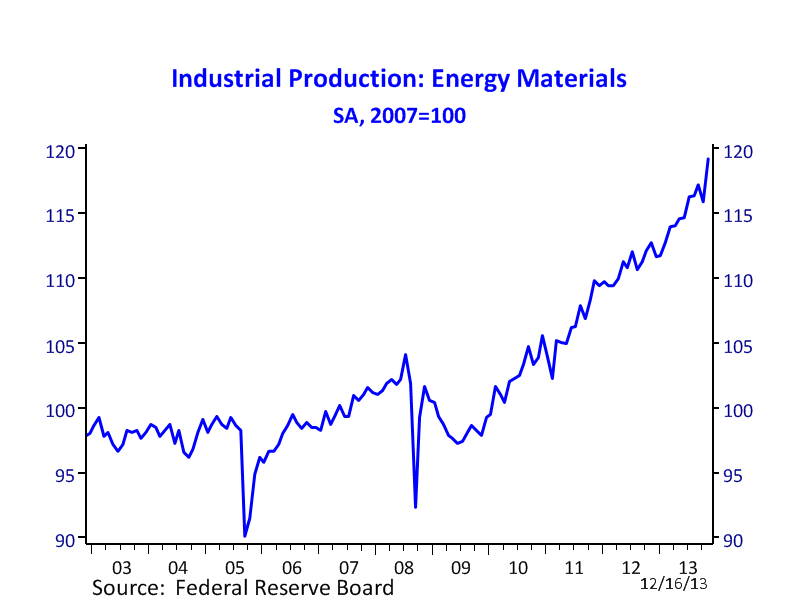
Manufacturing production set an all-time high in the past month. This portends well for further employment gains in the broader economy, which will then support the real estate market.
The manufacturing sector plunged sharply a few years ago, with industrial production falling 18 percent in a short timeframe. Since then, slow but steady gains over the past four years have resulted in retouching the peak production activity.
Though nowhere near the prior peak, the production of construction-related supplies has risen by 23 percent from the low point of a few years ago. Further increase is expected going into 2014 as housing starts will have to and will clearly improve because of the housing inventory shortage.
Even though manufacturing production is charting new highs, employment is not. Manufacturing employment has only recovered only about a tenth of the job losses that occurred in the recession and further the total employment across all sectors is still below the level of five years ago. Increased uses of automation and technology are leading to productivity gains, though at the expense of fewer workers getting hired.
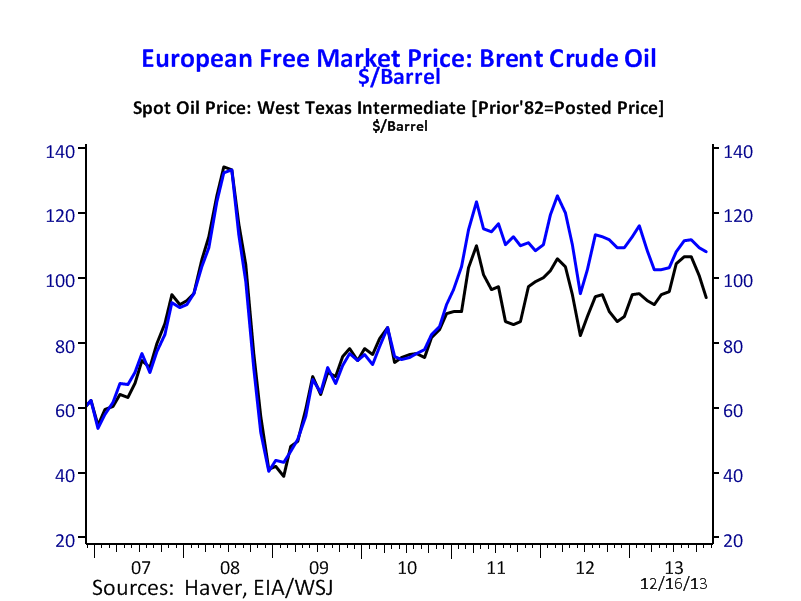
The energy renaissance in North Dakota, Texas, and Louisiana, along with natural gas drilling in Ohio and Pennsylvania, are the principal sources of increase in industrial production. Generally, oil is fungible and prices should equalize everywhere. But due to too much production in the U.S. and due to an inability to export oil to foreign countries, U.S. oil prices are notably cheaper compared to the international oil price in the London exchanges. Texas crude is $97 per barrel while London Brent crude is $111.
World events can move quite unexpectedly. Whales were hunted down to near extinction during the time of Moby Dick. After exhausting the Atlantic Ocean, whales from the south Pacific were hauled all the way to Nantucket, Massachusetts to extract whale oil, which was needed for lighting. But the whaling industry and Nantucket soon crashed when oil was discovered in Pennsylvania. What new energy source is around the corner in the future? 

Lawrence Yun, Chief Economist
Lawrence Yun is Chief Economist and Senior Vice President of Research at NAR. He directs research activity for the National Association of REALTORS® and regularly provides commentary on real estate market trends for its 1 million REALTOR® members.
By: Lawrence Yun (Economists’ Outlook)
Source article unavailable.



