TRD looks at the startups jostling for control of a potentially huge market.

Friday’s revelation that Airbnb is now worth over $25 billion was received with particular delight by a certain crop of commercial real estate tech startups.
Firms like PivotDesk, ShareDesk and LiquidSpace, which function as online marketplaces for short-term office rentals, see their residential counterpart as both a benchmark and a promise. These firms are trying to become the Airbnb of the office market, and with the firm’s new valuation, their ceiling seems to have risen substantially.
“I have no doubt that if we execute efficiently we can be as big as Airbnb is,” said David Mandell, CEO of PivotDesk. Avison Young’s CEO Mark Rose, who has invested in rival LiquidSpace, said: “We at Avison Young believe LiquidSpace could be as big as Open Table or Airbnb.” And Timothy Draper, a venture investor who is backing ShareDesk, replied “Yes!” when asked if the firm could emulate Airbnb’s success.
These entrepreneurs could be aiming even higher than Airbnb, given that the office market is far larger than temporary housing or hospitality. “We’re talking about the fifth-largest market in existence,” said Kia Rahmani, CEO and founder of ShareDesk. “And if you consider the fact at any given time the usage rate (for offices) is hovering between 45 and 50 percent, there’s a lot of value that’s locked up.”
A High Ceiling
Unlike shared office space provider WeWork , office rental marketplaces don’t lease and then sublet office space, but merely allow others to list it on their platforms. And while they benefit from the boom in coworking spaces like Regus or WeWork, which make up a chunk of their listings, they also offer landlords and companies the chance to rent out more traditional space on a short-term basis. Their ultimate goal is to eventually make all unused office and conference space available online at any time.

“Our ceiling is not the short-term rental market but a multiple of it,” said LiquidSpace founder Mark Gilbreath. “The appetite for flexibility, and for speed and ease of transaction go far beyond just the customers that have been transacting short-term office rentals.”
He pointed to Uber, which he said now serves three times as many customers in San Francisco as taxis traditionally have, as an example of a company that takes over a market and expands it. “You’ll see something very similar to Uber” in the office rental market, he added.
This is crunch time for players in the short-term office rental space, as many believe that the bulk of the spoils will eventually go to the alpha dog.
“I think history will tell you that consumers gravitate toward a single brand, so I think it will be dominated by a single player,” said Tod Francis, a managing director at Shasta Ventures, which invested in LiquidSpace. Generally, online marketplaces become more valuable the more users they have — people use Uber, Airbnb or Amazon because these sites offer the widest selection of cars, listings or goods. Economists call this the network effect, and its logic also applies to office marketplaces.
So which firm will muscle its way to the top? Here’s a look at the early contenders with a significant presence here in New York.
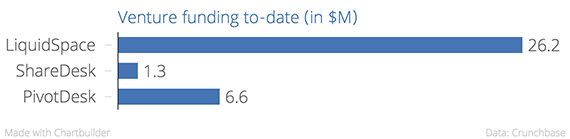
LiquidSpace Founded in 2010 by veteran tech entrepreneur Mark Gilbreath, LiquidSpace is the most well-funded short-term office rental marketplace by far. In October, the Palo Alto-based firm raised $14 million in a Series C round, according to Crunchbase, bringing its total venture funding to $26.2 million. Its backers include Avison Young, ROTH Capital Partners and Linkedin co-founder Reid Hoffman.
LiquidSpace allows landlords and tenants to list space on an hourly, daily or monthly basis.Transactions happen online and LiquidSpace takes a 10 percent cut of monthly rents, with differing rates for daily and hourly leases. While coworking spaces feature prominently — WeWork is a partner — the firm also lists a range of more traditional offices and conference centers, with partners such as Marriott.
“There will be a point in time when LiquidSpace could compete against the traditional providers- including Avison Young,” said Avison Young’s Rose. “But we would rather be ahead of the curve and have ownership in what could be transformative change.”
ShareDesk
(Click to enlarge photo. Kia Rahmani)
This San Francisco-based startup’s business model is essentially the same as LiquidSpace’s. Founded in 2012 by Kia Rahmani and Javier Jimenez and backed by $1.3 million in seed capital, ShareDesk claims to have 3,000 current listings, compared to LiquidSpace’s 6,000. The firm charges a flat fee of 20 percent for all transactions completed on the site.
But ShareDesk has a much more global platform – with listings in 70 countries, compared to LiquidSpace’s four – and is trying to differentiate itself by focusing more on the landlords and leaseholders that list space.
“We are very focused on the experience, that’s part of the reason why Airbnb has been successful,” Rahmani said. The firm recently launched Optix, a platform that allows those listing space on the site to manage short-term leases and engage with tenants.
PivotDesk
“Do you want random people come into your office on a daily basis or do you want to find a company you can trust?” — PivotDesk CEO David Mandell
While LiquidSpace and ShareDesk allow any user to book office space, Boulder-based PivotDesk acts more as a matchmaker bringing together small firms to share space and build a relationship.
A startup that has signed an office lease with future growth in mind could list excess space on PivotDesk. Other startups can then contact the company and arrange phone calls or visits. The idea is to pair firms with compatible mindsets and business models that will share space for at least a few months. All leases are monthly. “The big difference is we approach our solution from the space holder’s perspective,” said PivotDesk’s founder David Mandell. “Do you want random people to come into your office on a daily basis or do you want to find a company you can trust?”
Because PivotDesk caters to long-term leaseholders, it has little use for the short-term coworking spaces and conference centers that make up much of ShareDesk’s and LiquidSpace’s business. Instead, it’s trying to work within the traditional office market and make it more effective. The firm has had success with investors, raising a total of $6.6 in three rounds since its 2012 launch.
“There’s no reason there should be any commercial office space transaction without someone like us involved,” Mandell said.
Room to Grow
“The market is earlier in its development because consumers have just gotten used to short-term office space rentals, whereas in the home space it was already a habit that was formed.” — Shasta Ventures’ Tod Francis
While PivotDesk, ShareDesk and LiquidSpace currently have the largest presence in New York, there are a number of other startups in the mix. London-based Zipcube, for example, has a handful of office listings in the Big Apple, and other, similar startups are reportedly in the works around the globe. Meanwhile, the Tel Aviv-based startup Splacer, launched by architects Adi Biran and Lihi Gerstner, offers event spaces in Israel and New York on a short-term basis and just raised $1.4 million in seed funding. Breather, a firm that rents out private rooms, is often grouped in the same category and has raised $7.5 million. But it lists its own spaces, making it more similar to WeWork than to pure marketplaces like ShareDesk.
So far, short-term office rental sites are tiny compared to Airbnb, which has more than 1.4 million rooms listed, according to the Wall Street Journal – 230 times LiquidSpace’s total. Still, entrepreneurs argue that the sector is poised to grow dramatically. Because these startups don’t need to lease, renovate and build space, they can scale up far more quickly than coworking platforms like WeWork. At least in theory.
In practice, the sector still needs to overcome some cultural hurdles before it can reach its full potential, experts say. Unlike vacation rentals, short-term office rentals are still a strange proposition for many.
“The market is earlier in its development because consumers have just gotten used to short-term office space rentals, whereas in the home space it was already a habit that was formed,” said Shasta’s Tod Francis. And referring to similar startups that failed in the past, he added: “We never thought it would be easy.”
By: Konrad Putzier (The Real Deal)
Click here to view source article.
Archives for July 2015
Real Estate Economic and Forecast Update
View the forecast video, midyear forecast (July 2015) slides, and the full U.S. Economic Outlook on the Research & Statistics page.
The Economy
- GDP growth was slightly negative in the first quarter but will pick up in the second half. For the year as whole, GDP will expand at 2.1 percent. Not bad but not great. A slow hum.
- Consumer spending will open up because of lower gasoline prices. Personal consumption expenditure grew at 2.1 percent rate in the first quarter. Look for 3 percent growth rate in the second half.
- Auto sales dropped a bit in the first quarter because of heavy snow, but will ramp up nicely in the second half.
- Spending for household furnishing and equipment has been solid, growing 6 percent in the first quarter after clocking 6 percent in the prior. Recovering housing sector is the big reason for the nice numbers.
- Spending at restaurants was flat. That is why retail vacancy rates are not notching down.
- Online shopping is up solidly. That is why industrial and warehouse vacancy rates are coming down.
- Spending for health care grew at 5 percent in the first quarter, marking two consecutive quarters of fast growth. The Affordable Care Act has expanded health care demand. The important question for the future is will the supply of new doctors and nurses expand to meet this rising demand or will it lead to medical care shortage?
- Business spending was flat in the first quarter but will surely rise because of large cash holdings and high profits.
- Spending for business equipment rose by 3 percent in the first quarter. Positive and good, but nothing to shout about.
- Spending for business structures (building of office and retail shops, for example) fell by 18 percent. The freezing first-quarter weather halted some construction. This just means pent-up construction activity in the second half.
- In the past small business start-ups spent and invested. It was not uncommon to experience double-digit growth rates for 3 years running for business equipment. Not happening now. But business spending will inevitably grow because of much improved business financial conditions of lower debt and more profits and rising GDP.
- What has been missing is the “animal spirit” of entrepreneurship. The number of small business start-ups remains surprisingly low at this phase of economic expansion.
- Residential construction spending increased 6 percent in the first quarter. Housing starts are rising and therefore this component will pick up even at a faster pace in the second half.
- Government spending fell by 1 percent. At the federal level, non-defense spending grew by 2 percent, while national defense spending fell by 1 percent. At the state and local level, spending fell by 1 percent.
- The federal government is still running a deficit. Even though it is spending more than what it takes in from tax revenue, the overall deficit level has been falling to a sustainable level. It would be ideal to run a surplus, but a falling deficit nonetheless does provide the possibility of less severe sequestration.
- U.S. government finances are ugly. Interestingly though, they are less ugly than other countries. That is why the U.S. dollar has been strengthening against most other major currencies. It’s like finding the least dirty shirt from a laundry basket.
- Imports have been rising while exports have been falling. The strong dollar makes it so. Imports grew by 7 percent while exports fell by 6 percent. The net exports (at minus $548 billion) were the worst in seven years. Fortunately, with the West Coast longshoremen back at work, the foreign trade situation will not worsen, which means it will help GDP growth.
- All in all, GDP will grow by 2.5 to 3 percent in the second half. That translates into jobs. A total of 2.5 million net new jobs are likely to be created this year.
- Unemployment insurance filings have been rising in oil-producing states of Texas and North Dakota.
- Unemployment insurance filings for the country as a whole have been falling, which implies a lower level of fresh layoffs and factory closings. That assures continuing solid job growth in the second half of the year.
- We have to acknowledge that not all is fine with the labor market. The part-time jobs remain elevated and wage growth remains sluggish with only 2 percent annual growth. There are signs of tightening labor supply and the bidding up of wages. Wages are to rise by 3 percent by early next year. The total income of the country and the total number of jobs are on the rise.
The Housing Market
- Existing-home sales in May hit the highest mark since 2009, when there had been a homebuyer tax credit … remember, buy a home and get $8,000 from Uncle Sam. This tax credit is no longer available but the improving economy is providing the necessary incentive and financial capacity to buy. Meanwhile new home sales hit a seven-year high and housing permits to build new homes hit an eight-year high. Pending contracts to buy existing homes hit a nine-year high.
- Buyers are coming back in force. One factor for the recent surge could have been due to the rising mortgage rates. As nearly always happens, the initial phase of rising rates nudges people to make decision now rather than wait later when the rates could be higher still.
- The first-time buyers are scooping up properties with 32 percent of all buyers being as such compared to only 27 percent one year ago. A lower fee on FHA mortgages is helping.
- Investors are slowly stepping out. The high home prices are making the rate of return numbers less attractive.
- Buyers are back. What about sellers? Inventory remains low by historical standards in most markets. In places like Denver and Seattle, where a very strong job growth is the norm, the inventory condition is unreal – less than one month supply.
- The principal reason for the inventory shortage is the cumulative impact of homebuilders not being in the market for well over five years. Homebuilders typically put up 1.5 million new homes annually. Here’s what they did from 2009 to 2014:
- 2009: 550,000
- 2010: 590,000
- 2011: 610,000
- 2012: 780,000
- 2013: 930,000
- 2014: 1.0 million
- Where is 1.5 million? Maybe by 2017.
- Building activity for apartments has largely come back to normal. The cumulative shortage is on the ownership side.
- Builders will construct more homes. By 1.1 million in 2015 and 1.4 million in 2016. New home sales will follow this trend. This rising trend will steadily relieve housing shortage.
- There is no massive shadow inventory that can disrupt the market. The number of distressed home sales has been steadily falling – now accounting for only 10 percent of all transactions. It will fall further in the upcoming months. There is simply far fewer mortgages in the serious delinquent stage (of not being current for 3 or more months). In fact, if one specializes in foreclosure or short sales, it is time to change the business model.
- In the meantime, there is still a housing shortage. The consequence is a stronger than normal home price growth. Home price gains are beating wage-income growths by at least three or four times in most markets. Few things in the world could be more frustrating and demoralizing than for renters to start a savings program but only to witness home prices and down payment requirements blowing by past them.
- Housing affordability is falling. Home prices rising too fast are one reason. The other reason is due to rising mortgage rates. Cash-buys have been coming down so rates will count for more in the future.
- The Federal Reserve will be raising short-term rates soon. September is a maybe, but it’s more likely to be in October. The Fed will also signal the continual raising of rates over the next two years. This sentiment has already pushed up mortgage rates. They are bound to rise further, particularly if inflation surprises on the upside.
- Inflation is likely to surprise on the upside. The influence of low gasoline prices has been bringing down the overall consumer price inflation to essentially zero in recent months will be short-lasting. By November, the influence of low gasoline prices will no longer be there because it was in November of last year when the oil prices began their plunge. That is, by November, the year-over-year change in gasoline price will be neutral (and no longer a big negative). Other items will then make their mark on inflation. Watch the rents. It’s already rising at near 8-year high with a 3.5 percent growth rate. The overall CPI inflation could cross the red line of above 3 percent by early next year. The bond market will not like it and the yields on all long-term borrowing will rise.
- Mortgage rates at 4.3% to 4.5% by the year end and easily surpassing 5% by the year end of 2016.
- The rising mortgage rates initially rush buyers to decide but a sustained rise will choke off as to who can qualify for a mortgage. Fortunately, there are few compensating factors to rising rates.
- Credit scores are not properly aligned with expected default rate. New scoring methodology is being tested and will be implemented. In short, credit scores will get boosted for many individuals after the new change.
- FHA mortgage premium has come down a notch thereby saving money for consumers. By the end of the year, FHA program will show healthier finances. That means, there could be additional reduction to premiums in 2016. Not certain, but plausible.
- Fannie and Freddie are owned by the taxpayers. And they are raking-in huge profits as mortgages have not been defaulting over the past several years. The very high profit is partly reflecting too-tight credit with no risk taking. There is a possibility to back a greater number of lower down payment mortgages to credit worthy borrowers without taking on much risk. In short, mortgage approvals should modestly improve next year.
- Portfolio lending and private mortgage-backed securities are slowly reviving. Why not? Mortgages are not defaulting and there is fat cash reserves held by financial institutions. Less conventional mortgages will therefore be more widely available.
- Improving credit available at a time of likely rising interest rates is highly welcome. Many would-be first-time buyers who have been more focused about getting a mortgage (even at a higher rate) than with low rates.
- All in all, existing and new home sales will be rising. Combined, there will be 5.8 million home sales in 2015, up 7 percent from last year. Note the sales total will still be 25 percent below the decade ago level during the bubble year. Home prices will be rising at 7 percent. For the industry, the business revenue will be rising by 14 percent in 2015. The revenue growth in 2016 will be additional 7 to 10 percent.
By: Lawrence Yun, PhD., Chief Economist and Senior Vice President (NAR)
Click here to view source article.
Innovate ABQ Chooses Development Team for Next Phase
An architectural rendering depicts what a master plan for Innovate ABQ envisions for the site when fully developed. (Courtesy Perkins Will)
Innovate ABQ has selected a team to handle the next phase of developing the public-private project intended to spur innovation and entrepreneurship in Albuquerque.
Signet Development, Goodman Realty Group and Decker/Perich/ Sabatini will have 90 days to do preliminary planning for the seven-acre site at Broadway and Central, after which they will submit a more detailed proposal for the project. At that time, the Innovate ABQ board will determine whether the Signet team will be selected as the actual developer for the project.
The University of New Mexico purchased the former First Baptist Church property for $6.65 million as part of a broad plan by UNM, the city, county and the business community to build a high-tech research and development zone that can help turn the city’s core into a bustling center for technology-based economic growth.
The site eventually could include 824,000 square feet of facility space, according to a master plan approved by the UNM Board of Regents. It will be built in multiple phases over 10 to 20 years and include a mixture of research and laboratory facilities, business offices, administrative space, residential housing for students and others, and possibly a hotel and retail shops.
Lisa Kuuttila, president and CEO of UNM’s Science and Technology Corporation, said work by the Signet team over the next three months likely will include such things as a more in-depth market assessment and site analysis, preliminary financing plans, determination of a mix of spaces and order of development on the site. The team will work at its own expense during that time toward negotiation of a final development agreement.
The Innovate ABQ board unanimously chose the Signet team based on its response to a request for proposals issued this spring. The group was selected because of its “strong balance of local and national talent and experience with this type of project,” according to a release from Innovate ABQ.
Dekker/Perich/Sabitini, an architectural services firm, and the Goodman Realty Group are based in Albuquerque.
Signet, based in Jacksonville, Fla., was the developer on Innovation Square, a 40-acre research district at the University of Florida-Gainesville. University of New Mexico President Bob Frank has pointed to that project as a model for Innovate ABQ.
J. Jason Perry, Signet senior vice president, said his company was excited about working on Innovate ABQ. He said the company and Innovate ABQ will be talking over the coming week to define just what will be done over the next three months, but that it ultimately will lead to “a definitive project that we all agree can be delivered in the marketplace.”
“It sounds like the University of New Mexico is looking to really advance in the areas of innovation and entrepreneurship. That seems to be at the forefront. We think that’ll be a catalyst and really get the university out and working with the business community,” Perry said.
By: Charlie Moore (Albuquerque Journal)
Click here to view source article.
Santa Fe Task Force Looks to Keep City Open Later
Click here to watch source video.
SANTA FE (KRQE) – One of New Mexico’s top tourist towns is trying to stay open later.
Kate Kennedy has seen the late night venues come and go in Santa Fe’s downtown over the years.
“There’s been a lot of businesses that open,” Kennedy said. “Most of them close in their first year.”
Now a managing partner at Skylight, a late night bar and performance venue two blocks from the Plaza, Kennedy has been pushing for the City Different to embrace its nightlife.
“It needs to be part of the lifestyle again,” Kennedy said. “As the young professionals have left or haven’t been coming home, the focus on that part of the economy has sort of dissipated.”
Census data shows the city has been aging significantly. In 2000, a little less than 25 percent of Santa Feans were 55 or older. In 2010, that number had jumped to about 34 percent.
But Kennedy says the reality of Santa Fe’s nightlife is starting to change even if the perception’s not.
“I think the perspective is there’s nothing to do in this town, that we’re a small town with nothing to offer at night,” Kennedy said. “It’s just not true.”
That change has been helped along by the creation of the Nighttime Economy Task Force by Mayor Javier Gonzales. The group, which Kennedy is co-vice chair of, has been brainstorming and pushing several ideas to boost Santa Fe’s nightlife.
“What can we have that will both be beneficial for local residents and the millennial generation we want to attract over here,” said Zackary Quintero, an economic development specialist with the city of Santa Fe.
So far, the task force has backed a new food truck ordinance that’s allowing mobile vendors to sell near the Plaza. It’s also gotten city tourism to add a nightlife section to its website promoting the city. Last year, Night Wave Santa Fe launched a three-night weekend event boasting music, late night food offerings and more.
It’s working with the city’s parking staff to allow people to leave their cars parked outside some venues overnight and is trying to set up a New Year’s Eve event on the Plaza.
“I think it’s going to take us a good year or so to really see the impact of what the task force is trying to do,” Kennedy said.
“We need to send a clear message to millenials that this is gonna be a place for them,” Quintero said. “Not just as a destination to just stop by or just come to for one to two days.”
The task force is set to present its full recommendations to Santa Fe City Council in the fall.
By: Alex Goldsmith (KRQE News 13)
Click here to view source article.