Passengers would wait in canopy-covered stations to board Albuquerque Rapid Transit, as shown in this rendering for an iconic stop by the University of New Mexico.
ALBUQUERQUE, N.M. — An ambitious proposal to transform nine miles of the old Route 66 into an “Albuquerque Rapid Transit” corridor won support Tuesday from President Barack Obama.
The Federal Transit Administration recommended approval of a $69 million grant to help pay for the $119 million project, which continues to face opposition from some business owners along its route. It’s part of the president’s budget proposal, which now heads to Congress.
Albuquerque Mayor Richard Berry was thrilled. “Bus rapid transit” is a centerpiece of his second-term agenda.
The FTA recommendation “means the project is viable, and we can move forward,” Berry, a Republican, said Tuesday as he prepared for meetings at the U.S. Department of Transportation. “I’ve been told this was the milestone we’ve been looking for.”
Construction could start as soon as late May, the mayor said, near Coors and Central. The rest of the roughly $50 million needed for the project – much of it also federal money – is already in place, city officials said.
The $69 million “Small Starts” grant is crucial to the financing. It still must be approved by Congress – not at all a sure thing.
But Berry and other supporters are optimistic.
David Leard of HDR Engineering, which designed the project for Albuquerque, said no construction will start until the FTA issues a letter authorizing the city to begin spending local money. That could happen even before the federal grant is made final.
“It’s a common practice in the industry,” Leard said.
Furthermore, he said, no project recommended for funding in the president’s “Small Starts” budget has ever failed to receive the funding later.
“Once they’re recommended,” Leard said, “they’ve been funded.”
If the FTA authorizes the city to start spending, Leard said, there’s “very little risk, if any,” that the city wouldn’t get the money.
Albuquerque was among 10 cities to receive the recommendation for “Small Starts” funding. At least three other cities are in line for bus-rapid-transit funding, and three are working streetcar systems.
The Albuquerque proposal is for something called bus rapid transit, or BRT. The local project is known as “Albuquerque Rapid Transit.”
It’s supposed to mimic light rail but cost far less.
Crews would build a network of canopy-covered stations in the middle of Central Avenue, roughly every one-quarter to one-half mile between Louisiana and Coors. For most of the route, there would be dedicated lanes – one in each direction usually – for buses to travel in.
That would reduce the traffic capacity for regular cars.
The work would add landscaping, wider sidewalks where there’s room and other improvements.
The proposal has won broad support at City Hall. The City Council last year unanimously agreed to authorize borrowing $13 million to help make the city’s financial contribution.
But the project has drawn opposition from about 150 businesses. Some merchants in Nob Hill, for example, say construction of the project could put them out of business by making the area difficult to get to.
They also fear that reducing the traffic capacity on Central – from two lanes in each direction to one, in some places – will push customers away and damage the charm of the old Route 66 corridor.
Albuquerque, along Central Avenue, is home to the longest intact urban stretch of the old highway that once connected Chicago and Los Angeles.
Opponents of ART haven’t given up. Steve Schroeder, owner of Nob Hill Music and founder of the website SaveRt66.org, pointed out that the president’s budget is simply a proposal, not yet approved by Congress.
“I am disappointed,” he said Tuesday, “but I’m also hopeful this is going to get reviewed again.”
City Council President Dan Lewis, a Republican, said Tuesday that he won’t support this project moving forward “without more buy-in from the people that will be immediately impacted by it the most, which are the land owners and the business owners along Central.”
City Councilor Ken Sanchez, a Democrat whose family operates an accounting firm along west Central Avenue, said he supports the project in concept but that the city must have an “in-depth conversation” with merchants to ensure they aren’t forced out of business by the construction or other changes.
U.S. Sen. Martin Heinrich, a Democrat who once represented much of east Central Avenue as a city councilor, said he was pleased to see the project included in the president’s budget.
“Albuquerque Rapid Transit is a major investment in the infrastructure of the Central Avenue corridor,” he said, “and gives us the opportunity to boost economic development and connect people to the many businesses, schools, services, and unique experiences the city has to offer. A project of this size necessitates strong community input and it needs to be done right.”
Berry, for his part, said the city will work to minimize the disruption caused by construction. A local contractor, Bradbury Stamm, has been selected for the work.
“We’ve been able to design a world-class project,” Berry said, “because we have listened, we’ve talked to the experts, we’ve talked to the leading transportation minds, and Albuquerque will have, in my opinion, the premier rapid transit project in the country.”
The goal is to finish work in time for passengers to be boarding the new buses by September next year.
By: Dan McKay (Albuquerque Journal)
Archives for February 2016
Rapid Transit Debate Nears Final Stop
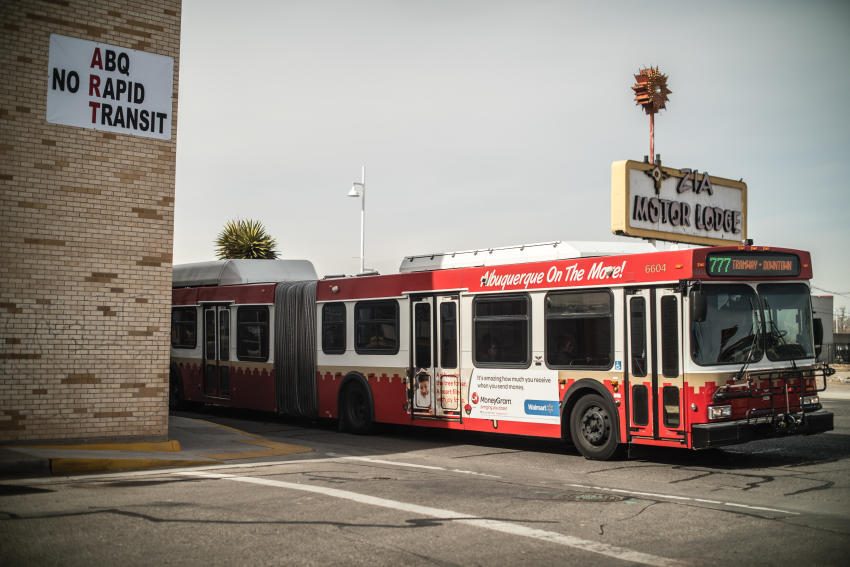
Albuquerque Rapid Transit
Supporters say
⋄ It has the benefits of light rail at a fraction of the price and will boost economic development.
⋄ Major employers and cultural destinations lie along the route, making it easier for people to get there without owning a car.
⋄ Even with reduced traffic capacity, Central Avenue will continue to operate at an acceptable level and nearby streets have the capacity to handle increased traffic, according to a city-commissioned traffic study.
⋄ The city will work with businesses along Central to minimize the disruption caused by construction.
⋄ Sidewalks will be widened where there’s room available, they will be upgraded for compliance with the Americans with Disabilities Act, and they will have better landscaping – making the whole area more pedestrian-friendly.
⋄ More intersections will have traffic signals, helping to protect pedestrians, and bicycle lanes will remain.
⋄ More predictable service.
Opponents say
⋄ People will avoid Central Avenue because of the increased traffic congestion, harming the historic Route 66 corridor.
⋄ The city’s traffic study found that more intersections along the route will be “deficient” if the project is built. For example, five intersections will operate deficiently in afternoon peak hours in 2017 after the project is built, compared with just two if it isn’t built.
⋄ Construction will discourage customers, forcing merchants out of business before the project is done.
⋄ The design limits the options of drivers who need to make left-hand turns.
⋄ Having buses and stations in the middle of the road is dangerous for pedestrians.
⋄ It’s not a substantial improvement over the “Rapid Ride” buses already in operation.
⋄ Young professionals aren’t suddenly going to embrace the bus system.
⋄ A bus system isn’t real economic development.
The signs are hard to miss.
Marquees and storefronts in the heart of Nob Hill and other neighborhoods along Central Avenue blare out their opposition to “Albuquerque Rapid Transit.”
They reflect the fear of some business owners that the $119 million project – a system of express buses and canopy-covered stations – could cost them customers and, eventually, their livelihoods along the old Route 66.
That anxiety may come to a head this week. The federal government is set to decide on Albuquerque’s application for about $69 million to help build the project.
Mayor Richard Berry, who used to run a construction company, says he understands the worry of business owners.
But the project, he contends, is simply the “next logical step” in local transportation – an investment that will spur development along the corridor and get people on the bus.
“This is something that we’ve studied extensively with some of the best transit minds in the world,” Berry said, “and they tell us it’s going to be a net positive, or we wouldn’t be doing it.”
He envisions buses that mimic light rail, running in dedicated lanes down Central Avenue. Pedestrians would enjoy wider sidewalks and new landscaping, and the bus would offer free Wi-Fi to passengers.
Steve Schroeder, the owner of Nob Hill Music, a record shop, isn’t convinced. The project, he said, risks destroying the charm of old Route 66.
“This is something that’s going to ruin one of our cultural jewels, our reputation, and our tourism,” he said.
Jean Bernstein, CEO of Flying Star Cafes and Satellite Coffee, put it this way: “We don’t believe in our heart that the bus will create the economic uptick that’s being promised.”
“Albuquerque,” she said, “is not Pittsburgh. Albuquerque is not Los Angeles. We’re a lower-density spread-out town.”
The ‘B-word’
The proposal is something known as “bus rapid transit,” but supporters don’t like the “b-word.” They call it Albuquerque Rapid Transit, or ART.
It would transform Central Avenue – the longest intact urban stretch of the old Route 66 that ran from Chicago to Los Angeles.
The buses would generally have their own dedicated lanes on Central – one in each direction, often in the center or median of the roadway – between Louisiana and Coors. In most cases, that would mean one fewer lane of traffic for regular vehicles.
In the heart of Nob Hill, for example, the regular lanes of traffic would be cut in half – from two lanes in each direction to one – to make room for the bus lanes and stations, and there would still be room for on-street parking in both directions.
Transit stations would lie in the middle of the road. Passengers would buy their tickets at kiosks there, reducing the amount of time the bus has to wait for people to board.
The buses would also communicate with traffic lights to get as many green lights as possible.
The goal is to provide travel times that are equal to or better than driving by car, city officials say.
The system would operate from 5:45 a.m. to 9:30 p.m., though city officials say they would like to expand the hours beyond that if they can afford it.
The bus would come by every seven to 10 minutes on weekdays.
Twenty bus stations would be spread about one-quarter to half a mile apart.
Bipartisan Support
The idea is popular at City Hall. It’s been embraced by Republicans and Democrats alike.
Albuquerque city councilors have already authorized borrowing about $13 million to pay for part of the project. The city has other federal and local money available, too, that can be earmarked for the project.
The $69 million “Small Starts” grant would provide the final chunk of funding needed.
As for operating the system, the city estimates that it would cost an extra $2 million a year.
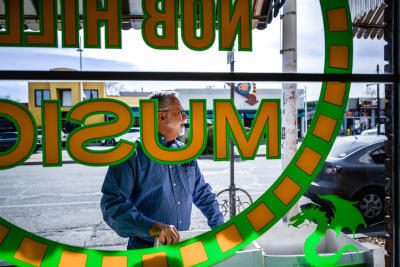
Signs of opposition
The ART proposal has also drawn support from some businesses, including O’Niell’s restaurant and public house, Molina Healthcare and the Historic District Improvement Co.
But many business and property owners along Central remain highly skeptical.
The “Save Route 66 Central” website lists more than 150 businesses opposed to the project. About a dozen large signs – urging “No Albuquerque Rapid Transit” or some variation – have been erected along the route.
Schroeder, the record shop owner, says the signs going up are attempts at “self-preservation.” He expects businesses to die if the project goes forward.
“I won’t survive the construction period,” he said.
Bernstein, CEO of Flying Star, says the city economy remains fragile.
“The construction will devastate merchants that are already feeling a long recession, competition and the Internet,” she said. “In other words, it’s the final straw.”
City leaders say they’re addressing those concerns.
Construction would be handled in chunks of about 2,000 feet at a time. Businesses could expect about two months of construction when crews would be widening sidewalks, resurfacing the roadway and handling other work.
At least one lane of traffic would remain open at all times.
Berry said the city would do what it can to help merchants. He mentioned the possibility of providing low-cost “bridge loans” to help them make it through financially.
A coalition of nonprofit lenders and business trainers, for example, has already announced a plan to work with merchants affected by construction.
Contractors working on the project would also have to guarantee they would finish on time, Berry said.
“We’re going to try to minimize our time in front of each of the individual businesses,” the mayor said. “The plan we’ve developed keeps Central open throughout the entire project.”
The city would help advertise that the businesses would remain open during construction, said Bruce Rizzieri, Albuquerque’s transit director.
But he noted that streets aren’t free of routine construction even without special projects like ART.
Flawed design
Opponents’ concerns aren’t limited to construction.
Many contend that Central just isn’t wide enough to accommodate ART and that the design is flawed.
For one thing, the dedicated lanes and bus stations in the middle of the road would block left-hand turns in and out of some properties, said Doug Peterson, whose family is a major property owner Downtown and along Central.
Encouraging people to make U-turns, he said, “is going to result in more T-boning of cars and be more dangerous for pedestrians. … We’re going to spend all this money and (endure) all this disruption for a system that will basically replace the already-adequate system we have.”
Decision Imminent
The future of the project could become clear this week. Berry said he expects the budget released by President Barack Obama on Tuesday to include a decision on the city’s funding request.
The project isn’t viable without the federal funding, he said. If the city does get the money, construction could begin as soon as late May. And passengers might begin boarding the first ART buses in September 2017.
By: Dan McKay (Albuquerque Journal)
Six Trends in Commercial Real Estate to Watch for in 2016
Urban Land online has named its top five most popular articles from 2015. What is top on the list? Six Trends in Commercial Real Estate to Watch for in 2015, written by Peter Burley, Director, Richard J. Rosenthal Center for Real Estate Studies, and David Lynn, CEO of Everest HIP.
The co-authors are at it again this year, outlining for readers six trends in U.S. commercial real estate to watch for in 2016. Summarized are the six trends below, but don’t miss out on the full article here:
The global urbanization trend continues in the United States, as it does elsewhere, as boomers and millenials seek enhananced access to jobs and amenitites – from shopping to entertainment to health care.
Interest rates will be on the rise – for sure this time – as the Fed move in December demonstrated. Forecasts vary, but the likelihood is that the Federal Funds Rate rises at least to, or above, 1.0 in 2016, with ten-year Treasuries pushing fractionally higher toward the 3 percent mark.
International capital flows into U.S. real estate assets will continue – and increase. Global economic and political uncertainty continues to drive capital to a “safe haven” in the United States.
There will be continued stress on retail and continued retail shifts – including mixed (virtual/physical) spaces and entertainment-themed spaces.
Additions to supply will continue to be limited, with only modest supply growth in a few sectors – multifamily (peaking, then slowing slightly in 2016), student and senior housing (creeping up), and single-tenant industrial (regional/nodal distribution centers) – and repurposing in others (suburban malls and those abandoned Sears and KMart stores).
Last year saw a dramatic drop in oil prices. Increased production and reduced demand due to slowing emerging-market growth have led to a drop in oil prices from $110 per barrel to under $50 per barrel.
By: REALTOR® University
Click here to view source article.
NAR: Expectations and Market Realities in Real Estate
Despite various global and domestic hurdles hindering economic growth, steady job gains and stable leasing demand should help keep commercial real estate activity expanding this year, according to the NAR Expectations & Market Realities in Real Estate 2016 report.
Highlights from NAR report: As 2016 gets underway, there has been a definite slowdown in the velocity of commercial real estate sales volume, per Real Capital Analytics. We expect commercial real estate to take on more of a defensive role in this environment, and as values and prices begin to level off, investors will likely benefit from it being a hard asset, as well as from its strong income flow, especially if long-term interest rates and 10-year Treasury rates remain low, as expected.
With respect to investment, it is always difficult to separate market realities from the “noise” in the market. However, it appears that we are entering a new phase of the cycle, and while we do not yet know what all the ripple effects of the economic and capital market chaos will be, investors should pay strong attention to the possible risks. Our goal is to help you do just that in NAR Expectations & Market Realities in Real Estate 2016—Navigating Through The Crosscurrents.
This report gives commercial investors the information they need to make forward-looking changes to the way they approach today’s market, focusing on:
- Economic outlook
- Capital markets
- Highlights and expectations for the five major property sector markets
- office
- industrial
- retail
- apartment
- hotel
- Collective analysis of the commercial investment environment
More Information:
- Read the NAR news release about this report.
- See more research on commercial real estate.
Read full NAR report.
By: National Association of REALTORS®
Click here to view source article.