• Skip to primary navigation
  • Skip to main content

CARNM

Commercial Association of REALTORS® - CARNM New Mexico

  • Property Search
    • Search Properties
      • For Sale
      • For Lease
      • For Sale or Lease
      • Start Your Search
    • Location & Type
      • Albuquerque
      • Rio Rancho
      • Las Cruces
      • Santa Fe
      • Industry Types
  • Members
    • New Member
      • About Us
      • Getting Started in Commercial
      • Join CARNM
      • Orientation
    • Resources
      • Find A Broker
      • Code of Ethics
      • Governing Documents
      • NMAR Forms
      • CARNM Forms
      • RPAC
      • Needs & Wants
      • CARNM Directory
      • REALTOR® Benefits
      • Foreign Broker Violation
    • Designations
      • CCIM
      • IREM
      • SIOR
    • Issues/Concerns
      • FAQ
      • Ombuds Process
      • Professional Standards
      • Issues/Concerns
      • Foreign Broker Violation
  • About
    • About
      • About Us
      • Join CARNM
      • Sponsors
      • Contact Us
    • People
      • 2026 Board Members
      • Past Presidents
      • REALTORS® of the Year
      • President’s Award Recipients
      • Founder’s Award Recipients
    • Issues/Concerns
      • FAQ
      • Ombuds Process
      • Professional Standards
      • Issues/Concerns
      • Foreign Broker Violation
  • Education
    • Courses
      • Register
      • All Education
    • Resources
      • NMREC Licensing
      • Code of Ethics
      • NAR Educational Opportunities
      • CCIM Education
      • IREM Education
      • SIOR Educuation
  • News & Events
    • News
      • All News
      • Market Trends
    • Events
      • All Events Calendar
      • Education
      • CCIM Events
      • LIN Marketing Meeting
      • Thank Yous
  • CARNM Login
  • Show Search
Hide Search

Archives for February 2016

Enterprise Zones Would 'Change Our Skyline'

February 1, 2016 by CARNM

News that a constitutional amendment was to be considered this legislative session may appear dry to some, but the change could have big impacts on the commercial real estate industry.
Sen. Daniel A. Ivey-Soto, D-Bernalillo, introduced a resolution to allow counties to limit property taxes. It would pave the way for counties to create “enterprise zones,” which would authorize counties to pause property taxes for new developments.
Ivey-Soto said the tax breaks would be a catalyst for urban centers and blighted neighborhoods across the state.
“It would encourage new buildings and demolition of old buildings, and incentivize property owners to modernize existing commercial spaces in New Mexico,” he said.
If a constitutional amendment was approved by lawmakers, the resolution would go before voters during the next general election cycle. Lawmakers would the be required to pass a bill defining what an economic development zone would look like, and how it would function.
“We need a tax deferred district for Downtown to spur private investment. This would help the entire state by creating a place for millennials and baby boomers looking for a walkable lifestyle.” – Ray Smith, President of Klinger Constructors
“I think it would change our skyline. It would change our skyline. It would allow great sites Downtown to be built up with new Towers.” -Todd Clarke CCIM, New Mexico Apartment Advisors
“Between this and the development ordinance changes, developments would happen quicker, and it also means less money and time and effort put into the financial aspect.” -Joe Farr, Senior Vice President of Gemini Rosemont Realty
Office Market Update
Leasing Activity Overshadowed by Climbing Vacancy
Albuquerque’s office market posted some positive new for 2015. There was 790,000 square feet of leasing activity in 2015, which exceeded the five-year average of 664,000 square feet of leasing activity. At the same time, the market saw more companies vacate space, according to a report by CBRE. About 904,000 square feet of office space was vacated in 2015, which the report said was the second highest in recent market history. It’s something the real estate community has seen all year, as more offices consolidate and downsize, or what some in market refer to as “rightsizing,” as offices become more efficient in smaller spaces. CBRE things that activity will slow this year, and industry watchers wonder when Albuquerque will see new businesses occupy nearly the considerable amount of available office space in 2016.
Albuquerque Office Space

  • Overall Vacancy Rate: 22.4%
  • Highest Vacancy Rate: Airport submarket, 42.9%
  • Lowest Vacancy Rate: Far Northeast Heights, 10.2%
  • Highest Rents: North I-25, $19 per square foot
  • Lowest Rents: Northeast Heights, $12.50 per square foot

By: Stephanie Guzman (Albuquerque Business First)
Click here to view source article.

Filed Under: All News

Added Value: Property and Assessment Management

February 1, 2016 by CARNM

”Asset managers know that their success is tied to our success. ” -Drew Genova, CBRE

IREM recently pulled the curtain back on its latest White Paper, exploring the changing relationship between property and asset management. A Shifting Dynamic: Asset vs Properly Management is a combination of practitioner interviews, the recent IREM job Analysis and other previously published intelligence, and it forms the foundation for ongoing research on the topic the Institute will explore in future weeks and months

  • Check out the Whitepaper.

In a discussion after the release of the White Paper, the initiative’s major contributors had the opportunity to reflect on its major takeaways . So what was the major headline emanating from the \’\’hire Paper? The three practitioners, from three different disciplines, offered three disparate perspectives.
“The major headline is that it’s not business as usual, and asset  managers  need  our  help  as property  managers  more than ever before,” offered Andrew Genova, executive man­ aging director at CBRE in Washington , DC. “The pressures that arc put on  them  from  the  sheer  number  of properties they handle  these days, which can  be upwards of 30 or 40, means they have to look to us to help them maximize value.” For Craig Cardwell, CPM, owner of Island  Investments  in Memphis, it’s a question of skill sets: “There arc very distinct skill sets for which there isn’t much crossover. But that doesn’t mean  that property managers cannot be more asset manager-like, and it doesn’t mean  that asset managers can’t learn to do property manager things. But have you ever seen an asset manager  try to get out of a paper bag trying to do property management? It’s not as easy as it looks.”
Bill Whitlow  is a partner in San Francisco-based  Ter­ra Search Partners, and he saw a three-fold header for the White Paper. First, “There’s absolutely a strategic partner­ ship between asset and property management,”he said, “and that’s the place where most of the value is created in real estate. Second, the White Paper discusses the so-called blu r­ ring of lines between  asset and property management and points out that ultimately there is no such blurring of lines, except perhaps from the property management perspective .” Finally, he referred to the discussion raised in the work about the possibility of career advancement from one discipline to the other: “It’s not that you can’t, bur chances are you won’t.
Diving deeper into each of those headlines, thc increased sophistication of the property management industry is an evolutionary development, said Genova, a result of greater pressure being applied by asset managers as well as the in­ creased technology and educational opportunities  that exist today. This, he noted has in turn created more of a strategic partnership between the two disciplines.
“Our relationship with asset managers has changed, and needed to change so we could perform at a higher level for them,” he said, “so in turn they can function at the higher level they need to. ,Ve have to align ourselves with them. \<Ve have to know what their goals arc, know their expectations. And with the increase in technology and infrastructure, they’re looking to us to guide them in best practices.
“We’ve all heard clients say, ‘l wish you would think like an owner,'” he continued. “What they’re saying is ‘We want you to look out for my interests and be my eyes and ears on the property)’· Give me  solutions.’ That strategy will help them advance further and clearly help us advance our roles as senior property  managers.”
v\lith the increased sophistication and more strategic alignment with asset management, benchmarking has be­ come “critically important,”said V\lhitlow. “Everybody talks about performance metrics. What is that really? It’s literally setting out the things that arc important from a performance standpoint, measuring everyone in the organization against each other in that regard and measuring every property in the portfolio.”
Whitlow’s focus has been mostly on the multifamily side, so he asked if this benchmark ing trend has become equally engrained on the commercial side. Genova answered:
“It’s improving. We’ve taken it upon ourselves to support continuing education and training. In today’s management business, the rubber meets the road when you look at your metrics and can say I am driving revenue as much as I am con­ trolling expenses.That’s the sea change for us as managers.”
The White Paper dealt thoroughly  with the question of lines being blurred between the two disciplines as a result of this growing sophist ication. It was a question that actually arose as a result of the earlier IREMJob Analysis conducted earlier in 2015.
Some respondents, checking off the box that they were as­ set managers, proceeded to list job responsibilities that were clearly in the wheelhouse of the property manager, including such tasks as monitoring preventive and routine maintenance programs and investigating and resolving complaints from residents, tenants and unit owners.The reverse was also true. “One of the things we learned was that we have many more  property managers performing asset management tasks,” Cardwell told the crowd. “But just because you per­ form the task doesn’t mean you’re the asset manager. That’s just tricking yourself: The demands are different  and the view of the world is different.” But, he added, despite the apparent myth of blurring lines, “the strategic partnership that exists remains important.”
Despite the increasing closeness of the relationship, arc there things that asset managers fail to “get” about property managers? “They don’t get that it’s a lot of work,” said Card­ well.
Genova provided a different nuance, believing that it’s not a matter of not “getting” but not seeing.”Property managers have internal pressures of training and education ,” and piles of paperwork, “a whole host of things we just don’t share with our clients. Yet it’s that internal work that adds to the pres­sure.”
At that point, the discussion turned to the feasibility of property managers moving into asset management positions. Despite the closeness of their working relationships, all three contributors agreed that the move was a tricky one.
“It’s not easy,” said Cardwell. “It’s a different skill set and a different mindset.” (In that regard, the term “DNA”came into play often during the discussion.)
Whitlow added that a transition is easier in a vertically integrated company, where you can get exposure to a variety of different disciplines including asset management. Otherwise, “with all of the asset management education you can get-on net present value, IRR, cap rates – if you aren’t in a place where you get to practice those concepts every clay, you won’t develop them. Without the opportunity to practice, you just won’t get there.”
Certainly, the rewards of such a move are there. The in­ come differential can be as high as one-and-a-half to two times, according to Genova. Whitlow said it could be as high as 30 percent.
Clearly, the relationship between asset and property man­ agers is in a state of necessity-driven flux. But. there is one realization that binds the two together, and ultimately, how­ ever the relationship continues to change, that one reality will remain, and Genova expressed it best: “Asset managers know that their success is tied to our success.”
By: John Salustri (IREM Insider)
Click here to view source article.

Filed Under: All News

No Surprise Here: Apartment Rents Increasing in Albuquerque

February 1, 2016 by CARNM

It’s a good time to be a landlord in Albuquerque.

The city’s apartment rental market, called one of the most steady in the nation by CBRE, has seen occupancy and rental rates increase year over year.

An apartment for rent in Albuquerque, where landlords are consistently seeing occupancy and rental rates going up.

CBRE’s Albuquerque office released new data that shows both regular apartment complexes, and those that offer affordable living, are posting rent increases.

Market-rate units saw average rent increase from $758 in January of 2015 to $778 in January of this year. Affordable living units, which usually have income limits, saw average rent increases from $701 to $712.

CBRE, which collected data on 140 market-rate apartment complexes and 45 affordable properties, saw two-bedroom, two-bath units post the largest rent gain.

While the rent increases may be a big jump for some residents, it’s nowhere near as fast as rents are climbing across the nation. The real estate research firm Reis Inc. reported average rents increased 4.6 percent nationwide in 2015.

Though Albuquerque’s rental market isn’t growing as fast, Billy Eagle, a senior associate with CBRE, said that’s a good thing.

“Cities that have seen double digit growth in the last couple of years are pricing themselves out in regards to their workforce,” Eagle said.

He said investors like Albuquerque’s stable market, because it means in an economic downturn, their properties are protected from big drops in occupancy.

The local apartment occupancy rate remains stable, at just more than 94 percent in January. The occupancy rate was 93.6 percent at the same time last year.

t’ll be interesting to see if Albuquerque’s rental prices drop or stay flat as more apartments come online. This year, Downtown’s Imperial Building, with 74 units, and Sawmill’s Madera Crossing, with 56 units, are expected to open.

Other proposed apartment projects include Titan Development’s Broadstone Northpoint, Western Albuquerque Land Holdings’ Westside complex, Uptown’s mixed-use center and a couple more affordable housing projects.

By: Stephanie Guzman (Albuquerque Business First)

Click here to view source article.

Filed Under: All News

Commercial Real Estate Takes Economy's Pulse

February 1, 2016 by CARNM

Commercial real estate is a good yardstick in measuring how the broader economy is doing.

When the economy is doing well, vacancy rates fall and rents go up. When the economy is doing poorly, the opposite happens – vacancy rates go up and rents fall.

“Where are we now in the cycle?” Walt Arnold of Sperry Van Ness/Walt Arnold Commercial Brokerage said.

“Even though we’ve had some job growth this year, we haven’t replaced all the jobs lost during the recession. Outside of retail, we’re not seeing significant private-sector development,” he said. “Until both those things move in the right direction, the office and industrial markets aren’t going far.”

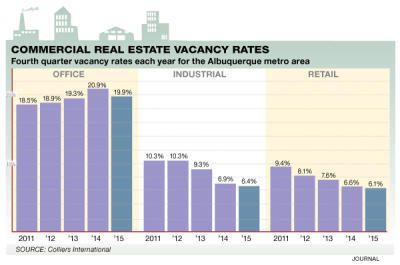
Based on statistics in fourth-quarter market reports from commercial real estate services company Colliers International, the office, industrial and retail property types were on a very gradual trajectory of improvement in 2015.

“Lack of new construction with speculative space, not build-to-suits or owner-developed projects, is behind the improvement,” said Ken Schaefer Colliers International. “It’s not so much the economy.”

The office market, which registered historically high vacancy rates for the fifth year in a row, showed some marginal improvement. The industrial market’s vacancy rate dropped to the lowest level since early 2008, but has yet to inspire the kind of new construction typical in a low-vacancy environment.

“Flat had become the new normal,” said Jim Chynoweth of commercial real estate services company CBRE. “I think we got beyond that last year. There was positive movement. The real differentiator was we saw fewer companies downsizing or leaving the market altogether.”

The office vacancy rate dropped to 19.9 percent in the fourth quarter from 20.2 percent in the third quarter and 20.9 percent in the fourth quarter of 2014, according to Colliers. The last time the rate was below the 20 percent threshold was the first quarter of 2014.

For perspective, the vacancy rate averaged 13.2 percent in 2004-09. The office market crashed the next year, when the vacancy rate shot up from 15 percent in the fourth quarter of 2009 to 17.1 percent in the first quarter of 2010. The rate peaked at 21.5 percent in the third quarter of 2014.

“The trend or theme of our market right now is flight to quality,” said Scott Throckmorton of Argus Investment Realty. “The higher-quality buildings are absorbing. The amount of space you can get in those buildings is getting fairly limited.”

Vacant space is gradually becoming more concentrated in lower-grade buildings with lower rents, which serves to drive down the average asking lease rate for the overall office market.

The average asking lease rate for Class B office space was $15.82 a square foot in the fourth quarter, the lowest it’s been since the third quarter of 2006. Class B office buildings make up more than two-thirds of the metro’s inventory of rentable office space.

The office market is heavily dependent on employment in the services-providing part of the metro economy, where employment has returned to 2007 levels. However, the services economy saw a shift in its makeup during the recession.

The education and health services sector, which is mostly health care jobs, overtook the professional and business services sector about five years ago as the metro’s biggest. Most health care workers work in medical facilities, not office buildings.

Encompassing a wide range of employees from Sandia National Laboratories to call centers, professional and business services is the biggest private-sector user of office space.

The employment sector was hammered by the recession, hemorrhaging 11,400 jobs from its peak of 66,100 in August 2008 to 54,700 in February 2011, according to state data. Professional and business services jobs were largely stagnant until 2015, when growth returned. As of November, the sector had 61,400 jobs in the metro.

The late recovery in professional and business services employment has, in turn, helped to delay the recovery in the office market.

The industrial vacancy rate dropped to 6.4 percent from 6.7 percent in the third quarter and 6.9 percent in the fourth quarter of 2014. The rate’s most recent high-water mark was 10.3 percent in the fourth quarter of 2012. The vacancy rate averaged 8.5 percent in 2004-09. Most of the activity in the industrial real estate market is in warehousing and distribution, not in plants and research buildings.

Employment in the goods-producing job sectors, mostly manufacturing and construction, is still running at a little better than two-thirds of what it was in the mid-2000s.

The retail vacancy rate nudged up to 6.1 percent in the fourth quarter from 6 percent in the third quarter, but was well down from 6.6 percent in the fourth quarter of 2014.

By: Richard Metcalf (Albuquerque Journal)

Click here to view source article.
Filed Under: All News

  • « Go to Previous Page
  • Page 1
  • Interim pages omitted …
  • Page 4
  • Page 5
  • Page 6
  • Page 7
  • Go to Next Page »
  • Search Property
  • Join CARNM
  • CARNM Login
  • NMAR Forms
  • All News
  • All Events
  • Education
  • Contact Us
  • About Us
  • FAQ
  • Issues/Concerns
6739 Academy Road NE, Ste 310
Albuquerque, NM 87109
admin@carnm.realtor(505) 503-7807

© 2026, Content: © 2021 Commercial Association of REALTORS® New Mexico. All rights reserved. Website by CARRISTO