• Skip to primary navigation
  • Skip to main content

CARNM

Commercial Association of REALTORS® - CARNM New Mexico

  • Property Search
    • Search Properties
      • For Sale
      • For Lease
      • For Sale or Lease
      • Start Your Search
    • Location & Type
      • Albuquerque
      • Rio Rancho
      • Las Cruces
      • Santa Fe
      • Industry Types
  • Members
    • New Member
      • About Us
      • Getting Started in Commercial
      • Join CARNM
      • Orientation
    • Resources
      • Find A Broker
      • Code of Ethics
      • Governing Documents
      • NMAR Forms
      • CARNM Forms
      • RPAC
      • Needs & Wants
      • CARNM Directory
      • REALTOR® Benefits
      • Foreign Broker Violation
    • Designations
      • CCIM
      • IREM
      • SIOR
    • Issues/Concerns
      • FAQ
      • Ombuds Process
      • Professional Standards
      • Issues/Concerns
      • Foreign Broker Violation
  • About
    • About
      • About Us
      • Join CARNM
      • Sponsors
      • Contact Us
    • People
      • 2026 Board Members
      • Past Presidents
      • REALTORS® of the Year
      • President’s Award Recipients
      • Founder’s Award Recipients
    • Issues/Concerns
      • FAQ
      • Ombuds Process
      • Professional Standards
      • Issues/Concerns
      • Foreign Broker Violation
  • Education
    • Courses
      • Register
      • All Education
    • Resources
      • NMREC Licensing
      • Code of Ethics
      • NAR Educational Opportunities
      • CCIM Education
      • IREM Education
      • SIOR Educuation
  • News & Events
    • News
      • All News
      • Market Trends
    • Events
      • All Events Calendar
      • Education
      • CCIM Events
      • LIN Marketing Meeting
      • Thank Yous
  • CARNM Login
  • Show Search
Hide Search

Archives for October 2016

What is Normal Wear and Tear?

October 1, 2016 by CARNM

Ripped or torn carpeting, gaping holes in the walls, doors hanging off the hinges — when a tenant moves out, some damage goes above and beyond the usual. But as most landlords know, these things are rarely straightforward.

What do you do about scuff marks on the hardwood flooring? Or nail holes from hanging pictures? What about dirty appliances? Can you charge a tenant to bring the property back into the same condition it was in before they moved in?
Of course, tenants want their security deposit back in full, but as a landlord, you must retain the deposit to apply toward any damage that the tenant is responsible for. When it comes to assessing what issues were caused by normal use and which problems are more excessive, it can get complicated.
When a tenant moves out, it’s up to the landlord to process their security deposit and return it in a timely manner. This deadline varies considerably from state to state, but for most areas, it’s about 30 days.
To further compound the issue, state and local regulations vary considerably on how security deposits should be handled. Not surprisingly, disputes regarding security deposits are among the most common reasons landlords and tenants end up facing each other in court.
To clear up some of the confusion surrounding this issue, here are some guidelines for the typical areas where damage occurs in a rental to help you determine whether it falls under the category of normal wear and tear or is something more serious.

Flooring

In most cases, you can’t expect the floor to be in pristine condition after a tenant leaves. Carpet naturally has a limited lifetime, especially if it’s a lighter color. High-traffic areas will naturally become worn down, and it’s common to see a few light stains and indentations from furniture. A steam clean, customarily performed in between tenants, should bring carpet back into decent shape. However pet stains, holes, and burns generally go beyond everyday wear and tear. When it comes to hardwood flooring, the same standards apply. Worn or scuffed flooring in areas that receive a lot of traffic is to be expected, while deep gouges or an extensive series of scratches are usually indicative of tenant damage. With tiles or linoleum, it largely depends on the quality of the flooring and what has caused the damage. If linoleum is starting to peel near the door, for example, it’s most likely the result of normal use. Broken or chipped tiles or deep scratches in flooring could have been caused by dropping heavy items or dragging something across the floor and may be damage the tenant could be held responsible for.

Walls and Doors

Faded paint or wallpaper is considered normal wear and tear, and minor superficial damage — such as a few small nail holes, or a hole where a door handle hit the wall — is usually considered normal wear as well. These small issues can easily be repaired and shouldn’t come out of the tenant’s security deposit. However, pen marks all over the walls, or deep gouges or dents that will require more than some quick plaster to repair, are usually considered excessive. Similarly, the cost to repair or possibly replace doors that are hanging off the hinges or sliding doors that have come off of their tracks and been banged around can usually be deducted from the tenant’s security deposit.

Appliances

Appliances that you supplied with the unit — such as air conditioners, furnaces, stoves, and washers and dryers — all age and will break down eventually. Your job is to determine whether the unit in question wore out on its own or was damaged by the tenant intentionally or by improper use. For instance, if your new appliances are broken and are still under warranty, you may want to find out the cause. For machines that are older than five years old, though, the breakdown could be normal wear and tear. In most cases, you shouldn’t take the cost of replacing appliances out of the tenant’s security deposit unless you can prove that they caused the damage themselves.

Pet Damage

One of the age-old landlording questions is deciding whether or not to make your rental pet-friendly. When you let furry friends stay, you’re acknowledging that they may make an impact on a unit. But just because you allow pets in your property doesn’t mean that you have to allow pet damage. Stained carpet, holes in the yard, and scratched or chewed floors, walls, or doors are not generally considered normal wear and tear and can all come out of the tenant’s security deposit.

Dirt and Grime

While you can’t require your tenants to shine the floors on their way out, this doesn’t mean that they have the right to leave your property in a filthy state either. Clogged drains from misuse or neglect; filthy bathtubs, showers, sinks, or toilets; food in the refrigerator or cabinets; a grimy stove; and piles of trash can all be considered excessive, and such in cases it’s not unreasonable for you to charge a cleaning fee. Just make sure to be clear about your expectations for the condition of the rental before your tenants move out, so they know exactly how you expect them to return the property to you.
The best test for these cases is whether the property has been returned to you in a way that’s considered to be reasonable, taking into account the amount of time that the tenant occupied it. For example, if you recently had new carpet installed and the tenant was only in the unit for six months, then the cost of replacing damaged carpet should come out of their security deposit. If, however, the carpet is ten years old, then you can’t expect the tenant to pay for a carpet upgrade simply because it’s worn out.
Finally, when it comes to security deposits, one of the best ways to protect yourself is by being proactive. Make sure you specify in the lease the condition in which you expect the rental to be returned to you. This should help to clear up any confusion and keep everyone on the same page. Another important tip is to always document everything. At Renters Warehouse, our property management team always conducts a walkthrough of the unit before the tenant moves in, documenting the condition of the property. We do another walk-through with the tenant when they move out. Video and photos are one of the best ways to demonstrate the state that the property was in, and will prove to be invaluable when it comes to withholding a security deposit or having to prove your case in court.
By: Kevin Ortner (REALTORMag)
Click here to view source article.

Filed Under: All News

Business Creation Index: October 2016

October 1, 2016 by CARNM

business-creation-index-october-2016

Introduction

The new Business Creation Index (BCI) was created to monitor local economic conditions from the perspective of NAR’s commercial members. The Business Creation Index (BCI) quarterly report offers insight from commercial real estate professionals into whether businesses are opening or closing by industry, population density, and subregion. On a monthly basis, it tracks three key questions related to local market conditions:
1. An increase of businesses opening in local communities in the last 30 days
2. An increase of businesses closing in local communities in the last 30 days
3. Net businesses opening and closing in local communities in the last 30 days
On the 2016 Profile of Commercial Members, NAR’s membership was asked the above questions over the last year from July 2015 to June 2016. The results gave way to creating the survey to gather monthly data and report changes on a quarterly basis.
Additional topics will be examined in depth on http://EconomwastsOutlook.Blogs.realtor.org/.
The next Business Creation Index (BCI) survey releases for 2016 and 2017 will be:

  • December, 2016
  • March, 2017
  • June, 2017
  • September, 2017
  • December, 2017

Click here to view PDF of entire Index.

By: National Association of REALTORS®
Click here to view source article.

Filed Under: All News

Industrial Roars Ahead

October 1, 2016 by CARNM

Efficient distribution networks mirror explosive growth in e-commerce.

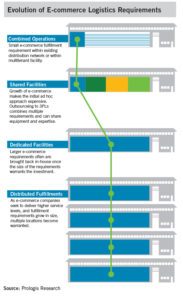
It is no surprise that the demand for industrial space in warehouse, distribution, and fulfillment centers has been soaring along with the explosive growth occurring in e-commerce.
Online sales in the U.S. are expected to reach $523 billion in 2020 – up 56 percent from the $335 billion in 2015, according to a report by Forrester Research Inc. Amid that backdrop, e-commerce users also are proving to have a big impact offline in the industrial real estate market. They have been gobbling up huge blocks of space, fueling new construction, and attracting more institutional and global investors to the market.
E-commerce launched a new generation of mega-sized facilities that can store and process goods more efficiently. As the industry continues to evolve, space demands are shifting once again as firms zero in on “the last mile” – the final leg of the journey in delivering product purchases. E-commerce companies are moving closer to customers to speed delivery.
“We are such a time-sensitive society where people want the stuff they order yesterday,” says William G. Leffew, CCIM, a senior vice president at Bellweather Enterprise in Louisville, Ky.
Shipping hubs such as Louisville, Memphis, Tenn., and San Bernardino, Calif., have benefitted significantly from that rapid-fire distribution of goods. For example, Louisville is an international hub for UPS, and its airport is one of the busiest in the world for freight tonnage. Louisville also has landed dozens of retail and e-commerce companies, including major firms such as Best Buy, Camping World, Guess, and L’Oréal to name a few.
However, Amazon is the clear leader of the pack in the e-commerce world. Not only is Amazon continuing to expand its distribution and fulfillment footprint with super-sized facilities in the U.S. and Canada, but the company has been the player to watch for how it is structuring its distribution network, and where it is locating facilities.
Amazon recently planted a flag in the Milwaukee metro with two fulfillment centers totaling about 1.5 million sf that opened in early 2015. “That really put us on the national map,” says Jeff Hoffman, CCIM, SIOR, a principal at Cushman & Wakefield | Boerke in Milwaukee.
Those facilities were located about 30 miles south of Milwaukee in Kenosha County, which is about two-thirds of the way between Milwaukee and Chicago. In early 2016, Amazon also leased 50,000 sf in an in-fill Milwaukee location to serve as an urban fulfillment center for its Amazon Prime delivery.
“A lot of developers and brokers scratched their head at the location. However, when you look at the key for e-commerce users – access to rooftops – it made a lot of sense for why they sited there,” Hoffman says.
Amazon dominates the conversation about e-commerce, but certainly there is a large and expanding e-commerce sector with online retailers such as Zappos (shoes) and Wayfair (furniture). Traditional retailers are being forced to compete in the online arena and are building out their own networks for distributing those goods to customers both nationally and internationally.
In addition, there is a broader ripple effect that is providing a lift to suppliers, 3PL companies, and packaging firms. In Milwaukee, for example, ULINE packaging has taken on over 3 msf of space in the Milwaukee metro in the past two years, including a new 1.2 msf distribution center that opened this spring.

Steady Demand for Space

26-30 Feat Tieg.indd
Overall, the industrial market has been performing very well with slow and steady improvement over the past five years. The vacancy rate for warehouse/distribution space held firm at 10.6 percent in first quarter, according to Reis. “I think it is a pretty broad-based recovery, although there are certain metros that are doing better than others, such as San Bernardino, Nashville, Chicago, and Atlanta,” says Barbara Denham, an economist at Reis Inc.
It is difficult to say how much e-commerce contributes to the overall activity in the market, Denham notes. In addition, a lot of e-commerce firms are building or buying their own spaces, which does not affect absorption or rents in the multi-tenant market, she adds. Under Armour, for example, reportedly invested $100 million in a new 1 msf distribution facility that it opened in Nashville, Tenn., earlier this year.
Certainly, there are multiple industries driving demand for industrial space. In Vancouver, B.C., the industrial market relies on key industries such as manufacturing, oil and gas, and lumber, as well as distribution.
“There has been a huge increase in demand and absorption for 3PL space,” says Sebastian Espinosa, CCIM, associate vice president, industrial at Lee & Associates in Vancouver (formerly DTZ Vancouver). The demand for large distribution facilities is putting added pressure on a market where both available space and land are in short supply.
In the past year, Amazon expanded its operations in Vancouver with the lease of an additional 570,000 sf of warehouse space in New Westminster, B.C. Amazon now occupies close to 1 msf in metro Vancouver with about 763,000 sf of warehouse and 189,500 sf of office space, according to Espinosa. Vancouver is battling a supply crunch with a record low metro vacancy rate that is below 3 percent.
For example, companies looking for 20,000 sf of distribution space in Surrey, B.C., a large suburban in southeastern Vancouver, have five or six options compared to about 10 choices just a year ago. Those options dwindle even further as the space requirement gets larger, Espinosa notes.
Demand for e-commerce fulfillment and distribution centers also is pushing rents higher in many metros. Globally, rents for prime logistics space rose 2.8 percent last year, according to CBRE. In addition, six of the top 10 global logistics markets with the fastest growing rents for prime logistics space were in the U.S. Oakland, Calif., posted the highest prime logistics space rent gains in 2015 at 29.8 percent; followed by New Jersey at 15 percent; and the Inland Empire in California at 13.5 percent. Nationally, average effective rents for the broader office/warehouse market reached $4.48 psf in first quarter, which represents an annual growth rate of 2.1 percent, according to Reis.

The Last Mile

Distribution and fulfillment users have become very location sensitive, which has created strong leasing velocity in the marketplace as companies reassess location strategy. “Targeting the rooftops” for locations is a strategy more frequently seen in the retail sector, but that approach is increasingly influencing site selection decisions for industrial users. Companies want locations that allow them to reach customers faster and more cost-effectively.
“Anything that you can do to reduce logistics expenses is critical right now,” Hoffman says.
For e-commerce firms in particular, industrial space needs is less about the cost of the real estate and more about transportation costs, agrees Kevin McGowan, CCIM, SIOR, president of McGowan Corporate Real Estate Advisors in Allentown, Pa.
“Real estate brokers are supposed to get low rents for their customers,” he says. “However, the reality is that you can get a really low rent, and if that facility is in the wrong place the cost for the company to deliver the product would not be competitive.”
Amazon is still growing and adding new facilities. At the same time, their distribution network is evolving as the company tries to figure out what’s next, McGowan adds. The Amazon Prime model that promises next day or even same day delivery is driving decisions to locate closer into the population centers of major cities. What’s ahead for Amazon and other e-commerce firms is trying to figure out “predictive demand.”
In theory, firms can use consumer habits and past order history to develop customer profiles and crunch that with big data to know what inventory needs to be moved closer to consumers, McGowan says.
“They are all about same day delivery,” he says. So how do you configure the supply chain so that one, same day delivery actually happens. Two, it is cost-effective so that you can make money doing it.”
Another consideration that is moving to the forefront for e-commerce companies is their ability to attract labor. Distribution has traditionally always been done at the pallet level, such as shipping large blocks of goods direct to a retailer. E-commerce is more highly focused on the parcel level as companies ship single items or a “shopping cart” of select items to an individual customer. So, even with a tremendous amount of automation, fulfillment centers need to hire a lot of workers.
In some instances, companies are moving further out in the metro where the cost of living is more affordable for warehouse workers. In other cases, companies are opting for in-fill locations where there is more population density.
“What we’re finding is that your traditional tenant mix is not looking to go out to the next rural cornfield for development,” Hoffman says. “They want to be close to rooftops. They want to be close to customers, and they want to be close to their employees.”

Rising Spec Development

E-commerce and 3PL firms are continuing to demand larger footprints for bulk industrial facilities. Buildings that are 500,000-plus sf with clear heights between 32- and 36-feet are now the norm. Those changing demands are driving more build-to-suit and spec activity, because the inventory that matches those requirements simply doesn’t exist.
In addition, traditional warehouse and distribution facilities were not designed to be ergonomically and labor friendly. Now there are more workers in the buildings and companies are competing for labor. Some facilities are sited in a “warehouse farm” where there may be 15 facilities.
“There are competitors next door that would happily take your labor force,” McGowan says. So, the smart companies are starting to design facilities that are more appealing to workers with natural light and a more comfortable environment. State-of-the-art buildings such as those occupied by Amazon also rely more on automation and robotics, which means more specialized requirements related to HVAC and other infrastructure.
That demand for more modern space has sparked development nationwide. Construction, including speculative development, is on the rise in many markets across the country. Nationally, there was 16.9 million sf of new warehouse/distribution space completed during first quarter, according to Reis. The busiest metros were Atlanta at 3.9 million sf, Dallas at 2.4 million sf, Chicago at 2.3 million sf, and Memphis at 1.5 million sf.
Louisville has had a front-row seat to the e-commerce building boom. In addition to its UPS hub, the metro also has a 6,000-acre re-purposed military ammunition facility known as River Ridge across the river in southern Indiana.  This park has received a mega-site designation for larger users and is home to many automotive suppliers, as well as a 1 million-plus sf Amazon facility.  In addition, the park is only about one-eighth developed.
“That has been a very active and dynamic market over there, and we are waiting to see how that plays out,” Leffew says.
According to CBRE, the Louisville industrial market has grown by more than 10 million sf since 2013, while vacancy as of first quarter remains at a healthy 4.7 percent. In addition, there is a massive amount of speculative development going on the Louisville metro with more than 4 million sf of space underway or planned. Despite that activity, banks are more conservative on construction lending. So far, construction financing has been pretty well mitigated as it relates to equity, proposed debt service coverage, and sponsorship, according to Leffew.
Access to construction financing will likely be “the great equalizer” that keeps developers in check, he adds.
By: Beth Mattson-Teig (Commercial Investment Magazine)
Click here to view source article.

 

Panama Canal: Changing Demand for East Coast Ports?

The long-awaited completion of the Panama Canal expansion has industrial owners and developers across the country watching to see how the expanded capacity may shift the balance of power in and around key ports on both coasts.

The $5.4 billion Panama Canal expansion opened in late June with a new third lane that is expected to more than double the canal’s capacity. The canal also will be able to accommodate significantly larger container ships. So, ships will now be able to carry more cargo, making the Panama Canal a more cost-effective route for firms exporting and importing goods to Asia.
There has been broad speculation that the expansion will draw shipping traffic from busy West Coast ports, namely California’s Los Angeles and Long Beach ports, and fuel more activity at East Coast ports such as the Port of New York/New Jersey, as well as Savannah, Ga., Norfolk, Va., and Charleston, S.C. It will take time to see how that plays out.
However, Los Angeles and Long Beach are likely to remain fairly entrenched as the top ports in the country. Combined, the two ports handle about one-third of all the shipping containers that enter the U.S. Los Angeles is the largest of the two with TEU (20-foot equivalent units) volume in 2015 at 8.2 million and Long Beach following at 7.2 billion. Much of that traffic flows to the Inland Empire, which is one of the hottest industrial markets in the country.
“There is such a huge West Coast market, that I don’t think it will suffer that much,” says Barbara Denham, an economist at Reis Inc.
The impact from the Panama Canal expansion could be lessened because there has already been a shift occurring over the past decade with more business moving from West Coast to East Coast delivery. West Coast ports accounted for 52 percent of all TEU volume last year in North America, down from 54 percent in 2014 and 57 percent in 2010, according to CBRE.
Industrial markets on the East Coast are preparing for demand in anticipation of more shipping traffic. For example, eastern Pennsylvania is sitting in a prime location about two hours inland from the Port of Elizabeth terminal in New Jersey.
“Our thesis is that Eastern PA will become more and more built out, like the Inland Empire of California,” says Kevin McGowan, CCIM, SIOR, president of McGowan Corporate Real Estate Advisors in Allentown, Pa. Some of that positioning is already well underway with land sites that are entitled or in play, McGowan notes.
“It feels like there is a little bit of anticipatory build-up on the development side with new speculative development for this increased demand,” he adds.
By: Beth Mattson-Teig (Commercial Investment Magazine)
Click here to view source article.

Filed Under: All News

Trends in Commercial Property Leasing

October 1, 2016 by CARNM

SIOR shares specific trends in commercial property leasing in this SIOR Report.

Read the SIOR Report article “Trends in Commercial Property Leasing“

By: Steve Lewis (SIOR Magazine: The Industrial and Office Magazine)
“Tenants are seeking more and more efficiency and are putting more and more people in the same or smaller amounts of space.”
General trends in commercial real estate property leasing at the national level, but SIOR recommends analyzation of trends at a local level in specific markets. Some such trends include the affinity toward downtown, walkable communities and the drive toward more efficiency, even at the cost of space.
Individual markets are analyzed in this SIOR Report and commercial real estate brokers are given tips on how to find the trends in their individual markets. Because of new trends, new needs in tenant improvement are being identified. This report discusses how SIORs are identifying and meeting those needs.
Click here to view source article.

Filed Under: All News

  • « Go to Previous Page
  • Page 1
  • Interim pages omitted …
  • Page 3
  • Page 4
  • Page 5
  • Page 6
  • Go to Next Page »
  • Search Property
  • Join CARNM
  • CARNM Login
  • NMAR Forms
  • All News
  • All Events
  • Education
  • Contact Us
  • About Us
  • FAQ
  • Issues/Concerns
6739 Academy Road NE, Ste 310
Albuquerque, NM 87109
admin@carnm.realtor(505) 503-7807

© 2026, Content: © 2021 Commercial Association of REALTORS® New Mexico. All rights reserved. Website by CARRISTO