• Skip to primary navigation
  • Skip to main content

CARNM

Commercial Association of REALTORS® - CARNM New Mexico

  • Property Search
    • Search Properties
      • For Sale
      • For Lease
      • For Sale or Lease
      • Start Your Search
    • Location & Type
      • Albuquerque
      • Rio Rancho
      • Las Cruces
      • Santa Fe
      • Industry Types
  • Members
    • New Member
      • About Us
      • Getting Started in Commercial
      • Join CARNM
      • Orientation
    • Resources
      • Find A Broker
      • Code of Ethics
      • Governing Documents
      • NMAR Forms
      • CARNM Forms
      • RPAC
      • Needs & Wants
      • CARNM Directory
      • REALTOR® Benefits
      • Foreign Broker Violation
    • Designations
      • CCIM
      • IREM
      • SIOR
    • Issues/Concerns
      • FAQ
      • Ombuds Process
      • Professional Standards
      • Issues/Concerns
      • Foreign Broker Violation
  • About
    • About
      • About Us
      • Join CARNM
      • Sponsors
      • Contact Us
    • People
      • 2025 Board Members
      • Past Presidents
      • REALTORS® of the Year
      • President’s Award Recipients
      • Founder’s Award Recipients
    • Issues/Concerns
      • FAQ
      • Ombuds Process
      • Professional Standards
      • Issues/Concerns
      • Foreign Broker Violation
  • Education
    • Courses
      • Register
      • All Education
    • Resources
      • NMREC Licensing
      • Code of Ethics
      • NAR Educational Opportunities
      • CCIM Education
      • IREM Education
      • SIOR Educuation
  • News & Events
    • News
      • All News
      • Market Trends
    • Events
      • All Events Calendar
      • Education
      • CCIM Events
      • LIN Marketing Meeting
      • Thank Yous
  • CARNM Login
  • Show Search
Hide Search

Archives for December 2016

What Does the Paid Sick Leave (Healthy Workforce Ordinance) Mean for MY Business?

December 27, 2016 by CARNM

What YOU need to know about the proposed Albuquerque Healthy Workforce Ordinance

As soon as this fall, Albuquerque voters may be voting for mandatory paid sick leave for all Albuquerque employees based solely upon a brief, inadequate, 4-sentence description of a broad- reaching and harmful Ordinance. The so-called Healthy Workforce Ordinance would require all employers, big and small, to provide all employees within the city with paid sick leave. Implementation of this law would have a significant negative impact on Albuquerque employers and employees. If adopted, the Ordinance would not be subject to revision or compromise and would go into effect as is.

  • Would my organization be subject to the Ordinance
    • All employers, large and small, with employees working in the City of Albuquerque would be subject to this Ordinance, without exception (even if the Organization itself is not based in Albuquerque, an employer only needs to have a “physical premises” in the City to be subject).
  • Would I have to pay all my employees paid sick leave?
    • All employees (including full-time, part- time, seasonal, and temporary employees) who work 56 or more hours within a year within the city limits of Albuquerque would have to be provided with paid sick leave. Employees who work less than 56 hours within Albuquerque city limits within a year would not need to be provided with paid sick leave. However, any employees, even those who are not based in Albuquerque, who do in excess of 56 hours of work (including training, meetings, sales calls, etc.) within City limits could be subject to the Ordinance if the employer has a physical premises in the City. Specifically, the language of the ordinance does not say that mandatory paid time off only accrues on hours worked within the City; it says that employees become eligible under the statute if they work 56 or more hours within the City and is silent as to where hours must be worked in order to qualify for.
  • How much paid time off are we talking about?
    • Every single employer subject to the Ordinance would be required to provide every eligible employee with one hour of paid sick leave for every 30 hours worked.
  • Employers with less than 40 employees
    • Employers with less than 40 employees are considered to be “small employers” under the Ordinance. (For this purpose, the number of employees is determined based upon all employees within the organization, including those located outside of Albuquerque.) Small employers would be required to allow employees to use at least 40 hours of accrued sick leave each.
  • Employers with 40 or more employees
    • Employers with 40 or more employees are considered to be “large employers” under the Ordinance. Large employers would be required to allow employees to use at least 56 hours of accrued sick leave each.
  • Can’t I just keep using my existing paid time off policy?
    • Probably not. Most employers’ existing paid time off policies will not be in compliance with the strict requirements of the Ordinance.
  • Compliant paid time off policies would need to:
    • Provide to each and every eligible employee (including part-time, seasonal, and temporary employees who work at least 56 hours in the year within the City) at least one hour of paid sick leave accrual for every 30 hours worked;
    • Track and report how each and every hour of paid leave was used (whether for sickness or another allowable reason under the proposed Ordinance, or whether the time off was used for a reason not covered by the Ordinance, such as vacation and family events). Employers would be required to maintain payroll records for each employee showing the weekly hours worked, wages paid, and the amount of paid sick time accrued and/or used each pay period;
    • Accrue paid leave beginning the first day of employment;
    • Allow employees to use accrued paid leave no later than 90 days after the start of employment;
    • Allow employees who leave the organization and are rehired within 12 months to access previously accrued and unused paid leave; and
    • Permit employees to carry over unused paid sick leave hours to the following year. There is no indication within the Ordinance that these rolled-over accruals cannot continue to build year-upon-year.

As a result, employees who are rarely ill could end up carrying a large amount of accrued paid sick leave (which is often a logistical, accounting, and record keeping nightmare).

  • Can I require that an employee who takes paid sick time provide documentation confirming the reason that they were absent?

Yes, if the employee is absent for 3 or more consecutive days the employer may require that the employee provide documentation proving that their absence was for a purpose covered under the Ordinance. However, the employer is responsible for any out-of-pocket costs (such as co-pays) incurred by the employee in order for them to obtain documentation proving the reason for their

  • Can I require that an employee who takes paid sick leave find a replacement to work their shift?

An employee can be asked to assist in finding a replacement, but their entitlement to use accrued paid sick leave cannot be contingent upon their locating a replacement to work for them.

  • What happens if an employee sues my organization under the proposed Ordinance?

The setup of the Ordinance is harshly anti-employer and very favorable to employees seeking to file

  • The Ordinance creates a presumption of retaliation by employers.

Essentially, if an employer chooses to terminate, demote, or take another non-favorable employment action (including bad marks on a review or a reduction in hours) within 90 days of that employee having made any noise about the Ordinance, or really, any employee who took leave under the Ordinance, then the presumption is that the employer retaliated and the burden of proof would be on the employer to demonstrate that they took the non-favorable action against the employee for some other, non-retaliatory.

  • Employees would have the right to form a class action to sue an employer.

Meaning that instead of facing individual lawsuits for violations, an employee (or former employee) could sue the organization on behalf of themselves and other similarly situated employees (the employee bringing suit would not need the consent of the other employees to file suit on their behalf).

  • Under the Ordinance, a successful suit against an employer could cost the employer:
    • Damages to account for “appropriate legal and equitable relief” – a fairly arbitrary amount set by a judge or jury;
    • Three times the dollar value of any sick leave due but not granted or paid by the employer;
    • Civil penalties of $50 per week per employee (maximum of $500 per employee);
    • Costs and attorney fees incurred by the employee(s) and their attorneys in bringing the suit (in many cases, this will be the most expensive part of a violation); and
    • In the case of a finding that the employer retaliated against the employee for asserting his or her rights under the Ordinance, reinstatement of the employee to their previous job and/or additional monetary damages including lost
    • Under the Ordinance, employers can also be subject to audit and investigation by the City Attorney’s Office.
    • The City Attorneys would be empowered to investigate and inspect employer records, enforce penalties payable to the City, and grant employees (and/or former employees) monetary

Bottom line, the proposed Albuquerque Healthy Workforce Ordinance would create a tremendous burden on Albuquerque businesses. Employers would be forced to overhaul existing paid time off policies (or do away with them all together and return to the days of separate sick and vacation leave banks) and would be exposed to a potential legal minefield.
Legal Opinion Provided by: Alice Kilborn, JD PHR SHRM-CP: Tel: (505) 235-8750 alice@kilbornconsulting.com www.kilbornconsulting.com
By: NAIOP NM (NAIOPNM.org)
Click here to view source article.
Filed Under: All News

It Was Going to Be the Year of the REIT. Until It Wasn't

December 27, 2016 by CARNM

2016 was supposed to be the year of the REIT — until it wasn’t.
In September, real estate got its own major market index category, bringing real estate investment trusts more visibility and, by extension, access to more capital.
Like clockwork, real estate-related ETFs saw their greatest inflow ever in September. But October saw steep outflows, due to investors’ fondness for higher government bond yields and a greater likelihood of an interest rate hike. November’s seismic political shift exacerbated those conditions, making an interest rate increase almost inevitable and sending bond yields soaring further.
The election of Donald Trump and his attraction to a stronger dollar have helped spur higher rates, meaning, also, higher borrowing costs. That’s a bad thing for REITs, which pay 90 percent of their taxable income as dividends and thus rely on debt for growth.
The specter of higher interest rates also caused a bond selloff and 10-year government bond yields to rise. Rising bond yields also make REIT yields less attractive to investors.
In turn, nearly all types of real estate investment trusts saw price declines recently, regardless of their underlying fundamentals. Total returns on the National Association of Real Estate Investment Trusts’ All Equity REIT index had surpassed the S&P 500 Index until November, when the S&P 500 pulled ahead. Recent price drops have offset some of REITs’ long-term gains:
Retail and health care REITs have suffered the most lately. The retail businesses that underpin the former have long faced dwindling in-store sales and looming deadlines for debt repayments. Rising interest rates will only mean more pain for retail landlords, who may have trouble refinancing.
Health care REITs, for their part, are the most susceptible to rising interest rates. Their underlying leases tend to be longer term than other real estate leases, meaning property owners may not be able to raise rents fast enough to offset rising rates.
But not all is bad in REIT-land.
Single-family housing rentals have been this year’s success story. Private equity real estate company Blackstone is set to make public its Invitation Homes holding, the biggest single-family housing landlord. The sector has received a boost from millennials delaying home ownership.  Industrial REITs, thanks to sustained demand from e-commerce, have also had a stellar year. Their growth is expected to continue as same-day e-commerce delivery requires more industrial space in and around major cities.
In general, real estate fundamentals are strong. Demand for real estate of many types is high and rents for the most part are growing. A steady interest rate increase and competition from bond yields won’t change that. In fact, an interest rate hike should signify an improved economy — which will have a greater impact on REITs than rates. And NAREIT’s average dividend yield (4.47 percent) is still about 200 basis points higher than 10-year treasury bonds (2.53 percent), so that still makes them an attractive bet.
Growth is still on the horizon for REITs, as evidenced by a 9 percent increase in the amount of capital raised this year compared to last, according to data from financial analytics company S&P Global. As noted above, REITs pay out most of their profits as dividends to investors, so they rely on borrowing to expand.
So while 2016 caused some short-term pain for REITs, the sector’s fundamentals suggest that it still has good long-term prospects.
By: Rani Molla (National Real Estate Investor)
Click here to view source article.
Filed Under: All News

More Signs the Apartment Boom May Be Fizzling

December 20, 2016 by CARNM

The so-called absorption rate is declining.

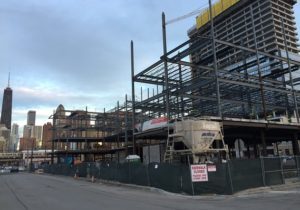
A number of residential high-rises are under construction in 2016 on and near the former site of Chicago’s notorious Cabrini-Green housing project.

Fresh data may confirm that the recent heyday for apartment construction is over.
Fewer newly-constructed apartments are being rented out, according to figures released early in December by the Commerce Department. The “absorption rate” — whether an apartment has been rented within three months of completion — was 58% in the second quarter of this year, down from 66% in the same period in 2015 — for a smaller pool of apartments.

That’s happening even as builders have been breaking ground on more single-family homes, and fewer multi-family. Through the first eleven months of 2016, multi-family starts are 4% lower than during the same period a year ago, while single-family starts are 11% higher.
Many economists want to see a stronger pace of single-family home building and buying, not just to ease supply shortages, but also as a barometer of a stronger economy and confidence in the housing market than the recent apartment boom has demonstrated.

Many Americans emerged from the downturn with dented finances and credit scores, not to mention negative views of homeownership, making it easier and more attractive to rent than buy. Mortgage lending is strict, and even small down payments have been hard to scrape together for many young people, especially as rental costs surge.
For many homeowners, equity and home values were pummeled, giving them little incentive to list their homes for sale. Tight housing inventory has pushed prices higher, favoring sellers.
And demand for rentals is likely to continue to grow, analysts believe, even as those cyclical trends ease. The massive baby-boom generation is renting more than earlier generations did at their age. Increasing ethnic diversity will likely mean more renting than buying.
Builders responded to those trends by ramping up construction of multi-family buildings. (The National Association of Home Builders, crunching Commerce Department data, found that about 92% of all multi-family units were built-for-rent in the third quarter, much higher than the 80% share in the two decades before the housing boom took off.)
On Friday, Commerce will report on November new home sales, data which only covers new single-family homes. The median forecast among economists surveyed by MarketWatch is for a 4% monthly increase, to a 583,000 annual pace of sales.
Like most metrics in the housing market, that would demonstrate slow and steady improvement, but still fall well short of sales volumes that the U.S. enjoyed even before the mortgage mania of the mid-2000s.
By: Andrea Riquier (MarketWatch)
Click here to view source article.

Filed Under: All News

Albuquerque Downtown Partnership

December 19, 2016 by CARNM

The vacant lot at the corner of Central and first street that is set up for mixed-use "entertainment" oriented development .Tuesday Dec. 13, 2016. (Jim Thompson/Albuquerque Journal)
The vacant lot at the corner of Central and first street that is set up for mixed-use “entertainment” oriented development. Tuesday Dec. 13, 2016. (Jim Thompson/Albuquerque Journal)

The City of Albuquerque plans to contribute to parking structure near new mixed-use downtown development.

ALBUQUERQUE, N.M. — Crews will soon start construction at the northeast corner of 1st and Central, transforming what is now a parking lot into One Central, a five-story residential/commercial building with an attached parking structure.
Albuquerque businessmen Jerry Mosher, Dale Armstrong and Tony Pisto will develop the site under One Central Operating Associates LLC. But the city of Albuquerque will play a major role in the undertaking too, ultimately contributing about half the total cost in a collaboration both parties say is essential to the project’s viability.
Developers conceived One Central to meet the city’s goal of a Downtown entertainment district. As planned, it will include 60 apartments above about 40,000 square feet of commercial space that developers hope to fill with a bowling alley, a brewery, restaurants and more. The parking garage will have 423 spaces, and the city will take over immediate management and operation duties, with an option to eventually buy it.
One Central will cost an estimated $40 million to develop. The city will chip in $17.55 million – most of it coming from lodgers’ tax collections – plus land valued at $1.4 million, accounting for just under $19 million. Bernalillo County has also approved an industrial revenue bond package that includes property and gross receipts tax breaks.

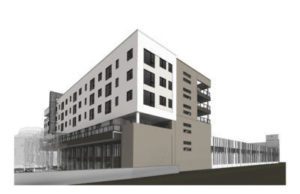
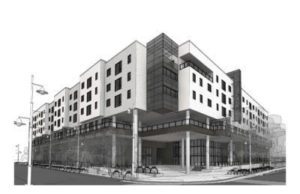
Courtesy of One Central Operating Associates Renderings of the planned One Central mixed-use development at the corner of First and Central. jdyer@abqjournal.com

Albuquerque Mayor Richard Berry contends that the city is not paying for half the development, but rather buying a parking garage. Once One Central builds the structure – scheduled for completion next fall – the city will pay the developer $17.55 million for an “exclusive operating agreement” and option to purchase it for $1,000 after 10 years, according to an agreement between the parties.
“If I didn’t think it made sense, we wouldn’t look at it,” Berry said in an interview.
The mayor said it will provide much-needed Downtown parking, and touted the associated jobs created by One Central’s construction and long-term operation. Public-private partnerships can spur development that otherwise would not occur, Berry said, citing the Imperial Building as one example. The $19.3 million mixed-use building at 2nd and Silver SW brought Downtown’s new grocery store, new eateries and more apartments.
“We never would have gotten a grocery store Downtown without (a public-private partnership),” Berry said.
Geltmore LLC and YES Housing developed Imperial with a boost from the city, which contributed $4.4 million (including the land), low-income housing tax credits, and various county and federal incentives.
“We went everywhere we could for funding to make this work,” Michelle DenBleyker, YES’ vice president of development said in an email to the Journal.
Mosher said One Central’s current incentive package represents the minimum needed to make One Central happen. In fact, the project nearly died last month when the Bernalillo County Commission approved a shorter-term tax break than One Central requested. County staff said the difference amounted to just $46,000 because it considered only the taxes due if the land remained in its current state – a city-owned surface parking lot. But One Central and the city calculated it as a $2 million loss in value, assuming it gets developed as planned.
Courtesy of One Central Operating Associates Renderings of the planned One Central mixed-use development at the corner of First and Central.

To save the project, the city upped its contribution by $300,000 and extended a free parking program for customers patronizing One Central’s businesses to 10 years from five years. The city values that benefit at $130,442 each year.
Courtesy of One Central Operating Associates Renderings of the planned One Central mixed-use development at the corner of First and Central.
One Central would be impossible without incentives, Mosher said, noting that space could not command rental rates required to cover its costs. It will ask $19 per square foot for commercial space, much less than Mosher said it would get in a high-demand trade area like Uptown, where CBRE research recently found the median asking rate is $25 per square foot.
He said his group would be borrowing a total of about $34 million from Los Alamos National Bank to build One Central.
“It’s a matter of economics. The project has to work,” Mosher said. “If we could get $25 (a square foot) Downtown, it wouldn’t matter what the taxes are, but the truth is we can’t.”
Mosher, whose other companies include electrical contractor Mosher Enterprises and Consolidated Solar Technologies, still described the project as “pretty risky,” and noted that its vitality hinges in part on a larger Downtown renaissance that will include Innovate ABQ and Albuquerque Rapid Transit.
Still, he called the project a “win-win” for the involved parties.
“The city helped us get it done and we solved a parking problem for the city,” he said.
By: Jessica Dyer (Albuquerque Journal)
Click here to view source article.

Filed Under: All News

  • « Go to Previous Page
  • Page 1
  • Page 2
  • Page 3
  • Page 4
  • Page 5
  • Go to Next Page »
  • Search Property
  • Join CARNM
  • CARNM Login
  • NMAR Forms
  • All News
  • All Events
  • Education
  • Contact Us
  • About Us
  • FAQ
  • Issues/Concerns
6739 Academy Road NE, Ste 310
Albuquerque, NM 87109
admin@carnm.realtor(505) 503-7807

© 2025, Content: © 2021 Commercial Association of REALTORS® New Mexico. All rights reserved. Website by CARRISTO