
• Skip to primary navigation
  • Skip to main content

CARNM

Commercial Association of REALTORS® - CARNM New Mexico

  • Property Search
    • Search Properties
      • For Sale
      • For Lease
      • For Sale or Lease
      • Start Your Search
    • Location & Type
      • Albuquerque
      • Rio Rancho
      • Las Cruces
      • Santa Fe
      • Industry Types
  • Members
    • New Member
      • About Us
      • Getting Started in Commercial
      • Join CARNM
      • Orientation
    • Resources
      • Find A Broker
      • Code of Ethics
      • Governing Documents
      • NMAR Forms
      • CARNM Forms
      • RPAC
      • Needs & Wants
      • CARNM Directory
      • REALTOR® Benefits
      • Foreign Broker Violation
    • Designations
      • CCIM
      • IREM
      • SIOR
    • Issues/Concerns
      • FAQ
      • Ombuds Process
      • Professional Standards
      • Issues/Concerns
      • Foreign Broker Violation
  • About
    • About
      • About Us
      • Join CARNM
      • Sponsors
      • Contact Us
    • People
      • 2025 Board Members
      • Past Presidents
      • REALTORS® of the Year
      • President’s Award Recipients
      • Founder’s Award Recipients
    • Issues/Concerns
      • FAQ
      • Ombuds Process
      • Professional Standards
      • Issues/Concerns
      • Foreign Broker Violation
  • Education
    • Courses
      • Register
      • All Education
    • Resources
      • NMREC Licensing
      • Code of Ethics
      • NAR Educational Opportunities
      • CCIM Education
      • IREM Education
      • SIOR Educuation
  • News & Events
    • News
      • All News
      • Market Trends
    • Events
      • All Events Calendar
      • Education
      • CCIM Events
      • LIN Marketing Meeting
      • Thank Yous
  • CARNM Login
  • Show Search
Hide Search

Archives for December 2016

December Business Creation Index

December 19, 2016 by CARNM


The new Business Creation Index (BCI) was created to monitor local economic conditions from the perspective of NAR’s commercial members. The quarterly report offers insight from commercial real estate professionals into whether businesses are opening or closing by industry, population density, and subregion. On a monthly basis, it tracks three key questions related to local market conditions:
1. An increase of businesses opening in local communities in the last 30 days.
2. An increase of businesses closing in local communities in the last 30 days.
3. Net businesses opening and closing in local communities in the last 30 days.

By: National Association of REALTORS®
Click here to view source article.
Filed Under: All News

CARNM Commercial Source: November 2016 Industry Statistics

December 16, 2016 by CARNM

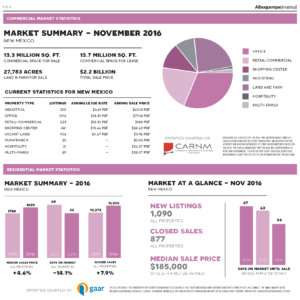
Market Summary – November 2016

industry-statistics-from-albuquerque-journal-homestyle-12-16-2016-2

By: HomeStyle Magazine (Albuquerque Journal)
Click here to view source PDF (Market Summary page).
Click here to view source PDF (Entire edition)
Click here to view source article.

Filed Under: All News

Tenant Creditworthiness

December 15, 2016 by CARNM

Part I: How future tenants’ credit ratings affect leasing.

Most businesses that rely heavily on real estate in their day-to-day operations prefer leasing to ownership for managing their real estate locations. Among the many reasons for this preference are the cost of capital and corporate flexibility.

As a result, investor ownership of real estate leased to businesses represents a large and growing long-term, income-oriented global investment class. These net lease investments allow landlords to be passive recipients of what they expect to be predictable long-term, income-oriented returns.
A common investor perception is that such return predictability can be elevated by investing in real estate leased to high credit quality tenants. In turn, high credit quality companies have responded, offering a bounty of leased real estate to individual and institutional investors estimated to be valued well in excess of $1 trillion.

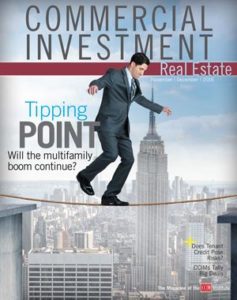
cire-novdec16-cover

Just a glimpse of this market shows smaller free-standing properties leased to investment grade companies and held by investors were estimated to have a combined value well north of $500 billion in 2014. To place this $500 billion subset of the broader net lease market into context, this amount is about five times the combined enterprise values of publicly traded U.S. REITs, which invest in such types of leased assets. With such a broad investor demand for real estate leased to high credit quality tenants, it makes sense to examine the degree to which corporate credit metrics govern net lease real estate investment risk.

Dispelling Prejudice

During the past few years, real estate analysts and investors have answered which they would prefer: investing in a store leased to Home Depot or a store leased to an Ashley Furniture licensee. Home Depot wins, hands down.
However, the question is unfair because not enough facts have been provided. Still, the sheer number of people who prefer Home Depot as a tenant shows a prevailing presumption. Most respondents presume that everything else is equal and that all they have to decide on is the preferred tenant. They want the better credit, so they choose Home Depot.
Those who know more about real estate and real estate leasing understand that the leasing playing field is not equal.
Real estate leases are simply contracts that each come with certain landlord rights, and wide diversity exists among net-lease contracts. Of course, tenant credit quality is a key component of lease contract risk, but it is far from the only consideration.
An investment grade company, such as Home Depot, is very likely to pay the rent it owes over the next few years. Investors, however, should concern themselves with more than just the short run. They should pay attention to the ability of the contract to perform well over its entire lifespan, which is often 10 years or longer.
When considering the longer-term risks, various considerations come into play. Foremost is the price a landlord pays for the real estate.
If the asset becomes vacant, how much is the downside risk? It turns out that it is common for real estate occupied by investment grade tenants to sell for considerably more than it costs to create. It also turns out that it is typical for real estate that is leased to investment grade tenants to have rents that are well above those in the local marketplace.

Binding Multiple Tenants

Another issue is the availability of master leases. Master leases are an institutional investor creation and are basically a single lease that binds multiple tenant properties. Their value lies in tenant alignment of interest. Having a single, or master, lease across multiple properties allows for locations to be aggregated. So if a tenant falls on hard times, master leases are more likely than not to prevent tenants from cherry-picking properties or retaining only select locations within a bankruptcy.
That is because tenants generally have to treat a master lease in bankruptcy as a single contract that is not divisible into multiple contracts. Unfortunately, master leases are generally not available from investment grade companies.
In the case of profit-center property, investors should know exactly how profitable the business at each location is to assess this lease-rejection risk. That would be another desirable contract feature: unit-level reporting of profit and loss statements for profit-center properties. Here, it turns out that it is unusual for investment grade tenants to agree to provide unit-level reporting.
The small print in leases is also important. Other contract issues that pertain to investment risk include whether the lease is signed by the tenant or its parent company; lease term (longer is better); the extent of landlord obligations; the ability to shut down the location without landlord consent; assignment rights to ensure the tenant stays liable for the lease obligation; subletting rights to be sure that any subtenants can be easily removed if the lease defaults; condemnation clauses; and environmental risks.
As to the small print, a landlord should know one important fact: it is commonplace for investment grade tenants to write their own leases.
All of a sudden, the Ashley licensee is starting to look a lot better. And then the question comes into clear focus: how important is the credit quality of my tenant, anyway?

Deceiving Statistics

Across the U.S., about 18,500 companies have revenues of more than $300 million. This includes multiple types of companies – from electric utilities to banks, to insurance companies to REITs, and industrial to retail and service companies. Of all of these businesses, only 3,120, or 16.9 percent, were even rated by Standard and Poor’s in 2014.
Investment grade credit ratings start off at BBB- for Standard and Poor’s and Fitch Ratings and at Baa3 for Moody’s. As of 2014, less than half of all of Standard and Poor’s rated U.S. companies had an investment grade rating. The result is that more than 92 percent of companies with more than $300 million in revenues have either no rating or a rating that is below investment grade.
The foremost reason for this big percentage is that approximately 83 percent of large companies elect not to be rated at all. Their choice generally reflects a corporate preference, rather than a reflection of their comparative credit quality. Businesses simply have credit options available that do not require them to have corporate credit ratings.
Of the approximately 1,400 U.S. companies rated investment grade by Standard and Poor’s in 2014, very few made the list of favored investment grade tenants. These tenants are defined as real estate-intensive businesses that employ numerous smaller, free-standing real estate locations.
In fact, Standard and Poor’s rates just 36 such companies and Moody’s rates 33. The highest-rated company today is Walmart, which is rated AA by Standard and Poor’s and Aa2 by Moody’s.
The first question an investor might ask is, “How likely is it that a corporate credit rating will last?” It turns out that corporate credit ratings can be fairly transitory.

Evaluating Probabilities

The Standard and Poor’s 2014 “Annual Global Corporate Default Study and Rating Transitions,” published in 2015, showed significant 10-year credit migrations for nonfinancial companies. The credit migration table is shown in Chart below.

If investors lease an expensive property to an investment grade tenant at a low investment grade tenant type of lease rate, the 10-year credit migration table might give them pause. And if investors look at the list of favored investment grade companies, more than two-thirds of their ratings are in the “BBB” area, where the probability of migration to below investment grade is about 56 percent during 10 years. Now, many leases extend for more than 10 years, which will meaningfully raise the likelihood that the tenant will no longer have an investment grade rating at the conclusion of the primary lease term.
Given that most real estate investors employ seven- to 10-year secured borrowings to acquire properties, tenant credit downgrades can have a definite adverse impact on the ability to refinance these assets.
Most of the downward migration movement across all investment grade ratings is to nonrated status. It is a corporate choice to join the 83 percent of nonrated larger companies. Of course, the credit migration table is a historic table that includes the Great Recession.
I think that in the future, however, migrations are likely to be the same or higher. This is because many investment grade companies are laden with real estate, which subjects them to activist shareholders who would prefer to see them with smaller, more efficient balance sheets.
Also, given that the number of retail and service companies is likely only a small portion of the nonfinancial universe evaluated by Standard and Poor’s, I surmise that the ratings volatility of such companies is likely to be even higher. In the end, public companies are run to benefit their shareholders, not their creditors, and their boards of directors will elect to do what they believe best for shareholders.

Evaluating Credit

The news recently has told me a lot about the notion of tenant credit migration. My career began as a credit analyst, and I have long known that corporate credit can be both volatile and transitory.
Credit quality can change because corporate business models that were once potent become functionally obsolete. Think Circuit City, the once-large appliance and electronics retailer that filed for bankruptcy in November 2008 and then shuttered all of its locations, or Borders Books, which disappeared not long after filing for bankruptcy in November 2011.
Most often, creditworthiness changes because of corporate strategic or capitalization decisions. Leadership simply abandons the credit status quo and opts for a new paradigm.
As is shown in the credit migration tables, most downward migration is comparatively orderly and not due to insolvency. But insolvencies do happen, with most businesses able to reorganize. From the vantage point of landlords and creditors, corporate insolvencies can come on quickly from once-investment grade ratings.
In 1990, Circle K, which was then the nation’s second-largest convenience store chain operating 4,631 stores in 32 states, filed for bankruptcy protection. A few years earlier, I had personally visited the investment grade retailer, which had a preference for leasing its stores.
However, the company declined to share unit-level profitability with landlords or the actual cost to construct its stores. I was told not to concern myself with these details, since the company, which was investment grade, would be fully obligated to make the lease payments. Such lack of transparency ultimately proved harmful to their many landlords.
Later, Kmart, a leading discount retailer, was rated Baa3 by Moody’s, with a stable outlook up to April 2000. Less than two years later in January 2002, the company filed for bankruptcy protection. Kmart emerged from bankruptcy after shedding approximately 300 unprofitable stores.
Unfortunately for the landlords, they had no advance warning, as the leases did not provide them with any unit-level financial reporting. They thought that their rents were being paid by the “credit” (the company).

Discovering Valuable Lessons

In bankruptcy, with unprofitable store leases either rejected or renegotiated, the landlords learned an important lesson. The rents actually came from the profits of the stores that they owned, and the “credit” was only worth something if the tenant was solvent. The landlords would have made far better investment decisions if they had understood the profitability of the stores that they owned.
George Bernard Shaw was unfortunately right. History repeated itself, and new generations of investors did not learn from their predecessors.
Look for Part II of this article to be published in the 2017 January/February issue of Commercial Investment Real Estate.
By: Christopher H. Volk (Commercial Investment Real Estate Magazine)
Click here to view source article.

Filed Under: All News

Convince Investors to Buy Rental Property Now

December 15, 2016 by CARNM


Use these tips to help your clients diversify their portfolio.

If you, your agents, or your clients are looking to diversify investments, you’ll want to consider adding rental properties to your investment portfolio early in 2017.
Rental property is an especially hot investment right now, and for good reason. While house flipping is largely speculative and depends on short-term appreciation and increasing property values, rental property is a more sure and steady investment option. You can generate solid monthly income in the form of rental payments while at the same time experiencing the benefits of long-term appreciation.
Industry experts and analysts say now is an excellent time to own rental property, and many investors are snatching them up right and left. Demand for rentals is at an all-time high and expected to grow into the future. According to the Urban Institute, nearly two-thirds of the households that are formed between the years 2010 and 2030 are expected to be in rental housing.
Here are some tips for how to talk to investors about why now is a great time to get started with rental property.

Fewer People Are Buying Homes

Consumers may be holding off on home purchases by choice or necessity. Though experts are divided on what exactly is causing homeownership rates to drop, it’s safe to say that affordability is one of the main reasons that first-time buyers are having a hard time getting onto the housing ladder.
For many, renting is the only fiscally reasonable option. Housing prices are skyrocketing, especially in high-demand areas, while wages have stagnated, and those who have poor credit history or are struggling to save up for a deposit are finding it all but impossible to buy. This is especially true when it comes to cash-strapped millennials, who form the largest percentage of renters. Many of them are graduating from college with significant student loan debt.
But it’s not just financial considerations that are at play: Attitudes toward renting are shifting, and it no longer carries the stigma that it once had. There’s also a small but growing minority known as “lifestyle renters” — people who could afford to buy but choose not to, preferring freedom from home repairs and maintenance over the commitment of a mortgage.
Laurie Goodman, co-director of the Housing Finance Policy Center at the Urban Institute, told National Public Radio in July that the dip in homeownership among younger generations is “a permanent shift.” She referenced a study by Fannie Mae showing that homeownership has fallen 6 percent since 2000 among young, college-educated, upper-income white families. “And that sort of best captures the subtle change in attitudes towards homeownership,” Goodman said, “because this is a group for whom there’s no reason not to be homeowners.”

The Rental Market is Booming

With rental demand growing, the Census Bureau recorded a drop in the homeownership rate to 62.9 percent in the second quarter of 2016. That’s the lowest it’s been in more than 50 years. Meanwhile, 36.4 percent of U.S. households were in rental housing in 2015 — the largest share since the late-1960s. Over the last 10 years, the number of renter households expanded by 9 million.
Demand for single-family rental housing is particularly high. The single-family sector has traditionally housed about 30 percent of the nation’s renters, but today, its share of the market now stands at 35 percent, or 14.8 million households.
This growing demand has contributed to increasing rental prices. Rents increased 3.6 percent in 2015, according to the Joint Center for Housing Studies’ Consumer Price Index. And over the last 10 years, average rents in the top 50 markets have risen 22.3 percent. Meanwhile, vacancies are low, dropping to just 7.1 percent in 2015 — its lowest point since the mid-1980s. The long-term forecast looks good for rental property investors.

How to Capitalize on the Growing Demand for Rentals

If your client is still toying with the idea of investing in real estate, they’re not too late to the table. It’s true that there are fewer deals today than there were immediately following the recession, but there are still bargains to be had if you know where to look. If you as a broker have connections, use them. If you’re familiar with local markets, use that knowledge to gain an advantage for your company. You’ll be able to spot the best deals that will offer a better rate of return, and you’ll help your clients steer clear of overpriced properties.
While managing rental property used to involve a significant amount of work, that’s no longer the case. Many real estate investors are now hiring professional property management companies — which is another service your brokerage could offer. This allows your clients to outsource the day-to-day management responsibilities and all of the work with tenant sourcing and screening. It also frees your clients up to focus on their investment strategies and grow their portfolios — with you.
If “rent estate” is a new niche for your company, talk with other brokers and professional real estate investors to learn from their experience. Do your homework on home values and rent prices in key markets that you’re interested in investing in or serving. Start browsing online foreclosure listings. You’ll also want to determine your clients’ ideal rate of return; gross annual returns of 15-20 percent are excellent and not unrealistic in some markets.
Don’t wait too long before diving into this niche. Rental demand is currently sky high, and rental prices are only going up. Many investors are jumping onboard and snatching up properties, and now is your chance to capitalize on the growing demand.
By: Kevin Ortner (REALTORMag)
Click here to view source article.

Filed Under: All News

  • « Go to Previous Page
  • Page 1
  • Page 2
  • Page 3
  • Page 4
  • Page 5
  • Go to Next Page »
  • Search Property
  • Join CARNM
  • CARNM Login
  • NMAR Forms
  • All News
  • All Events
  • Education
  • Contact Us
  • About Us
  • FAQ
  • Issues/Concerns
6739 Academy Road NE, Ste 310
Albuquerque, NM 87109
admin@carnm.realtor(505) 503-7807

© 2025, Content: © 2021 Commercial Association of REALTORS® New Mexico. All rights reserved. Website by CARRISTO