The IRS agrees with NAR that real estate brokerages shouldn’t be subject to a restriction on the 20 percent business income deduction enacted last year as part of the tax reform law. The development is a win for NAR advocacy efforts because the association met with the IRS to discuss the issue at length. The issue is covered in the latest Voice for Real Estate video. Also covered are financial wellness, housing sustainability, home price trends, and ideas from the fast-growing brokerages on how to give consumers what they want.
Archives for August 2018
A Sector-by-Sector Look At Net Lease Cap Rates
For the first half of this year, the average cap rate rose in nine out of the 11 net lease subsectors compared to the same period last year.
For the first half of this year, the average cap rate rose in nine out of the 11 net lease subsectors compared to the same period last year, according to the Calkain Cos.’ Semi-Annual Net Lease Report.
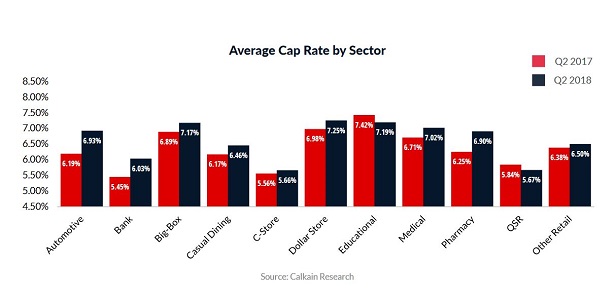
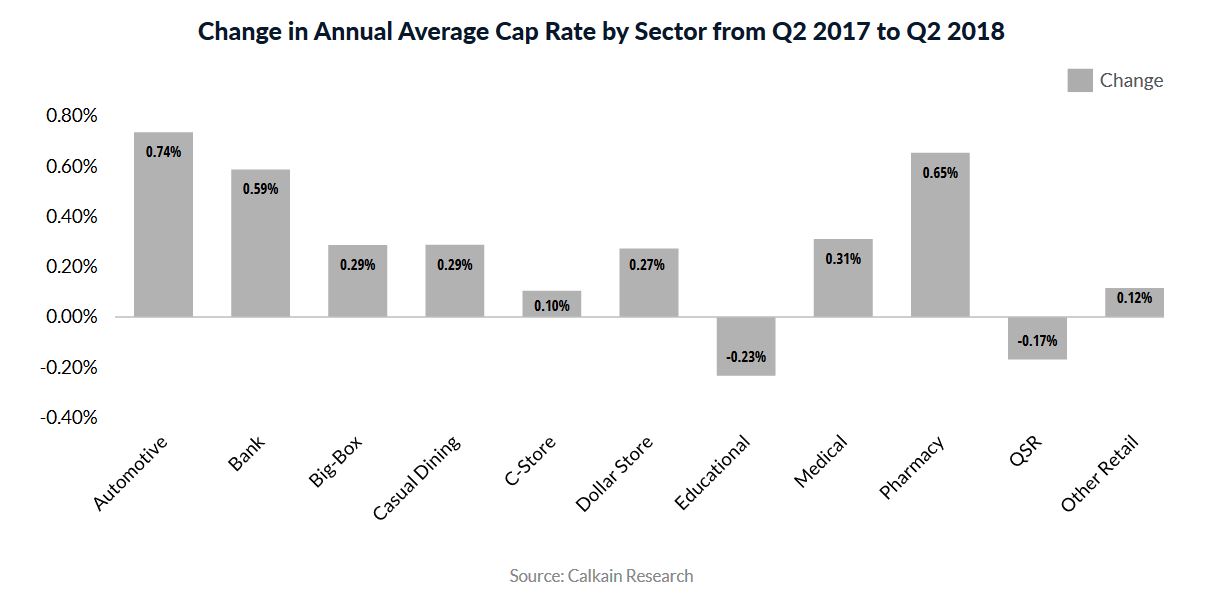
Registering the largest increases were the automotive sector (from 6.19 to 6.93%) and the pharmacy sector (from 6.25 to 6.9%). Meanwhile, educational and quick service restaurants experienced cap rate declines. Following is a look at some of the drivers behind the performance in some of these sectors.
The Automotive Sector
Average cap rates in the automotive sector rose 74 basis points over the past year. Some reasons behind this increase, according to Calkain, include the possibility that auto sales have peaked for this cycle and that a meaningful share of recent purchasers are behind on their auto loan payments. “Elevated delinquency rates have a tendency to result in tighter lending standards, which in turn constrains new car purchases,” according to the report. “This could provide a boost to auto parts and auto service sectors in the near future and help lead to cap rates increasing at a slower pace.”

The Pharmacy Sector
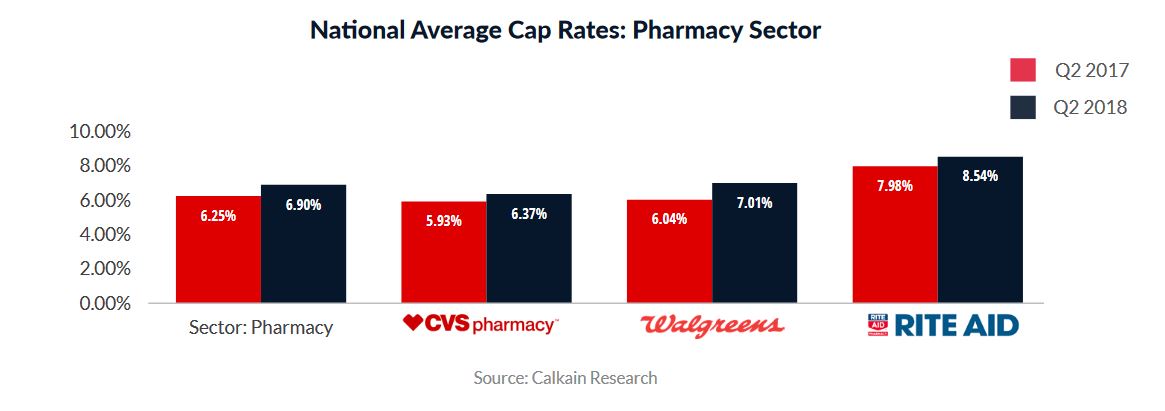
Cap rates rose in the pharmacy sector by 65 basis points between Q2 2017 and Q2 2018. There were a number of industry event during this period, most recently the cancellation of Albertson’s purchase of 2,500 Rite-Aid stores. An arguably more significant source of cap rate movement came from Amazon, Calkain Cos. wrote, when it acquired PillPack, an online pharmacy. “With online growing as a threat to traditional pharmacy operations, cap rates in this segment may continue to rise.”
The Big Box Sector
Average annual cap rates among Big Box properties rose 28 basis points to 7.1% during the first half of the year. However, the report said, this increase needs to be put into context: inflationary pressures are rising and consumer prices rose nearly 3% during the 12-month period. “Viewed from that perspective, the increase in cap rates is smaller than expected.”
By: Erika Morphy (GlobeSt)
Click here to view source article.
Land Owners Are Using Ground Leases More and More
Landowners in markets with underutilized land are turning to ground lease structures rather than sell.
Landowners are turning to ground leases more often. Ground lease structures have increasingly grown in popularity over the past two decades. Private landowners have turned to ground leases as an alternative to selling land sites, particularly in areas with a underutilized land, and as a way to promote public policy agendas, according to Ira J. Waldman, a partner at real estate law firm Cox, Castle & Nicholson. Through ground leases, landowners are able to maintain ownership while also benefiting from development. While ground leases have become more complicated, they can present challenges in the sale or purchase of a property.
Ground leases can be used by both private landowners as well as publicly owned land, but the lease structures vary between the two. “Public entities are more likely to be interested in pursuing public policy goals and exercising development controls over and above what is possible pursuant to their governmental functions, as well as avoiding the political slings and arrows about why the land was sold,” Waldman tells GlobeSt.com. “These include affordable housing, local and veteran hiring, prevailing wage and design and use requirements, such as public parking, day care requirements, bicycle shops, etc. Private landowners are less constrained by public policy goals and more consumed with profitability. So public ground leases by their very nature are more complex than private ground leases as the public policy goals are built into the document structure.”
Landowners in particular benefit from ground lease structures because they are able to maximize the value of the land without foregoing ownership. “For public entity landowners, they can retain ownership of the land, pursue public policy goals and profit from the development, while exercising as much control as they desire over the project with the protection of all manner of indemnifications from the ground tenant/developer,” adds Waldman. “Ultimately at the end of the lease they own the improvements, which, if they have required continual maintenance, repair and upgrades, can be enormously valuable.”
For landowners, there are ample benefits to ground leases, but Waldman says that the disadvantages are limited—which is likely the reason why this has become so popular. For the ground tenant, however, there are some disadvantages, typically in the complexities of the lease and site restrictions. “Ground tenants and developers are compelled to navigate what can be a complex structure, imposing on them somewhat inflexible long-term complex requirements and use restrictions, difficulties in negotiating financing arrangements and, in one way or another, paying for the landowner’s legal and other costs incurred in the transaction,” he explains.
There are also challenges for sublessees or operators on the land site, who can often see additional legal issues as a result of a ground lease. “For sublessee operators, there are several additional legal issues that it must navigate in order to protect itself and its investment from the possibility of default by the ground tenant/developer under the ground lease and any actions that may be taken by the lender to the ground tenant/developer,” explains Waldman.
Ground tenants can navigate these issues with patience during the negotiating process and an understanding of ground lease structure. “The best practice for a landowner and a ground tenant/developer is to consider in advance the position of the other and anticipate what may be required to reach a consensus deal, which includes the concerns of the lender to each,” adds Waldman. “For example, anyone regularly involved in a ground lease transaction understands or should understand that there are certain necessary rights that a leasehold lender will require to protect its position. It serves little purpose for a landowner to argue about leasehold lender protections that are not contrary to the long-term interests of the landowner.”
By: Kelsi Maree Borland (GlobeSt)
Click here to view source article.
Multi-Story Industrial Is Coming Sooner Than You Think
Design firm Ware Malcomb has designed a multi-story industrial prototype in response to increasing inquires from developers.
Multi-story industrial has been a kind of abstract idea as a solution to the growing supply constraints and industrial needs in Southern California—but it is likely closer than you think to becoming a reality. Designer Ware Malcomb has created a multi-story industrial design prototype in response to increasing demands from developers. The firm says that this model is the future of urban industrial, and it meets the unique needs of ecommerce and last-mile delivery companies.
The firm approached the design prototype with three fundamental rules in mind. First, the building layout cannot compromise tenant functionality, including truck yards and doors, racking, aisles and clear heights, for example. Next, the building structure and systems must be designed to keep the cost as low as possible. Finally, the building must be designed for complete flexibility with the option to be leased as a typical multi-tenant building. “Based on the high volume of inquiries we are receiving, and the multistory site plans our team is processing daily, the interest and demand are consistently increasing,” according to Jay Todisco, EVP at Ware Malcomb, tells GlobeSt.com. “We are currently in final design and engineering on five multi-story distribution projects that will be built in North America.”
Multi-story industrial seems like the perfect solution to the supply challenges in Southern California, but the model typically comes with higher costs than a standard, single-story industrial building. “To understand the costs, we had full architectural and engineering drawings priced in detail by general contractors,” explains Todisco. As a result, functionality and cost are the biggest challenges in designing a prototype that will work. “The multistory distribution buildings cannot compromise functionality and must be as economical to build as possible,” says Todisco. “The biggest challenge will be for capital markets to recognize, and ultimately embrace multistory facilities as institutional grade real estate assets. This will not happen until a few facilities are fully built and the leasing absorption can be measured and normalized with buildings of similar usage.”
The firm took a close look at the cost challenge during the design, and found that it is possible to make these projects pencil, considering rapidly rising demand and rental rates. “We evaluated several alternate structural systems and building skins, with careful attention to constructability in urban locations with limited site access and staging. The multistory distribution buildings cost three times as much as a comparable building, but the net result is at least two times more rentable area. Demand will continue to increase for the next several decades due to the explosion of last touch delivery expectations, and growing e-commerce consumer demand.”
Europe has used multi-story industrial facilities for years, and the concept is already being put into practice on the East Coast. Ware Malcomb is currently under construction on a three-story ecommerce distribution center totaling approximately 375,000 square feet in Red Hook, Brooklyn. It will be the first multi-story industrial project to open in the market. “We have been working with different developers and have several projects that are scheduled for construction completion within the next 18 months,” adds Todisco. “Multistory distribution projects tend to be in highly urbanized locations with dense population profiles and adjacent to international sea ports. The common denominators of these locations are high land cost and growing e-commerce last touch consumer demand.”
By: Kelsi Maree Borland (GlobeSt)
Click here to view source article.