• Skip to primary navigation
  • Skip to main content

CARNM

Commercial Association of REALTORS® - CARNM New Mexico

  • Property Search
    • Search Properties
      • For Sale
      • For Lease
      • For Sale or Lease
      • Start Your Search
    • Location & Type
      • Albuquerque
      • Rio Rancho
      • Las Cruces
      • Santa Fe
      • Industry Types
  • Members
    • New Member
      • About Us
      • Getting Started in Commercial
      • Join CARNM
      • Orientation
    • Resources
      • Find A Broker
      • Code of Ethics
      • Governing Documents
      • NMAR Forms
      • CARNM Forms
      • RPAC
      • Needs & Wants
      • CARNM Directory
      • REALTOR® Benefits
      • Foreign Broker Violation
    • Designations
      • CCIM
      • IREM
      • SIOR
    • Issues/Concerns
      • FAQ
      • Ombuds Process
      • Professional Standards
      • Issues/Concerns
      • Foreign Broker Violation
  • About
    • About
      • About Us
      • Join CARNM
      • Sponsors
      • Contact Us
    • People
      • 2026 Board Members
      • Past Presidents
      • REALTORS® of the Year
      • President’s Award Recipients
      • Founder’s Award Recipients
    • Issues/Concerns
      • FAQ
      • Ombuds Process
      • Professional Standards
      • Issues/Concerns
      • Foreign Broker Violation
  • Education
    • Courses
      • Register
      • All Education
    • Resources
      • NMREC Licensing
      • Code of Ethics
      • NAR Educational Opportunities
      • CCIM Education
      • IREM Education
      • SIOR Educuation
  • News & Events
    • News
      • All News
      • Market Trends
    • Events
      • All Events Calendar
      • Education
      • CCIM Events
      • LIN Marketing Meeting
      • Thank Yous
  • CARNM Login
  • Show Search
Hide Search

Archives for 2019

Swimming in Capital Markets Liquidity: Sources of Commercial Real Estate Debt

December 13, 2019 by CARNM

As we enter into the second half of 2019, we approach 10 years of recovery in the real estate markets. One question on the mind of investors is the concern over when the end of the cycle hits, one of the 2019-2020 Top Ten Issues Affecting Real Estate. While transaction volume has slowed, there is a growing disconnect between seller prices and buyer bids. One place where the market continues to be flush with liquidity is on the debt side of the capital stack. While CMBS continues to be a viable product, volume of issuance is down almost 15% year over year for the first quarter 2019 vs. 2018, and down over 12% for year end 2018 vs. 2017. Other capital markets debt products have grown in popularity and are contributing to the liquidity in the market.
Mortgage REITs is a product that has been around since inception back in 1969. While they had perception issues that impacted them in the late 1970’s, they have made a comeback over the last decade, with firms like Blackstone, TPG, ARES and Starwood creating publicly traded Mortgage REITs over the last few years. The Mortgage REITs have many financing tools at their disposal today. Part of their financing toolbox include leveraging the equity raised in the public markets with commercial real estate CLO transactions as well as securing multiple warehouse lines from investment banks and large commercial banks. Pricing, flexibility and cost will drive which financing levers are pulled.
The commercial real estate CLO market, which is a way for lenders to leverage their business, has been growing over the last few years, and is expected to continue as long as there is investor appetite for bonds. Commercial real estate CLO’s are structured finance securities collateralized primarily by below investment grade floating rate commercial real estate loans backed by bridge/transitional loans. The lender that is using the commercial real estate CLO execution, will securitize a pool of floating rate loans creating various rated bonds for investor consumption. The commercial real estate CLO issuer retains the “equity” in the commercial real estate CLO, being the most subordinate part of the structure.
The commercial real estate CLO business is a far cry from the CDO business of 12 years ago where everything and “the kitchen sink” could be put into a deal. Post crash, deals tend to be more conservative and deals tend to see senior mortgages only. Early on CRE CLO transactions were static only and like CMBS transactions needed all loans contributed in the pools by the closing. That said, CRE CLO’s still tend to have more transitional assets than CMBS whether static or not.
As the market has matured, there has been a growth of a more flexible pool, the managed pool. A managed pool differs from static in a couple of key ways. First, there is a ramp up period to add loans into the pool after the deal closes. Second, loans can be replaced in the pool. In so doing, the duration of the deals can be pushed out longer, as it is less impacted by prepayment since loans are replaced. That said, investors pay more for a static deal, not managed, because of the certainty of what the make-up of the pool is. To mitigate this concern, managed deals do have eligibility criteria to keep the quality of the pool similar to the level at closing. Managed pools are becoming more popular and the spread premium is tightening. In 2018, 54% of all deals were managed and 46% were static. In 2016 the percentages were quite different, with 25% managed and 75% static. On a year over year basis, Q1 2018 had $3.2B of issuance while Q1 2019 was at $3.6B, so the size of the market continues to grow.
Another source of significant capital in the marketplace is coming from Debt Funds, which have been established to provide both senior bridge loans as well as mezzanine loans which are secured by the equity in the borrower. The number of Debt Funds has grown exponentially over the last few years, with a universe which includes small-balance high-yield shops, and large debt funds raising capital from high net worth investors, pension funds and endowments (like Calmwater Capital) or from foreign and domestic institutional capital (like Acore Capital and Prime Finance). Time will tell if capital will shift to troubled or distressed loans in the never-ending search for yield as rough waters lie ahead.
Insurance companies like NY Life, Principal, John Handcock, MetLife and Nuveen, are leveraging their organization’s infrastructure and managing third party accounts interested in issuing debt. Even several major development firms like Silverstein, Mack Real Estate, Related Properties, S.L. Green, and Brookfield have entered the lending business. Private equity has its role in the marketplace as well, with Blackstone, Colony, Oaktree, INVESCO, CIM and Starwood providing liquidity to the market, particularly on larger deals. Investment Banks and Commercial Banks like Morgan Stanley, Citigroup, JP Morgan, Wells Fargo and Bank of America are wearing multiple hats, originating loans, providing leverage via warehouse lines, or managing the execution of CLO’s. In fact, the Commercial Banks use their ability to provide warehouse lines to garner the CLO business from their borrower clients! Whether a borrower needs a $2M, $20M or $200M loan, there are multiple options for the debt.
When we look at the composition of lenders in the market, CMBS, Debt Funds and REIT’s represented 26% of total issuance in both 2017 and 2018. Within that segment, we did see a shift from CMBS to Debt Funds and REITs, with CMBS at 19% of the 26% in 2017 and 16% of the total in 2018. Liquidity from Funds and REITs are providing alternatives, and with the debt markets flush with liquidity and competition for transactions fierce, the question to ask is whether we are headed for rough waters with the possibility of credit and structural deterioration.
By: Constantine Korologos, CRE®, MAI, MRICS and Jeffrey Lavine, Esq (CRE)
Click here to view source article

Filed Under: All News

2019-2020 Top Ten Issues Affecting Real Estate™

December 13, 2019 by CARNM

The Counselors of Real Estate has identified the current and emerging issues expected to have the most significant impact on real estate, with U.S. infrastructure being the leading concern of the 1,100-member organization. The Counselors once again released its annual list of the Top Ten Issues Affecting Real Estate™ as the keynote address of the National Association of Real Estate Editors’ annual conference in Austin, Texas.
“Many of these issues are interrelated and thus influence one another,” said Julie Melander, 2019 Chair of The Counselors of Real Estate. “Clients of Counselors seek unbiased, objective advice on the critical factors that will impact all property sectors today, as well as those issues that may affect their decisions over the next ten years. This thought leadership initiative is an invaluable service to those clients and to the real estate industry in general.”

1. Infrastructure

In our survey, more than 50% of responding Counselors ranked Infrastructure as one of the top three issues. Respondents urged that this not be “put on the back burner” even though it is often displaced from public attention as more controversial matters capture headlines. One CRE commented, “Without substantial infrastructure improvements, several large U.S. cities (including New York and Washington D.C.) will become untenable for corporate expansions and top talent.” Much of America’s future economic growth depends upon improved productivity. Productivity, in turn, will be a function of efficiencies across the core systems in the economy.

2. Housing In America

Millennials and Gen Z have trouble affording housing in neighborhoods near employment centers. Meanwhile, Baby Boomers have had difficulty selling their homes. The underlying causes are on both the supply and demand side. Construction costs have increased, and new construction has occurred mainly in the high-end market. On the demand side, younger households have student loan debt and high healthcare costs. Unemployment may be at a fifty-year low, but real income for 80% of the population has diminished. This widens the gap between an increasingly expensive supply of housing and a decreasing ability to pay.

3. Weather and Climate-Related Risks

Climate risk has emerged as an important aspect of fiduciary duty and investment risk management. Weather and climate-related events present physical and operational risks for real assets, both in terms of acute risk from natural disasters, but also chronic risks from sea level rise, drought, heat waves, water scarcity, and food security. The year 2017 was the most expensive year in recorded history, costing the U.S. more than $300 billion in weather and climate-related insurance losses. For all property types, natural disasters dramatically decrease property values.

4. The Technology Effect

Real estate has had a different technological adoption path from other industries. Technological advances move faster than the industry can adopt them and have a wide variety of solutions and results. This has operational and cybersecurity risk implications. In the back office, data costs and needs for specialized skills pose a challenge for small businesses competing with larger firms. Building technology is rapidly transformed by occupant experience and behavior monitoring, requiring integration and automation like never before. Consumer adoption of e-commerce has impacted industrial real estate positively and retail somewhat negatively.

5. End-of-Cycle Economics

The U.S. economy is in the tenth year of recovery. While there are a greater number of available jobs than workers to fill them, inflation and interest rates remain low and consumer confidence levels are relatively elevated. Low unemployment rates create little room for growth and yield curves have recently inverted. Watching the property markets specifically, construction cycles are well underway in growth markets and cap rates reflect a mature cycle. A Counselor warned, “Lessons never seem to be learned. Market participants are once again lacking discipline.”

6. Political Division

Political gridlock and/or infighting is either creating problems or frustrating solutions to many of the other issues identified on our list. The state of America’s political dysfunction has intensified over the past several years. Policies which might otherwise elicit bipartisan action have been blocked by the political chasm.
While our members hold a broad spectrum of political views, it is the effect of the partisan division itself that prompts concern. One CRE described it this way, “Political differences make our options more limited, increase the cost of solutions, and cost us more and more of our competitive advantage around the world.”

7. Capital Market Risk

Long-term treasury rates declined recently as investors seek safety reflecting recent market volatility and uncertainty, and inverted to levels below short-term rates as of mid 2019, a frequent indicator of upcoming recessions. Transaction volume fell by 4% year-over-year in Q2 2019 according to Real Capital Analytics as cap rates are at record lows in high demand markets. Public REITs faltered in 2018 but posted solid returns so far in 2019, and high-grade debt issuance is strong. Since 2008, the outstanding aggregate mortgage balance for GSEs, which include Ginnie Mae, Freddie Mac, and Fannie Mae, has grown from under $100 billion to over $670 billion.

8. Population Migration

The map of population change from 2010 to 2018 shows gains in coastal cities. Big cities are prospering in California, the Pacific Northwest, Florida, the major Texas metros, and the Atlantic corridor from Boston to Washington, DC. Secondary cities are also growing. Meanwhile, there has been demographic shrinkage in the rural Midwest, South, the “Rust Belt”, and Appalachia. Long-term trends have altered opportunities for workers in agriculture, heavy industry, and mining. Population growth has decelerated due to constrained immigration and the lack of “natural increase” (the excess of births over deaths) from the existing population.

9. Volatility and Confidence

Market sentiments are prone to change rapidly and sometimes quite dramatically. Consumer confidence often reaches high points just prior to recessions, yet many mistakenly interpret these polls as predictors of future consumer behavior. The deceleration in employment over the first half of 2019 may combine with financial market jitters over tariffs and the inverted yield curve to weaken confidence. Investment in existing and new property is an expression of performance expectations, and data suggests that confidence in sustained demand for residential and commercial property assets is faltering.

10. Public & Private Indebtedness

The real estate industry typically views debt as a financial tool that can enhance return for equity investors, when used responsibly. Therefore, it is telling when CREs sound alarms about debt. U.S. consumer debt has hit record highs, with rising delinquency rates damaging credit scores and the residential mortgage market. The U.S. Federal budget deficit has widened after tax cuts and increased spending. Most states are constitutionally obligated to maintain balanced budgets, driving property and real estate transaction tax increases. In Europe, the economy is largely buoyed by household debt subsidized by negative interest rates.
By: CRE
Click here to view source article

Filed Under: All News

Commercial Transactions Expand Modestly in Q3

December 11, 2019 by CARNM

Amid a slowing economy, REALTORS® reported modest activity in sales, leasing, and development according to NAR’s 2019 Q3 Commercial Real Estate Trends & Outlook Report. REALTORS® are mostly engaged in the sale, leasing, and development of properties valued at less than $2.5 million.

Sales

Total sales volume in 2019 Q3 rose at a modest pace of 3% from a year ago. Sales growth has moderated since 2017 compared to the almost 10 percent growth per year since 2012 through 2016.
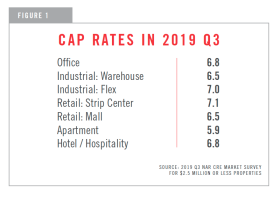
Chart showing Cap rates in 2019 Q3

By asset class, respondents reported strong sales in apartment and industrial markets. The median going-in cap rates for all property types was 6.6%, with apartment properties having the lowest median cap rate, at 5.9%, followed by industrial warehouse, at 6.5%. Retail strip centers had the highest cap rate, at 7.1%. Cap rates continue to decline, especially for apartments and industrial properties given the demand for these types of properties (falling cap rates = rising prices).
Leasing

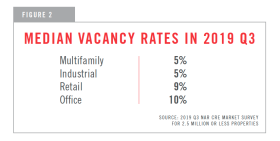
NAR members, including those with specialized commercial designations (CCIM, CRE, CPM, ALC and SIOR) reported a modest annual gain of 2.4% in leasing volume in 2019 Q3. Vacancy rates in the small commercial real estate market continued to trend down in this quarter. The lowest median vacancy rates were in apartment and industrial properties, at 5%. REALTORS® reported high vacancy rates in retail properties, at 9%, and office properties, at 10%.

Chart showing median vacancy rates in 2019 q3

The US Census Bureau reported in 2019 Q2, that the national rental vacancy rate was 6.8%, well below the 9% rate in 2012. With low vacancy rates, rents rose on average by 3.8% in 2019 Q2 from one year ago.

Construction/Development

NAR members on average reported that construction activity rose at a modest pace of 4% percent in 2019 Q3 from year ago levels. The pace of construction activity peaked in 2016 and has tapered since then.

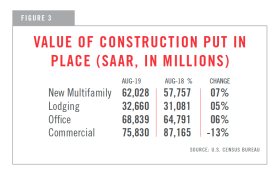
chart showing value of construction put in place (SAAR in millions)

As of August 2019, the U.S. Census Bureau reported that the seasonalized annual value of construction put in place for office, lodging, and multifamily structures increased compared to one year ago, but it decreased for commercial properties (buildings for wholesale, retail, and selected service industries).
By property type, respondents reported the strongest annual increase in Class A apartment properties, Class A hotels/hospitality, Class B/C apartments, and Class A industrial warehouses. Respondents reported a decline in construction activity for retail malls.

Outlook and Opportunities

Amid concerns about an economic slowdown, 48% of respondents reported they expect business conditions to improve in the next 12 months, slightly lower when compared to 53% of respondents in the 2019 Q2 survey. Members identified several market opportunities, such as the construction of affordable housing, industrial-flex office, repurposing and rehabilitation of closed retail malls, and senior housing, among others.

Generally speaking, multi-family and industrial will continue to be strong commercial asset classes. The multifamily market is expected to remain bright in metros with low vacancy rates and affordable rents. E-commerce will continue to sustain demand for industrial properties, particularly flex properties. Retail brick and mortar will continue to do well in growing metros and in retail niches that require face-to-face customer service. The office market will be sustained by the growth in technology-driven jobs. The Opportunity Zone tax break on capital gains is expected to bolster commercial and residential real estate sales in 2019-2020.
By: NAR
Click here to view source article

Filed Under: All News

Expect Continued Economic Growth, Slower Real Estate Price Gains and Small Chance for Recession in 2020, According to Group of Top Economists

December 11, 2019 by CARNM

A group of top economists arrived at a consensus 2020 economic and real estate forecast today at the National Association of Realtors®’ first-ever Real Estate Forecast Summit. The economists who gathered at NAR’s Washington, D.C. headquarters expect the U.S. economy to continue expanding next year while projecting real estate prices will rise and reiterating that a recession remains unlikely.
These economists predicted a 29% probability of a recession in 2020 with forecasted Gross Domestic Product growth of 2.0% in 2020 and 1.9% in 2021. The group expects an annual unemployment rate of 3.7% next year with a small rise to 3.9% in 2021.
When asked if the Federal Open Market Committee will change the federal funds rate in 2020, 69% of the economists said they expect no change, while 31% expect the committee will lower the rate next year.
The average annual 30-year fixed mortgage rates of 3.8% and 4.0% are expected for 2020 and 2021, respectively. Annual median home prices are forecasted to increase by 3.6% in 2020 and by 3.5% in 2021.
“Real estate is on firm ground with little chance of price declines,” said NAR’s Chief Economist Lawrence Yun. “However, in order for the market to be healthier, more supply is needed to assure home prices as well as rents do not consistently outgrow income gains.”
Apartment rents are expected to rise 3.8% and 3.6%, respectively, in 2020 and 2021. According to the group of economists, annual commercial real estate prices will climb 3.6% in 2020 and 3.4% in 2021.
“Residential and commercial real estate investment remains attractive as we approach the start of a new decade,” said NAR President Vince Malta, broker at Malta & Co., Inc., in San Francisco, CA. “Increased home building can serve as a stimulator for the overall economy, and we strongly encourage more homes to be built as buyer demand remains strong.”
The 2019 NAR Real Estate Forecast Summit consensus forecasts are compiled as averages of the responses of 14 leading economists who participated during the summit. The survey was conducted from December 2-5, 2019.
The National Association of Realtors® is America’s largest trade association, representing more than 1.4 million members involved in all aspects of the residential and commercial real estate industries.
By: Troy Green (NAR)
Click here to view source article

Filed Under: All News

  • « Go to Previous Page
  • Page 1
  • Page 2
  • Page 3
  • Page 4
  • Interim pages omitted …
  • Page 70
  • Go to Next Page »
  • Search Property
  • Join CARNM
  • CARNM Login
  • NMAR Forms
  • All News
  • All Events
  • Education
  • Contact Us
  • About Us
  • FAQ
  • Issues/Concerns
6739 Academy Road NE, Ste 310
Albuquerque, NM 87109
admin@carnm.realtor(505) 503-7807

© 2026, Content: © 2021 Commercial Association of REALTORS® New Mexico. All rights reserved. Website by CARRISTO