• Skip to primary navigation
  • Skip to main content

CARNM

Commercial Association of REALTORS® - CARNM New Mexico

  • Property Search
    • Search Properties
      • For Sale
      • For Lease
      • For Sale or Lease
      • Start Your Search
    • Location & Type
      • Albuquerque
      • Rio Rancho
      • Las Cruces
      • Santa Fe
      • Industry Types
  • Members
    • New Member
      • About Us
      • Getting Started in Commercial
      • Join CARNM
      • Orientation
    • Resources
      • Find A Broker
      • Code of Ethics
      • Governing Documents
      • NMAR Forms
      • CARNM Forms
      • RPAC
      • Needs & Wants
      • CARNM Directory
      • REALTOR® Benefits
      • Foreign Broker Violation
    • Designations
      • CCIM
      • IREM
      • SIOR
    • Issues/Concerns
      • FAQ
      • Ombuds Process
      • Professional Standards
      • Issues/Concerns
      • Foreign Broker Violation
  • About
    • About
      • About Us
      • Join CARNM
      • Sponsors
      • Contact Us
    • People
      • 2026 Board Members
      • Past Presidents
      • REALTORS® of the Year
      • President’s Award Recipients
      • Founder’s Award Recipients
    • Issues/Concerns
      • FAQ
      • Ombuds Process
      • Professional Standards
      • Issues/Concerns
      • Foreign Broker Violation
  • Education
    • Courses
      • Register
      • All Education
    • Resources
      • NMREC Licensing
      • Code of Ethics
      • NAR Educational Opportunities
      • CCIM Education
      • IREM Education
      • SIOR Educuation
  • News & Events
    • News
      • All News
      • Market Trends
    • Events
      • All Events Calendar
      • Education
      • CCIM Events
      • LIN Marketing Meeting
      • Thank Yous
  • CARNM Login
  • Show Search
Hide Search

Archives for November 2021

The Coming U.S. Regulatory Oversight of, and Demand for, Climate Disclosure

November 6, 2021 by CARNM

Overview

Regulation and oversight of climate disclosure and related carbon measurement is coming to the U.S. On April 9, 2021, the United States Securities and Exchange Commission (SEC) issued a risk alert cautioning firms that their Environmental, Social, and Governance (ESG) statements will be more heavily scrutinized. Deborah Cloutier, CRE, outlines how evolving ESG strategies may impact commercial real estate globally.1 In the U.S., following the SEC risk statement, President Joe Biden issued an Executive Order requiring federal regulatory and mitigation plans for climate-related financial risk.2 These actions follow the March 10, 2021 implementation of required ESG reporting in the European Union on the Sustainable Finance Disclosure Regulation (SFDR).3, 4

The many real estate firms, states, and municipalities setting carbon neutrality targets to mitigate climate risks should prioritize processes and systems that can withstand regulatory scrutiny.5 Based on historical patterns, regulation requiring third-party verification of climate disclosures analogous to accounting audits is highly likely.

This article first provides brief background on the heavy regulatory push and industry demand for carbon neutrality disclosure in the United States. Following the background, author insights revolve around three key areas: First, what globally accepted carbon-neutral measurement, reporting, and strategic framework does your firm use? Second, are the carbon offsets you purchase in compliance with United Nations (UN) standards, from an accredited source, and/or SEC-verifiable? Third, what third-party auditing of your Global Greenhouse Gas (GHG) measurement is in place and are they by a certified auditor, such as an ISO 14000 Family (Environmental Management) auditor?6

Background

Regulatory Push

The Biden White House Executive Order on Climate-Related Financial Risk charged the government to establish a government-wide strategy regarding “the measurement, assessment, mitigation, and disclosure of climate-related financial risk,” by Fall 2021.7 This specifically mentioned Employee Retirement Income Security Act of 1974 (ERISA) and new requirements for major federal suppliers (e.g. Real Estate providers) to disclose greenhouse gas emissions and climate-related financial risks.

The Executive Order builds on a recent series of regulatory actions. The aforementioned SEC risk alert cautioned, “variability and imprecision of industry ESG definitions and terms can create confusion among investors.”8 The Wall Street Journal interpreted this to mean that “some investment firms…were potentially misleading investors.”9 The National Law Review stated that “Courts may find that unsupportable statements on environmental initiatives are not mere puffery, but actionable under anti-fraud laws.”

Carbon Neutral Demand Leads Regulation

The regulatory push, in part, responds to significant market demand for certifiable and transparent carbon disclosure methods. Drivers of demand come from municipalities, pension funds, and investment funds. Numerous U.S. cities have pledged to become carbon neutral as part of the Carbon Neutral Alliance. The Bloomberg Climate Alliance recently funded 25 cities pledging to reduce carbon output and/or become carbon neutral. Specific to pension funds, the Climate Action 100+ has 49 U.S.-based “Asset Owners” committed to carbon neutrality at a fund level. Similarly, in the investment world, the Net Zero Asset Managers Initiative contains 87 asset managers with $37 trillion in assets pledged to achieve net-zero carbon.

In short, a large and growing segment of influential stakeholders in the real estate capital markets have already established themselves on a path to carbon neutrality. This begs the question of how, given increased regulatory oversight, they will achieve this goal in a transparent and defensible way.

Media Shows Increased Focus

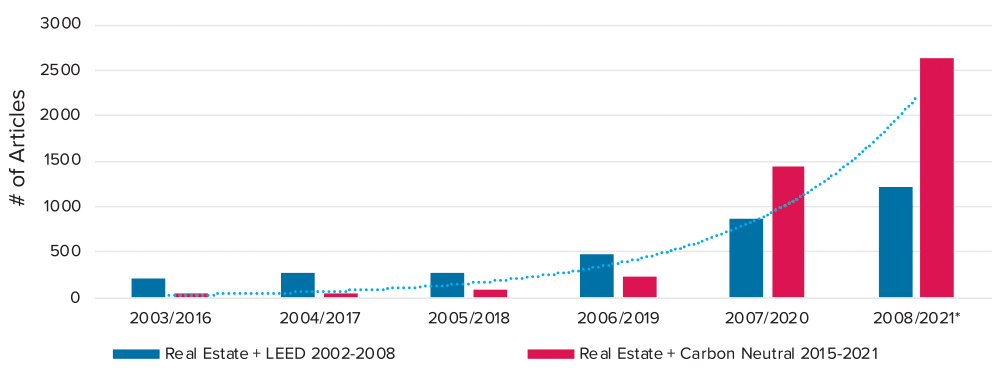
Media attention towards carbon neutrality and real estate continues to escalate geometrically. The graph in Figure 1, generated from a LexisNexis search of articles, emphasizes this point, showing the prevalence of the combined keywords “Carbon Neutral and Real Estate” in recent years compared to media attention towards Leadership in Energy Efficient Design (LEED) in the early 2000s when it gained significant popularity.

Figure 1: Media Attention Towards Carbon Neutrality and LEED
In response, ratings firms have already enacted new ESG measures, such as Institutional Shareholder Services (ISS) launching new ESG performance and risk scorecards. Moody’s recently produced climate-adjusted credit scores for approximately 37,000 public companies.10 S&P Global added 400 data points to ESG scores.11 Urban Land Institute, in conjunction with Heitman, recently published a report entitled “Climate Risks a Determinate Factor for Real Estate Investors.”12

In summary, the awareness of climate risk among institutional investors is not new. An increased and broader focus from the wider market and media participants is.

Insight 1: Standards

Globally Accepted Carbon Neutral Measurement Systems

The SEC alert stated, without expressly endorsing any strategy, that firms should adhere to a voluntary ESG global standard such as the Equator Principles or the U.N.-sponsored Principles for Responsible Investment (UNPRI) and Sustainable Development Goals (SDGs) as examples.13, 14 An in-depth discussion of these and related ESG programs requires its own article; the purpose here is to provide a high-level understanding of what leading systems are that may meet the SEC guidance.

Simplifying, two major levels could be assessed for carbon measurement. First, what processes, systems, baselines, and quality control mechanisms are in place to ensure consistent and accurate measurements. Second, what specific global greenhouse gas (GHG) measurement system is used at the asset level.

The SEC mentioned systems, the Equator Principles and the UNPRI, fall in the first category. They frequently refer to the Paris Accord and the Task Force on Climate-Related Financial Disclosures (TCFD).15, 16 These documents outline those organizational-level processes and strategies, representing great systems for firms to act upon.

Strategies focusing on compliance should consider measurement standards accepted by the United Nations Framework Convention on Climate Change (UNFCCC). Most major systems, including those discussed above, defer to the Greenhouse Gas (GHG) Protocol for asset-level (and some further organizational) GHG reporting metrics.17 The GHG Protocol, the PAS 2050/2060 certification strategy developed by the British Standards Institution, and ISO 14064 are all UNFCCC approved.

As the SEC specifically avoided endorsing any strategy, the exact acceptable future standards remain opaque. However, those listed above are clearly global standards with wide acceptance that appear aligned with current regulatory guidance. UNFCCC approved strategies typically cross continental boundaries and are highly likely to be included in ultimate regulation.

ISO 14000 Family as a Global Standard, a Brief Overview

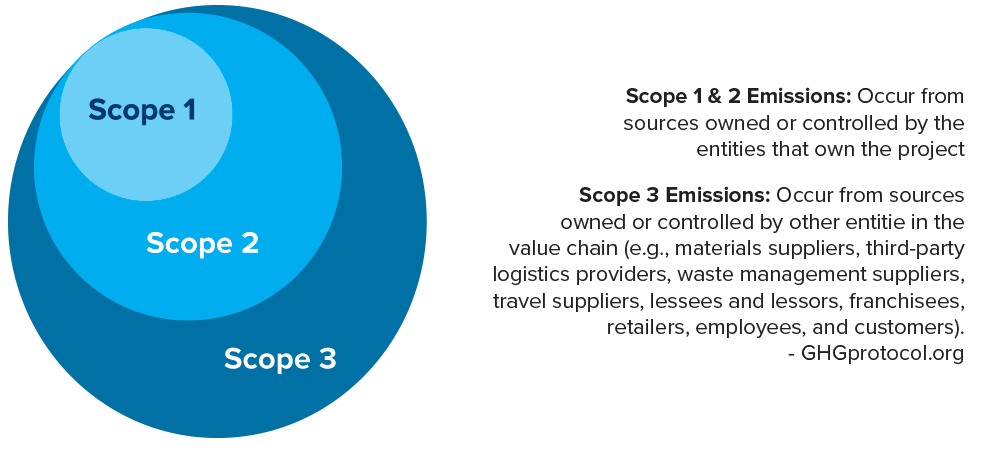
ISO 14064 and 14065 address greenhouse gas accounting and verification. Audit boundaries define the scope of a project and its ultimate third party review. When properly measured and offset with ISO, a firm meets the definition of Carbon Neutrality. Measuring and offsetting Scope 1, 2 & 3 emissions meets the definition of Net Zero Emissions. The decision to focus on Scope 1, 2 &/or 3 encompasses environmental and strategic components and should be discussed both internally and potentially with an outside expert.

The graphic in Figure 2 gives a high-level view.

Figure 2: Scope 1, 2, and 3 Emissions
Source: Net Zero Analysis 2021

ISO 14001 International Environmental Management Audit allows for flexible boundary setting on company or project audits. These boundaries are an important part of reporting transparency, as they clearly define the scope of the audit, making it directly comparable to other similar project audits. Examples of audit boundaries for new construction:

  1. Carbon Neutral Construction (Scope 1 & 2): An acceptable plan should address the entire Carbon Footprint and Environmental Impacts from architectural design and owner decisions, including environmental impacts of the construction of the building. While each project is unique, a “typical” project might include site energy and construction while excluding land-use changes.
  2. Net Zero Construction (Scope 1, 2 & 3): An acceptable plan would include everything within the project’s Carbon Neutral Construction Audit Boundaries plus the value-chain carbon footprint. This would include the business activities of all the contractors, designers, supply houses, and job-site employees. As shown in the Figure 1 diagram, the entire supply chain would have to be carbon neutral.

Related, and the potential subject of its own article, ISO 14024 and 14025 are the metrics for measuring “Product GHGs through a Life Cycle Assessment” (LCA). This is the basis for an Environmental Product Declaration (EPD) via the International EPD* System.18 In North America the Carbon Leadership Form (CLF) has developed the Embodied Carbon in Construction Calculator, or “EC3 Modeling Tool,” which is used in determining the GHG emissions for all materials used in construction and maintenance of a real estate asset, delivering a total Embodied Carbon Footprint.19

Obviously, this brief overview provides only a surface understanding of the ISO 14000 family processes which include: Setting Audit Boundaries, Data Collection, Measurement, Reduction Plans, Compensation (carbon offsetting), Third-Party Review, and Reporting. An ISO professional can help with your specific needs which may include the use of additional measurement strategies, building management systems and/or an internet of things (IOT) installation.

LEED and GRESB?

Leadership in Energy and Environmental Design (LEED) provides many benefits to building owners and tenants and, for many firms, acts as a key ESG input.20, 21 However, LEED buildings are not carbon neutral under any UNFCCC/Paris Accord criteria. Therefore, though LEED (BREAMM, Green Globes, etc.) may be a valid and important part of your ESG platform, specific to carbon neutrality, none of those certifications count. Also, while the United States Green Building Council (USGBC) does offer a separate LEED program towards carbon neutrality, their standards are not aligned the GHG Protocol, UNFCCC or ISO 14000 family standards as of this writing.

Similarly, GRESB provides potential ESG benefits across a variety of dimensions.22 Many capital sources consider strong GRESB ratings as signals of ESG excellence. However, to the best of our knowledge, specific to carbon disclosure, their standards are not aligned with the GHG Protocol, UNFCCC or ISO 14000 family as of this writing.

Strategies for Carbon Mitigation

Most carbon reduction frameworks call for organizations to prioritize direct on-site emission reductions. This begins with baseline assessment in accordance with a globally approved protocol like ISO 14000 family of standard, PAS 2050/2060 or the Corporate GHG Protocol.23 After assessing baseline, the reduction of carbon output would always be the primary path prior to assessing the potential impact of purchasing renewable energy certificate (RECs) and/or carbon offsets. Specific carbon and energy mitigation strategies depend on a myriad of organizational and asset level considerations, best assessed with experts in those areas.

As of UN Climate Change Conference COP 25 conference, RECs apply in different ways depending on whether they are in the same State or Province as the user. if the Renewable Energy Facility and the offtaker are not in the same State or Province Boundary the offtaker can only claim “Supporting Renewable Energy.” If the Renewable Energy Facility and the offtaker are in the same State, Province, microgrid, or e-grid Boundary than the offtaker can claim they are using Renewable Energy and apply the Fuel Switching Clean Development Mechanism (CDM) and claim the reduction in carbon footprint. Typically, the use of RECs permit the user to lower their Scope 2 emissions, although, in some scenarios, with the validation of an outside expert, RECs may create a carbon offset project.

After carbon mitigation strategies and, potentially, RECs have been effectively implemented, remaining carbo output can be offset.

Insight 2: Carbon Offsets

What is an Offset?

For those not familiar with carbon offsets, they are a security representing a formally measured reduction in GHG emissions or an increase in carbon storage (e.g., through land restoration or the planting of trees) – that is used to compensate for emissions that occur elsewhere. Effectively, the purchase of an offset funds and/or supports projects that reduce GHG emissions.

The United Nations certifies carbon offsets through the UNFCCC; they developed a group of methodologies under the Clean Development Mechanism (CDM) for large and small projects, which are periodically updated.24 UNFCCC Carbon Offset Registry lists projects that meet the current CDM Rules and Reference and where their Certified Emission Reductions (CER) carbon offsets can be found.25, 26

A registry is a central clearinghouse where offsets are validated, issued, and retired. The UNFCCC has only recognized a handful of carbon offset registries as assuring valid carbon offsets. More information can be found at the UN Carbon Offset Platform.27 Additional Carbon Offset Registries that meet the UNFCCC standards are VERRA and Gold Standard.28, 29 These registries list carbon offsets from CDM Projects and develop new methodologies that follow the UNFCCC CDM Rules and Reference requirements.

Compliance Markets vs. Voluntary Markets

Currently, two carbon offset markets exist: the Compliance Markets for regulated entities offsetting as required by statute, law or regulation, and the Voluntary Carbon Market for non-regulated business entities and individual carbon offset purchases.

Remember, carbon offsets are securities and thus fall under SEC and/or FINRA regulation and registration requirements.30 To be exempt from registration, the transactions must meet specific criteria. Very few do, which means that trading in unregistered securities is rampant in the voluntary carbon offset marketplace. Compliance and Voluntary Markets are both, in fact, regulated markets at the following levels:

  1. At the carbon offset project level by the UNFCCC CDM as the international standard
  2. At the national level in the U.S. by the SEC for securitized offsets, and Commodity Futures Trading Commission (CFTC) for carbon offsets as a commodity
  3. At the regional level, U.S. examples include the Western Climate Initiative (WCI) and Regional Greenhouse Gas Initiative (RGGI); these are Compliance Cap-and-Trade Markets31, 32
  4. At the sub-regional level, one U.S. example is the New York City Law 97.33 This is a Cap-and-Trade Market within the larger RGGI Market.

Due to the historical lack of verification and documentation, the Voluntary Carbon Market as a whole should be labeled “caveat emptor.” A number of carbon offset sellers in this space represent their offsets as meeting all of the “Global Standards,” but fail to use licensed Broker-Dealers and may not meet the requirements for a registration exemption. Additionally, many carbon offsets in the Voluntary Carbon Market do not meet the labeling requirements for the Federal Trade Commission – 16 CFR part 260 and Green Guides 2020.

Due to the historical lack of verification and documentation, the Voluntary Carbon Market as a whole should be labeled “caveat emptor.” A number of carbon offset sellers in this space represent their offsets as meeting all of the “Global Standards,” but fail to use licensed Broker-Dealers and may not meet the requirements for a registration exemption. Additionally, many carbon offsets in the Voluntary Carbon Market do not meet the labeling requirements for the Federal Trade Commission – 16 CFR part 260 and Green Guides 2020.34, 35

Most of the Voluntary Carbon Offset Transactions are private placements, which are never recorded. One example of this is The Nature Conservancy’s Fake Forest Offsets which used a non-UNFCCC carbon offset registry.36 This allowed the use of a noncompliant methodology, which they marketed to companies naïve regarding necessary due diligence and the inherent risks involved in purchasing the offsets. While most ESG professionals bring tremendous experience, the complicated set of rules and regulations regarding carbon footprint frequently extend beyond their education and budget constraints. Organizations should be sure to ask carbon offset sellers for:

  1. Record of compliance with UN strategies and markets
  2. Evidence of their broker-dealer relationship and/or registered exception to sell
  3. Chain-of-custody documentation for retirement

SEC-Regulated Carbon Offset Markets

Although more may enter, at the time of this writing, the Entrex Carbon Market is the only U.S. SEC-regulated carbon offset market.37 Entrex trades in compliance, voluntary, and regulated-market specific carbon offsets.38

The advantage to using an SEC-regulated market is the offloading of regulatory compliance risk. Firms purchasing offsets from an SEC-regulated and approved exchange should easily be able defend the validity of those offsets to an SEC regulator in the future.

The transactional paperwork from the Entrex Carbon Market provides full transparency to support corporate ESG reporting and disclosure claims. All quality assurance, quality control, CDM methodology review, and audits for all projects seeking to place carbon offsets on the Entrex Carbon Market must be performed by an ISO 14000 Family Lead auditor.

Insight 3: External Verification

Third-Party Audit

Virtually every system suggests external third-party verification at the asset level. For example, the GHG Protocol says, “for external stakeholders, external third-party verification is likely to significantly increase the credibility of the GHG inventory.” PAS recommends either ISO 14001 or Greenhouse Gas Protocol for external third-party verification. See Figure 3.

Figure 3: Measuring Emissions

Source: UNFCCC39

An ISO 14000 Family auditor currently meets international standards and aligns with current regulatory guidance. At the UNFCCC Congress of the Parties (COP) 25 in 2019 “International Standards Are Key to Carbon Transition,” Miguel Naranjo, Programme Officer at UN Climate Change, said, “ISO standards and internationally agreed rules and guidelines play a crucial role in ensuring such credibility.”40 PAS 2050 recommends ISO 14001 (part of the ISO 14000 Family) for external verification. The ISO 14000 family is accepted by the UNFCCC, the UNPRI, and the sole current SEC-regulated carbon offset exchange for external verification.

UNFCCC

The UNFCCC REPORTS Commitments to Net Zero, through the UN Race to Zero campaign, have doubled in less than a year including approximately 733 cities, 31 regions, 3,067 businesses, 173 institutional investors, and 622 Higher Education Institutions reporting voluntary carbon disclosures.41, 42 In 2021, the committee has seen 100% increase in growth of requests from firms preparing for more regulated disclosures. UNFCCC Climate Neutral Now has seen 500 Companies reporting their Carbon Footprint, Reduction Plans, and Carbon Offset usage in 2021.

Adhering to UNPRI or Equator Principles require measuring, managing for sustainable outcomes, and reporting—typically to the UNFCCC Climate Neutral Now (CNN) Initiative. That team uses ISO 14000 for definitions and terms and the ISO 14001 International Environmental Management Audit for data handling, which covers setting audit boundaries, data collection, measurement, reduction, contribution (to an offset project), third-party review, and publishing the report on the company or project website.

While it is possible other accreditations may ultimately be included in SEC guidance, the ISO 14000 Family is a currently accepted global standards that should withstand any regulatory scrutiny and is highly likely to be included in ultimate regulation.

Conclusion

Climate disclosure regulations are law in the European Union. Every signal from the Biden administration, regulatory bodies and related entities suggests formal regulations will happen in the near term in the U.S. Many multi-national firms already are struggling to understand and meet the guidelines of EU regulatory requirements and these will be only confounded by new U.S. regulations. Firms that raise capital across multiple regions also are subject to the current EU and future U.S. rules.

This article outlined, at a high level, strategies that meet current United Nations standards. One consistent signal appears from the continued opacity firms face in meeting EU SFDR and future U.S. standards, that global standards in accordance with the Paris Accord and United Nations directives appear acceptable.

This article provided insights around three key questions. First, what are globally accepted carbon-neutral measurement systems? These include frameworks such as the GHG Protocol, PAS 2050/2060, or ISO 14064. Second, are your carbon offsets compliant? Firms should understand that traded carbon offsets are securities that are already regulated by FINRA/SEC/CFTC and they should confirm their purchases are approved by or formally exempt from those bodies. Further firms should ensure offsets are compliant with UNFCCC standards, approved by a third party, and prepared to withstand scrutiny. Finally, what third-party verification should my firm use? Third-party auditing needs to be performed by qualified personnel under acceptable standards—at this time, the ISO 14000 family meets all relevant global standards.

Source: “The Coming U.S. Regulatory Oversight of, and Demand for, Climate Disclosure“

Filed Under: All News

Office is the New Retail: A Dynamic Property Sector Faces Painful Adjustments and a Bifurcated Recovery

November 6, 2021 by CARNM

Despite wholly different market dynamics, the office property sector is confronting some challenging adjustments coming out of the pandemic that eerily mirror those buffeting the retail sector.

American office workers are preparing to venture out from their home offices and return to their company offices. But the workplace will not be the same. Most of us won’t be commuting in every day. More of us than ever before will rarely return to the headquarters. And many central headquarter offices will go away, replaced by smaller, more dispersed offices.

This reality invites the disingenuous strawman argument from some that “the office is dead.” It’s not, not nearly, and no one seriously believes it is. But the industry does face some daunting challenges that promise to alter fundamental market dynamics.

The “Death of Retail”

That faulty “office is dead” logic covers familiar terrain concerning the “death of retail.” Shopping center boosters often trot out and then shoot down this canard someone points out the severe threats confronting the retail sector. In reality, no one seriously doubts that most people will continue to purchase the majority of their retail goods and services in stores for the foreseeable future.

At the same time, it’s clear that the sector is undergoing some painful adjustments as it downsizes and adapts to new store locational strategies and evolving consumer shopping patterns. We simply have too much retail space in this country. And an ever-rising share of shopping is moving online, amplified by the exigencies of shopping during a pandemic. Most department stores are likely to close in the coming years.1 Many, many malls, too, as store closures have topped store openings for several years running.2

But not everyone is hurting. Some retail segments are doing quite well (like grocers, home improvement, and dollar stores). Many retail chains and shopping centers are doing record business. Overall, the retail sector is going gangbusters now, with total sales up an astonishing 17% over the prior peak in January 2020. Much of the gains are from e-commerce. But even after subtracting online sales, in-store spending through the end of March was up 10% over the prior peak.

So, the real story is not the “death of retail” but rather the “bifurcation of retail”: the large and growing chasm between retail winners and losers. This trend is not new. I personally began writing about this topic more than a decade ago, and I’m sure I wasn’t the first.3 Retail has always been the most dynamic property sector, continually reinventing itself as new concepts and players regularly displace the previous market leaders.

However, this sorting process has intensified in recent years. Even before the pandemic, when the nation was still in the midst of a decade-long economic expansion, retailers were closing stores at rates typical of a deep recession. Blame bankruptcies for some, but most are due to portfolio rationalization as chains revise their business models to prioritize store profitability over store count.

In short, retail is not dying, but neither is everything copacetic. The reality is somewhere in the middle.

Are Offices Next?

Now some office building owners are adopting a similar strategy. The hollow “office is dead” argument they love to shoot down goes something like this: “We’re never going back to the office because we’ve all learned that we can work at home just as well.” The reality, of course, is that people are tired of working remotely in isolation. We want to put on real clothes. We’re social animals who need the interaction of a communal workplace, both for personal fulfillment and professional advancement. And many workers cannot work effectively at home because they don’t have the quiet space they need.

Many owners cite a study by the Gensler Research Institute that found that “only 12% of U.S. workers want to work from home full-time.”4 Further, “70% of people want to work in the office the majority of the week.” This study, and many like it, are recited as evidence that claims of the “death of offices” are a gross exaggeration. Which, of course, they are. But so is the assertion that offices will return much as they were before once the pandemic passes. They won’t.

No one actually believes that we’ll all be dressing in our sweatpants for the rest of our working days, seeing each other only on Zoom. That argument does not require serious debunking. But neither does the claim that office demand will revert to their old levels because “most workers want to get back to the office,” or even because their firms want them back in the office.

We’ve invested too much in facilitating working from home. Workers have learned that they can find a better use for the time they formerly spent commuting and preparing for going to the office. And firms are starting to understand just how much they can save on occupancy costs with a hybrid strategy that embraces remote working at least some of the time for at least some workers. We’ve come too far to unring that bell.

The Inevitable Pendulum Swing Back

As with the fallacy of retail’s “all or nothing” future, so too the outlook for office demand will fall in between the extremes of everyone working from home and everyone returning to the office full time. But how far will the pendulum swing back to pre-pandemic levels?

It’s too early to know for sure, but there’s plenty of evidence that we will not get back to where it started. Consider these recent studies:

  • In a global Robert Half survey, a third of “professionals currently working from home due to the pandemic would look for a new job if required to be in the office full time.”5
  • A third of Bay Area workers polled by EMC Research say “they will go into a workplace less often after the pandemic is over.”6
  • And two-thirds of respondents to a global survey of office workers by JLL want to work remotely at least once a week, and fully one-third would prefer between three and five days a week.7

Thus, if workers have their way, remote working will be an enduring legacy of the pandemic. But what about their employers, who ultimately control office demand? The pandemic precipitated a swift and widespread shift in employer attitudes toward working from home. In PwC’s January U.S. Remote Work Survey, 83% of executives “say the shift to remote work has been successful for their company.”8 Most expect working from home to become a permanent fixture of corporate life, though the frequency of remote working will vary tremendously by market, business line, and occupation.

The Impact on Office Demand

Even a modest permanent adoption of remote working could have profound implications for office demand. As firms experiment with more “hot desking,” fewer employees will have full-time dedicated workplaces. Workers would come to the office on a rotating basis, reducing the office space required for a given number of workers.

A December 2020 survey of office space decision-makers commissioned by the Building Owners and Managers Association International (BOMA) found “43% seeking to reduce the size of their office square footage, 24% maintaining their current footprint, 9% increasing their size and the remainder being unsure.”9

An updated global KPMG survey of CEOs provides a more optimistic outlook with “only 17% of global executives looking to downsize their office space as a result of the pandemic,” down from the “69% of CEOs surveyed in August 2020 [who] said they planned to reduce their office space over 3 years.”10 Further, “only three in 10 . . . global executives are considering a hybrid model of working for their staff, where most employees work remotely 2–3 days a week.”

Few firms will be abandoning offices altogether. That would be the classic strawman argument, as no one seriously contemplates a work world without offices. The clever folks at Green Street conclude, based on their surveys and models, that ultimately around 10% of office workers will always work from home, 30% will never work remotely, and the remaining 60% will be somewhere in the middle.11

This conclusion seems broadly consistent with the findings of a study from the University of Chicago that predicts that “22% of all full work days will be supplied from home after the pandemic ends, compared with just 5% before.”12 For Green Street, these work patterns will translate into a 15% reduction in office demand over time. In other words, a material hit to office markets.

The Impact on Office Markets

A long list of major employers already has changed employment policies to embrace at least some level of remote working as a permanent feature or work life, including Salesforce, Spotify, Twitter, and Microsoft, among many others.13, 14, 15, 16 Some have announced plans to reduce their office footprint, including JPMorgan Chase and Deutsche Bank, specifically because they expect (or will require) many of their professionals to work remotely at least part of the week.17, 18

You’d never guess at the turmoil roiling office markets from looking only at headline occupancy data. Cushman & Wakefield pegs the 1Q21 national “vacancy” rate (really, unleased space) at 16.3%.19 That’s up 340 basis points over the last year to its highest level in a decade. But considering how many firms shut their offices during the pandemic – many of which are still closed – the wonder is that these figures aren’t even higher.

Dig deeper, however, and the reality is not as sanguine. Office market trends generally do not shift quickly due to the long lease terms typical for office space. But sublease market data can presage what’s coming. JLL reports 151 million square feet of sublease space was available nationally at the end of Q1, up over 60% from early 2020.20 More telling, that’s 22% above the previous high-water mark reached in 2002. And all that’s on top of the 125 million square feet of negative net absorption over the past four quarters, reflecting both reduced leasing activity and more leases being allowed to expire.

Since tenants offer up their excess space for sublease, this metric provides insight into future leasing intentions. After the Great Financial Crisis (GFC) that started in late 2008, leasing was tepid for much of the following decade-long expansion due to the tremendous overhang of “shadow” office space – unoccupied space that’s not technically available to the market. By my rough estimate, firms leased half as much additional space per new office worker as usual in prior expansions.

With twice as much sublease space on the market now as at the peak of the GFC, and the baseline vacancy rate already approaching its GFC peak, we can expect vacancies to soar to new peaks this year and next as leases expire and firms recalibrate their future space needs. The next few years will be difficult as markets sort to new equilibrium rent levels required to fill the empty space. Strong expected economic growth this year and next will provide only a partial offset

A Bifurcated Downturn . . . and Recovery

Despite some obvious differences in their market dynamics, both the office and retail sectors have suffered during the pandemic for broadly similar reasons: each sector depends on social interaction as an essential feature of their function. Along with the hospitality sector, office and retail both sustained expensive losses as our economy shut down and we all retreated to the safety of our homes.

But as we emerge from our cocoons, the office sector shares another key attribute with retail: the bifurcated fortunes of different segments and markets during the recovery and going forward.

Just as the pandemic accelerated retail trends already in place that favored e-commerce at the expense of department stores, apparel stores, and interior malls generally, so too, we’re witnessing a bifurcation between winners and losers in the office space. This emerging trend marks a sharp contrast to historical patterns. Though there’s always variation in how the office market in different metros performs over the cycle – some Sunbelt markets maintain persistently high vacancy rates, for example, while some coastal markets are consistently below average – office markets generally rise and fall together more uniformly than do other property sectors. (For the technically inclined reader: Relative to their mean vacancy rate across metros, office markets tend to have the lowest standard deviation, a concept known as the “coefficient of variation.” The same holds for rents.)

Not this time. There’s now a much more significant variation among metros than in typical downturns. Most notably, less expensive metros are gaining at the expense of pricier metros, even if media accounts routinely exaggerate the growth in migration.

Some segments, especially tech and finance, got hit harder because they have a greater share of professionals who can work remotely. As it happens, many of the pricy metros most concentrated in tech and finance are in blue states with the most severe and prolonged COVID restrictions, providing a triple whammy to those office markets. Thus, San Francisco and New York have both suffered double-digit increases in vacancy rates, while vacancy rates rose less than five percentage points in Atlanta and Dallas. (Though, to be fair, vacancies in these sunbelt markets started out much higher than in the gateway markets, and they remain higher to this day.)

However, the vast majority of residents exiting expensive cities do not move to new metros but rather migrate to elsewhere within their region because they are not fully untethered from their workplace.21, 22 They need to come into their office at least occasionally, usually at least once a week, limiting how far they can reside from their base office. Interstate moves rose modestly during the pandemic but are still relatively rare and migration rates remain below those in prior decades. That goes doubly for corporate relocations, despite several high-profile announcements.23 Few firms up and move from one state to another.

But even these intraregional trends are in sharp contrast to migration patterns during the last few decades. Occupancies and rents typically have declined more in suburban markets than in CBDs during recent recessions as office tenants exploit falling rents to trade up for better, more centrally located space. During the last cycle, CBDs far outperformed their suburban counterparts, falling less during the recession, then recovering sooner and growing faster during the expansion.

The exact opposite seems to be happening now, however. Both office and apartment tenants are trading down for less expensive space beyond downtown neighborhoods. This migration partly reflects the aging of millennials, who are now ready to raise families and need more space. Their employers are following them to less dense and less expensive office space outside the CBDs. Some firms are experimenting with a “hub and spoke” locational strategy to replace the traditional CBD headquarters: less costly for the firm, shorter commutes for the workers.

Surely downtown office markets will recover as pandemic restrictions ease, urban amenities like restaurants and entertainment reopen, and former city-dwellers return to their old neighborhoods. But likely not nearly to their prior levels, if survey data are to be believed.

A Tech-Enabled Shift

The market shifts we’re seeing in the office sector share one other key trait with those in the retail sector. Both are facilitated by advances in technology. In retail’s case, nonstore shopping required dramatic advances in not only the mechanics of shopping online, but also the logistics of how goods move from manufacturer to consumer.

Similarly, for employees to be efficient and effective working away from the company office required innovations in how we communicate and collaborate offsite. Video calling apps like Zoom and Google Meet grew from niche products to essential business tools. At the same time, firms sharply expanded their use of collaboration software like Microsoft Teams and Slack. And firms and their workers have invested to upgrade their broadband capacity to handle all the additional bandwidth needed.

With these investments, companies today are far more prepared to support remote working than before the pandemic. Moreover, with this improved infrastructure, firms will be reluctant to revert to their old ways of doing business, particularly when they can reduce occupancy costs by using less – and less costly – space.

This development is particularly ironic and painful for tech markets, which have thrived based on their very proximity to one another. Leveraging what geographers call “economies of agglomeration,” tech markets attract a disproportionate share of talent and investment. Now the very products they developed are facilitating their decline.

And Some Important Differences

The parallels with the retail sector can be stretched only so far. Though we use the term “bifurcation” to describe the diverging fortunes within each sector, outcomes tend to be more binary (winner or loser) in retail than in office, particularly for individual assets. A failing shopping center can enter a death spiral where rising vacancies trip “go-dark” and “co-tenancy” clauses that no amount of rent concessions can save. By contrast, a vacant office building usually can attract new tenants simply by reducing rents, though the repositioning may entail a financial hit and expensive renovations. As a result, shopping centers are more prone than office buildings to endure high, persistent vacancies.

Office markets also have many more assets at more price points than do retail markets. Thus, it’s often easier for an office building to find its position along the price/quality continuum and shift up or down as market conditions dictate. With more options for market pivots, outcomes are less “winner take all” than in the retail sector. Recently vacated offices in tech and other gateway markets can find new life with different tenants, though likely at lower rent levels.

Finally, the office sector is much less overbuilt than the retail sector. While individual office markets are prone to regular bouts of cyclical oversupply, the office sector overall has not experienced the perennial overbuilding that plagued the retail sector for the two decades leading up to the GFC. Nor is the office sector likely to suffer nearly as much demand erosion as the retail sector.

These fundamental differences suggest that the office sector will not suffer nearly the same degree of fallout as we expect in the retail sector. Still, the uncanny similarities between the two sectors imply that the office sector faces some challenging adjustments coming out of the pandemic.

Source: “Office is the New Retail: A Dynamic Property Sector Faces Painful Adjustments and a Bifurcated Recovery“

Filed Under: All News

On the Hunt for a Productive New Biomanufacturing Site?

November 5, 2021 by CARNM

Real estate and facility strategy can fuel efficiency, scale, and speed to market for your new biomanufacturing operation

Amid explosive demand for biology-based innovation, many biomanufacturing organizations are expanding their footprints, requiring advanced real estate strategies to optimize their growth plans. With shrewd site selection, workplace design, and facility management, launching your new site can be a boon to production — while fueling efficiency and attracting prize talent over the long term.

Expansion may well be urgent, considering growing pressure for warp-speed innovation and production. Today’s biologics are supporting a global patient base that’s only going to increase. Thanks to continuing breakthroughs in medicine, more people live longer lives — and seek out more therapies as they age. Meanwhile, millennials are reaching their earning potential, and many prioritize spending on personalized care.

Worldwide pharmaceutical sales are predicted to escalate at a compound annual growth rate (CAGR) of 7.4 percent through 2026, to nearly $1.4 trillion in sales, according to JLL’s 2021 Life Sciences Real Estate Outlook. This represents a major spike in the next six years compared with the previous six, when sales grew at just 2.9 percent. Notably, much of this growth is expected from biotechnology-driven therapeutics sales, which on their own are on pace to grow at a momentous 10.1 percent through 2026.

In addition to meeting rising demand for general biologics therapies, the industry response to COVID-19 will have lasting impact, too. Urgent vaccine production is driving a reinvention of life sciences manufacturing and creating a ripple effect of accelerated production. Since the pandemic began, 600 tests, drugs, and devices were granted emergency-use authorizations, a previously seldom-used regulatory pathway, with many expected to gain Phase II approval over the next three years. Additionally, broad-based support for reshoring of manufacturing will likely increase potential speed to market and profitability into the future.

Critical Key Steps
To keep up with all the momentum, biotech innovators need access to well-located, compliance-forward, talent-friendly manufacturing facilities. Following are three critical key steps to accelerate opening — and position the location for longer-term agility and innovation.

Step 1:
Foster innovation with tech-fueled site selection.

Choosing the right location is critical to efficiency, compliance, and talent considerations alike. You’ll need to weigh a range of competing criteria, including proximity to research and development (R&D) facilities, supply partners, and labor pool.

For example, choosing a Good Manufacturing Practices (GMP) facility near R&D operations can shorten the supply chain and allow for collaboration between researchers and manufacturing staff that will develop and refine processes, particularly for small-batch, clinical trial manufacturing. Generally, it’s also important to look for facilities with generous, clear heights; ample utilities; and backup power; as well as easy access to major transportation infrastructure.

Today’s biologics are supporting a global patient base that’s only going to increase.Yet, it’s challenging to find ready-to-use biopharmaceutical production space in the U.S. — especially near the most advanced clusters in Boston and San Francisco. According to JLL research, long-term employment increases, industry and demographic shifts, record funding, tight vacancies, and rising rents are all signs of space limitations in the life sciences real estate market.

Fortunately, advanced data and analytics tools can bring accuracy and speed to your search, helping you elevate worthy location options and avoid costly missteps. By visualizing multiple sites against your criteria, you can assess the pros and cons of any location, from macroeconomic data and tax incentives, to prospective path, to ownership and flexibility.

If your initial searches aren’t promising, it may be worthwhile to consider adaptive reuse. Building a new facility in the right location is complex and time-consuming — a mismatch for fostering innovation. Leasing and adapting an existing GMP space can help your organization expand production faster, leaving more resources for R&D.

Consider, for inspiration, the Seattle developers who are converting a former T-Mobile data center space in the crowded Bothell submarket. Other creative adaptive re-use stories include repurposing a former ice-skating rink, a printing press facility, vacant malls, and big-box stores.

Once you’ve narrowed down the right location, turn to a project management team to help accelerate facility buildout from design and site plan review through implementation. An experienced project manager can help navigate the entire process, from facility system decisions like electricals and HEPA filtration, to procurement and contracts, to commissioning and validating production processes.

Step 2:
Design flexible space for the people who will use it.

Biomanufacturing facilities are first and foremost a workplace. The people who work there day in and day out will perform better if they are supported by the space to do their best work.

Integrate human experience into design strategy from the outset. You might begin by providing space for employee well-being features, such as natural light, outdoor views, plants, and high-quality indoor air. Most leading life sciences organizations have already recognized these advantages in other facilities, but today’s in-demand biomanufacturing specialists are also uninspired by the windowless and cramped settings of traditional manufacturing facilities.

Create flexibility in your buildout throughout, to support a quality work environment while also strengthening organizational agility. After all, research priorities can change rapidly, as can manufacturing technologies.

Choosing the right location is critical to efficiency, compliance, and talent considerations alike.To avert functional obsolescence, incorporate flexible design principles that allow for new configurations and foster more agile operations, like “plug-and-play” equipment, moveable workbenches, and retractable electrical coils. Other strategies include adding thick floor slabs in corridors to support movement of heavy equipment in and out without damaging the floor.

Space configuration can also play a role in improving the human experience at work. As biomanufacturing becomes more collaborative, laboratory researchers, engineers, and data scientists alike will increasingly work alongside each other at intervals through the pre-clinical manufacturing process. Often this cross-section of colleagues requires a mix of collaboration-oriented workspaces that they can claim as needed. Positioned in lower floors near entrances and exits, these collaborative areas can also help facilitate flexible working patterns while showcasing a culture of collaboration. By offering inviting, well-lit spaces with video-conferencing capabilities, whiteboards, and open seating, your organization can show it values idea exchange and multidisciplinary innovation.

Other ways to leverage workplace design to support recruitment and retention include on-site cafeterias, huddle booths, informal lounges, and other casual socialization areas — balanced by their opposites: quiet rooms and/or a library for heads-down work.

Step 3:
Boost productivity with leading facilities management.

Biopharmaceutical manufacturing has traditionally been resource- and cost-intensive, in part due to its low yields and relatively high level of waste. With facility management (FM) best practices, however, organizations can make significant gains in efficiency.

Effective FM teams can start with the basics, solving facilities distractions and making repairs as they come up to create a reliable environment that supports core employee productivity. They can also perform mundane, yet critical, operational tasks such as providing a steady supply of clean glassware and research or testing inventory so that their teams don’t have to. But they can go further, too. With preventative maintenance practices, FM experts can avert costly replacements, extending equipment life — and long-term value.

Importantly, experienced life sciences facility managers know that manufacturing facilities for breakthrough therapies need more specialized knowledge than is needed for facilities in other manufacturing sectors. In fact, for biologics, cell and gene therapy, and other emerging biotechnology modalities, manufacturing facilities demand the same kinds of compliance, quality control, and maintenance strategies as are required in R&D environments.

To avert functional obsolescence, incorporate flexible design principles that allow for new configurations and foster more agile operations.To produce, test, and improve development of today’s increasingly sophisticated class of drugs, companies need access to compliant, GMP facilities. They need to know their facilities are in continual compliance with FDA regulations governing safety, sanitation, and quality-control procedures from production and processing through packaging. By partnering with a trusted facilities management provider, biomanufacturing leaders can stay laser-focused on their core work, entrusting their partner with the critical matter of compliance.

Worthy FM service providers can add further value by contributing a deep bench of skilled workforce. Leading providers will have invested in talent, technologies, and best practices to manage the most challenging, highly specialized lab and manufacturing environments across the life sciences industry. They may also be able to offer substantial pricing discounts on supplies and services through their own vetted supplier networks. If you’re considering enlisting a third-party facility management company, look for parties with a deep track record in facilitating regulatory compliance, operational consistency, and quality assurance in diverse, sophisticated facilities.

To support quality and optimize uptime, enlist select FM leaders early in the process to create standard operating procedures for safety, calibration, quality assurance, and other critical areas well before production begins — and to maintain 99 percent uptime and rigorous regulatory compliance from thereon out.

An accelerated site launch is only the beginning.
In the coming months and years, biotechnology companies can expect to see more demand for their products — if they step up to the opportunity now. Breakthrough treatments will always be needed, and a growing global population guarantees demand will only continue to increase.

Whether you’re preparing to launch a site to support clinical trials, or for full-scale to-market production, providing the right facility — in the right location and with the right strategy — will help advance the global effort to improve quality of life for people around the world.

Source: “On the Hunt for a Productive New Biomanufacturing Site?”


Filed Under: All News

Why Apartment Cap Rates Are Projected to Remain Low

November 5, 2021 by CARNM

Spreads between bond and property yields are generous enough to absorb higher long rates in the short term, Investcorp wrote.

The multifamily sector entered the pandemic on solid footing, and despite challenges brought on by the pandemic, it has the potential to continue to outperform in the years ahead, according to Investcorp.

Despite treasury yield increases, apartment cap rates are projected to stay low in the next couple of years, supporting an increase in capital values.

“The economic recovery continues in earnest, but this is raising questions about quite how transitory the current high rates of inflation are,” wrote Michael O’Brien Co-Head of Real Estate North America, Head of Residential Vertical, at Investcorp.

“Core inflation will likely stay elevated, which should force the Fed to push up rates. And while rising Treasury yields are projected to squeeze the yield gap enjoyed by apartments, given the strong prospects for NOI growth in the apartment sector, apartment yields are projected to stay low.”

Spreads between bond and property yields are also currently generous enough to absorb higher long rates in the short term, O’Brien said.

The current spread between apartment cap rates and 10-year Treasury yields is 186 basis points, above the 2001 to 2021 average of 200 basis points.

“Lower vacancy rates and accelerating rental growth will support apartment income. A substantial recovery in net operating income will mean that yields see little change over the year, despite strong investor demand.

“The industry is underpinned by strong fundamentals and it has shown resilience during these disruptive times. As such, despite the uncertain long-term implications of the pandemic, it should not affect the dynamics of supply and demand. Demand for multifamily property is expected to remain strong and will continue to outpace supply.”

O’Brien noted that younger generations saddled with student debt will find home ownership unattainable. And while the recent crisis has led to even more millennials and Generation Z living at home with their parents, they will eventually move out and become a strong pool of new renters.

“Furthermore, the expansion of remote working means that people have more flexibility over where they live, which will likely favor cities where the cost of living is relatively more affordable.”

On the supply side, while the pace of new construction has picked up meaningfully compared to the lows seen a decade ago, this is projected to not be enough to make up for current housing shortfalls, O’Brien wrote. It is estimated that 2.3 million homes are needed each year over the next 10 years to balance the supply/demand imbalance.

“Until construction ramps up, housing shortages will persist, increasing demand for the rental market. The multifamily sector is projected to continue to perform well as it has over the past two decades.”

He said that rental growth for apartments is also projected to continue to outpace inflation, making it a good hedge against the pressure of rising prices.

Source: “Why Apartment Cap Rates Are Projected to Remain Low“

Filed Under: All News

  • « Go to Previous Page
  • Page 1
  • Interim pages omitted …
  • Page 4
  • Page 5
  • Page 6
  • Page 7
  • Page 8
  • Interim pages omitted …
  • Page 10
  • Go to Next Page »
  • Search Property
  • Join CARNM
  • CARNM Login
  • NMAR Forms
  • All News
  • All Events
  • Education
  • Contact Us
  • About Us
  • FAQ
  • Issues/Concerns
6739 Academy Road NE, Ste 310
Albuquerque, NM 87109
admin@carnm.realtor(505) 503-7807

© 2026, Content: © 2021 Commercial Association of REALTORS® New Mexico. All rights reserved. Website by CARRISTO