In each Economic Update, the Research staff analyzes recently released economic indicators and addresses what these indicators mean for REALTORS® and their clients. Today’s update discusses the latest on industrial production data.
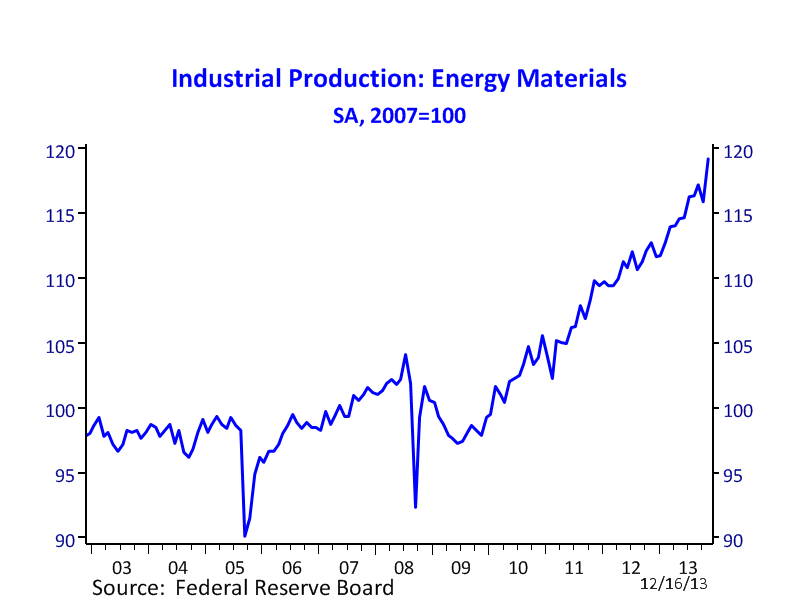
Manufacturing production set an all-time high in the past month. This portends well for further employment gains in the broader economy, which will then support the real estate market.
The manufacturing sector plunged sharply a few years ago, with industrial production falling 18 percent in a short timeframe. Since then, slow but steady gains over the past four years have resulted in retouching the peak production activity.
Though nowhere near the prior peak, the production of construction-related supplies has risen by 23 percent from the low point of a few years ago. Further increase is expected going into 2014 as housing starts will have to and will clearly improve because of the housing inventory shortage.
Even though manufacturing production is charting new highs, employment is not. Manufacturing employment has only recovered only about a tenth of the job losses that occurred in the recession and further the total employment across all sectors is still below the level of five years ago. Increased uses of automation and technology are leading to productivity gains, though at the expense of fewer workers getting hired.
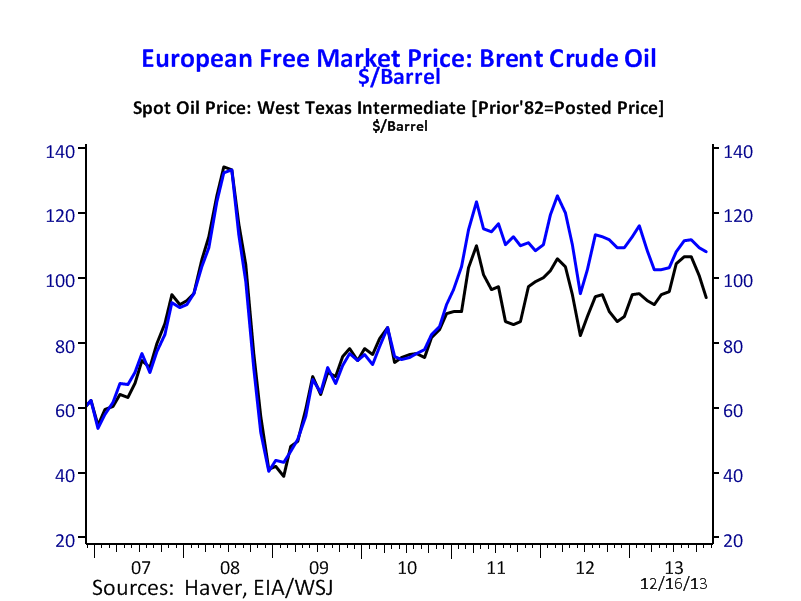
The energy renaissance in North Dakota, Texas, and Louisiana, along with natural gas drilling in Ohio and Pennsylvania, are the principal sources of increase in industrial production. Generally, oil is fungible and prices should equalize everywhere. But due to too much production in the U.S. and due to an inability to export oil to foreign countries, U.S. oil prices are notably cheaper compared to the international oil price in the London exchanges. Texas crude is $97 per barrel while London Brent crude is $111.
World events can move quite unexpectedly. Whales were hunted down to near extinction during the time of Moby Dick. After exhausting the Atlantic Ocean, whales from the south Pacific were hauled all the way to Nantucket, Massachusetts to extract whale oil, which was needed for lighting. But the whaling industry and Nantucket soon crashed when oil was discovered in Pennsylvania. What new energy source is around the corner in the future? 

Lawrence Yun, Chief Economist
Lawrence Yun is Chief Economist and Senior Vice President of Research at NAR. He directs research activity for the National Association of REALTORS® and regularly provides commentary on real estate market trends for its 1 million REALTOR® members.
By: Lawrence Yun (Economists’ Outlook)
Source article unavailable.
Working With Banks to Secure Commercial Real Estate Loans
A podcast featuring Ted Blank, CCIM. Includes pointers on what to do before approaching banks for commercial real estate loans.
By: Ted Blank (National Association of REALTORS®)
Click here for source podcast
Commercial Fundamentals Notch Steady Gain in 3rd Quarter 2013
While we are still grappling with the delays from October’s government shutdown, the estimates for third quarter economic output show much of the same. Gross domestic product rose at an annual rate of 2.9 percent in the third quarter, on the heels of a 2.5 percent rise in the second quarter. While the acceleration in the economic pace is welcome, most of it was boosted by inventory adjustment.
All main GDP components—consumers, businesses, government and trade—were positive contributors to third quarter growth. Consumer spending gained 1.5 percent, driven by a 4.3 percent rise in consumption of goods. Businesses approached investments with a cautious outlook in the third quarter, as the specter of budget wrangling in Washington and the possibility of a government shutdown loomed large. Nonresidential fixed investments rose at an annual rate of 1.6 percent. Business spending on buildings jumped 12.3 percent in the third quarter, on the heels of a 17.6 percent gain during the second quarter. The noticeable advances point to a strengthening pipeline of commercial developments, as market fundamentals continue to improve.
The past few quarters have witnessed a broad slowdown in global economies’ rates of growth. Against this trend, the U.S. economy posted a positive trade balance in the third quarter. The increase in international trade provides for continued strengthening in industrial sector fundamentals, with warehouses seeing marked results.
Government spending posted a modest increase in the third quarter, as spending at state and local government levels rose after years of cutbacks. With stronger balance sheets, state and local governments increased their spending by an annual rate of 1.5 percent. Federal government spending continued declining, as the process of “sequestration” marched on, posting a 1.7 percent slide in the third quarter.
The outlook for the last quarter of 2013 does not bear much glee. With the knowledge of the government shutdown in the rearview mirror, and a retail season already eyeing steep discounts, the GDP outlook for all of 2013 projects an annual growth rate of only 1.7 percent.
Net absorption of office space is projected to total 32.2 million square feet by year end. Office vacancies are expected to decline to 15.7 percent by the end of 2013. The markets with the lowest forecasted office vacancy rates are Washington, D.C., New York and Little Rock, with availability rates of 9.8 percent, 9.9 percent and 12.0 percent, respectively. Rents for office properties are expected to increase 2.4 percent over the year.
Industrial markets contend with demand for warehouse space. Net absorption of industrial space is projected to total 97.0 million square feet by the end of 2013, driving vacancy rates to 9.3 percent. The metro areas with the lowest industrial vacancy rates are Orange County, at 3.9 percent, followed by Los Angeles with 4.0 percent, and Miami, at 6.0 percent. Rents for industrial buildings are expected to grow 2.4 percent this year.
Consumers opened their wallets in the third quarter, propping demand for retail spaces. Net absorption of retail buildings is expected to total 10.5 million square feet this year, accompanied by a vacancy rate of 10.5 percent by year-end. Markets with the lowest retail vacancy rates are led by Fairfield County, CT, at 3.9 percent. Rounding the top three are San Francisco, at 4.0 percent, and Long Island, NY, at 5.2 percent. Rent for retail properties are projected to increase 1.4 percent over the year.
The apartment market is on track to close the year on a strong note. Net absorption is expected to total 239,443 units this year. Against a supply of only 123,518 new units, vacancy rates are estimated to reach 4.1 percent by the end of 2013. Metro areas with the lowest vacancy rates are New Haven, CT, at 1.9 percent and Syracuse, NY, at 2.0 percent. Following closely behind are Minneapolis and San Diego, both at 2.1 percent. Apartment rents are projected to increase 4.0 percent in 2013.
By: George Ratiu (Economists’ Outlook)
Click here for source article
10 Ideas to Save Money for Commercial Real Estate Landlords
The bad news is that commercial real estate investment property costs increased when taxes increased in January. Interest rates have also increased. The good news is that savvy commercial real estate landlords can take proactive measures to improve the bottom line now and in the upcoming new year. With the help of experienced legal counsel, landlords and commercial real estate investment property owners can consider the following suggestions for increasing their properties’ profitability.
10 Tips to More Income
1. Refinance. As predicted, interest rates have climbed but still remain historically low, so now is the time to take advantage of low rates, available financing, and rising property values before the window of opportunity closes. Before you decide to refinance, compare the expected savings and income with the expected expenses and risks, and determine if and when the benefits outweigh the costs. The costs can include appraisal, inspection, legal, title, and other fees, and any penalties for early payment of the existing loan. The risks can include restrictions and guaranties in loan documents. The benefits can include lowering payments, accessing needed cash, avoiding balloon payments, reducing or extending the loan term, reducing the amount of debt, improving loan terms, and increasing income by using loan proceeds to make improvements. Review your properties to minimize your costs and risks and maximize your benefits.
2. Reduce Taxes. Have you considered a real estate tax appeal before the deadline? Even landlords who lease on a triple-net basis should consider filing timely tax appeals to lower their property taxes. In this economy, tenants are extremely sensitive to additional costs; this move avoids losing tenants because the taxes being passed through are too high, helps existing tenants survive by saving money, and attracts new tenants who are comparison shopping among potential sites. Another way to obtain tax benefits is through 1031 exchanges.
3. Plan. Consult with counsel to discuss and update your plans and options, including estate planning, exit strategies, and business succession planning. An experienced trusts and estates lawyer can ensure that the maximum amount of your money stays where you want it, instead of going to Uncle Sam. Full Story
By: Jerry A. Nelson, Esq. (CCIM Institute)
Click here for source article