Commercial real estate investment trends were positive in 2014, following on last year’s tail winds. Sales of large CRE transactions (LCRE)—over $2.5M—advanced 21 percent year-over-year in, totaling $438 billion, based on Real Capital Analytics (RCA) data. The investment trends continued apace in the first quarter 2015, totaling $129 billion, a 45 percent increase from the same period in 2014.
Investor demand for properties continued on an upward path, as economic fundamentals, broadening lending sources and capital followed returns. With global economies moderating in 2014, the U.S. property market became an even stronger contender for cross-border investors, as well. Secondary and tertiary markets remained on the list of investor destination due to higher yields. However, top markets returned to the forefront as capital sources consolidated in pursuit of top-tier properties.
In comparison to the high-end deals, 86 percent of commercial REALTORS® posted transactions below the $2.5 million threshold in 2014. Although many REALTORS® participate in transactions above $2.5 million per deal, they serve a segment of the commercial real estate market for which data are generally not as widely reported, which we term the small CRE transactions (SCRE).
Based on National Association of REALTORS® (NAR) data for the SCRE market, sales volume increased 35 percent on a yearly basis in 2014. The strong increase mirrored the renewed investor interest in stable market and properties offering higher yields.
Prices for REALTORS® commercial transactions advanced 8 percent year-over-year in 2014, a much slower pace than in LCRE transactions. Cap rates averaged 8.1 percent over the year, a 40 basis point decline from 2013. Yields in SCRE markets continued to offer a premium compared with the 6.8 percent average recorded in LCRE transactions during 2014.
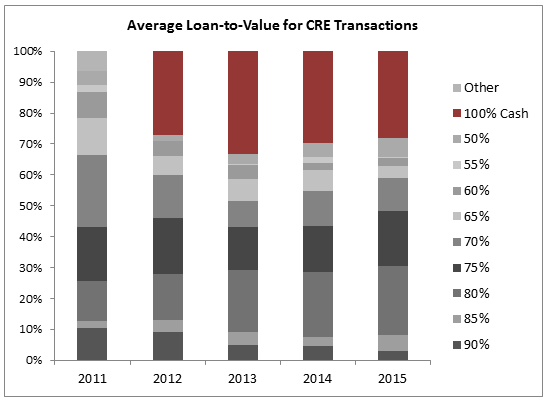
While lending conditions eased in 42 percent of REALTORS markets, financing remained a major concern. For 59 percent of members, the average transaction’s loan-to-value (LTV) was 70 percent or higher, with 31 percent of total deals posting LTVs of 80 percent or above. Just as importantly, cash deals comprised 28 percent of all transactions. While the figure represents a decline from 2014, it has hovered around the 30 percent mark for the past four years.
(Click to enlarge photo)
In LCRE markets, national banks provided the bulk of debt financing, actively competing with government sponsored enterprises, CMBS conduits and life insurance companies. However, in SCRE markets, where many commercial REALTORS® are active, regional and community banks were the largest lending group, making up 58 percent of transactions.
The lending survey highlights the marked differences in the LCRE markets versus the SCRE markets. Debt financing represents a much-larger portion of capital in SCRE markets, whereas LCRE deals benefit from significant equity contributions.
For commercial REALTORS®, 42 percent of transactions failed due to lack of financing, mostly on account of stringent loan underwriting standards. With higher costs of compliance and higher capital reserve requirements for CRE loans, regional and community banks have shouldered a proportionally larger share of the costs, leading to more cautious lending activity. In 2014, 22 percent of REALTORS® reported tightening lending conditions, compared with 28 percent in 2013. While the figure points to an improving capital market, the pace and volume remains slower than for LCRE markets.
By: George Ratiu (Economists’ Outlook)
Click here to view source article.
Archives for June 2015
Albuquerque: Ranked One of Most Underrated US Cities
It’s not a double-blind study with a complex methodology, but Albuquerque is considered the fourth most underrated city in the U.S., according to a report in BuzzFeed.
It’s not exactly a double-blind study with a complex methodology, but Albuquerque is considered the fourth most underrated city in the U.S., according to a report in BuzzFeed.
The popular digital news organization says it asked its readers to tell them about the most underrated cities in the country. Albuquerque came in fourth, behind Minneapolis, Detroit and Charlotte, N.C. The BuzzFeed list includes 34 cities overall.
“It’s the largest city in the Land of Enchantment, and it has so much to offer: a great brewery scene, unparalleled cuisine, and events and concerts throughout the year. Plus, it’s home to one of the biggest and most beautiful festivals in the world: the annual International Balloon Fiesta! Surrounded by mountains, with the Rio Grande running through it, it’s also absolutely gorgeous,” says a comment by Facebook user Chelsea Clark, which BuzzFeed used with the Duke City listing.
Other cities in the ranking of underrated urban centers include Baltimore, Cleveland, Houston, Buffalo and Des Moines.
By: Mike English (Albuquerque Business First)
Click here to view source article.
Albuquerque Rapid Transit System Could Change the Face of Central Avenue

It’s an idea that would transform the old Route 66 in Albuquerque.
Buses would travel down the middle of Central Avenue as passengers wait under canopy-covered stations. On most stretches, cars would be limited to one or two lanes each way. Wide sidewalks and new landscaping would flank the roadway.
Whether any of it will happen depends a bit on some behind-the-scenes work underway this summer at City Hall.
Mayor Richard Berry’s administration is preparing applications for federal funding aimed at helping pay for Albuquerque Rapid Transit, or ART – a 10-mile, $100 million network of express buses along Central Avenue between Louisiana and Coors.
The goal is to secure about $80 million in federal funds, with the remainder from the city or other sources.
“It would be the next logical step in public transportation, and it can be done for pennies on the dollar compared to light rail and trolleys,” Berry said in an interview.
The idea has broad support at City Hall. City councilors have already authorized bonds that would provide about $13 million for the project.
But there’s no getting around the dramatic change it would bring to Central Avenue, and the neighborhoods and businesses along the old Route 66. Central is the longest urban stretch of Route 66 still intact.
The buses would have their own dedicated lanes, one in each direction, throughout 90 percent of the route. That would mean fewer lanes for cars, trucks and other traffic.
Some anxiety
Some business owners are apprehensive about the idea.
“Who’s going to ride it?” asked Larry Koch, owner of the shop Larry’s Hats in Nob Hill.
He and other business owners wonder whether their customers will really start taking the bus. Koch also fears the potential noise and traffic congestion that would come from reducing the lanes of traffic for other vehicles.
Patrick Frey, who owns BZ Skateshop in Nob Hill, said Albuquerque is a “cruising, low-rider town.” He hopes the project succeeds, he said, but he’s skeptical about reducing traffic capacity on Central.
There aren’t enough north-south transit connections to get people to Central in the first place, he said, even if they want to link up with the proposed route.
“We’re a very spread-out town,” Frey said.

Others are more supportive. They envision a better pedestrian environment that will make it more pleasant for people to stroll between restaurants and shops.
Todd Clarke of New Mexico Apartment Advisors said apartment owners and developers are generally excited about the prospect of a big public investment in Central Avenue. Better transit options make apartments more attractive to residents, resulting in higher rents, he said.
“This investment, followed by the unified development ordinance (a new zoning effort), is really going to lead to a lot more densification,” Clarke said. “Even if you’re not in the corridor, that should get people excited.”
Higher densities help make an area more attractive to companies like, say, a Nordstrom, he said. (A Nordstrom Rack, an “off-price” division of the retailer, is already planned for the Winrock area in Uptown.)
Key time frame
Albuquerque Rapid Transit is entering a critical phase.
The mayor is asking city councilors to approve about $1.2 million that would serve as matching funds for about $6.6 million in federal grants Albuquerque is seeking.
Another key application – for perhaps $70 million – is due in August and a decision could come in the fall.
Berry said he has visited with leaders in the Federal Transit Administration repeatedly to put Albuquerque in a better position to secure funding.
“I think our project is seen as one of the premier projects in the United States,” Berry said.
That’s at least partly because of the way the bus lanes and stations would stand out, in combination with other improvements.
“This is not just the bus,” Berry said. “It really looks and feels like a public transportation system.”
If all goes well, passengers could be boarding the bus in September 2017.
The mayor said he likes that the local money, perhaps $20 million, can be leveraged to generate about $80 million in federal funds. He said he hopes the project will trigger private development along the route, which includes the International District, Nob Hill, the University of New Mexico, Downtown, the BioPark and west Central.
But Paul Gessing of the Rio Grande Foundation, a research group that advocates limited government and individual liberty, said the funding isn’t free, even if some of it comes from the federal government.
“It’s not the way these projects should be done,” he said. “We shouldn’t be pilfering money out of other people’s pockets.”
Gessing is also concerned about reducing the lanes of traffic.
“I think it’ll actually hurt mobility,” he said.
If the city builds the system, it will also have to pay to operate it – a cost estimated at $2 million a year, though federal funding might offset that, too, in the early years, according to the city.
“I just think, as mayor of our city, that it could really make a big difference,” Berry said, and “I’m a fiscal conservative.”
City Councilor Trudy Jones, who at the mayor’s request is sponsoring two resolutions to authorize federal applications, said no public transportation system ever “breaks even,” though it’s important to provide one.
“I think it will make life easier for a huge number of our citizens who rely on public transportation,” Jones said.
About ABQ Rapid Transit
- It’s intended to mimic light rail, only on rubber wheels.
- The buses travel in a dedicated lane, allowing them to bypass traffic congestion. In short stretches, where a separate lane isn’t practical, they may mingle with regular traffic.
- The design would vary along the route. In the Nob Hill area, for example, the proposal is to reduce the lanes of traffic from two each way to just one each way, with the dedicated bus lanes in the middle of the street. Wider sidewalks, on-street parking and trees would make it a friendlier place to walk. Farther east on Central and in a stretch on West Central, the three lanes of traffic now going each way would be reduced to two lanes each way to make room for the buses and landscaping.
- The buses communicate with traffic signals to reduce the wait times at red lights.
- Passengers board the bus from raised platforms that are level with the floor of the bus, as on a subway. Stations would be spaced out roughly every one-quarter to one-half mile.
- Passengers buy tickets or passes at kiosks before getting on the bus, shortening the time each bus stays at a stop. It would cost $1, like other buses.
- The city would still operate the Route 66 bus route, which provides more frequent stops.
- If funding goals are met, major construction could begin in about a year and service could start in 2017.
By: Dan McKay (Albuquerque Journal)
Click here to view source article.
An Uncommon Face-Lift Coming to I-25 Interchange
The plans for New Mexico’s first diverging diamond interchange which features criss-crossing roadways and the addition of traffic lights on either side of the N.M. 14 that runs under Interstate 25. Courtesy image
The state Department of Transportation is about to start work on a major overhaul of the Interstate 25 interchange with N.M. 14 and Cerrillos Road south of Santa Fe, a project that looks perplexing on paper but which officials and engineers say is designed to improve safety and reduce traffic congestion.
Preparation for construction of New Mexico’s first “diverging diamond interchange,” which features criss-crossing roadways and the addition of traffic lights on either side of the state highway that runs under the interstate, is set to start next week. The department said in a news release that the work isn’t likely to be completed until the winter of 2016.
A combination of state and federal funds are being used to pay for the nearly $20 million project.
Rosanne Rodriguez, a spokeswoman with the transportation agency, said the bridges that carry traffic on the current network of ramps and overpasses are nearing the end of their design life. So the state hired the Albuquerque-based engineering and architecture firm Molzen Corbin to analyze the interchange and determine the best options moving forward.
Jerry Paz, a vice president at Molzen Corbin with three decades of experience as an engineer, said his group considered a number of possible solutions, including simply rehabilitating the current roadways. Paz said three years ago, his team and the state Transportation Department initially were skeptical when the Federal Highway Administration suggested the “diverging diamond” design as an option.
After running traffic simulations and weighing cost considerations, he said, his group settled on the odd-looking design. After a trip to Utah, where there are four such interchanges, state officials were on board, too. “We didn’t want to jump into it too early,” Corbin said. “But that [trip] confirmed in everyone’s mind that this was a good idea.”
Cities nationwide, including Springfield, Mo., and Brighton, N.Y., have started to adopt the model, which first appeared in Europe. The U.S. Federal Highway Administration has lauded the snaking design, saying this type of interchange allows traffic to move quickly while reducing the threat and severity of collisions.
The existing interchange is last point of access to I-25 for motorists leaving city limits on Cerrillos Road. Those seeking to get on northbound I-25 must cross two lanes of traffic on N.M. 14 to get reach an on-ramp. Likewise, motorists headed toward the city on N.M. 14 must cross two lanes of traffic if they want get onto southbound I-25.
But the diverging diamond interchange is aimed to solve that traffic conflict.
The plan calls for northbound and southbound lanes of N.M. 14 to diverge from their normal parallel structure and intersect at two points with traffic signals on either side of the I-25 underpass, creating a loose diamond shape. As a result, motorists who just want to stay on N.M. 14 will have to go through two sets of traffic lights.
Cerrillos Road and N.M. 14 will be expanded to three lanes in the immediate area of the interchange. Southbound travelers on N.M. 14 who want to get onto southbound I-25 will still be able to veer right onto an on-ramp. Likewise, northbound travelers on N.M. 14 who want to get onto northbound I-25 will still be able to veer right to an on-ramp.
However, those wishing to travel in the opposite direction on the interstate compared to their current direction on N.M. 14 will have to pass through a signaled intersection before reaching an on-ramp. While these motorists might have to stop at an intersection, they won’t have to turn in front of oncoming traffic, thus reducing the chance of a collision.
Paz said most collisions around the interchange actually have occurred on the northbound I-25 on-ramp from N.M. 14 and the I-25 off-ramp onto N.M. 14. The new design, he said, will provide longer merging lanes for getting on and off the interstate.
The plan also calls for the removal of three bridges associated with the northbound off-ramp from I-25 onto Cerrillos Road. Their absence means the state can save $10 million that would have been spent restoring those bridges. The main bridges carrying interstate traffic through the interchange will be renovated.
The project also calls for the construction of a trail in the place of the razed bridges that will tie into the Arroyo Chamiso Trail. That will allow hikers, bicyclists and other pedestrians the option of avoiding the interchange. Paz said the project also calls for wider shoulders for bicyclists who want to ride along N.M. 14.
Paz he is aware that some members of the public may be wary of the changes, but he said that as construction gets underway, the state will mount an outreach campaign that will include posting information about the project on a website. The goal, he said, is to give the public a reason to feel comfortable about the new interchange. And he’s confident that motorists will be fine with the design once they try it.
“It looks confusing on paper,” Paz acknowledged. “But as you drive through it, it’s not confusing at all.”
I-25 interchange project
Cost: $20 million, a combination of state and federal funds
Features:
• Longer merging lanes for getting on and off the interstate.
• Criss-crossing roadways and the addition of traffic lights on either side of N.M. 14 that runs under the interstate.
• Construction of a trail in the place of the razed bridges that will tie into the Arroyo Chamiso Trail.
How it works:
• Motorists who just want to continue on N.M. 14 will go through two sets of traffic lights.
• Southbound travelers on N.M. 14 who want to get onto southbound I-25 will still veer right onto an on-ramp; northbound travelers on N.M. 14 who want to get onto northbound I-25 will still veer right to an on-ramp.
• Northbound drivers on N.M. 14 aiming to travel south the interstate and southbound drivers aiming to travel north on the interstate will have to pass through a signaled intersection before reaching an on-ramp, reducing the chance of a collision.
By: Chris Quintana (Santa Fe New Mexican)
Click here to view source article.
I-25 interchange project
Cost: $20 million, a combination of state and federal funds
Features:
• Longer merging lanes for getting on and off the interstate.
• Criss-crossing roadways and the addition of traffic lights on either side of N.M. 14 that runs under the interstate.
• Construction of a trail in the place of the razed bridges that will tie into the Arroyo Chamiso Trail.
How it works:
• Motorists who just want to continue on N.M. 14 will go through two sets of traffic lights.
• Southbound travelers on N.M. 14 who want to get onto southbound I-25 will still veer right onto an on-ramp; northbound travelers on N.M. 14 who want to get onto northbound I-25 will still veer right to an on-ramp.
• Northbound drivers on N.M. 14 aiming to travel south the interstate and southbound drivers aiming to travel north on the interstate will have to pass through a signaled intersection before reaching an on-ramp, reducing the chance of a collision.
By: Chris Quintana (Santa Fe New Mexican)
Click here to view source article.