The legalization of marijuana in many states has led owners of cannabis-related enterprises to seek out commercial practitioners for help in securing property.
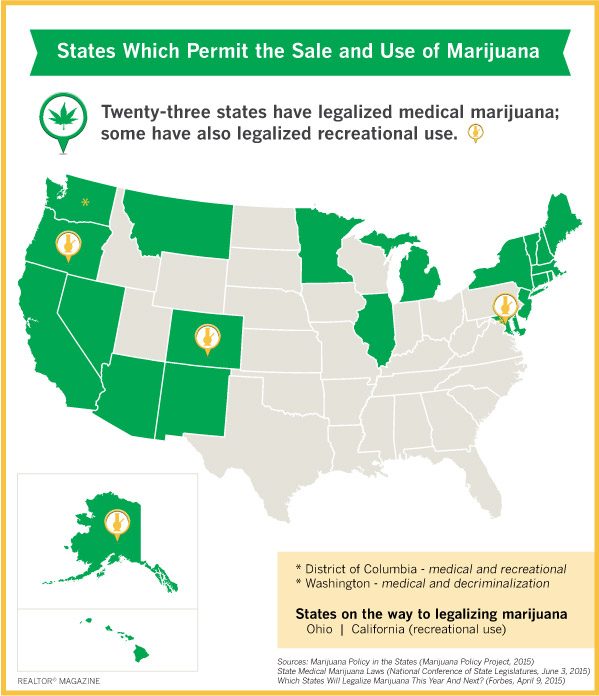
Now that 23 states have legalized some form of marijuana use — mostly for medicinal purposes, but four states and Washington, D.C. have also legalized recreational use — there’s a new niche in the commercial real estate business: helping cannabis businesses find property to set up shop.
Pot dispensaries have specific real estate needs and typically have to comply with strict zoning regulations that limit where they can grow and/or sell marijuana. For example, they often must operate a certain distance from schools, parks, and other public facilities. But properties that fulfill these requirements and serve the business’ needs are scarce, making it all the more necessary for cannabis entrepreneurs to seek the advice of a real estate professional.
Zoning regulations are just one of many hurdles pot dispensaries have to clear to secure property. Other challenges facing the industry include:
- Most traditional banks and commercial real estate lenders don’t extend loans to cannabis businesses because marijuana is still illegal under federal law.
- The rental practices of cannabis business owners can be especially unorthodox because they typically pay in cash.
- Because marijuana is still illegal under federal law, there’s some risk that practitioners and the pot dispensaries they help could land in legal trouble.
- The marijuana cultivation process comes with the potential for fires, explosions, mold, and electrical blowouts.
- Some landlords may be resistant to lease to marijuana businesses because they oppose legalization of the drug.
These challenges can drive up the cost of industrial warehouses suitable for growing and processing cannabis as well as retail locations for marijuana dispensaries. In Portland, Maine, broker Susan Scanlon of Commercial Properties Inc. says demand from cannabis businesses has driven basic warehouses leases from $5 per square foot to between $8 and $9. In most cases, the tenants will invest another $75,000 to $100,000 on buildouts that typically include increased electricity for grow lights, water for irrigation, and a dedicated HVAC system that maintains appropriate humidity.
Leases tend to be triple-net, and tenants in Scanlon’s market commonly make all the improvements themselves because they don’t want anyone — even the landlord — to see their proprietary growing processes, she explains.
Changes in marijuana laws can also influence local real estate markets. Having seen the result of the state’s legalization of medical marijuana in 1999, some Maine property owners are closely watching to see if a proposal to legalize recreational pot makes it on the ballot in 2016. If it does — and passes — prices for property used to produce marijuana stand to rise even higher.
In Colorado, which began allowing the sale of marijuana for recreational use in 2014, properties appropriate for pot growers are selling at up to double their value three years prior to the passage of the state law, says Derek Peterson, CEO of Terra Tech Corp., which invests in commercial space for cannabis businesses. Leases are worth three to four times more.
Houston-based Taylor Consulting Inc. is betting that rents will continue to rise for Denver’s pot-friendly properties, which ranged from $15.50 to $19.20 per square foot in the first quarter of this year. “We’re looking to gain a foothold to develop our assets in this evolving industry,” Taylor CEO Scott Wheeler said in a statement.
Terra Tech recently tried to buy a 3,500-square-foot building in Las Vegas ahead of a Nevada vote on marijuana legalization in November 2016. The property had been on the market for 18 months. “They were asking $575,000, and we went in and offered $650,000 — that’s a $75,000 premium,” Peterson says. “They strung us along and someone woke up and paid them more.”
In some areas, cannabis businesses have set up LLCs to purchase land in order to avoid revealing their identities. Anonymity can keep sellers and landlords from charging them a premium for property because of their link to marijuana.
Getting in on the Marijuana Niche
In states where marijuana laws are in flux, it may be wise for commercial practitioners to begin incorporating considerations for pot businesses into their existing marketing plans. Due-diligence services for commercial property users, identifying potential rehabs for developers, or locating prospective investment properties for buyers are a few things practitioners could get a leg up on.
But keep in mind the social implications on your own business. Offering a cannabis specialty could make you the target for snide comments from co-workers and competitors — at least initially. “There was a lot of giggling when we first got into it,” Scanlon says. “Even I needed an attitude adjustment. But now we’re forming alliances with insurance agents and investors.”
Since zoning plays a role in determining which property a cannabis company can use, keeping up with legislative actions can give you a competitive edge.
“If you’re watching a market that’s going through legalization, inside the legislation you’ll see where the zoning parameters are going to land,” Peterson explains. “Then, you can use your own MLS screenings to proactively identify properties. Go knock on doors and tell owners, ‘Your building will be a target property if the legislation passes.’ Get those properties listed ahead of time.”
Warehouses, especially standalone properties and those that are already demised into smaller spaces, are popular in Maine, where regulated “caregivers” can grow pot for up to five medical patients at a time.
“Zoning in Maine is really on a town-by-town basis,” Scanlon says. “Municipalities, such as the larger cities, have a large variety of zones, while some of the smaller towns have only one or two zones. I have had the most success in industrial zones, since a warehouse is the most workable space. In some towns, it is simply viewed as an agricultural use. There are a few municipalities that have placed a moratorium on growing or dispensing.”
Landlords vs. Business Owners
Convincing landlords to lease to cannabis businesses can be a challenge. Some won’t want to be associated with marijuana businesses, while others won’t want the hassle of having to take cash payments to the bank.
It takes a lot of water and electricity to grow marijuana, so a landlord might also worry that leaks could cause extensive property damage or faulty electrical wiring could cause fires. Some landlords have included humidity limits in their leases, Scanlon says.
But tenants should negotiate for their own protections to be outlined in leases as well, says attorney Chris Gooch, director of commercial and real estate litigation at Phoenix-based law firm Fennemore Craig. Given the increased risk of property damage due to the cultivation process, business owners may want it in writing how much responsibility each party takes for repairs. Insurance risks are another area of concern. Cannabis facilities are often targeted by criminals looking to steal marijuana or money.
Savvy landlords will attempt to distance themselves legally from such tenants to avoid conflict with federal law, says Lynn Fulstone, a Fennemore Craig attorney based in Las Vegas. For example, “a landlord would not want to base the rent on a portion of the proceeds,” she says. “That moves you closer to aiding and abetting [someone violating federal law].”
Protecting the Practitioner
The discrepancy between state and federal marijuana laws leaves real estate professionals working with cannabis businesses open to possible legal trouble. Practitioners should consult a lawyer to have disclaimer language written into any agreement with their client, Gooch says.
The thinking is that should federal policy change — say, after the next presidential election — to make prosecuting marijuana businesses a higher priority, practitioners need to be protected. “The federal policy could be to seize the [business owner’s] assets, including the building, and the real estate professional would be one of the people the landlord would be looking to for recovery of damages,” Gooch says.
For property managers, it’s important to know what risks landlords face when leasing to cannabis businesses. You don’t want to inadvertently advise them to do something that could come back to bite them. For example, landlords whose properties are mortgaged could be breaking the agreement with their lender by allowing its use for illegal purposes under federal law. Cannabis businesses also often require many certificates, conditional-use permits, and business licenses to operate. Their failure to obtain the necessary credentials could have blowback on the landlord.
“You probably don’t ever want to do a full-service gross lease,” Fulstone says. “Make sure it’s triple-net — the tenant pays for everything and the landlord is only a ground lessor.”
Prospecting for Business
How much can you earn in this niche? “Your ROI as an agent isn’t enormous,” Scanlon says. The amount of suitable space for cannabis businesses is limited, so “you spend a lot of time looking at space, and then it’s a contest to see who’s going to be in first.” Stiff competition can lead some brokers to shop an available property to in-house clients before placing it on the open market, though that’s a practice often frowned upon in the larger real estate world.
There’s no doubt that demand is strong for real estate service providers who understand marijuana industry issues. “The brokers in Las Vegas were charging $20,000 retainers to spend time, energy, and effort looking at properties for [cannabis businesses],” Peterson says. “We want someone out there working for our best interest. We struggle to find good real estate practitioners.”
To find clients in the cannabis market, ask your state marijuana regulator for a list of companies and individuals who have requested registration, certification, or other legal permission to open a dispensary, grow operation, or processing facility, Peterson says.
You can also plant seeds for your cannabis niche by soft-launching your efforts online. Bruce Ailion, CRB, CRS, a real estate attorney and associate broker at RE/MAX Town & Country in Woodstock, Ga., expects his state to be among the last to legalize marijuana. But he’s already reserved several URLs targeting pot-friendly real estate.
“There will be a strong market for brokers ready to serve this market on day one,” Ailion says. “Finding the sweet spot in the market and being there first has been the cornerstone of my business for 37 years.”
By: Dona DeZube (REALTOR® Magazine)
Click here to view source article.