• Skip to primary navigation
  • Skip to main content

CARNM

Commercial Association of REALTORS® - CARNM New Mexico

  • Property Search
    • Search Properties
      • For Sale
      • For Lease
      • For Sale or Lease
      • Start Your Search
    • Location & Type
      • Albuquerque
      • Rio Rancho
      • Las Cruces
      • Santa Fe
      • Industry Types
  • Members
    • New Member
      • About Us
      • Getting Started in Commercial
      • Join CARNM
      • Orientation
    • Resources
      • Find A Broker
      • Code of Ethics
      • Governing Documents
      • NMAR Forms
      • CARNM Forms
      • RPAC
      • Needs & Wants
      • CARNM Directory
      • REALTOR® Benefits
      • Foreign Broker Violation
    • Designations
      • CCIM
      • IREM
      • SIOR
    • Issues/Concerns
      • FAQ
      • Ombuds Process
      • Professional Standards
      • Issues/Concerns
      • Foreign Broker Violation
  • About
    • About
      • About Us
      • Join CARNM
      • Sponsors
      • Contact Us
    • People
      • 2026 Board Members
      • Past Presidents
      • REALTORS® of the Year
      • President’s Award Recipients
      • Founder’s Award Recipients
    • Issues/Concerns
      • FAQ
      • Ombuds Process
      • Professional Standards
      • Issues/Concerns
      • Foreign Broker Violation
  • Education
    • Courses
      • Register
      • All Education
    • Resources
      • NMREC Licensing
      • Code of Ethics
      • NAR Educational Opportunities
      • CCIM Education
      • IREM Education
      • SIOR Educuation
  • News & Events
    • News
      • All News
      • Market Trends
    • Events
      • All Events Calendar
      • Education
      • CCIM Events
      • LIN Marketing Meeting
      • Thank Yous
  • CARNM Login
  • Show Search
Hide Search

Archives for April 2016

Albuquerque Among the Most Cost-Friendly Cities To Do Business in the Country

April 5, 2016 by CARNM

 
Albuquerque was ranked the fifth most cost-friendly city to do business among mid-sized businesses, according to KPMG. Ivana Starcevic/ISTOCK
When it comes to the cost of doing business, Albuquerque is a good deal.
Albuquerque is the fifth most cost-friendly city to do business among 18 medium-sized cities, according to KPMG’s Competitive Alternatives study, released last week. Albuquerque was compared to cities with a population between 750,000 and 2 million.
According to the study, Albuquerque, the Duke City, which had a cost index of 94.4, showed “strong results in all aspects of labor costs.” The cost index is defined in the study as the average business costs in the four largest U.S. cities: New York, Los Angeles, Chicago, and Dallas-Fort Worth.

Baton Rouge, Louisiana, was ranked the most cost-friendly city to do businesses in the midsize group, followed by New Orleans; Nashville, Tennessee; and Omaha, Nebraska. Trenton, New Jersey, and Honolulu were the most expensive midsize cities to do business, according to KPMG.

While it ranked third for labor costs, Albuquerque costs were only 0.6 percent higher than Nashville, which had the lowest labor costs. Albuquerque also was third for effective corporate income tax rate.

KPMG’s Competitive Alternatives study measured business operating costs in more than 100 cities in 10 countries.

KPMG, which has an Albuquerque office, was recently named one of Fortune’s 100 Best Companies to Work For.

By: Christopher Ortiz (Albuquerque Business First)

Click here to view source article.
Filed Under: All News

Winds of Trade Blow Strong in Southern NM

April 4, 2016 by CARNM

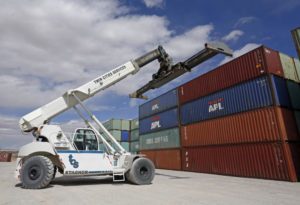
A stacker moves containers inside the facilities of Twin Cities Services Inc. in Santa Teresa, New Mexico, Thursday, March 31, 2016. (Andres Leighton/For the Albuquerque Journal)

SANTA TERESA – The economic potential for New Mexico in U.S.-Mexico trade can be summed up in a wind blade.

Manufactured in Ciudad Juárez by Arizona-based TPI Composites Inc., trucked over the border at Santa Teresa, stored on a lot in the Santa Teresa industrial zone, loaded by a New Mexico crane company onto rail, then shipped to U.S. wind farms via the new Union Pacific rail yard: The blades boost trade, fuel business on both sides of the border and showcase the capabilities of the region’s only land port of entry, with its overweight trucking zone and unique ability to handle oversized loads. And the company that makes them is expanding this year with a second plant in Juárez.

As New Mexico looks to diversify its economy beyond industries tied to the U.S. government and commodities such as metals, potash and oil, the state’s sights are trained on this small but growing trade hub at the U.S.-Mexico border.

A truck transporting a wind blade wait in line to cross into the United States at the Santa Teresa-San Jeronimo border crossing, near Ciudad Juarez, Mexico, Thursday, March 31, 2016. (Andres Leighton/For the Albuquerque Journal)

The past two years have brought new development momentum to Santa Teresa, business leaders say, thanks to growth in Mexico’s maquiladora industry and factors that have boosted interest in this wide-open corner of southern New Mexico. Infrastructure investments, the overweight zone for big rigs and new rail connections have stoked developers’ interest and lured providers of warehousing and logistics services to the area.

The hub’s first new industrial park in 15 years is going up, its anchor tenant putting the finishing touches on its facade. A dozen new businesses have located in Santa Teresa since 2014. Two have expanded and two more are in the process of expanding; there are a half-dozen deals in the pipeline, developers say. Some 4,400 feet of rail has been laid to link distribution centers with Union Pacific, which built a massive, $400 million rail depot two years ago.

Albuquerque builder Krishna Reddy recently visited the border crossing where Santa Teresa meets San Jerónimo, not far from the sprawl of El Paso and Ciudad Juárez, and said he was “struck by the enormous potential in that area for cross-border commerce and trade.” Then he asked, “Why is there empty space out there? As far as the eye can see, there is nothing.”

But the view is deceiving: There are 3.5 million square feet of occupied industrial space in Santa Teresa and another 1.6 million square feet occupied in San Jerónimo. At least half a million square feet of speculative industrial space is being planned on both sides of the border, developers say.

The U.S. Commerce Department reports that New Mexico exports to Mexico nearly doubled in 2014 to $1.55 billion, then grew 9 percent to $1.68 billion in 2015, a year when overall U.S.-Mexico trade contracted slightly due to the drop in oil prices.

Truck traffic at the crossing grew by nearly a third between 2011 and 2015, from fewer than 74,000 trucks to more than 96,000 trucks, according to U.S. Customs and Border Protection.

“Since the Great Recession ended, the state’s economy has been moving sideways,” said Roberto Coronado, senior economist of the Dallas Federal Reserve Bank, El Paso branch. “If you split the state, you see the northern part struggling and the southern part growing at a nice pace. The bright spot in southern New Mexico continues to be Santa Teresa and continues to be trade.”

Maquila growth

The maquiladora industry in Ciudad Juárez has shown double-digit growth over the past 18 months, thanks to strong U.S. demand for autos, electronics and other consumer goods, Coronado said.

The growth in Mexican manufacturing has meant more business for the parts and materials suppliers, and logistics services providers, in New Mexico – especially in Santa Teresa.

That is the key to unlocking the potential of the North American Free Trade Agreement, said Jerry Pacheco, president of the Border Industrial Association in Santa Teresa and executive director of the International Business Accelerator, a nonprofit trade counseling program.

“For the California Gold Rush of 1849,” he said in an interview alongside area developers, “very few people made money in the actual gold. Where the people made money was in selling to the prospectors. That is what we are doing. We’re selling space, putting up buildings, for all these companies that are participating in NAFTA. Our role here is to get in front of those deals and attract them to our region.”

MCS Industries Inc., a maker of frames and home decor, set up a distribution center in Santa Teresa in 2008 and this year moved into a new, 215,000-square-foot building in Westpark, the area’s newest industrial park, which is being built by the area’s largest landholder, Chris Lyons.

Omega Trucking is planning to move into a brand-new building on five acres in May, said Miriam Kotkowski, the company’s president and general manager.

Omega and its sister company Autotransportes Chamizal move about 350 trucks a month through the Santa Teresa port, Kotkowski said. She credits the overweight zone and the ability to cross wide loads at Santa Teresa, which is unique in the region; as well as attentive, community-oriented leadership at U.S. Customs and Border Protection as the reasons Santa Teresa is her preferred port of entry.

“We are in a growth mode right now,” she said. “Once we move to Santa Teresa, we are expecting 20 percent to 30 percent growth in the next couple of years, all related to trade with Mexico.”

The port can accommodate the enormous molds for the TPI windmill blades that Omega brings south to Juárez, for example, while the overweight zone lets trucks carry 96,000 pounds, which is what Mexico allows but is over the U.S. limit of 80,000 pounds.

The savings provided by the overweight zone to manufacturers in Mexico is not just about the distances traveled in heavier trucks but the ability to cross freight directly from the plant to a Santa Teresa warehouse without having to unpack in Ciudad Juárez first – a security risk in a region known for drug trafficking.

Ed Hazelton’s Twin Cities Services Inc. provides truck-to-rail services on a 32-acre lot in Santa Teresa. He said he is buying another 19 acres next door to allow for the growth he expects this year and next.

“Ninety-five percent of the product that comes through our facility is either destined to or coming out of Mexico,” he said – containers that were shipped to the West Coast from China, Vietnam, Taiwan and Japan, offloaded onto the UP railroad and hauled to Santa Teresa.

“As far as our business goes, we have seen steady growth,” he said.

Santa Teresa is looking forward to an influx of capital outlay funding, including $8.3 million that will pay to rehabilitate three key roads linking the Pete V. Domenici International Highway and the industrial parks, and $200,000 to expand wastewater treatment capacity.

“I know that the state is investing more money in utilities and roads,” said Gustavo Deandar, president of INDEL Food Products Inc., an El Paso-based canner of chiles under the Del Sol brand.

Deandar also leases warehouses and has been investing in Santa Teresa. He has more than 400,000 square feet in two buildings, he said, and is considering building a speculative building on a new parcel. Deandar also said, “Down the road, we are thinking we can move to Santa Teresa.”

“We hope the state keeps supporting us, and I think they will,” he said. “We feel trade with Mexico will just continue to flourish. We are counting on that, as well.”

By: Lauren Villagran (Albuquerque Journal)

Click here to view source article.

Filed Under: All News

ABQ Rapid Transit Project Faces Legal Challenges

April 4, 2016 by CARNM

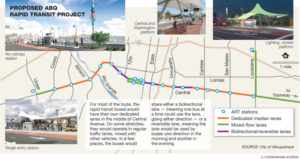
The city of Albuquerque is distributing these renderings about the proposed Albuquerque Rapid Transit bus, including a canopy-covered station that would sit at Cornell and Central, a key entrance to the University of New Mexico, and the kiosks at which passengers would buy tickets before boarding the bus at the proposed Downtown bus station at Second and Copper NW.

The debate over Albuquerque Rapid Transit is headed to court.
Attorneys representing residents and businesses opposed to the project – or with grave concerns about its design – filed a pair of lawsuits Monday afternoon, one in state court, the other in federal.
They accuse the city of violating the National Historic Preservation Act and other federal and city laws. Each lawsuit also asks a judge to order a halt to the project.
The lawsuits allege that ART would choke traffic along Central Avenue and disrupt the character of old Route 66. Albuquerque is home to the longest urban and intact stretch of what was once Route 66 and many historic buildings are along the route, the suits say.
Gilbert Montaño, chief of staff under Mayor Richard Berry, said the city is confident ART is legally sound and construction is still set to begin this summer. Litigation is a normal part of carrying out big transportation projects, he said.
“This is not something that in any way caught us off guard,” Montaño said Monday.
The state court lawsuit was filed by attorney John McCall on behalf of Western View Restaurant and other residents and businesses opposed to the project. They are located mostly along the western half of the ART route.
Pictured are signs dotting Central Avenue opposing the Albuquerque Rapid Transit project. This sign is in front of the Walgreens on Central near Girard. Albuquerque, New Mexico (Roberto E. Rosales/Albuquerque Journal)
“I think we have a very good case,” McCall said Monday in an interview, “and I think a lot of it has to do with the fact that there’s a tremendous amount of opposition.”
In a series of rowdy meetings earlier this year, opponents turned out in force, shouting down and mocking city executives pitching the project.
Central Avenue is already the heaviest-used transit corridor in the city, with both local routes that offer frequent stops and faster Rapid Ride buses. Albuquerque Rapid Transit would replace most of the Rapid Ride service along Central.
The city contends the new ART would provide even faster service and would arrive every seven to 10 minutes.
The city rushed through approvals for Albuquerque Rapid Transit, McCall said, in violation of legal requirements.
The federal lawsuit was filed by attorneys John Boyd and Yolanda Gallegos on behalf of a series of business and property owners.
The $119 million transit project would create a nine-mile network of dedicated bus lanes and bus stations in the middle of Central Avenue. Work could start in late July and the city hopes to have ART in operation by fall next year after about 14 months of construction.
The City Council approved the project last month on a 7-2 vote, with Councilors Dan Lewis and Klarissa Peña opposed.
The project is a priority of Mayor Berry, who says it would attract development to the area.
The federal government would provide about $101 million of the funding for the project, though the largest chunk of the money – a “Small Starts” grant – has not yet been formally approved. About $18 million in city money would also go toward the project.
The federal lawsuit alleges the city failed to notify the Federal Transit Administration that ART was likely to generate intense public discussion. The plaintiffs also say the FTA improperly granted the city an exception to the standard requirement of studying the project’s potential environmental impact.
The federal complaint also alleges the city deliberately withheld information about ART from businesses and misled people by claiming the existing buses are full.
“Even the most casual observer of city buses traveling along Central Avenue knows these statements to be divorced from reality,” the lawsuit said.
The city contends that, at especially busy times of the day, it’s standing room only on some Central Avenue routes.
The state lawsuit, meanwhile, says ART would disrupt traffic so severely that it would constitute a “public nuisance.”
Along much of the route, there would be fewer lanes for regular traffic – sometimes one in each direction, rather than two – as a necessity to make way for the new bus-only lanes.
Each lawsuit names both federal and city officials as defendants.
Large employers along the route, such as the University of New Mexico and Presbyterian Hospital, have come out in support of the project.
By: Dan McKay (Albuquerque Journal)
Click here to view source article.
 

Filed Under: All News

As Construction Increases, Albuquerque Looks to Staff Up a Key Department

April 4, 2016 by CARNM

Albuquerque Mayor Richard Berry unveiled his proposed $524 million general fund budget for the city last week.

Highlights include more money for the Albuquerque Police Department, wage increases for city employees, and more resources for the animal welfare department and other city programs.

Albuquerque’s mayor proposes adding more positions to the city’s planning department, among other initiatives in his latest city budget proposal.

But three line items within the mayor’s proposed budget are of particular interest to developers and those in the construction industry.

The budget shows $1.5 million would go towards debt service on $18 million in new revenue bonds for new capital projects. Berry also proposes increasing the planning department’s budget by $522,000 — money that will be used to create new positions within the department.

Berry didn’t specify how many positions the extra funding would create, and representatives weren’t immediately available for comment Monday.

The city’s planning department has been busy lately. The mayor tweeted in February that more developers and businesses are submitting plans to the city, which usually means an increase in construction projects.

#ABQ has seen a 200% increase in submittals to the Environmental Planning Committee for April. That means more building happening in ABQ!
— Mayor Richard Berry (@Mayor_Berry) February 29, 2016

Also of interest for those in the real estate and retail industries — Berry wants to allocate $1 million towards a new initiative that would keep the city streets cleaned up.

“This increased funding will add new anti-graffiti efforts, a doubling of our anti-panhandling/weed and litter program … and a robust concentration on our city streets that will target abandoned and unsightly buildings and vacant lots, street and right of way cleaning, new striping and signage,” Berry said in the budget letter to the Albuquerque City Council.

The cleanliness issue is one that has touch the Nob Hill corridor recently. National planning expert Robert Gibbs once said the city could do a better job at helping to keep Nob Hill clean. Gibbs said he noticed trash, outdated signs, graffiti and half-torn posters along Central Avenue through the historic corridor.

The proposed budget will now be poured over by the Albuquerque City Council, which must make any amendments and approvals.

By: Stephanie Guzman (Albuquerque Business First)

Click here to view source article.

Filed Under: All News

  • « Go to Previous Page
  • Page 1
  • Page 2
  • Page 3
  • Page 4
  • Page 5
  • Go to Next Page »
  • Search Property
  • Join CARNM
  • CARNM Login
  • NMAR Forms
  • All News
  • All Events
  • Education
  • Contact Us
  • About Us
  • FAQ
  • Issues/Concerns
6739 Academy Road NE, Ste 310
Albuquerque, NM 87109
admin@carnm.realtor(505) 503-7807

© 2026, Content: © 2021 Commercial Association of REALTORS® New Mexico. All rights reserved. Website by CARRISTO