• Skip to primary navigation
  • Skip to main content

CARNM

Commercial Association of REALTORS® - CARNM New Mexico

  • Property Search
    • Search Properties
      • For Sale
      • For Lease
      • For Sale or Lease
      • Start Your Search
    • Location & Type
      • Albuquerque
      • Rio Rancho
      • Las Cruces
      • Santa Fe
      • Industry Types
  • Members
    • New Member
      • About Us
      • Getting Started in Commercial
      • Join CARNM
      • Orientation
    • Resources
      • Find A Broker
      • Code of Ethics
      • Governing Documents
      • NMAR Forms
      • CARNM Forms
      • RPAC
      • Needs & Wants
      • CARNM Directory
      • REALTOR® Benefits
      • Foreign Broker Violation
    • Designations
      • CCIM
      • IREM
      • SIOR
    • Issues/Concerns
      • FAQ
      • Ombuds Process
      • Professional Standards
      • Issues/Concerns
      • Foreign Broker Violation
  • About
    • About
      • About Us
      • Join CARNM
      • Sponsors
      • Contact Us
    • People
      • 2026 Board Members
      • Past Presidents
      • REALTORS® of the Year
      • President’s Award Recipients
      • Founder’s Award Recipients
    • Issues/Concerns
      • FAQ
      • Ombuds Process
      • Professional Standards
      • Issues/Concerns
      • Foreign Broker Violation
  • Education
    • Courses
      • Register
      • All Education
    • Resources
      • NMREC Licensing
      • Code of Ethics
      • NAR Educational Opportunities
      • CCIM Education
      • IREM Education
      • SIOR Educuation
  • News & Events
    • News
      • All News
      • Market Trends
    • Events
      • All Events Calendar
      • Education
      • CCIM Events
      • LIN Marketing Meeting
      • Thank Yous
  • CARNM Login
  • Show Search
Hide Search

Archives for November 2016

CARNM Commercial Source: IREM Practices Diversity by Virginia Gonzales

November 11, 2016 by CARNM

Diversity Advisory Board Approves New Statement

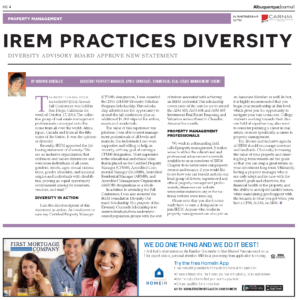
abq-journal-homestyle-11-11-16-cover-page homestyle-11-11-16-article

By: Virginia Gonzales of Commercial Real Estate Management (Homestyle Magazine by The Albuquerque Journal)

The Institute of Real Estate Management (IREM) Annual Fall Conference was held in San Diego, California the week of October 17, 2016. The collective group of real estate management professionals converged onto the scene from all over the world: Africa, Japan, Canada and from all the fifty states of the Union. It was the epitome of diversity. Recently, IREM approved the following statement of diversity: “We are an inclusive organization that embraces and values differences and welcomes individuals of all races, genders, creeds, ages, sexual orientations, gender identities, and national origins and individuals with disabilities, proving an equal opportunity environment among its members, vendors, and staff.

Diversity in Action

I am the direct recipient of this statement in action. As I endeavor to earn my Certified Property Manager (CPM®) designation, I was awarded the 2016 IREM® Diversity Scholars Program Scholarship. This scholarship afforded me the opportunity to attend the fall conference plus an additional $1,000 stipend for airfare, meals, and incidentals. The value of this experience was priceless. I was able to meet management professionals of all levels and markets. The individuals I met were supportive and willing to help, insincerity, with my goal of earning a CPM® designation. Most impressive is the educational and ethical value that is placed on the Certified Property Manager (CPM®), Accredited Commercial Manager (ACoM®), Accredited Residential Manager (ARM®), and Accredited Management Organization (AMO®) designations as a whole. In addition to attending the Fall Conference, I was also awarded the IREM Foundation Diversity Outreach Scholarship. The purpose of the Diversity Outreach Scholarship is to assist individuals from under-represented population groups with the cost of tuition associated with achieving an IREM credential. This scholarship covers most of the cost for me to attend the ASM 603, ASM 604 and ASM 605 Investment Real Estate Financing and Valuation series offered in Chandler, Arizona this month. 

Property Management Professionals

We work in a demanding field called property management. It makes sense to utilize the educational and professional advancement materials available to us as members of IREM Chapter 46 to better serve our property owners and tenants. If you would like to see how you can benefit and join our local group of diverse, experienced and ethical property management professionals, please see our website www.iremnewmexico.org or the national website www.irem.org. Please note that you don’t necessarily have to earn a designation to join IREM. Anyone who works in property management can also join as an Associate Member as well. In fact, it is highly recommended that you begin your membership at this level, which gives you the opportunity to navigate your way to success. College students working towards their chosen field of expertise may also want to consider pursuing a career in real estate, or more specifically, a career in property management.

The diverse and inclusive agenda of IREM should encourage investors and landlords. Obviously, increasing the value of your property and drawing long-term tenants are the goals so that you can reap a great return on your investment long term. Ultimately, having a property manager who is not only adept and in tune with the owner’s goals and objectives, the financial health of the property, and the ability to anticipate liability issues, while maintaining good rapport with the tenants, is what you get when you hire a CPM, ACoM, or ARM.

Click here to view source PDF (article only).

Click here to view source PDF (full issue).

Click here to view source article.

Filed Under: All News

Baby Boomers Rapidly Becoming The New Hipsters Fueling Unprecedented Apartment Demand

November 10, 2016 by CARNM

LOS ANGELES, CA – According to Manny Gonzalez, FAIA, LEED AP and principal, with international, award-winning KTGY Architecture + Planning, National Multifamily Housing Council’s (NMHC) research shows that aging boomers will represent a larger share of growth in the apartment market as millennials begin to marry, have children and buy homes.
From affordable senior rentals to luxury living, the demand for age-qualified apartment homes is higher than ever. And with 10,000 people a day turning 65 through 2030 that demand will continue to grow. “Just like the millennials who fueled the recent surge in apartment construction, the 55+ renters are looking for many of the same things. They rank proximity to grocery stores, dining and entertainment at the top of their list,” Gonzalez said.
“Demographic studies and historical patterns also point to the 55+ cohort downsizing and choosing a more convenient lifestyle,” said Gonzalez.
Incorporating Universal Design into active adult apartments is critical for attracting new residents and for allowing existing residents to remain in their apartment as their lifestyle needs change, Gonzalez commented. “Incorporating Universal Design is key and the best Universal Design is invisible. You don’t know it’s there until you need it,” Gonzalez said.
One example, Gonzalez states, is Kohler’s grab bar that doubles as a wall shelf for shampoo or soap or as a towel rack. Other examples include a walk-in or curbless shower, no-step entry and outlets in the hallway at switch height so no one has to bend over to plug in the vacuum. “It is more than just placing a microwave at chair height,” Gonzalez said.
Some of the 55+ renters are looking for a second home near family, particularly when grandchildren are involved. “Boomers don’t want to sleep on the couch every time they visit their son or daughter, nor do they want to sell their home. An apartment offers a home away from home. And, should the child move at some point, they don’t have to worry about trying to sell that second home,” said Gonzalez.
A great design element inspired by millennials is to allow residents to customize the entry to their units, Gonzalez suggested. “If the design team doesn’t, this cohort will figure out a way to do it themselves. Incorporating a window box, photo frame or pot shelf can do the trick and help keep decorations from getting out of control, especially during the holidays,” said Gonzalez.
“After catering to millennials for some time, the industry needs to give these growing number of renters what they need as they easily could become more important than the much-prized millennials,” Gonzalez said.
A frequent speaker at the most prestigious national and regional industry events, Gonzalez will offer his expertise and insights at NMHC OPTech Conference and Exposition on November 16, 2016, in Dallas, Texas. He will be a featured panelist at NMHC OpTech’s general session, “The New Hip-sters: Planning Now for an Older Demographic,” along with panelists Helen Foster, principal, Foster Strategy, LLC; Tim Hermeling, executive vice president, marketing, Cortland Partners; and Cristina Sullivan, COO, Gables Residential.
Gonzalez has also been invited to speak at BizFed Institute’s NextUp Forum, “Housing Now – Turning NIMBY to YIMBY” on Friday, November 18, 2016, held at Woodbury University in Burbank, Calif. Gonzalez will be a featured panelist in the session, “NIMBY to YIMBY: Digging for Answers to Get Shovels in the Ground” and will discuss how cities and developers can convert opponents, NIMBY (Not In My Backyard), to proponents, YIMBY (Yes, In My Backyard).
Gonzalez is the managing principal for KTGY’s Los Angeles office. He is responsible for the design, land planning and production of residential and mixed-use developments throughout the U.S., including active adult and affordable multi-family communities as well as mixed-use residential, office and/or hotel/hospitality with retail.
By: MultifamilyBiz.com
Click here to view source article.

Filed Under: All News

TICs 2.0: Securitized 1031 Industry Is Making a Comeback

November 9, 2016 by CARNM

Ten years ago, the Tenant in Common (TIC) industry was at the top of its game. The fractional ownership structure had become a favorite for 1031 investors looking to defer capital gains and trade-up to larger, more expensive properties. At its peak, TICs were raising more than $3 billion in equity annually, including $3.6 billion in 2006.
The financial crisis was a death blow to the sector. Transactions dried up and fundraising ground to a halt. At the same time, the downturn exposed some flaws in the structure and TICs took a precipitous fall from grace. Stories of properties under water were all too common due to inflated purchase prices, high leverage loans and, in some cases, even charges of wrongdoing by the TIC sponsor.
After a very public implosion, TICs slipped quietly into the background. Now the remaining legacy TIC deals are once again moving to the forefront as TIC ownership groups try to resolve their maturing 10-year loans. At the same time, the securitized 1031 is staging a big comeback with a new vehicle. TICs have been cast aside in favor of fractional ownership deals structured as a Delaware Statutory Trust (DST).

Cleaning up legacy TICs

One of the “dirty little secrets” in the remaining wall of CMBS loan maturities is a large number of loans that were originated by TIC syndicators, says Jay Maddox, principal in the capital markets group in the West Los Angeles office of real estate services firm Avison Young. TIC owners—more than any other ownership group—overpaid for assets, and those loans could be a big source of problem loans in the coming year, Maddox notes.
Although many TIC syndicators are no longer active, the properties themselves are still owned by the TIC structure that was initially set-up. “I think you will see a lot of those loans end up foreclosed by the special servicers,” says Maddox. Some deals are still under water. Another big challenge for TICs is that co-owners must agree unanimously to a particular course of action. That unanimous agreement has been difficult to achieve given that TICs can include up to 35 individual investors. In addition, many groups are unable or unwilling to put additional capital into a property to deleverage an asset or get it back on its feet.
As a firm that specializes in providing a secondary market for commercial real estate by buying out limited partner interests, QuickLiquidity comes across quite a lot of TIC deals where owners are looking to exit. In part, TICs struggled with the same problems that hit a lot of property owners in the recession—bad timing, says A. Yoni Miller, co-founder and chief marketing officer at QuickLiquidity. “Most of the TICs that we have seen weren’t conservative enough,” he says. TICs paid too much; properties were too highly leveraged; and they didn’t have the money to put back into the property to keep it afloat, he says.
Inland Real Estate Exchange Corp. (now Inland Private Capital Corp.) was very active in the TIC market pre-recession and remains a major player in the 1031 securitized market. Inland is one of only a few sponsors that are still in the market and standing behind its legacy TICs. Inland has already monetized many of the legacy TIC deals that it helped structure prior to 2008, and the company is just “scratching the surface” on about $1 billion in full cycle activity, according to Keith Lampi, president and COO of Inland Private Capital Corp.
Some of Inland’s TIC properties have been sold, while others have been refinanced and converted to the DST structure. In cases where neither of those solutions works with a distressed property, Inland has helped to work those out by tax deferring investors out of those programs and into another investment program that puts them into a position to rebuild equity over time, says Lampi.
New structure replaces TICs
One of the big selling points of TICs and securitized 1031 deals, both then and now, is that it gives individual investors the ability to pool their money and buy a stake in larger, institutional quality assets. The securitized 1031 industry not only still exists, but it has come “roaring back” in a big way, says Lampi. In 2015, securitized 1031 deals surpassed $1 billion in equity raised and projections for 2016 are for equity raised to reach $1.5 billion. However, in the post-recession market, the 1031 securitized structure or “wrapper” has changed. The industry has navigated away from TICs in favor of the DST.
In 2004, the IRS provided guidance for DSTs to be considered for like-kind real estate in a 1031 exchange. But the vehicle didn’t take off until after the recession, when the industry was searching for an alternative to TICs. “The two structures are actually quite a bit different, and there are a lot of unique improvements that the DST structure brings to the table when compared to the Tenant in Common structure,” says Lampi.
For example, TIC investors have voting rights on major business such as signing a lease, selling a property or refinancing a loan. Approval of any of those actions requires unanimous consent. “When the economic downturn occurred, sponsors had some pretty serious issues herding the investment group to ensure that unanimity was achieved,” says Lampi. DST investors do not have the same voting rights.
The TIC structure also limits the number of investors in any one deal to a maximum of 35, whereas the DST does not have a limit. That allows 1031 investors to more easily diversify reinvestment across several different properties, because the minimum investment levels are much lower with larger pools of investors. DSTs can also include more than one property in a deal in order to provide added diversification.
There has been a big shift in the market going from TICs to DSTs, notes Miller. However, some new TICs are still being created, especially in the case where it is a close-knit group of family members or friends who want to set up a fractional ownership entity. A lot of people have said that TICs are still dead, and they definitely are not at the volume that they were, but there are still a lot of TIC deals still out there, he adds.
By: Beth Mattson-Teig (National Real Estate Investor)
Click here to view source article.

Filed Under: All News

ABQ Named Among Top Beer Destinations

November 9, 2016 by CARNM

There are 67 breweries in New Mexico. Albuquerque made the top 10 of Travelocity’s Top Beer Destinations.

Albuquerque Makes Top 10 in Travelocity’s Top Beer Destinations

In a survey last year, more than 1,000 people told the travel site they would like to go on a trip to visit craft breweries and sample local beers. The site enlisted the Brewers Association to come up with Travelocity’s first Beer Index.

According to Travelocity, craft beer production increased 13 percent, about 24 million barrels, in 2015, roughly 700 million more pint glasses of beer than in the previous year. There are about 4,800 craft breweries in the U.S. The breweries on Albuquerque Business First’s annual Breweries List brewed a collected 70,640 barrels of beer in 2015. There are 67 breweries in New Mexico as of September, according to the state’s Regulation and Licensing Department.

Albuquerque was ranked No. 10 on the list. The Portland-Vancouver-Beaverton, Oregon metro area was ranked No. 1, followed by Denver-Aurora, Colorado and Seattle-Tacoma-Bellevue, Washington.

“Small and independent craft brewers are part of the DNA of their communities,” said Julia Herz, craft beer program director for the Brewers Association and publisher of CraftBeer.com, in a statement. “They are becoming mainstay attractions for travelers. Whether as part of a backyard getaway, a break from a business trip or as the main reason for a beer-focused vacation, we encourage everyone to broaden their knowledge of beer by visiting these local brewers, to experience firsthand the advancing beer culture across the country.”

Breweries have a $520 million economic impact in New Mexico, according to America’s Beer Distributors.

By: Christopher Ortiz (Albuquerque Business First)

Click here to view source article.

Filed Under: All News

  • « Go to Previous Page
  • Page 1
  • Page 2
  • Page 3
  • Page 4
  • Page 5
  • Go to Next Page »
  • Search Property
  • Join CARNM
  • CARNM Login
  • NMAR Forms
  • All News
  • All Events
  • Education
  • Contact Us
  • About Us
  • FAQ
  • Issues/Concerns
6739 Academy Road NE, Ste 310
Albuquerque, NM 87109
admin@carnm.realtor(505) 503-7807

© 2026, Content: © 2021 Commercial Association of REALTORS® New Mexico. All rights reserved. Website by CARRISTO