• Skip to primary navigation
  • Skip to main content

CARNM

Commercial Association of REALTORS® - CARNM New Mexico

  • Property Search
    • Search Properties
      • For Sale
      • For Lease
      • For Sale or Lease
      • Start Your Search
    • Location & Type
      • Albuquerque
      • Rio Rancho
      • Las Cruces
      • Santa Fe
      • Industry Types
  • Members
    • New Member
      • About Us
      • Getting Started in Commercial
      • Join CARNM
      • Orientation
    • Resources
      • Find A Broker
      • Code of Ethics
      • Governing Documents
      • NMAR Forms
      • CARNM Forms
      • RPAC
      • Needs & Wants
      • CARNM Directory
      • REALTOR® Benefits
      • Foreign Broker Violation
    • Designations
      • CCIM
      • IREM
      • SIOR
    • Issues/Concerns
      • FAQ
      • Ombuds Process
      • Professional Standards
      • Issues/Concerns
      • Foreign Broker Violation
  • About
    • About
      • About Us
      • Join CARNM
      • Sponsors
      • Contact Us
    • People
      • 2026 Board Members
      • Past Presidents
      • REALTORS® of the Year
      • President’s Award Recipients
      • Founder’s Award Recipients
    • Issues/Concerns
      • FAQ
      • Ombuds Process
      • Professional Standards
      • Issues/Concerns
      • Foreign Broker Violation
  • Education
    • Courses
      • Register
      • All Education
    • Resources
      • NMREC Licensing
      • Code of Ethics
      • NAR Educational Opportunities
      • CCIM Education
      • IREM Education
      • SIOR Educuation
  • News & Events
    • News
      • All News
      • Market Trends
    • Events
      • All Events Calendar
      • Education
      • CCIM Events
      • LIN Marketing Meeting
      • Thank Yous
  • CARNM Login
  • Show Search
Hide Search

Archives for January 2017

Structuring Real Estate Joint Ventures: A Developer's Perspective

January 11, 2017 by CARNM

Developers and sponsors seeking acquisitions and/or development of new real estate projects have long recognized the benefits of attracting a capital partner suitable for its needs, especially now when the acquisition and project costs have escalated dramatically, especially in gateway cities where the sudden price increases are most acute: New York, San Francisco, Los Angeles and Miami.

Developers and sponsors seeking acquisitions and/or development of new real estate projects have long recognized the benefits of attracting a capital partner suitable for its needs, especially now when the acquisition and project costs have escalated dramatically, especially in gateway cities where the sudden price increases are most acute: New York, San Francisco, Los Angeles and Miami. Even well-heeled developers and investors are loathe to undertake risks of developing many projects, however optimistic and rosy it all appears at the outset. In order to mitigate at least a portion of that risk, and not entirely deplete its cash reserves, it is often advisable for the developer or sponsor to align itself with a capital partner, especially if debt or other structured financing is also required. It is within that framework that we intend to ruminate about many of the critical components one would encounter in negotiating the best arrangement for such developer or sponsor to couple with an equity source.
The most complex arrangements are those arising out of a project involving construction and development, rather than the somewhat vanilla acquisition of an office building, shopping center, or rental apartment community. Most of the difficulties which may be encountered by either or both of the partners will typically emanate from a newly created project or the redevelopment of an existing project.This analysis will begin by highlighting some of the essential elements needed for a developer or sponsor to JV an acquisition and/or development of a real estate project anywhere in the country, with the expectation that the capital partner will perfectly align with the developer’s/sponsor’s development expectations. Within that context, a developer needs some true business (and legal) insight as to what elements of the negotiation should be viewed as “non-negotiable” vs. a myriad of more nuanced matters to be agreed-to between the developer/sponsor and the capital partner.
At the outset, entity choice, typically a Limited Partnership or LLC, is often determined by the usual factors: taxes, lender requirements, and securities requirements. The initial and somewhat rudimentary basics are:

  • Articles of Org. & Operating Agreement (LLCs) or Certificate of Limited Partnership for Limited Partnerships
  • Place of filing normally “home state” of developer or capital partner or Delaware (NY often choice of private equity firms based in NY)
  • Be wary of “SPE” requirements, where bankruptcy-remote entities will be mandated
  • Is this a one-off arrangement or negotiated as part of a series of JVs?
  • Will the sponsor prefer not to dilute its ownership interest (i.e. granting an interest in the venture in exchange for capital injection) and instead opt to obtain mezzanine financing?

Presuming the parties elect to form an LLC (probably 90 percent or more of new Real Estate JVs), then the terms and provisions included (or unintentionally excluded) from a well-drafted Operating Agreement or Partnership Agreement can result in major discord between the venturers, including unnecessary litigation. As such, each of the following items should be thoughtfully considered and addressed in the Operating Agreement or Partnership Agreement.

  • “Catch-up” and “claw-back” provisions
  • Profit participation
  • Preferred returns; waterfalls and distributions
  • Fees (development, management, and/or sales & marketing)
  • Typical Terms
    1. Identification of members/partners
    2. Description of JVs purpose and description of “project,” as applicable
    3. Capital contributions
    4. Change of control restrictions
    5. Percentage Interest of each member
    6. Transfer of Interest Restrictions
    7. State of formation; registered agent
    8. Reps & Warranties of Developer & Capital Partner
    9. Any prohibition as to other ventures?
    10. Confidentiality/Publicity rights
  • Negotiated Terms
    1. Issuance of new interests;preemptive rights for existing members
    2. Management/Major Decisions
      • Consent of partner & consequences of breach
    3. Fee Structure
      • Distributions & Allocations
      • Promotes
  • Permitted transfers of Interests
  • Permitted Encumbrances
  • Hurdle Rates / IRR; how is this calculated, compounded or cumulative?
  • Return of Capital
  • Critical Terms
    1. Time expectations for completion of project & stabilization; impact of project entitlements; GC contract and bank financing
    2. Consent Rights
    3. Guaranty of bank or other debt (including intra-partnership equity) and credit enhancements
    4. Management and Major Decisions
    5. Exit Strategy
      1. Buy / Sell provisions
      2. Dissolution
  • ROFO, ROFR & “PUT” provisions
  • Release Prices of Units / Lots, Parcels or Density

Clearly, the sponsor or developer must negotiate numerous critical deal points, to be included in the Operating Agreement or ancillary contracts, and the dynamics of those negotiations will flow from the relative strength of the sponsor or developer vs. its intended capital partner. Factors which will be in play are:
– Quality, experience & financial heft of sponsor and project desirability
– Type of Project & Location
– Risk of completion
– Status of entitlements
– GC & performance bond
– Tax benefits, SAD’s; CDD’s or other tax improvement districts
– Area Competition / Radius Restrictions
– Management – day-to-day control vs. “major decisions” requiring consent
– Often the developer gains greater leverage following more capital being injected by developer
– Speed of decision-making by capital partner
– Reporting (transparency always helpful)
– Key personnel
– Create an Operating Agreement / Limited Partnership Agreement for governance, containing as many concrete terms and provision as possible in order to avoid conflict down the road.
– Expected Debt and Restrictions, noting credit officers of banks and other institutional lenders have recently become much more conservative.
Establishing each party’s respective role in the venture, addressing rights and obligations and how they are invoked, invariably leads to the essential questions – “who proposes a “major decision” for the venturer; is such decision warranted; and what happens when the venturers do not agree? Is this occurring out of a sponsor’s concern that a project is not meeting expectations, financial or otherwise? Should that matter? Even when business relationships are thriving, they often sour as a consequence of harsh differences that can percolate when any milestone date or event, or performance level of the project, falls short. A synopsis of how this evolves in a real project setting is noteworthy, and an overview of major decision engineering is fruitful. Moreover, who proposes major decisions and what transpires after the venturers fail to agree is critical.

  • Typical Major Decisions:
    1. Acquisition of property
    2. Sale of Property
    3. Debt or structured finance
    4. Tax-incentives or submittal to some form of development district
    5. Capital contributions
    6. Plan for development, if applicable
    7. Major contracts, leases & licenses
    8. Identity of property manager; sales/leasing brokerage firm; various consultants (architect, planner, civil & structural engineers, environmental engineer, etc.)
    9. Agreements with Affiliates
    10. Project budgets
    11. Distributions/reserves
    12. Bankruptcy/dissolution / assignment for benefit of creditors
  • Will non-agreement as to “consent” trigger buy/sell?

Unquestionably the developer’s counsel will need to push back on a broad menu of events as permitting the “removal” of the developer as the Manager or General Partner of the JV. You can expect that the capital partner will, however, insist upon most, if not all, of the following as causes for removal:
-Committing certain felonies or other “bad boy acts,” such as misapplication of funds, waste; and failure to insure and/or pay RE taxes & assessments
– Causing loan default under bank loans, material contracts, land use entitlements, etc.
– Failure to make capital contributions or achieve certain milestones or RR for project development
– Fraud or gross negligence or intentional tort
– Non-compliance w/permits, licenses & approvals
Some ancillary factors should also be considered during the negotiating process:
– Removals “for cause” vs. “without cause”
– Developer must negotiate as many cure rights as possible, with reasonable notice provisions
– Default by Pres./CEO different than low-level employee
– Developer must be aggressive in negotiating very few removal rights
– No forfeiture of equity–just promote
What are the usual consequences of removal?
– Loss of control or voting rights
– Dilution of interest
– Loss of Promote and/or development fees
– Possible impact on right to receive, promote, “preferred returns” & fees, and the like
– Termination of affiliate agreements
– Personal or parent guaranty being triggered
In summary, my advice to a sponsor or developer is to secure knowledgeable counsel that is well-versed in the structuring of project entities for real estate developers and capital partners in a fashion which does not materially restrict developer’s ability to build and complete its project. Note that every relationship is enhanced when an agreement between them is clear and encompasses a multitude of possible changes which may evolve. Good Luck!
By: Chuck D. Brecker Esq. (Commercial Property Executive)
Click here to view source article.
Filed Under: All News

Cabela’s at Journal Center is a Go

January 11, 2017 by CARNM

ALBUQUERQUE, N.M. — Work is officially underway on the new Cabela’s at Paseo and I-25, anchoring what will ultimately be a $68 million, mixed-use development including other retail, restaurants and apartments.
The 21-acre development, called Legacy Journal Center, is being developed by Titan Development, the project’s managing partner.
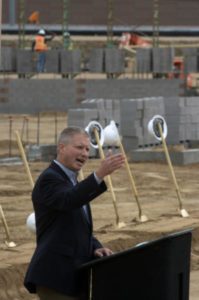
“Having a great anchor like Cabela’s is going to be a strong attractor for us to spur further development,” Kurt Browning, Titan’s chief development officer, said at a groundbreaking Wednesday morning.

Kurt Browning with Titan Development speaks at Cabela’s groundbreaking event at the Journal Center on Wednesday, January 11, 2017. (Greg Sorber/Albuquerque Journal)

Titan is already in negotiations with other retailers and restaurants interested in the site, which is at the southwest corner of Interstate 25 and Paseo del Norte.
Cabela’s, a purveyor of hunting, fishing and outdoor gear, is shooting to open this fall, Browning said, and will hire an estimated 150- full-time, part-time and seasonal employees for the 70,000-square-foot store, the first in New Mexico for the Sidney, Nebraska, company.
Browning said total construction and infrastructure costs would be $68 million during a six-year buildout. Once retailers and restaurants are operating, they will generate an estimated $70 million in sales annually. Browning said the center will create 300 permanent jobs, 40 of which will be managerial, and about 600 construction jobs.
General contractor Kraus-Anderson Construction Co. Minnesota said  70 percent of its subcontractors on Cabela’s will be local vendors.
Titan has plans to build an apartment complex nearby at Headline Boulevard and Lang Avenue, perhaps with its signature Broadstone name but with a more “urban” look.
“What today is an 8-to-5 workplace will be more live-work-play,” said Browning of the development, in which Journal Center Corp. is a partner “The residential component is a game changer,” he said.
Albuquerque Mayor Richard Berry, left, looks over blueprints of the new Cabela’s with project superintendent Ken Tyler before the groundbreaking event for the outdoor retailer on Wednesday, January 11, 2017. (Greg Sorber/Albuquerque Journal)
“We are excited about the future jobs and development that will grow this site,” said Mayor Richard Berry at the event.
An avid hunter and fisherman, Berry said Cabela’s will draw visitors from around the state. “With that great brand that they have, it will be a huge draw,” predicted Berry.
“It’s going to be one more reason to stay a bit longer, to do a little more more shopping,” generating revenue that will help support city services, said Berry.
By: Steve Sinovic (Albuquerque Journal)
Click here to view source article.

Filed Under: All News

Earn 10 CEs: 1/30-2/2 Local CCIM 101

January 10, 2017 by CARNM

This course fulfills the NMREC requirement that new licensees must complete either the New Broker Business Practices Course or the CCIM 101 course in their first year of licensure.

CCIM 101 Financial Analysis for Commercial Investment Real Estate

January 30 – February 2, 2017
8:00 a.m. – 5:00 p.m.
Staybridge Suites

2651 Northrise Dr, Las Cruces 88011

10 CE Credits
Register Online

CCIM 101 serves as your introduction to the CCIM Cash Flow Model. Learn to apply the CCIM Cash Flow Model to make your investment decisions based on wise investment fundamentals. Some of the concepts you will explore include IRR, NPV, Cap Rate, Capital Accumulation, and the Annual Growth Rate of Capital.
 

Filed Under: All News

Consider This Before Jumping into the Seniors Housing Market

January 9, 2017 by CARNM

The statistics don’t lie—the seniors housing development market is hot right now. More than 10,000 Americans turn 65 every day, thus strengthening the argument for developing a seniors housing asset. So how do you get in on the boom?
First, it is important to set the record straight: Yes, the seniors housing industry is a lucrative market open to commercial real estate developers interested in diversifying their development opportunities. However, developers entering the marketspace should be careful not to overlook the distinctions unique to seniors housing developments. To succeed in the market, it is critically important to consider aspects that set seniors housing developments apart from general commercial real estate projects.

Regulatory risk

Seniors housing assets are typically subject to a broader range of regulations that can vary significantly by jurisdiction. Local and federal regulatory scrutiny has drastically increased in recent years. Assisted living communities have seen an increase in licensing and regulatory oversight. State and federal governments have also attempted to tighten regulations at skilled nursing facilities regarding fraudulent and ineffective billing practices. With increased regulation come higher barriers to entry, and an emphasis on asset management for developers already playing in the industry.
In order to mitigate this risk, it is important to retain knowledgeable advisors capable of advising on the regulatory regime (including licensure, certificates of need, facility design and construction requirements) before finalizing your plans to develop a new seniors housing community. Joining forces with a seasoned manager/operator with local roots can also help in quickly gaining a foothold in a new jurisdiction.

Day-to-day operations

Unlike other commercial real estate assets, the management and operation of a seniors housing community requires significant amounts of oversight and sector-specific experience. Given that the seniors housing industry primarily focuses on dealing with elderly, and sometimes frail, residents, it is critical for developers to design the community to specifically cater to these individuals in all aspects of their housing and care. Where do accidents occur? How do seniors like to socialize? What options are residents looking for from a dining program? These are all issues inherent in the design of a community that can make or break your success in this industry. Selecting qualified third-party operators with a proven track record, carrying sufficient insurance and utilizing appropriate legal structures can help to manage operational risks which are intrinsic to this industry.

Permanent residence; level of services

Seniors housing developments require a safe and healthy environment for residents to live out the reminder of their lives, while being monitored by appropriately trained staff. This means residents expect certain minimum services, including: meals, transportation, medication assistance, activities, rehab facilities, concierge services, etc. at each community.
This means that large common areas, multiple dining rooms, planned events and varied menu options are essential. Developers should ensure that a community properly incorporates desired amenities: i.e. movie theatres, game rooms, full-service bars, beauty salons and spas. Developments with limited amenities will struggle to compete with other communities in the market that embrace this enhanced living experience.

The labor force

Seniors housing communities require a highly skilled and often government-regulated staff. The result is that communities must be able to absorb higher labor, training and management costs. Also, competition for such qualified seniors housing staff can become problematic due to the limited availability of skilled professionals in certain markets. Make sure to do your homework on the availability of staff before jumping into a market.
Further, to protect an investment in a seniors housing facility, it is important to locate, train and retain professional and licensed staff to ensure the continued safety of residents. Regardless of your planning and preparation, plaintiffs’ attorneys will look for opportunities to litigate when mistakes happen. Developers can help to mitigate operational risk by carefully considering operators and implementing appropriate training and policies at a facility.

Conclusion

Given the status of the baby boomer generation, entry into the seniors housing market can be a lucrative opportunity for commercial real estate developers. With proper consideration of sector-specific requirements, new entrants can take advantage of this profitable development sector.
By: Michael Okaty (National Real Estate Investor)
Click here to view source article.

Filed Under: All News

  • « Go to Previous Page
  • Page 1
  • Interim pages omitted …
  • Page 3
  • Page 4
  • Page 5
  • Page 6
  • Go to Next Page »
  • Search Property
  • Join CARNM
  • CARNM Login
  • NMAR Forms
  • All News
  • All Events
  • Education
  • Contact Us
  • About Us
  • FAQ
  • Issues/Concerns
6739 Academy Road NE, Ste 310
Albuquerque, NM 87109
admin@carnm.realtor(505) 503-7807

© 2026, Content: © 2021 Commercial Association of REALTORS® New Mexico. All rights reserved. Website by CARRISTO
