• Skip to primary navigation
  • Skip to main content

CARNM

Commercial Association of REALTORS® - CARNM New Mexico

  • Property Search
    • Search Properties
      • For Sale
      • For Lease
      • For Sale or Lease
      • Start Your Search
    • Location & Type
      • Albuquerque
      • Rio Rancho
      • Las Cruces
      • Santa Fe
      • Industry Types
  • Members
    • New Member
      • About Us
      • Getting Started in Commercial
      • Join CARNM
      • Orientation
    • Resources
      • Find A Broker
      • Code of Ethics
      • Governing Documents
      • NMAR Forms
      • CARNM Forms
      • RPAC
      • Needs & Wants
      • CARNM Directory
      • REALTOR® Benefits
      • Foreign Broker Violation
    • Designations
      • CCIM
      • IREM
      • SIOR
    • Issues/Concerns
      • FAQ
      • Ombuds Process
      • Professional Standards
      • Issues/Concerns
      • Foreign Broker Violation
  • About
    • About
      • About Us
      • Join CARNM
      • Sponsors
      • Contact Us
    • People
      • 2026 Board Members
      • Past Presidents
      • REALTORS® of the Year
      • President’s Award Recipients
      • Founder’s Award Recipients
    • Issues/Concerns
      • FAQ
      • Ombuds Process
      • Professional Standards
      • Issues/Concerns
      • Foreign Broker Violation
  • Education
    • Courses
      • Register
      • All Education
    • Resources
      • NMREC Licensing
      • Code of Ethics
      • NAR Educational Opportunities
      • CCIM Education
      • IREM Education
      • SIOR Educuation
  • News & Events
    • News
      • All News
      • Market Trends
    • Events
      • All Events Calendar
      • Education
      • CCIM Events
      • LIN Marketing Meeting
      • Thank Yous
  • CARNM Login
  • Show Search
Hide Search

Archives for February 2017

100 Best Places to Live in the USA

February 1, 2017 by CARNM

U.S. News analyzed the 100 most populous metro areas to find the best places to live. To make the top of the list, a place had to have good value, be a desirable place to live, have a strong job market and a high quality of life.

100 Best Places to Live in the USA

Albuquerque made the list at #74.

What’s it like to live in Albuquerque, NM?

Perhaps best known for the annual Albuquerque International Balloon Fiesta and as the setting for AMC’s hit show “Breaking Bad,” Albuquerque, New Mexico, is a culturally rich and naturally beautiful metropolitan area. Sitting at the crossroads of New Mexico’s major highways (Interstates 40 and 25), Albuquerque has long attracted new residents with its favorable economy and artistic atmosphere.Albuquerque residents have plenty to keep them busy, from the art galleries of Old Town to the historic Native American sites all around the region.
The Albuquerque BioPark’s zoo, gardens and aquarium are popular with families, and a host of museums are great places to spend the rare rainy day. While its nightlife is tame by big-city standards, Albuquerque has a robust culinary scene that features local red and green chile peppers, and includes nationally recognized wineries and breweries.Albuquerque offers quick access to outdoor recreation, such as hiking, mountain biking and even skiing in the Sandia Mountains that border the metro area to the east. The Rio Grande that flows through the city center is a playground for kayakers, and miles of walking and cycling trails wind through its wooded banks.

Rankings

U.S. News analyzed 100 metro areas in the United States to find the best places to live based on quality of life and the job market in each metro area, as well as the value of living there and people’s desire to live there. Albuquerque ranks as #74 with an overall score of 6.3 out of 10.

Albuquerque, NM Quick Stats

902,731 METRO POPULATION | $44,440 AVERAGE ANNUAL SALARY | 68.7° / 45.4° AVG HIGH/LOW TEMPS
37.1 MEDIAN AGE | N/A MEDIAN HOME PRICE |  9.5 inches AVG ANNUAL RAINFALL

5.9% UNEMPLOYMENT RATE | $814 AVG MONTHLY RENT | 23.4 minutes AVG COMMUTE TIME

What’s the cost of living in Albuquerque, NM?

Albuquerque’s cost of living is slightly below the national average. Albuquerque wasn’t as affected by the housing bubble nearly as much as other parts of the country, and home costs are starting to rise. Additionally, Albuquerque has the highest property tax rates in the state. One- and two-bedroom apartments tend to rent for less than $900 a month, which is lower than the national average. Albuquerque residents also pay slightly less than the average American for groceries, utilities, and transportation.

What’s the weather like in Albuquerque, NM?

Albuquerque enjoys all four seasons. During a typical year, monsoon rains in June and September bring cooler temperatures just as 100-degree days are reached. Albuquerque receives three or four good snowstorms a year, though the snow melts quickly. In all, Albuquerque records around 300 sunny days a year, making it one of the sunniest places in the U.S.

Seasonal Temperature (Avgs)

38.0°F Winter
56.6°F Spring
76.5°F Summer
57.2°F Fall

Seasonal Rainfall (Avgs)

0.5 in Winter
0.6 in Spring
1.6 in Summer
1.1 in Fall

What’s the best way to get around Albuquerque, NM?

Given the large size of Albuquerque, plus people’s love for the nearby mountains and wilderness areas, most people rely on their own cars to get around. The Nob Hill, Downtown and Old Town neighborhoods are pedestrian-friendly, and Albuquerque does have extensive paved bike paths popular with both commuters and recreational riders.The ABQ Ride bus system operates routes throughout Albuquerque. The New Mexico Rail Runner Express is a passenger train that travels the north-south Interstate 25 corridor from the cities of Belen to Santa Fe, with four stops within Albuquerque and a fifth stop in the nearby town of Bernalillo.The Albuquerque International Sunport offers direct flights to roughly 20 domestic destinations and is serviced by major U.S. airlines such as American Airlines, Delta, JetBlue and Southwest Airlines. There is also an Amtrak train station and a Greyhound bus station.

Who lives in Albuquerque, NM?

Albuquerque’s population is slightly older, with the 45 to 64 age group making up a quarter of the population. Because of Albuquerque’s pleasant weather and low cost of living, it is also a popular retirement destination. Ages 65 and older represent 14 percent of the population.
Twenty-eight percent of Albuquerque households are families with children younger than 18.Albuquerque’s long Spanish and Native American history is easily seen in its population and culture. The Old Town Plaza, where the historic San Felipe de Neri church can be found, is surrounded by art galleries and restaurants that reflect the metro area’s Hispanic heritage. This area also hosts numerous cultural events, such as the San Felipe Fiestas.
Democrats outnumber Republicans in Albuquerque, though Independents have a noticeable (albeit small) presence. Meanwhile, roughly half the population is religious, and many who are identify as Catholic.

What is there to do in Albuquerque, NM?

Albuquerqueans of all ages enjoy hiking the Sandia Mountains and exploring area parks like Petroglyph National Monument. During the winter, residents are quick to head to the mountains for ski weekends. In addition to outdoor recreation, Albuquerque enjoys a thriving art scene with a wide array of local galleries and a flourishing performing arts scene. Families enjoy visiting Albuquerque’s zoo, aquarium and museums, such as the New Mexico Museum of Natural History and Science and the Explora children’s museum.
Albuquerque offers a diverse range of shopping, from major retailers to many local boutiques. Nob Hill still sports the neon signs of its Route 66 heyday, now lined with fun locally owned shops and restaurants. The culinary scene is dominated by New Mexico’s legendary green chile; however, Albuquerque also has a growing craft beer scene, not to mention a number of local wineries.
Find out more about what there is to see and do in Albuquerque, NM
By: Steve Larese (US News)
Click here to view source article.

Filed Under: All News

The Last Innings – What to Expect in 2017

February 1, 2017 by CARNM

Prosperity continues in 2017, but the cycle is heading toward a fall


The upward momentum that commercial real estate prices and values have been experiencing has recently slowed relative to their appreciation trajectory since their amazing recovery starting two years after the credit crisis. Given the challenges in today’s world and the many dynamics affecting commercial real estate, the economy, and the financial markets, it is time to fully understand the next phase of the current market cycle.

As the transition moves to this next phase, it is time to examine the key forces that will dictate one of the following:

  • market adjustment;
  • market correction; or
  • major market correction or crisis.

All investors, including commercial real estate investors, are focused on when is the end of this phase of the cycle; what will be the triggers that push the industry into the new era; and what should commercial real estate professionals expect for value and price changes.

Final Innings

Looking back, commercial real estate has been a stellar investment performer and a preferred asset class since shortly after the credit crisis. This continues as institutional investors consider commercial real estate as the top investment alternative.
It is a real asset, offers strong income, and has matured as an asset class. As shown in Exhibit 1, the strength of this confidence in commercial real estate and stocks has declined from peak levels of a few years ago, while investor confidence in cash has grown and confidence in bonds remains relatively low. This pattern signals that a market turn is around the corner but not how far out.

CIRE - JF17 28A

Commercial real estate looks like the best investment choice, and the rationale stills holds true. Investor focus must be in preparing for the next phase and determining when it will turn.
Situs RERC recently polled real estate professionals at the 10th annual University of Chicago Booth School of Business Real Estate Conference about where the industry is in the current cycle. Using a baseball analogy to compare the results of this real time poll and Situs RERC’s view, commercial real estate is in the bottom of the eighth inning at the end of 2016 and will enter the ninth inning in 2017.
The year 2017 is expected to be much like 2016, with commercial real estate prices and values on average increasing sluggishly and cap rate compression  stalling. Like the final game of the 2016 World Series, the industry will go into extra endings due to the influences and forces that evolved since the Great Recession and through the transition into the next era. At some point, the extra innings will end and the game will be over. Just as in baseball, it is difficult to tell how many extra innings will be played to usher in the next phase of the cycle.
If this is the case, examination of the final script and the players that will deliver that conclusion. In the commercial real estate investment game, other influences and forces will determine the end of this stellar performance.

Rising Risks

Looking to 2017 and beyond, the risk factors facing the economy, the investment environment, and commercial real estate are considerable. The Federal Reserve has clearly called the plays and influenced the key aspects of the economy, interest rates, and financial markets. The Fed’s future decisions will also influence the next cycle, as its members will have to eventually increase short-term interest rates.
In a surprising turn of events that stymied the pollsters, Donald J. Trump was elected president. After a campaign fraught with acrimonious rhetoric, the president-elect’s tone and tenor has changed. Although the election brings uncertainty, this uncertainty appears to be positive for investment, at least for now.
Typically, what is good for the economy is good for commercial real estate. Mr. Trump’s proposed pro-growth fiscal policies, however, have stoked inflation worries, sending Treasury rates upward.
The cap rate compression during the past few years has been driven by a low interest rate environment. If interest rates rise too quickly, commercial real estate may not be able to absorb the impact. Only time will tell whether President Trump’s policies come to pass, but since commercial real estate tends to lag economic trends by at least six months, commercial real estate growth in 2017 will likely hold steady.
Also, potential black swan events could lead to a major market correction. Although it is tempting to believe there is a nice script of events that will happen in sequence smoothly and predictably during this next cycle, not everything goes as planned. This is true especially since the new set of players has not experienced these kinds of events since the Great Recession.
It is all new and the economy will reach a  normalized level, but there will be ups and downs. The question is, how volatile will the transition be for commercial real estate?
Most important for the industry is the reality that the Fed will raise short-term interest rates several times throughout 2017. The primary driver of low long-term interest rates has been the Fed’s low rates, a sluggish economy, and low inflation. Commercial real estate investment lives on debt to the tune of 50 percent or higher and remains one of the most leveraged asset classes.
As a result, the industry has been one of the biggest beneficiaries of this historical low interest rate environment that has pushed cap rate compression to a new level. Now the Fed is playing the waiting game with rate hikes since economic conditions have continued to improve. Situs RERC’s expectation is that a series of interest rate increases is on the horizon.
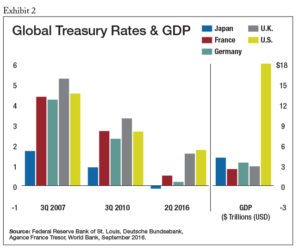
Although it is likely that the Fed will continue to raise interest rates in 2017, rates are still at historical lows for the major global economies (see Exhibit 2). While central banks are trying to fight their country’s respective economic problems, the negative impact of this uncertainty is felt in the U.S. In fact, the Federal Open Market Committee hesitated to raise rates in 2016 in part due to unanswered questions of global growth amid speculation about the impact of Brexit.

Situs RERC’s view and that of its investment survey respondents varied as to when 10-year Treasuries were expected to normalize. Although some respondents felt that Treasuries would normalize during the next one to three years, the majority thought it would be three to five years.
In addition, respondents believed 10-year Treasuries would normalize at a level of 3 percent to 4 percent. With current rates at below 2 percent, the U.S. economy has baked this level into the prices and values of commercial real estate.
Long-term rates are going to look OK in the future relative to past levels, but they will increase by 50 to 100 percent from today’s level. This means that cap rates and discount rates will have to respond. The commercial real estate rate response will not be a simple answer.

Steady ROI

While the economy continues to crawl, annual commercial real estate income returns have been a positive note in an environment filled with uncertainty. Income return has been relatively stable during the past decade with the most recent quarters resulting in rolling annual returns of 4 to 6 percent, which is approximately double the dividend yield seen in the S&P 500 over recent quarters.
According to the most recent Situs RERC institutional investor survey data, expected rents have remained stable or increased for most of the major property types compared to a year ago with the exception of the suburban office, retail power center, and regional retail mall property types. Because of long-term leases already in place, investors can expect stable rent payments in 2017.
The spread between real estate returns and 10-year Treasuries has been around 550 basis points to 600 basis points during recent quarters. The solid spread between real estate returns and 10-year Treasuries is indicative of the current market environment, with low interest rates maintaining the spread. The spread for real estate is greater than the spread of corporate bonds compared to 10-year Treasuries.
Considering the level of risk, the spreads indicate that real estate provides a solid risk-adjusted return compared to alternative fixed income investments and has the capacity to take on some of the interest rate hikes of the future but not all of the likely interest rates moves.

Differentiating Sector Fortunes

According to Real Capital Analytics, transaction prices for all the major property types are as high or higher than they were prior to the market crash, which suggests the peak for commercial real estate pricing. However, prices are not the only consideration when assessing the worth of a property; price needs to be assessed in reference to the value of the property.
According to Situs RERC’s institutional investment survey respondents, investors believe overall commercial real estate values and prices are generally moving in tandem.
Respondents to the Situs RERC’s surveys rated the major property types on return on investment compared to risk. For overall commercial real estate, there was no change in third quarter 2016 from third quarter 2015, with respondents maintaining that return outweighed risks for investors.
Exhibit 3 shows the return vs. risk and value vs. price ratings before, during, and after the credit crisis. While current ratings reflect that commercial real estate return outweighs risks and these values are nearly equal to price, it is important to note that ratings have decreased compared to three years ago and are trending toward levels similar to those before the Great Recession. These results hint that a market correction is near.

Changing Markets Landscape

Situs RERC monitors 48 metros that are split into primary, secondary, and tertiary markets based on the statistical distribution of value and price metrics. The best opportunities in each of these markets were based upon the lasting, sustainable value characteristics of the individual metros compared to their pricing levels.
Primary markets are typically preferred by big investors because of the perceived durability of the market when things get tough for commercial real estate. These cities offer a better risk-adjusted return over the long run due to its long-term establishment and economic diversity.
However, prices in these areas, particularly for Class A properties, are at record highs. Due to increased foreign capital, solid property fundamentals, and scarce supply, costs are likely to continue to increase for the primary markets into 2017. Investors who are yearning for higher yields or are chasing alpha may want to look to core-plus opportunities or spread their wings and venture into new markets, however.
Dallas and Seattle ranked No. 1 and No. 2, respectively, with regards to value vs. price investment opportunities for the industrial, office, and multifamily sectors.
Extreme competition in primary markets, particularly for Class A properties, is driving investors toward secondary and tertiary markets where higher yields can be found. At the same time, the risks associated with the secondary markets have been tempered by strong population growth and improving economies.
Austin, Texas, tops Situs RERC’s list as the best secondary market in which to invest, particularly for office properties. Austin had the largest population growth of all the secondary-metros measured by Situs RERC, and that population is forecasted to continue to grow in 2017 and its employment rate outpaces national levels. Yet, pricing in the Austin market is still reasonable, helping to make Austin the No. 1 secondary market.
For tertiary markets, Omaha, Neb., takes the No. 1 spot in the office, retail and multifamily sectors among the tertiary markets. Strong fundamentals and relatively solid pricing contribute to its high ranking.
The retail sector, buoyed by wage growth and strong auto sales is a particular bright spot for Omaha’s market. Transaction volume in the office, retail and apartment sectors has increased in 2016, including a couple of high-profile deals. This activity is leading to an uptick in prices compared to the previous quarter.

Future Challenges

In revisiting the original concerns, most professionals responding to Situs RERC’s various surveys believed a market correction will not occur until about 2019, with the market correction expected to range from 15 to 20 percent. While the end of this cycle is on the horizon for commercial real estate, the market appears poised to offer relative solid income returns in 2017 and modest to flat appreciation.
Although commercial real estate prices have increased tremendously since the Great Recession, prices alone can mask the true returns investors can expect. Situs RERC used statistical modeling to forecast those values during the next several years.
When considering commercial real estate from a capital return perspective only, the increase in its values are not as dramatic as prices, given that most of the run-up in values are driven by capital expenditures.
As shown in Exhibit 3, the commercial real estate value index declined 32.1 percent in the early 1990s. The subsequent recovery spanned over a decade as the value index grew by 73.2 percent. However, the industry’s value index dropped 31.7 percent in the wake of the Great Recession.
Today, values have increased 49.9 percent, which is 20.3 percent higher than in the 1990s. Situs RERC’s outlook for commercial real estate values over the next several quarters wanes slightly until growth becomes negative by the end of 2017.
Situs RERC predicts that commercial real estate will continue to be the best asset choice in 2017 and most likely for several years to come compared to stocks and bonds. It is difficult to predict when the next market decline will occur, but there is overwhelming evidence that interest rates will increase in 2017, although slowly. As the industry progresses beyond 2017, more unknowns enter the equation and prognostications become increasingly hard to make.
For example, if the Fed raises interest rates too much or too suddenly, higher-than-expected inflation may occur in 2018 and beyond. In addition, major geopolitical events and shifts in foreign and domestic economies could bring an end to the long streak of prosperity for the industry.
There is a market correction on the way estimated to be approximately 20 percent, and this will start appearing at the end of 2018 or the beginning of 2019. The market correction will play out over the next two years, and challenges and bumps will occur along the way.
Commercial real estate is in the best position among the alternatives to manage through the next phase if supply stays in check and if crazy debt stays out of the game.

2017 Snapshot

By: Kenneth P. Riggs Jr., CCIM,CRE,MAI
As this final part of this upward cycle plays out and waits for the next phase, U.S. commercial real estate is a relatively safe, stable place to park investment capital.
Situs RERC’s expectations for 2017 and beyond include:
The year 2017 will be much like 2016 for the industry, with decelerated value increases, little or no cap rate compression and the risk of increased interest rates.
The U.S. presidential election will have minimal impact on commercial real estate in 2017. The seeds of the next phase of the cycle have been planted during the past eight years.
Economic growth will continue to strengthen, and inflation will increase in 2017.
The Fed’s quantitative easing efforts will decrease, increasing short-term interest rates.
The industrial sector will continue to enjoy the largest valuations relative to price of the major property types in 2017, but the office sector has risk from a value vs. price comparison.
Properties with long-term leases in place offer more interest rate risk and thus value adjustments when rates rise, and this is not being priced in the market today.
Hotels and apartments are in the best position to take advantage of a growing economy to hedge out interest rate risk.

By: Kenneth P. Riggs Jr., CCIM, CRE, MAI, FRICS

Click here to view source article.

Filed Under: All News

CCIM – Celebrating 50 Years

February 1, 2017 by CARNM

Founding CCIM Institute members advanced the commercial real estate industry.

To celebrate the 50 years of CCIM Institute, Commercial Investment Real Estate will showcase prominent CCIMs who moved the entire commercial real estate profession forward. All six issues of CIRE published in 2017 will share stories and facts about our past, creating a vivid perspective for the next 50 years.

Q&A: John “Jack” Peckham, III, CCIM

CCIM Designee No. 359; former CCIM Institute instructor; president of Peckham Boston Advisors in Boston
CIRE:  Why did you become a CCIM designee and volunteer leader for CCIM Institute? 
Peckham: When I took what became the first CCIM core course in 1963, I owned a firm with nine or 10 commercial brokers in Boston. The instructor, Jay Levine, CCIM, harangued me to earn my CCIM designation, which I did in 1967.
Fifty years ago and today, the people who are CCIMs and those working toward gaining the CCIM designation are far better informed and connected than those not connected. CCIMs using the knowledge and technology tools CCIM provides can compete with the big commercial real estate firms.
Also, I served on the Board of Governors for the National Institute of Real Estate Brokers and voted for the acquisition of the continuing professional education program from the California Real Estate Association in 1966. The CREA training became the foundation for what ultimately became CCIM Institute in 1967.
I ended up teaching CCIM courses for several years and learned even more from mentors who were instructors, such as Levine and Vic Lyon. I started doing more deals in my marketplace because of that knowledge.
CIRE:What events outside of the commercial real estate arena drove its expansion in the 1960s and 1970s? 
Peckham: Technology developed from the 1960s and 1970s made the invention of free web browsing in the early 1990s possible, which was the biggest breakthrough. When I started working on the web, I knew it would change everything and was the defining moment of using technology in commercial real estate.
CIRE: How has commercial real estate changed through the years? 
Peckham: Most of the changes are connected to technology. For example, we can connect investors to the right investments.
CIRE:What will CCIM Institute look like in next 15 years? 
Peckham: CCIM Institute must offer practical technology tools to help CCIM members make money. These tools would provide CCIM members with six steps to finish a transaction.
On the training side, CCIM Institute instructors have to teach beyond the analytical contents. We need to provide more courses in negotiations, demographics, and how to put a deal together.

CCIM Designee Recognizes the Power of Technology

“As cities are being dramatically changed by modern building techniques and man has the prospect of far greater longevity due to amazing medical advances – so is the Realtor faced with dramatic changes in merchandising techniques. Realtors specializing in the brokerage of income properties are faced with an enormous challenge. The age of computers is upon us! Real estate investors are demanding – and receiving – increased professionalism- John “Jack” Peckham, III, CCIM, published this story for CID Letter in 1968

Evolution of CCIM Courses

From the start, the atmosphere in CCIM courses was one of academic training with an emphasis on application. CCIM classes offered practical, down-to-earth, inspirational, and imaginative material taught by successful commercial real estate practitioners. Early CCIM courses included economic analysis, how to arrange a commission when no cash is available, financing two-way exchanges, and instruction in tax motivation.

Branding CCIM Designation

“We could have taken [the content of] these courses and made millions. But we were trying to create a designation recognizable by the public. The goal was to upgrade the profession we loved and develop a cadre of people we could communicate and do business with.”- Fred Becker, CCIM, early CCIM Institute instructor

Check out CIRE magazine’s web exclusive articles celebrating CCIM Institute’s 50th Anniversary. Archived pieces from the late 1980’s discussing and dissecting the history of CCIM Institute.

By: Sara S. Patterson (CIRE Magazine)
Click here to view source article.
 

Filed Under: All News

NMREC Requirements

February 1, 2017 by CARNM


Please Note NMREC Changes and Requirements Including:

  • Link to the Core Electives List and the Ethics Electives List
  • “Planning Ahead Erases Trouble” – a great article about how to take the Core Course in a 3-year cycle.
  • Coming Soon: Online Renewals & No More Paper License Renewals (Scanning and emailing course completion certificates to the Commission will be required).

For more information, read the complete newsletter here.

READ THE REVISED RULE BOOKLET HERE (EFFECTIVE JANUARY 2017). A SUMMARY CHECKLIST WILL BE AVAILABLE SOON.

Click here to view White Paper Rules Changes
New Mexico Real Estate Commission


Filed Under: All News

  • « Go to Previous Page
  • Page 1
  • Interim pages omitted …
  • Page 3
  • Page 4
  • Page 5
  • Search Property
  • Join CARNM
  • CARNM Login
  • NMAR Forms
  • All News
  • All Events
  • Education
  • Contact Us
  • About Us
  • FAQ
  • Issues/Concerns
6739 Academy Road NE, Ste 310
Albuquerque, NM 87109
admin@carnm.realtor(505) 503-7807

© 2026, Content: © 2021 Commercial Association of REALTORS® New Mexico. All rights reserved. Website by CARRISTO