• Skip to primary navigation
  • Skip to main content

CARNM

Commercial Association of REALTORS® - CARNM New Mexico

  • Property Search
    • Search Properties
      • For Sale
      • For Lease
      • For Sale or Lease
      • Start Your Search
    • Location & Type
      • Albuquerque
      • Rio Rancho
      • Las Cruces
      • Santa Fe
      • Industry Types
  • Members
    • New Member
      • About Us
      • Getting Started in Commercial
      • Join CARNM
      • Orientation
    • Resources
      • Find A Broker
      • Code of Ethics
      • Governing Documents
      • NMAR Forms
      • CARNM Forms
      • RPAC
      • Needs & Wants
      • CARNM Directory
      • REALTOR® Benefits
      • Foreign Broker Violation
    • Designations
      • CCIM
      • IREM
      • SIOR
    • Issues/Concerns
      • FAQ
      • Ombuds Process
      • Professional Standards
      • Issues/Concerns
      • Foreign Broker Violation
  • About
    • About
      • About Us
      • Join CARNM
      • Sponsors
      • Contact Us
    • People
      • 2026 Board Members
      • Past Presidents
      • REALTORS® of the Year
      • President’s Award Recipients
      • Founder’s Award Recipients
    • Issues/Concerns
      • FAQ
      • Ombuds Process
      • Professional Standards
      • Issues/Concerns
      • Foreign Broker Violation
  • Education
    • Courses
      • Register
      • All Education
    • Resources
      • NMREC Licensing
      • Code of Ethics
      • NAR Educational Opportunities
      • CCIM Education
      • IREM Education
      • SIOR Educuation
  • News & Events
    • News
      • All News
      • Market Trends
    • Events
      • All Events Calendar
      • Education
      • CCIM Events
      • LIN Marketing Meeting
      • Thank Yous
  • CARNM Login
  • Show Search
Hide Search

Archives for June 2017

Economy Watch: Food & Beverage Sales May Help Ailing Shopping Centers

June 30, 2017 by CARNM

Restaurants and other eateries account for more than 20 percent of units in new and redeveloped shopping centers in mature markets, according to a recent Cushman & Wakefield report. This trend will likely continue as consumer spending on eating out is expected to grow over the next decade.

The increasing presence of food and beverage in shopping centers—often accounting for more than 20 percent of units in new and redeveloped centers in more mature markets—is being driven by rapid global growth in consumer spending on eating out, according to a new report from Cushman & Wakefield. It’s a trend that might help some retail properties from going under.
With spending on eating out expected to grow over the next 10 years and consumers’ desire to enhance a shopping trip with social and leisure experiences increasing, food and beverage is now critical to the success of any retail development, the report asserts. Moreover, that’s the case in most parts of the world.
All four global regions examined in the report are forecast to experience growth in food and beverage expenditure, led by Asia Pacific and the Middle East and Africa. Based on data from Oxford Economics, consumer spending is forecast to nearly double in the latter region ($182.5 billion to $363.5 billion) and more than double in the former region ($1.05 billion to $2.3 billion). As such, food and beverage spend is predicted to grow at an annual average of 7.4 percent between now and 2026 in both regions.
Europe and the Americas, as more mature markets, aren’t expected to see the same increases in consumer spending but are nonetheless expected to enjoy healthy food and beverage annual spending growth of 4.9 percent and 5.5 percent, respectively.
As spending increases, customer expectation does too. Once-ubiquitous food courts, made up of common seating areas surrounded by fast food outlets, are a dying breed, the report noted. While mainstream brands with the ability to pay higher rents still dominate, landlords are recognizing the importance of diversity. Other concepts, such as the food hall, have evolved, while there’s also a move toward creating different eating and drinking zones within shopping centers.
By: Dees Stribling (Commercial Property Executive)
Click here to view source article.

Filed Under: All News

CARNM Commercial Source: Fundamentals of Real Estate Demand by Conner Marshall

June 28, 2017 by CARNM


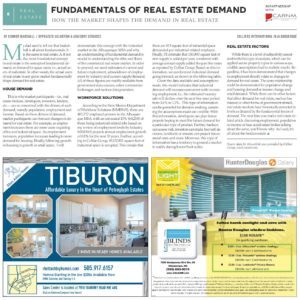
My dad used to tell me that basketball is all about fundamentals. It is the same in real estate. A, if not the, most foundational concept in real estate is the concept of fundamental demand, or demand for space users; i.e., actual users of real estate. In other words, the actual users of real estate in any given market fundamentally shape demand for real estate.

House Demand


This is why market participants—i.e., real estate brokers, developers, investors, lenders, etc.—are so concerned with the drivers of such demand, namely population, employment and income. Based on these drivers of demand, market participants can forecast changes in demand for real estate. For example, as employment increases there are more users requiring office and industrial space. As employment increases, population increases leading to more demand for housing. Finally, following growth in housing is growth in retail space. I will demonstrate this concept with the industrial market in the Albuquerque MSA and why an understanding of fundamental demand is crucial to understanding the ebbs and flows of the commercial real estate market. In order
to proceed, we need estimates of current and future employment, a breakdown of employment by industry and current supply/demand. All of these figures are readily available from government data sources, select commercial brokerages and various data providers.

Workforce Solutions

According to the New Mexico Department of Workforce Solutions (NMDWS), there are 401,717 employed persons in the Albuquerque MSA, with an estimated 15% (60,258) of these being industrial-related jobs based on my review of employment levels by industry. NMDWS projects annual employment growth of 0.8% for the next 10 years. Further, according to CoStar Group, 49,137,851 square feet of industrial space is occupied. This reveals that there are 815 square feet of industrial space demanded per industrial-related employee. Finally, I’ll estimate that 150,000 square feet of new supply is added per year, consistent with average annual supply added the past five years as reported by CoStar Group. Based on this information, we can forecast industrial demand going forward, as shown in the following table: Given the data available and assumptions made, this model indicates that industrial demand will increase concurrent with increasing employment; i.e., the estimated vacancy rate will decline over the next five-year period from 3.6% to 1.2%. This type of information can be powerful for decision-making, assuming the assumptions made are credible. With this information, developers can plan future projects hoping to meet the future demand for a particular type of product. Further, bankers can assess risk, investors can make buy/sell decisions, landlords or tenants can project future rental rates and more. Moreover, this type of information has a tendency to ground a market to reality during boom/bust cycles.

Real Estate Factors

While there is a level of subjectivity associated with this type of analysis, which can be applied across property types in various ways, credible assumptions lead to realistic results. Regardless, it has been demonstrated that changes in employment directly relate to changes in demand for real estate. The same relationship could be demonstrated for population change and housing demand or income change and retail demand. While there can be other factors that affect demand for real estate, such as low interest or other forms of government stimuli, real estate markets have historically corrected to levels as dictated by the fundamental forces of demand. The next time you read a real estate-related article discussing employment, population or income or hear a real estate broker talking about the same, you’ll know why. As I said, it’s all about the fundamentals.

By: Conner Marshall, Appraiser Valuation & Advisory Services at Colliers International in Albuquerque (HomeStyle Magazine by Albuquerque Journal)

Click here to view source article.

Click here to view source PDF (article only).
Click here to view source PDF (full issue).

Filed Under: All News

Repeal of WOTUS Rule Moves Forward

June 28, 2017 by CARNM

The Realtors Land Institute (RLI) stands behind the U.S. EPA’s decision yesterday to move forward repealing the controversial Clean Water rule, also known as Waters of the U.S. (WOTUS), which was put in place in 2015. The move would take the legislation back to what it was prior to 2015 while the agencies involved reevaluate the definition of what constitutes as ‘Waters of the U.S’.
All of this follows President Donald Trump’s executive order on February 28, 2017, which called upon the EPA to review the rule. EPA Administrator Scott Pruitt stated that the intent of the review is to “[Take] significant action to return power to the states and provide regulatory certainty to our nation’s farmers and businesses.”
The Realtors Land Institute has long advocated that withdrawing WOTUS would have a beneficial impact on the real estate sector, especially land real estate. The organization hopes to see the review of the rule eliminate the need for costly and time-consuming permits on waters that were previously unregulated by the federal government.
“RLI looks forward to working with the Administration, EPA Administrator Scott Pruitt and the Assistant Secretary of the Army for Civil Works, as they move forward to develop common-sense solutions to protecting our nation’s water resources while balancing the interests of land real estate and communities nationwide,” said Brandon Rogillio, ALC, 2017 Realtors Land Institute National President.
Learn more about this issue and other legislative issues important to land real estate owners and agents on the Realtors Land Institute’s Advocacy page.
About the REALTORS® Land Institute
The Realtors Land Institute, “The Voice of Land,” continually strives to maintain its status as the acknowledged leader for all matters pertaining to the land real estate profession. RLI endeavors to remain the essential membership organization for the extraordinary real estate professionals who broker, lease, sell, develop, and manage our most precious resource: the land. The Realtors Land Institute, provides the expertise, camaraderie, and valuable resources that are the foundation for all land real estate professionals to become the best in the business. For more information, visit rliland.com or call 800.441.5263.
By: Jessa Friedrich (REALTORS Land Institution)
Click here to view source article.

Filed Under: All News

Commercial Solar Array Is Not a Nuisance

June 28, 2017 by CARNM

Read the full decision: Myrick v. Peck Elec. Co
Vermont’s highest court rules that property owners could not claim that commercial solar panel array constituted a nuisance because the solar array did not interfere with the owners’ use of their property, even though the owners claimed that the aesthetics of the solar panels had damaged their property values.
A group of landowners (“Owners”) filed a lawsuit after a neighbor leased the property to a solar company that built a commercial solar panel array (“Panels”) on the property.  The Owners alleged that the Panels constituted a private nuisance because the Panels affected the neighborhood’s aesthetics and caused a loss in property values.  The trial court dismissed the lawsuit, finding that the state’s law bars nuisance actions based solely on aesthetic harm allegations.  The Owners appealed.
The Supreme Court of Vermont affirmed the trial court ruling.  Vermont defines a private nuisance as an “interference with use and enjoyment of another’s property that is both unreasonable and substantial.”  Court have found that an “unattractive sight” by itself does not constitute a private nuisance because this does not interfere with an owner’s use of their land and is subjective, unlike objective factors courts have found to constitute private nuisances such as noise, light, vibrations, and odors. The Owners argued that the court should expand the definition of private nuisance to cover conditions like the Panels, but the court declined to do so.
Next, the Owners argued that Panels had impacted their property values.  The Owners cited an earlier case that had found that a reduction in property values following a town’s drinking water contamination could sustain a nuisance complaint based on a public perception of widespread contamination.  But the court stated that the Owners only evidence for the alleged nuisance was the reduction in property values, not an objective condition like the water contamination.  Since there was no objective evidence of interference with the Owners’ use of the property by the Panels, the court rejected this argument as well.  Finding that claims for aesthetic harm alone could not support a private nuisance lawsuit, the court affirmed the trial court.
By: National Association of REALTORS®
Click here to view source article.

Filed Under: All News

  • Page 1
  • Page 2
  • Page 3
  • Interim pages omitted …
  • Page 5
  • Go to Next Page »
  • Search Property
  • Join CARNM
  • CARNM Login
  • NMAR Forms
  • All News
  • All Events
  • Education
  • Contact Us
  • About Us
  • FAQ
  • Issues/Concerns
6739 Academy Road NE, Ste 310
Albuquerque, NM 87109
admin@carnm.realtor(505) 503-7807

© 2026, Content: © 2021 Commercial Association of REALTORS® New Mexico. All rights reserved. Website by CARRISTO