Many factors drive real estate investment and development, including economic conditions, market demand, and the availability of capital. Studies reveal another critical element now plays a significant role in determining where new real estate projects will be planned and built: proximity to smartly-designed and well-maintained infrastructure. More than ever people are specifically interested in public transit and pedestrian walkways that provide accessible, reliable, and convenient ways to travel between home and work, schools and recreation.
Recent research supports this contention. A study from the Urban Land Institute, “Infrastructure 2014: Shaping the Competitive City,” found that improving transportation infrastructure ranked among the highest priorities from 440 public officials and real estate leaders surveyed.
A trend known as transit oriented development (TOD) has been popularized by this demand. The concept centers on building high-density multifamily, office, and mixed-use properties within a defined proximity – usually a one-half mile walking distance – from a rapid transit or light rail station. Proponents of TOD development cite benefits that include putting undeveloped or underdeveloped properties to more productive uses, slowing the pace of urban sprawl, reducing traffic congestion, and contributing to sustainability through less reliance on personal auto use.
Examples of TOD developments most often can be found in older urban markets with “legacy” transit networks established before auto travel became dominant. In recent years, the concept is taking hold in emerging metro areas where new rail transportation is helping manage growth, provide greater access to businesses and social services, and contribute to the quality of life. Recognized for decades by urban planners as a viable way to design and grow livable and resilient communities, transit oriented developments gaining broader acceptance by municipalities seeking to address mounting issues like affordable housing options in gentrifying neighborhoods and access to more convenient community services and resources.
TOD Poses Challenges for Developers
Like any real estate development, new TOD properties present specific demands to the development team. Working with transit agencies and navigating requirements laid out by local governments are among factors developers must address.
Francis DeCoste, COO of Transit Realty Associates of Boston, pointed out one initial issue developers encounter centers on the mission of transit providers. “There is, of course, a transit component to a TOD project” he said. “So, the challenge is that these projects have to be coordinated with transportation agencies. Their main business is moving people and not developing real estate. Both parties have different types of objectives, and getting those objectives coordinated is one of the biggest challenges developers face.”
Most TOD projects, DeCoste added, require a high degree of density within the overall development to help address any related infrastructure costs and may include securing air rights needed to build the project. That can lead to challenging negotiations with the local government during the initial planning stages. “When going through the governmental approval process, developers have to make municipalities understand what’s needed to develop these sites as a TOD property,” DeCoste said. “The developer may have to give up some density, which they may or may not want to do. And, there’s the idea that a TOD property has reduced parking; developers have to get the municipality to buy off on the idea that it’s okay to have less parking.”
New Rail Network Driving TOD in Orlando
The foundation of TOD development centers on providing convenient public transit options to reduce automobile ownership and the need for lots of parking. That makes sense in dense, older metro areas with established transit networks like Chicago, which in 2015 enacted an ordinance that includes eliminating parking restrictions for mixed-use properties built within a quarter-mile of an existing Chicago Transit Authority or Metra rail station.
But the concept also is taking hold in still car-centric markets with recently-completed public transportation networks. That’s the case in Orlando, where the SunRail commuter line now operates 12 stations within three counties. Preliminary guidelines for planning the line, which opened in 2015, included detailed “TOD community sketchbook” documents to give the communities served a vision of potential redevelopment projects near SunRail stations. A Phase 2 is underway that will add four more stations to expand the rail network and help guide adjacent multifamily and other commercial property development.
“Transit oriented development is really starting to happen here in Orlando,” said Cynthia Shelton, CCIM, CRE, CIPS, Senior Managing Director of Capital Markets at Landqwest Commercial, a diversified central Florida real estate firm. “These kinds of properties give rise to the idea of the walkable city. People like my 27-year-old daughter want to live in a downtown area where she can say, ‘I work there, I play there, and I take my dog for walks there.’”
A recent surge in new and remodeled properties in the downtown area of Lake Mary, which boasts a SunRail station, was cited by Shelton as an example of the impact the rail line has made on the real estate market in that suburban Orlando city. Developers of properties near the Lake Mary City Hall received tax credits for such incentives as design setbacks or incorporating fewer parking spaces into the property.
“Some new development had been going on before the SunRail station was built, but now developers have really embraced it,” she said. “Today, it’s not just three blocks from the station to City Hall, it’s three blocks to the new restaurant, the yoga studio and the office.”
The Outlook for TOD
Expect the fundamental idea of TOD – using transit as a major factor that drives new development and energizes cities – to continue to gain acceptance. Real estate professionals contacted said the industry is becoming increasingly aware of the role transit oriented development projects play in urban planning and development today, and studies have revealed people support the concept. A case in point: The “2013 Community Performance Survey” from the National Association of REALTORS® showed 60 percent of respondents favored diverse, walkable communities that are closer to employment.
NAR offers an incentive to get TOD type of developments underway through the Smart Growth Grants program, designed to encourage REALTORS® and communities to build responsible communities that offer a range of housing options, are walkable and include various transportation options.
Perhaps the most compelling factor regarding the future of TOD properties centers on housing preferences made by millennials. A survey, “Transit Oriented Development in America,” produced by infrastructure consultants HNTB Corporation, found that 70 percent of millennials would pay more in rent or mortgage to get to work or play without using a vehicle.
By: Edward M. Bury (National Association of REALTORS®)
Click here to view source article.
Archives for August 2017
Breathing Easier In NM’s Oil Patch
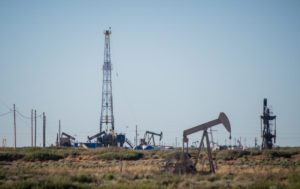
A rig drills for oil while pump jacks pull crude from the ground near Loco Hills in southeastern New Mexico. Most of the new oil investment in the state is coming from mid- and large-sized producers who can weather the price of $50 per barrel. Small, independent producers are having to hunker down until better times arrive. (Roberto E. Rosales/Albuquerque Journal)
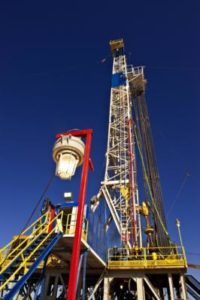
on a Devon Energy well
pad on New Mexico’s
side of the Permian
Basin. (Courtesy of
Devon Energy)
Billions of dollars in new investment is flowing again in southeast New Mexico’s oil patch. Production is up, service companies are putting people back to work and more revenue is flowing into state coffers.
But by all accounts, it’s a modest recovery at best compared with the boom times of just a few years ago. Full recovery isn’t on the horizon yet. And, notwithstanding renewed confidence among producers, even the moderate gains achieved to date remain tenuous given the widespread uncertainty about oil prices going forward.
Many believe this is the new normal, at least for now, with most fresh investments coming from mid- and large-sized producers who have the cash to generate returns at $50 per barrel. Hundreds of others – small, independent producers who operate marginal stripper wells – are hunkering down to keep what they already have going until better times arrive
Crude price plunge
A truck delivers water for use in oil wells west of Hobbs. New Mexico’s oil output is at record highs. (Roberto E. Rosales/Albuquerque Journal)
Things are certainly better than they were in 2015 and early 2016, when world oversupply sent prices plummeting from historic highs of above $100 a barrel to below $30. That forced nearly all new exploration and drilling operations in New Mexico’s side of the Permian Basin to a screeching halt.
Active drilling rigs fell from about 100 before the crash to 15 by early last year. Between 12,000 and 18,000 workers lost their jobs, including both direct and indirect employment.
That, in turn, pushed the state budget into crisis, forcing lawmakers to cut spending by hundreds of millions of dollars in the last three years as revenue from taxes on oil production and related activities plunged.
But the price has since rebounded significantly, thanks largely to the Organization of Petroleum Exporting Countries’ decision last November to cut production by u
p to 1.8 million barrels per day. Prices for U.S. benchmark crude climbed above $50 per barrel earlier this year. It’s since fluctuated in the $45 to $50 range.
That, combined with new technological advances and operational improvements by companies to reduce costs, has allowed many mid- and large-sized producers to start drilling again for new oil. Particularly so in the Permian Basin, one of the country’s most-productive reservoirs, where operators use advanced techniques to crack open hard shale rock, releasing high-yield gushers that bring immediate returns on investment even at today’s moderate prices.
“The Permian’s geology makes it very attractive,” said New Mexico Oil and Gas Executive Director Ryan Flynn. “With all the technological advances, it’s a low-risk environment that’s made the whole area very resilient. Production there continues to increase.”
Unprecedented investment
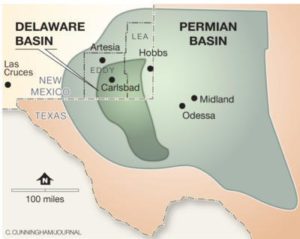
About 60 drilling rigs are now back at work in New Mexico, particularly in the Delaware Basin, an oval-shaped, shale-rock formation that protrudes from southwest Texas northward into Lea and Eddy counties. That zone’s lucrative potential is attracting unprecedented interest from some of the world’s largest producers, including ExxonMobil, which announced a $5.7 billion investment there early this year.
The Navajo Refining Co.
in Artesia. About 60 drilling rigs
are now back at work in
southeastern New Mexico,
particularly in the
Delaware Basin, an
oval-shaped, shale-rock formation that
protrudes from southwest Texas
northward into Lea and
Eddy counties. (Roberto
E. Rosales/Albuquerque Journal)
Since last September, mid- and large-sized companies have committed nearly $16 billion to investments in the Delaware to acquire lease holdings, initiate new drilling operations, and construct more pipelines and oil-and-gas gathering and processing infrastructure, said Daniel Fine, a longtime New Mexico-based energy analyst.
“There’s up to five layers in the Delaware that an operator can drill continuously through and claim all the reserves,” Fine said. “There’s a study underway by the U.S. Geological Survey that I expect will show up to 30 billion barrels of recoverable oil equivalent in the Delaware.”
That compares to 20 billion barrels the Geological Survey estimates for the neighboring Midland Basin in West Texas.
Increased activity is pushing New Mexico output to record highs. Average monthly oil production hit 13 million barrels a day from January through May, up from 12 million in 2016. Total output reached 65.5 million barrels in the first five months, up from 60.1 million in the same period last year.
That’s having an impact on jobs and state revenue. Unemployment in Lea County dropped from a high of 9.4 percent last October to 7.9 percent in July, according to the state Department of Workforce Solutions. And, rather than the chronic budget deficits faced in recent years, the state is expecting $25 million in new money for fiscal year 2019.
Looming oversupply
But that’s a far cry from the robust revenue streams before the oil crash, when both high production and record prices combined to fill state coffers. And unemployment in Lea County is still much higher than before the crisis.
“We’re getting some stability,” said Senate Finance Committee chair John Arthur Smith. “But it’s not a lot of additional revenue. Rather, we’re just not facing an emergency situation like before.”
Increased production improves things, but prices need to climb to the mid-$60s or beyond to significantly improve the budget, Smith said. For each $1 drop or increase, New Mexico loses or gains between $7 and $10 million.
But that’s unlikely in the short term. OPEC production limits are expected to end next March, and the U.S. Energy Information Administration projects domestic production will reach an all-time record of 10 million barrels a day in 2018, potentially creating another oversupply crisis and downward pressure on prices.
And in the meantime, even if prices remain stable at current levels, New Mexico’s small, independent producers are unlikely to initiate new production.
“Our company hasn’t drilled a new horizontal well this year, and we don’t plan on doing it,” said Raye Miller, president of Regeneration Energy Corp. in Artesia. “We just don’t see investment of new capital warranted at these price levels.”
By: Kevin Robinson-Avila (Albuquerque Journal)
Click here to view source article.
Taos Officials Celebrate New Airport Runway
Kenyon Rainer, with Star Road Dance Company from Taos, walks across the apron at Taos Airport on Friday. He and his family sang and danced at a grand opening for the new 1.5 mile Crosswinds runway at the airport. (Eddie Moore/ Journal)
After decades of discussion, controversy and litigation, Taos officials threw a party Friday to celebrate a new, longer runway and expansion at the municipal airport north of town.
Town leaders hailed the $26 million project as a boon for tourism and economic development, and much more.
“This isn’t just an airport runway,” Mayor Dan Barrone said. The project “is about new economic opportunities and partnerships that will increase accessibility between Taos and the world, between Taos and new tourism opportunities.”
Work on the 1½-mile runway, which is perpendicular to the single pre-existing landing strip, started in 2015. Discussion of the project began about 25 years ago.
The new runway, about 3,000 feet longer than the old one, is intended to increase the number of planes that can land and improve safety at an airport known for windy conditions at high altitude on the Taos mesa.
Federal Aviation Administration administrator Michael Huerta said at Friday’s event that the second runway would help pilots during blustery conditions by providing a second option depending on which way the wind is blowing. The longer runway also makes it easier for all aircraft to land in varying weather conditions, he said. The federal government provided most of the funding for the expansion.
“For me, this is one of the most satisfying projects we’ve completed during my tenure with the agency,” Huerta said. “Because an airport is, in a sense, a treasure. It’s a lifeblood of a community, an asset that leverages so many different things.”
In addition to private planes, Barrone said users will include aircraft for fighting wildfires, search-and-rescue teams and transporting patients. “Because of this project, lives will be saved,” the mayor said.
Opponents maintain that more airplanes mean more pollution and lower property values and that the airport will benefit only the wealthy with private planes, including part-time residents whose increasing numbers erode local culture. About two years ago, a state court judge rejected a challenge to the airport plans and how they was approved by Taos County. But opponents have gone to the New Mexico Court of Appeals, which has agreed to hear the case.
Barrone said the new runway represents fulfillment of a “sacred pledge” to keep air traffic away from Taos Pueblo, a UNESCO World Heritage Site.
Drummers and dancers from Taos Pueblo were present for Friday’s celebration, but pueblo officials did not attend. They had long opposed airport expansion but supported the project following an agreement that planes can’t fly lower than 5,000 feet over pueblo land.
The airport sees an average of 400 or 500 flights per month. Airport manager John Thompson said the FAA estimates the number of flights will increase 5 percent annually for the next five years.
Thompson said within the next three years, the airport would like to start using the new runway for small, commercial flights.
Barrone said local officials would like to see flights connecting to Santa Fe and Denver, to help attract national and international travelers.
Mike Garcia, the project engineer, said he hopes the town will help those still apprehensive about the runway see its benefits for the entire community. “Now that it’s done, I hope it helps bring the community together … I hope the community starts to accept it,” Garcia said.
By: Megan Bennett (Albuquerque Journal)
Click here to view source article.
Empty Acres, Room to Grow
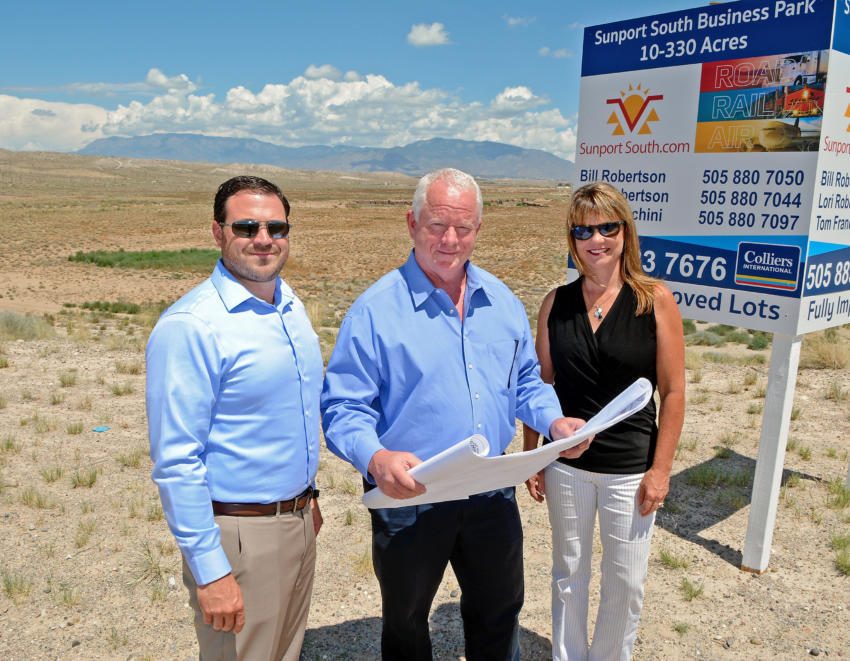
Tom Franchini, left, Bill Robertson and Lori Robertson survey the 550-acre site of Sunport South Business Park.
(Jim Thompson/Albuquerque Journal)
If your business involves warehousing, light or heavy manufacturing or data center activity, know this: Developers of business parks in the Albuquerque area are eager to be your landlords.
Thousands of empty acres zoned for industrial use are envisioned as future hubs of economic activity. The owners, both public and private, are working to make them shovel ready for future tenants – ranging from humble startups looking to expand to those of the caliber of social-media giant Facebook, which is building a $250 million data center in Los Lunas.
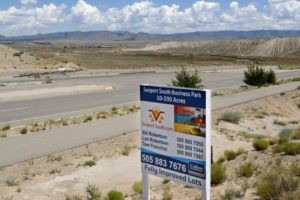
The wide-open high desert real estate at Sunport South Business Park holds the promise of new jobs. (Jim Thompson/Albuquerque Journal)
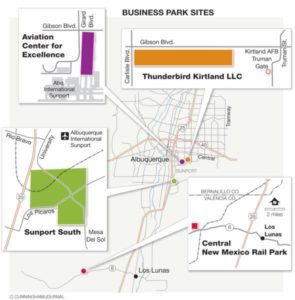
Industrial real estate matters because it is a major driver of employment, say economic development officials and brokers, though success of the developments is predicated on economic growth in the region. Four ambitious industrial developments have hit the market in the past couple of years: Sunport South Business Park; the Central New Mexico Rail Park; the Aviation Center for Excellence at Albuquerque International Sunport; and a new development partnership recently announced by Kirtland Air Force Base.
They are casting a wide net, pitching to site selectors at industry gatherings and other referral sources, and emphasizing their various logistical advantages, such as access to major highways, an airport and rail lines.

Gary Tonjes
It’s good for prospects to have many choices, but serious buildouts will take time, said Gary Tonjes, president of Albuquerque Economic Development Inc. The private, nonprofit membership organization keeps an inventory of sites for selection consultants scouting the metro area, nurtures the relationships and connects prospective businesses to brokers. “This (marketing) process is a two- to three-year” undertaking, said Tonjes, taking a long view on business park development that could be populated by e-commerce, distribution and manufacturing facilities
“It’s also about making sure we’ve got sufficient inventory of functional, flexible modern buildings available so we can attract good prospects who create jobs and contribute” to our tax base, Tonjes said.
But prospects are not just looking for a piece of land. “That piece of land has to be ready to go,” said Bill Robertson of Colliers International’s Albuquerque office, which is marketing the Sunport South business park. “Not having enough built sites available is the biggest deterrent” to attracting clients to the region, said Robertson,
Sunport South
The long-term success of the industrial park south of Albuquerque International Airport will be its access to the city’s freeway system – with companies located there “that are running trucks all day,” according to Robertson. He said a large retailer already has been scouting the park for a shovel-ready space to house 100,000 square feet geared to warehouse/distribution activity.
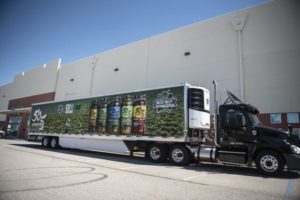
Commodities that need to be transported need warehouse space. Flagship Food Group, producer of 505 Southwestern chile products, is expanding to this facility at 530 Airport Drive NW. (Roberto E. Rosales/Albuquerque Journal)
Sunport South is targeting owner-builders with the money to build their own facilities or teaming on build-to-suit projects. Robertson hopes to broker transactions and make tenant announcements by the first quarter of 2018. “Once there’s activity at the site, one deal will lead to another,” he said.
Phoenix-based owner/developer Horne-Stewart LLC hired Colliers to drum up interest in the park, where lot sizes range from 10 to 69 acres, said Robertson. Horne-Stewart is spending a couple million dollars on infrastructure, which includes soil compacting, grading, water pumping, and road and bridge improvements. The business park has 408 acre-feet of ground water rights, which would be ideal for users needing water for cooling equipment, process uses, cleaning and steam generation. The 550-acre park also is equipped with natural–gas lines, electricity, water and sewer lines. About 200 acres will be devoted to bike trails and walking paths.
Central New Mexico Rail Park
A new industrial park served by rail is proposed for a 1,400-acre site west of Los Lunas by project developer Rio Real Estate Investment Opportunities. The Central New Mexico Rail Park is designed for large land users, such as third-party logistics operations, as well as sites for manufacturing, warehouse and distribution opportunities, said Rob Dyche, owner-broker for Rio Real Estate. To enhance its marketability, Bernalillo County provided a $400,00 grant to help pay for a rail spur to the Burlington Northern Santa Fe main line.
Dyche said the rail park is primarily marketing to large-scale manufacturer such as Niagara, a water bottling business that now calls the Rail Park home. Niagara took over 160,000 square feet of the former Merrilat cabinet factory. The rail-reliant company, which employs about 50 people, invested about $20 million in tenant improvements, including bottling equipment and water pumping costs, said Dyche. Niagara ships its bottled water out on milelong trains headed for customers at Walmart stores.
Aviation Center for Excellence
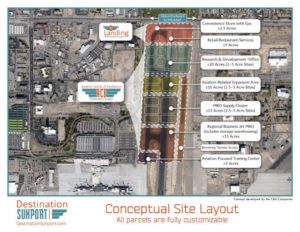
This conceptual rendering shows the potential layout slated for a former Albuquerque International Sunport runway. (Courtesy of City Of Albuquerque)
The center is getting about $8 million in improvements, such as asphalt and concrete removal, enhanced access from Gibson and Girard, interior roadways and utility extensions, said airport spokesman Dan Jiron. “We should be ready for tenants in late November or early December,” said Jiron. Jiron said the ideal businesses would be those needing access to an airport runway system, proximity to a military base or both.
Thunderbird Kirtland
Another contributor to the airport submarket is a recently announced venture between Kirtland Air Force Base and a company called Thunderbird Kirtland Development Ltd. The two entities are hashing out a long-term lease for 100 acres along Gibson Boulevard, which is expected to be concluded in the next six months.
In July, the Air Force announced that it had retained Thunderbird Kirtland to develop a research park with office, industrial, retail and hospitality facilities.
Thunderbird consists of Albuquerque-based Yearout Companies, Dekker/Perich/Sabatini architects and IDP Development out of San Antonio, a business with expertise in enhanced use leases at military installations, said Kevin Yearout, CEO of the Yearout Companies. Thunderbird is putting together a business development plan that targets defense contractors and vendors complementing the mission sets at Kirtland, said Yearout.
Existing space
Commodities that need to be transported need warehouse space. Flagship Food Group, producer of 505 Southwestern chile products, is expanding to this facility at 530 Airport Drive NW. (Roberto E. Rosales/Albuquerque Journal)
When suitable existing industrial buildings come on they market, they do get snapped up. One example is the nearly 80,000 square-foot warehouse in the Meridian Business Park at 530 Airport Drive NW that Flagship Food Group recently announced it would occupy. The company makes frozen Mexican-style frozen entrees and salsas under the 505 Southwestern banner.
As the company grows, the new location helps Flagship meet its need for better logistics. That’s because the production plant, which Flagship opened three years ago at Desert Surf Circle NE, no longer has enough room for dry and cold storage prior to shipment via truck, said Carlos Angulo, Flagship’s chief operating officer.
He said Flagship was competing for the space with other potential tenants.
The new warehouse, near I-40, is an ideal way-station between production plant and customers, mostly chain grocers in other states, said Angulo. Tenant improvements at the warehouse will total $3 million, including a massive subzero temperature freezer – about 36,000 square feet in size.
Not only will the landlord profit from a ten-year lease, but Flagship will add 200 new manufacturing and distribution jobs company wide.
The state is provide $550,000 for Flagship’s expansion through the closing fund established by the Local Economic Development Act.
By: Steve Sinovic (Albuquerque Journal)
Click here to view source article.


