Gene Ventura of Faris Lee weighs the benefits in this EXCLUSIVE interview.
Ventura: “Long gone are the days when senior housing projects were developed in remote locations tucked away from everything.”
As e-commerce continues to alter the retail industry, owners have turned to ever more creative solutions to fill vacant properties left in the wake of this transition. Should senior housing be one of the options? That’s one of the suggestions from Gene Ventura, senior managing director at Faris Lee Investments. GlobeSt.com met with Ventura to hear more.
GlobeSt.com: Has retail been overbuilt? If so, what properties are most likely at risk?
Gene Ventura: With the recent flurry of retailer closures and less to backfill these vacant sites, it is apparent that we are overbuilt even in highly trafficked areas. According to Cowen and Company’s research analysts, the US has about 40% more shopping space per capita than Canada. Although overall retail spending continues to rise steadily the face of American shopping has changed.
GlobeSt.com: What other uses make sense?
Ventura: Innovative retail is expanding and replacing outdated product as a direct result to how consumers have changed the way they shop digitally. Companies with new digital concepts like Kendra Scott Jewelers, Warby Parker, and Nespresso are thriving. We are seeing the greatest transformation of the retail landscape in modern day history delivering experiential concepts to a demanding Millennial generation.
As we all know, location is the driving factor for retail. Malls, grocery-anchored and daily-needs centers are usually a quick drive or walk from suburban neighborhoods. With big boxes closing and threats of major retailers going out of business, there is vacant space opening up in prime locations ready for redevelopment. This trend provides developers with an ideal opportunity to consider senior housing projects as the locational demand for this product type mirrors that of suburban retail. Long gone are the days when senior housing projects were developed in remote locations tucked away from everything!
GlobeSt.com: Why does senior housing top your alternative-use-for-retail list and how does it benefit nearby retail?
Ventura: There are a few key reasons why senior housing is an ideal solution to replace struggling big box centers or largely vacant strip malls in suburban areas:
Demographics: According to the United States Census, the total population age 65 and older is roughly 48 million which is 15% of the total population. This is up 1.6 million from 2014 and this large demographic continues to grow, and likewise, demand for senior housing grows.
Downsizing in the community: Baby Boomers originally moved to the suburbs decades ago to raise families and now want to downsize; however, they want to remain in the community they have long called home near their friends, children and grandchildren.
Amenity-rich location: They are prime sites for senior housing because they are typically near a variety of other thriving retail centers, medical services, restaurants, and array of other amenities seniors wish to be near.
Retail-friendly demographic: A large portion of Baby Boomers have money to spend and they like to shop in stores as opposed to online. This makes for a symbiotic relationship between nearby access to senior housing and retail.
GlobeSt.com: How are you advising clients that may consider converting all of or a portion of their retail property to senior housing?
Ventura: As a firm specializing in retail, we work with a lot of owners on how best to position their retail asset and sometimes senior housing is an ideal fit.
We usually see two kinds of owners of retail property in need of help: 1) Those that have assets with a high vacancy that can’t be filled; 2) Those that have excess land, but it doesn’t make sense to develop additional retail. Either way, we advise our clients to help create a strategic plan to monetize their assets as opposed to just sitting on them and losing money. We are working on a couple projects right now that involve converting retail-zoned land into senior housing. Ultimately, these owners will see their under-performing property turn into a stable, cash-flowing asset with returns that far exceed current levels.
By: Geoffery Metz (GlobeSt)
Click here to view source article.
Archives for November 2017
CARNM Commercial Source: Local Apartment Investment Trends Show Steady Improvement by Todd Clarke CCIM


In a world where investors can move their capital to any city offering higher returns, Albuquerque offers three competitive advantages over other similarly sized markets:
1. Availability of small investor inventory
2. Steady investment growth
3. Ability to ladder up
Inventory
Small inventory availability in Albuquerque is demonstrated by the number of apartment investments that are four (4) units or smaller. Currently those buildings that contain fewer than 4 units make up 13% of the total number of apartment units, but 74% of the apartment buildings. This large inventory of smaller apartments allows an investor ease of access into the market, more so that competing cities like Phoenix, Las Vegas, Tucson and Denver.
Growth
Albuquerque’s historical growth trend has allowed it to avoid the volatility of many competing markets that have a boom or bust mentality. Although all real estate is cyclical and often follows national and local economic cycles, the underlying fundamentals of apartment investment have been steadily improving. The most exciting apartment demand fundamentals are driven by one trend shared by two major demographics, the Millennials and the Baby Boomers.
Millennials, those who are 35 years and younger are choosing to rent 65% of the time, inverting the historical ownership trend where 65% of previous generations preferred to own. These Millennials are looking for locations with high quality social experiences, often found with a walk-score metric. In fact, a recent study by the Apartment Association of NM demonstrated that those communities that scored in the top 10% of walkability, public transportation or biking achieved rents 25% higher than average. The most sought-after submarkets for this generation include Downtown, Old Town, and anywhere with a high number of local brew pubs and craft coffee shops.
The second component of this trend is driven by the Baby Boomer generation, those who are 55 years or older. This generation is starting to downsize, eliminate weekly housing maintenance chores, and desires the same kind of urban experiences preferred by the Millennials. Said another way, they also seek the collection of experiences over the collection of things. In the coming years, look for more and more rental housing that caters to the Baby Boomers by offering the Disneyland clean versions of urban housing in submarkets like Uptown and Nob-Hill
These two generations make up 50% of the current demographic and their increasing demand translates to increased rental levels and leads to higher property values
Laddering up
Albuquerque’s unique blend of the above two trends has allowed investors to start with a small down payment and grow their portfolio over time. It has experienced investors who started with a fourplex in college who have retired with 200+ unit portfolios, often entirely free and clear of any debt.
Future trends
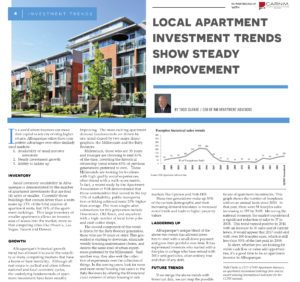
If we merge the above trends with historical data, we can map the possible future of apartment investments. This graph shows the number of fourplexes sold on an annual basis since 2000. In that year, there were 51 fourplex sales increasing to 215 by 2005. Mirroring the national economy, the market experienced a significant reduction of sales to 37 in 2008. This trend turned positive in 2014 with an increase to 76 sales and at current levels, it would appear that 2017 could end with over 100 fourplex sales, which is still less than 50% of the last peak in 2008.
In short, whether you are looking for stable cash flow or value add opportunities, it’s a good time to be an apartment investor in Albuquerque.
By: Todd Clarke CCIM, NM Apartments Advisors, Inc (HomeStyle Magazine by Albuquerque Journal)
Click here to view source article.
Click here to view source PDF (article only).
Real Estate Roundtable Explains Congress’ Tax Reform Proposals
“At a time when other countries are doing everything they can to catch up with us, our highly developed partnership tax rules have helped us stay the forefront of start-up and entrepreneurial activity.”

Congressional Republicans are close to fulfilling a promise they have made repeatedly for years, comprehensive tax reform.
On the business side, the core elements of tax reform are a reduction in the corporate tax rate, a restructuring of the tax rules for multinationals, and some form of tax relief for pass-through businesses. Commercial real estate is primarily constructed, owned, and managed by businesses and entrepreneurs operating in pass-through form.
We asked Real Estate Roundtable CEO Jeffrey DeBoer and Roundtable Senior Vice President Ryan McCormick to help GlobeSt.com readers understand what type of relief Congress is considering for pass-through businesses, and what it could mean for both the commercial real estate industry and the broader economy.
We have been hearing for years that our corporate tax rate and rules are hurting US competitiveness. Why are pass-through businesses part of the tax reform conversation?
DeBoer: Today, most economic activity in the United States is conducted by pass-through businesses—partnerships, LLCs, S corporations, REITs, and sole proprietorships. In 2013, the most recent year we have data, pass-throughs generated nearly 62 percent of total business income. Well over 90 percent of small businesses (500 or fewer employees) are organized in pass-through form, and remarkably, these businesses created more than 60 percent of the net new jobs over the last 25 years.
Increasingly, the focus of US corporations is on their global operations and activities, which are vast and complex. Pass-through businesses, in contrast, are the principal employer and, in reality, the economic engine of the domestic economy.
Early on, policymakers recognized that in order for tax reform to spur real economic growth, they would need to encourage capital formation, investment, and job creation at all levels of economic activity, including pass-through businesses.
OK, so pass-through businesses have grown and now represent over half of the business activity. Other than the lack of an entity-level tax, what is their great appeal? Why do they deserve special treatment?
DeBoer: The ability to use the pass-through, partnership form to flexibly and effectively raise capital and conduct business is one of the great American innovations of recent decades. At a time when other countries are doing everything they can to catch up with us, our highly developed partnership tax rules have helped us stay the forefront of start-up and entrepreneurial activity. They are a critical part of our “intangible infrastructure”: the legal, regulatory, and tax system that makes the United States the envy of the world when it comes to entrepreneurship, risk-taking, and productive investment.
Take the case of real estate. Partnership tax rules in the United States facilitate new construction, increased investment, and job creation—much more than would occur if every owner was forced into the corporate form with a single class of stock. In partnerships, real estate professionals can join forces with institutional investors or other passive owners and allocate the risks and rewards of the business however they choose, as long as the arrangement has “substantial economic effect.” In reality, virtually every partnership agreement is different. The result is a much more dynamic and robust commercial real estate industry that reacts quickly to the changing needs and demands of America’s communities. This same phenomena plays out in other industries—our flexible partnership tax rules promote capital formation and the allocation of risk in ways that accelerate investment and create jobs.
And that’s just partnerships. Our tax rules related to real estate investment trusts (REITs) have made it possible for individuals at all income levels to efficiently and responsibly invest in professionally managed real estate. Our REIT rules have been such a success that they are now being rapidly adopted and implemented in countries around the world.
Aren’t pass-through businesses already tax advantaged, compared to corporations? Do they really need the relief?
Ryan McCormickDeBoer: Currently, the tax rate on pass-through businesses can get as high as 43.4% (39.6% plus 3.8% tax on net investment income, which includes rental income). Corporations pay a top rate of 35%, and corporate income may be taxed again (at a top rate of 20%) if it is distributed to shareholders. Of course, corporations don’t have to distribute their income, and many don’t. For example, Berkshire Hathaway, Warren Buffett’s firm, hasn’t paid a dividend in over 50 years. Corporations can permanently defer the second level of tax. In contrast, the owners of pass-through business are taxed on the business’s net income every year, even if the profits are reinvested in the business and not distributed.
In light of corporations’ permanent tax deferral, if the corporate tax rate was reduced to 20%, and the top pass-through rate remained where it is today, the tax burden on partnerships and other pass-through businesses would be roughly double that of large corporations.
Combined, the outsized and important role that partnerships and other pass-through businesses play in the economy, and the relatively high tax rates on pass-through income, it is critical that meaningful tax reform include robust relief for pass-through businesses.
The full House of Representatives has passed its version of tax reform. What are they proposing for pass-through businesses?
McCormick: The House bill would create a new, reduced rate for pass-through business income of 25%. In addition, a lower rate of 9% rate for small businesses would be phased in gradually over five years. Eligibility for the 9% rate would phase out for taxpayers filing a joint return with incomes over $150,000 ($75,000 for singles).
For months, critics have suggested that taxing pass-through income at a lower rate would lead wealthy individuals to shelter their income in LLCs or S corps. The House drafters developed a creative and effective solution to this concern. First, the bill would not allow investment income—capital gains, dividends, interest, and similar portfolio income—to qualify at all for the 25% rate. Second, the bill would prevent taxpayers from converting their wages and other compensation for services into income taxed at the 25% rate.
Under a default rule of “safe harbor.” active business owners, i.e., owners who are actually providing labor and services to the business, would be taxed at the reduced rate on 30% of their pass-through income (0% in the case of personal services businesses). Alternatively, the owner could qualify for a higher percentage if they have significant capital invested in the business.
The passive owners of a pass-through business, i.e., limited partners or outside investors who are not being compensated for providing labor or services to the business, would get the full benefit of the 25% rate.
In so doing, the House bill creates strong “guard rails” against abuse of the pass-through rate, while creating a powerful new incentive that would attract capital and investment to entrepreneurial activities.
What is the Senate proposing? Would it differ from the House approach?
McCormick: The Senate pass-through proposal differs dramatically from the House approach. First, rather than a reduced tax rate, the Senate creates a 17.4% deduction for qualifying pass-through income. The deduction translates into the equivalent of a 6.7% rate reduction (less than half of the 14.6% rate reduction in the House). Second, the Senate proposal is temporary and would expire at the end of 2025.
More importantly, the Senate includes an odd rule that limits the total deduction to no more than 50% of W-2 wages paid by the business. Thus, if the total direct wages of the partnership represent less than one-third of business profits, the taxpayer would not qualify for the full 6.7% rate reduction.
Moreover, the Senate bill lacks effective guard rails against abuse. For example, employees could recast themselves as independent contractors and fully benefit from the pass-through tax benefit. In contrast, under the House proposal, taxpayers who provide labor or services to the business only qualify for the benefit to the extent that they have capital invested, or it is not a personal services business.
OK, that is the general structure of the House and Senate proposals. How do you see these concepts working in the case of commercial real estate?
McCormick: It is important to keep in mind that this debate is about the operating profits of a business. It is unrelated to capital gains and asset appreciation, which is so important to real estate investment. In our case, this is really about how the government taxes the leasing income generated from commercial real estate tenants.
Real estate has a life cycle, and early on, significant capital is spent constructing, improving, and repositioning properties to their most productive use. At the front end, a lot of risk is borne by general partners and investors, and significant operating profits may not emerge for many years. By distinguishing between active and passive investors, and allowing active owners to get the reduced rate to the extent of their investment in the business, the House model is well-designed for capital-intensive businesses, like real estate or energy, that pool capital from many sources. It would help attract investment to the industry, that would be used to put people to work.
By limiting the pass-through deduction to no more than 50% of the entity’s W-2 wages, the Senate proposal largely eliminates the potential benefit for commercial real estate. Unless a business spends 35% of its income on W-2 wages, it will not qualify for the full deduction. This penalizes businesses that put lots of people to work indirectly, but don’t have large direct payrolls, such as real estate partnerships that put capital at risk for a new project and hire contractors, subcontractors, architects, engineers, brokers, and many others. All of this labor activity is put in motion by the initial deployment of capital, which is disregarded under the Senate proposal.
Are there related provisions that could affect capital formation and investment in pass-through businesses?
McCormick: Another proposal, which first emerged for the first time when the Senate bill was introduced two weeks ago, would prohibit general partners and other active owners of pass-through businesses from currently netting all business losses against their wages and investment income. The proposal appears to be aimed at preventing tax rate arbitrage (active pass-through income is preferred, while losses would be deducted against high-taxed income). However, the same could be said for the deferred tax liabilities of corporations. In the corporate context, deductions were claimed against high-rate income, but the income will now be taxed at a reduced rate.
The effect of the Senate’s active loss limitation proposal is to discourage entrepreneurship—for example, if an executive uses her evenings and weekends to go out on her own and start a new business, and the start-up loses money in the early years as it gets off the ground, she would be out the cash but still taxed on her full salary. It is very hard to understand how such a harsh proposal fits in with “pro-growth” tax reform.
Does the Real Estate Roundtable have a strong preference for the House or Senate approach? Why or why not?
DeBoer: Tax reform that spurs growth and jobs in the underlying economy will be good for the commercial real estate industry, provided it does not alter the basic principle that real estate should taxed on an economic basis, avoiding excessive incentives or disincentives that distort business decisions.
We are concerned that eliminating the deductibility of state and local taxes will harm many local communities and disrupt demand for commercial real estate in certain markets. We are also concerned about potential changes in the incentive for homeownership, which has so many benefits from neighborhoods and the overall economy. Lastly, tax reform that leads to large deficits could have adverse economic consequences over the long term.
But unlike early tax reform blueprints, both the House and Senate bills generally preserve rules that tax real estate based on the economics of transactions—e.g., the deductibility of business interest, cost recovery, and like-kind exchanges.
Reducing the tax burden on pass-through businesses is an opportunity to spur entrepreneurship and give a real lift to America’s true job creators—the partnerships, family businesses, and others who drive economic activity here at home, including commercial real estate. This effort should not be relegated to the back pages, an afterthought in the race to reduce the corporate tax rate.
The Roundtable favors the House pass-through proposal, which recognizes that not all owners of pass-through businesses are the same—some owners run the business, whereas others are just investors. The House approach promotes capital formation and job growth while avoiding potential abuse by looking to the active owner’s investment in the business. It will be a powerful catalyst for entrepreneurship that reduces the cost of capital for businesses that lack easy access to public equity markets.
Is the Roundtable advocating for specific changes?
McCormick: If policymakers opt for the Senate approach, they should remove counterproductive rules that would restrict the ability of capital-intensive businesses to qualify. The final pass-through provision should recognize that not all job creators have large direct payrolls and eliminate the W-2 wage restriction. Property owners and developers deploy capital that leads to immense labor activity, and they should not be penalized under the final bill.
The W-2 wage restriction would lead to tax-motivated restructuring. Firms will seek to “game” the rules by merging labor-intensive and capital-businesses under one roof. Others will look to “in-source” job functions, such as accounting or janitorial services, to boost their W-2 wages. These are functions that are more efficiently conducted in the hands of specialized businesses. That is exactly the type of tax-motivated, uneconomic activity that tax reform should discourage.
Great overview, what are the next steps in the process and what is the timing?
DeBoer: After years of debate and discussion, tax reform is now moving forward at break-neck speed. The House has passed its bill, and the full Senate could pass its version as early as the week after Thanksgiving. While much has been made about their differences, the reality is that the two bills are remarkably similar. The major outstanding issues include the state and local tax deduction, homeownership tax incentives, and relief for pass-through businesses. Assuming Senate Leaders can bring along reluctant Members—an open question right now—we believe tax reform could be on the President’s desk before Christmas. That is why it is critical for those in our industry to fully understand what’s on the table and what’s at stake.
By: Erika Morphy (GlobeSt)
Click here to view source article.
CRE’s Gap In Emerging Technologies
Owner-operators and owner-investors are challenged with finding a balance between operational benefits delivered by existing technology and the potential disruptive impact to business models by what’s coming next,” says Altus CEO Robert Courteau.
“Organizations that will lead the way as the next wave of technology arrives are those that seek to change the rules of the game,” says Courteau.
There’s a gap between the impact of emerging disruptive technologies on commercial real estate and CRE executives’ recognition of that impact. That’s among the findings of the Altus Group’s latest CRE Innovation Report showing division among industry leaders at owner-operator and owner-investor firms about the potential of new technologies to drive change.
“CRE firms are facing the challenge of finding a balance between operational benefits delivered by existing technology and the potential disruptive impact to business models by what’s coming next,” says Altus CEO Robert Courteau. “Organizations that will lead the way as the next wave of technology arrives are those that seek to change the rules of the game by disrupting traditional business processes and models, adding greater value and gaining competitive advantage.”
Conducted among 400 CRE executives with a total of more than $2 trillion of assets under management globally, Altus’ study found that respondents who recognized the disruptive potential of six emerging technologies were in the minority. These included smart building technology (35% of respondents), artificial or machine intelligence (28%), big data and predictive analytics (24%), augmented and virtual reality (18%), blockchain technology (14%) and driverless vehicles (9%).
On the other hand, a sizable majority of respondents said their firms have benefitted from technology investments made over the past two years. Eighty-six percent of respondents with AUM greater than $500 million cited cost and operational efficiencies that have resulted from these investments, for example, with firms of of between $250 million and $500 million in AUM not far behind on a percentage basis.
And more than half the respondents saw strong potential in process automation for tasks including debt underwriting and property management. “Debt underwriting, especially for stabilized real estate assets, will eventually be performed almost exclusively by artificially intelligent bots, and not human labor,” the report quotes MetaProp NYC cofounder Zach Aarons as saying. “However, in the meantime, technology will enable human commercial loan officers to underwrite better and faster, creating more value for their companies and themselves.”
The Altus survey also found that just 14% of executives compared their operational expenses against competitors, the market or industry, indicating what Altus calls “a significant performance management shortfall.” However, 69% said they believe there is significant potential to conduct better benchmarking around operational expenses. These result suggest that a deeper analysis of property expenses is an overlooked area in terms of applying analytics and monitoring, and has the potential to unlock greater portfolio value.
Fifty-eight percent of survey respondents said their firms are using significantly more CRE-specific applications now than they were three years ago. Yet 59% also said they don’t have significant integration between major management systems and applications, a mismatch that can hinder their ability to make faster and more transparent decisions. Aggravating this gap is a shortage of technology staff, cited by 50% of respondents.
Among Altus’ recommendations to senior executives at CRE firms: anticipate what’s ahead, and understand what’s already here. “As PropTech helps to transform the CRE industry, it is important for executives to not just keep an eye on how emerging technologies may affect their own firms, but how they may change their interactions with the processes of other segments—such as lending,” according to Altus’ report. “Driverless vehicles, for example, may seem more distant in the future, but this ‘game-changer’ has the potential to fundamentally alter the way people think about the space that we occupy and the locations of our places of work and home.”
The survey of executives in both front- and back-office positions was conducted in September by IDC on behalf of Altus. The full report can be downloaded here.
By: Paul Bubny (GlobeSt)
Click here to view source article.


