• Skip to primary navigation
  • Skip to main content

CARNM

Commercial Association of REALTORS® - CARNM New Mexico

  • Property Search
    • Search Properties
      • For Sale
      • For Lease
      • For Sale or Lease
      • Start Your Search
    • Location & Type
      • Albuquerque
      • Rio Rancho
      • Las Cruces
      • Santa Fe
      • Industry Types
  • Members
    • New Member
      • About Us
      • Getting Started in Commercial
      • Join CARNM
      • Orientation
    • Resources
      • Find A Broker
      • Code of Ethics
      • Governing Documents
      • NMAR Forms
      • CARNM Forms
      • RPAC
      • Needs & Wants
      • CARNM Directory
      • REALTOR® Benefits
      • Foreign Broker Violation
    • Designations
      • CCIM
      • IREM
      • SIOR
    • Issues/Concerns
      • FAQ
      • Ombuds Process
      • Professional Standards
      • Issues/Concerns
      • Foreign Broker Violation
  • About
    • About
      • About Us
      • Join CARNM
      • Sponsors
      • Contact Us
    • People
      • 2026 Board Members
      • Past Presidents
      • REALTORS® of the Year
      • President’s Award Recipients
      • Founder’s Award Recipients
    • Issues/Concerns
      • FAQ
      • Ombuds Process
      • Professional Standards
      • Issues/Concerns
      • Foreign Broker Violation
  • Education
    • Courses
      • Register
      • All Education
    • Resources
      • NMREC Licensing
      • Code of Ethics
      • NAR Educational Opportunities
      • CCIM Education
      • IREM Education
      • SIOR Educuation
  • News & Events
    • News
      • All News
      • Market Trends
    • Events
      • All Events Calendar
      • Education
      • CCIM Events
      • LIN Marketing Meeting
      • Thank Yous
  • CARNM Login
  • Show Search
Hide Search

Archives for April 2021

US Retail Sales Increase 9.8 Percent in March, Surpassing Forecasts by Economists

April 15, 2021 by CARNM

WASHINGTON, D.C. — The U.S. Commerce Department reports that retail sales increased 9.8 percent in March, following a 2.7 percent decrease in February. The numbers surpassed the Dow Jones economists’ prediction of a 6.1 percent gain for the month. The sales growth is the biggest monthly gain since May 2020 (18.3 percent), which also came after a round of stimulus checks. According to CNBC, the newly issued stimulus checks gave consumers more discretionary income to spend on goods and services from retailers and restaurants than they had in February.

The sporting goods, clothing and food and beverage categories generated the greatest increases in sales since pre-pandemic. Bar and restaurants saw an increase of 13.4 percent, while sporting goods sales increased by 23.5 percent. Clothing and accessories retailers had an 18.3 percent increase, and motor vehicle parts and dealers experienced a 15.1 percent jump.

Some economists predict that people are still trying to save a portion of their stimulus checks. According to the CNBC, people saved 34.5 percent of stimulus checks and spent 29.2 percent. The news outlet also reported that inflation is becoming an increasing worry for economists as there has already been an increase in gas prices.

Source: “US Retail Sales Increase 9.8 Percent in March, Surpassing Forecasts by Economists“

Filed Under: All News

Surviving Retail in Troubled Times

April 14, 2021 by CARNM

The COVID-19 pandemic has exacerbated and accelerated already challenging circumstances for shopping malls and their owners, but there may be other options for these beleaguered assets.

Although 2020 is now in our rearview mirror, the impact of this turbulent year will be felt in the commercial real estate industry for years to come. While the industrial and apartment asset classes have navigated the COVID-19 pandemic relatively unscathed, the retail asset class has been battered by the pandemic. As the pandemic shuttered most of the U.S. economy in the second quarter of 2020 and caused retail sales to fall precipitously, many retailers were wounded. In some instances, those wounds were fatal, with as many as 25,000 stores expected to have closed in 2020.

Considering the social and economic upheaval that has occurred since that initial shock, retailers have experienced a wide variation in performance. Grocery stores, dollar stores, and other essential retailers have survived, and in some cases thrived, as the pandemic has unfolded. However, department stores, apparel retailers, restaurants, and other similar purveyors of non-essential goods have struggled.

Trouble at the Mall

American shopping malls faced significant adversity long before the coronavirus came to our shores. Amid the pandemic, those headwinds have only grown stronger. While department store sales have steadily declined in the past two decades, e-commerce sales have grown dramatically in the same time frame.

IA Winter 2021 -8

The closure in many areas of department stores like Sears, JCPenney, and Lord & Taylor along with retailers like Brooks Brothers and Forever 21 has created significant vacancy in shopping malls and placed tremendous financial pressure on shopping mall owners.

The Crystal Mall in Waterford, Conn., is a classic example of the challenges faced today by many B-class and C-class shopping malls which constitute approximately 70 percent of all the malls in the country. If you include restaurants and other nontraditional retail outlets, Crystal Mall has the potential to house 80 retail tenants. In 2018, Sears filed for bankruptcy and closed its anchor store there. This closure resulted in reduced customer traffic in the mall, which in turn hurt other retailers.  Since the Sears bankruptcy filing, six other retailers in the mall have filed for bankruptcy including JCPenney, Neiman Marcus, Men’s Wearhouse, Forever 21, and GNC. Retail industry experts project that there will be more retailers filing for bankruptcy protection in 2021. As of this writing, 35 storefronts in the mall are currently vacant. Between the bankruptcies, store closures, and prior vacancies, 44 percent of the available store space in this mall is vacant. Will it survive? The jury is still out, but it is doubtful. Is this the fate of similar B- and C-class shopping malls across the country?

Troubled Retail Assets

In order to understand the true magnitude of the troubled mall problem, it is instructive to examine the delinquency rate of retail commercial mortgage-backed securities (CMBS) since most retail shopping malls are financed with CMBS debt. As of December 2020, 12.94 percent of all retail CMBS debt is more than 30 days delinquent.

IA Winter 2021 -7

This delinquency rate has nearly tripled in the past 12 months. In many instances these delinquency numbers do not reflect some of the loans that have been designated as current, but those loans are current only because of the granting of forbearances and the authorization for borrowers to use replacement reserves to bring their debt service payments up to date.

Creative Solutions for Retail Properties

Some commercial real estate industry estimates note that total retail real estate square footage could contract by 20 percent by 2025 due to the growth in e-commerce sales, falling department store sales, retailer bankruptcies and other similar challenges. One major driver of this reduction in retail space will be the closing of B-class and C-class malls. Adaptive reuse of these failing retail properties as warehouse/distribution space, medical facilities, educational centers, and municipal and cultural facilities are options. Another option is to re-imagine these shopping malls as mixed-use urban town center properties that contain residential, vibrant retail, family entertainment, and office components.

The Randall Park Mall in North Randall, Ohio, is one example of successfully repurposing a closed shopping center. Opened in 1976, the mall contained 2.2 million square feet of retail space at its height. It included five department stores that served as anchors. In 1996, this mall began its decline and ultimately closed in 2009. It sat abandoned for several years and became a community eyesore. In 2018 the mall was repurposed as an Amazon fulfillment center that provides 2,000 local, full-time jobs as well as a new source of tax revenue for the community. The demolition and development of this 855,000-sf distribution facility cost $177 million.

Troubled shopping malls can be adaptively repurposed to provide new sources of tax revenue for municipalities and to inject new life into local communities. However, there are many political, legal, financial, and market challenges that can be encountered in the process.  For example, there may be zoning issues that must be addressed. The community may fear and oppose the proposed new use. The political establishment may perceive that there will be a loss in sales tax revenue. The property owner, the proposed user, the municipality, and all other stakeholders must work together to address these issues if the adaptive reuse is to be successful.

Troubled retail assets will be a part of the commercial real estate landscape as we progress through 2021 and subsequent years. Commercial real estate professionals can position themselves and their clients for success by providing creative, adaptive reuse solutions that address the market needs and demands.

Source: “Surviving Retail in Troubled Times“

Filed Under: All News

Had Enough ‘Disruption’ Yet? Economic Reflections After the (First) Summer of COVID-19

April 14, 2021 by CARNM

It is now nearly a quarter-century since the adjective ‘disruptive’ gained currency as a positive value, rather than referring to its prior pejorative meaning of ‘disintegrative’ or ‘misbehaving’. The popular embrace of ‘disruption’ as an engine of forward economic change dates from a 1997 book by Harvard professor Clayton Christensen, The Innovator’s Dilemma.1 In a way, this adoption of a stark metaphor to characterize progress is reminiscent of another Harvard professor, Joseph Schumpeter, who coined the phrase ‘creative destruction.’2 It is the same spirit as a venerable revolutionary slogan, ‘You cannot make an omelet without breaking some eggs,’ dating to 18th century France and popular in the civil unrest in the United States during the 1960s.3

At its best, this line of thinking reflects a willingness to discard comfortable but unproductive ways of doing things in favor of an innovative leap ahead. At its worst, however, the concept can become an apologia for mischief that covers the very high failure rate of economic experiments.

The incremental alternative of sustainable innovation has garnered fewer headlines over this last quarter century or so, but was at the heart of a previous approach to successful business. That approach focused on the concept of ‘continual improvement,’ a management philosophy most associated with W. Edwards Deming, whose advisory work with Japanese companies was widely credited with accelerating the post-World War II resurgence of the Asian economy.4

The pedigree for this incrementalist approach goes deep in history. Indeed Albertus Magnus, the 13th century philosopher, made a point that change typically moves through a sequence of intermediary steps. The great natural scientist Carl Linnaeus (18th century) gave us the pithy Latin statement natura non saltum facit (“nature does not make leaps”), which inspired Darwin a century later to trace the path of evolution in The Origin of Species. The founder of modern economics, Alfred Marshall, used this Latin phrase as the epigraph of his 1890 Principles of Economics, a text which laid out fundamental economic concepts still considered relevant to understanding economic utility, investment returns, supply and demand, and competition in the marketplace.5

Considering the Disruption of the Coronavirus Pandemic

One of Marshall’s key insights was that economics was not merely a study of wealth, and the activities that go into the creation of wealth. Rather, he considered economics as the study of human beings and their attainment and use of the material elements of well-being. Earning and spending money, he thought, found their interpretative context in the satisfaction of certain necessities of life, most particularly food, clothing, and shelter.

There can be no doubt that the Coronavirus and its active disease manifestation, COVID-19, have caused a major economic disruption. It may be thought that this disruption is different in kind from the examples considered by Christensen and Schumpter but, nevertheless, their thoughts are relevant to our economic situation and to the consequent conditions we find in the real estate markets. Moreover, the temptation to find a quick fix, a kind of leap, is especially strong amongst policy makers right now, and so the systematic perspective of Marshall can be a healthy corrective to some of the ‘magical thinking’ being applied to the restoration of the U.S. economy.

First, let’s look at the ways that the current economic downturn is properly called a ‘disruption.’ Over the years, my commentary has alluded to the five primary kinds of change we normally consider in real estate: cycles, trends, maturation, change of state, and disruption.6 Of these basic forms of change, three are ‘continuous’ change – cycles, trends, and maturation – and two – change of state and disruption – are ‘discontinuous.’7

Much of the standard economic commentary refers to the present condition as a recession. But that is not exactly accurate, if recession is fundamentally considered to be a natural, predictable phase of the business cycle. The danger in that way of thinking lies in the continuous and self-correcting characteristics of the business cycle, as understood by macroeconomics.8 In such a view, recessions – economic contractions that are widespread and of significant duration – are caused by imbalances in production or consumption, with those imbalances adjusted either by the mechanism of market prices, or by the interventions of fiscal or monetary policy. This is ‘continuous’ change that fits the pattern of the eight recessions I’ve experienced during my working career. But it does not accurately describe what is going on in 2020, nor what is likely to be transpiring over the next year or two.

To state the obvious, the economic downturn was triggered by a public health crisis, remains linked to that public health crisis, and the economic future will be shaped in response to that public health crisis. In other words, we should not be expecting economic self-correction to lead us into recovery and then into expansion. Virtually all economic models are predicated on a theory (and equations) anticipating a cyclical return to equilibrium. But just as no model forecast the current crisis, we should not place much confidence in forecasts expecting market forces to restore America’s economic momentum. As a lesson in humility learned by excessive reliance on econometric models, we can do no better than re-read Alan Greenspan’s Foreign Affairs essay, “Never Saw It Coming,” on the Global Financial Crisis (November/December 2013).9

Setting Sights on a Vibrant Future, Not a ‘Return to Normal’

At the time of the Great Depression, in the 1930s, America and the world faced a similar economic cataclysm, one which appeared intractable to either a “wait for the markets to correct” approach or to then-conventional policy approaches, such as protective tariffs to shield domestic industries from international competition. The solution was not to look backward toward re-creating the Gilded Age of the Roaring Twenties. Over time, rather, a series of important changes were introduced by a succession of U.S. presidents (Roosevelt, Truman, Eisenhower) that broke with past practices and laid the foundation for a half-century growth.

Let’s take a look at what a look forward on the economy might entail, if we were to use the tools and the insights of both approaches of disruption/innovation and of incremental building on historical trends and examples.

Employment

The plunge in employment since March 2020, when the U.S. economy locked down against the pandemic is of historic proportions. As of April, the year-over-year job loss tallied by the Bureau of Labor Statistics exceeded 20 million, or 13.4 percent of total employment. Even with regional economic re-openings, by August the number of employed workers was down 10.2 million on a twelve-month comparative basis, or 6.8 percent.10

While month-to-month figures look more encouraging, with 10.3 million jobs regained from the April trough, momentum has been slowing. In July, 1.73 million added jobs amounted to just 36 percent of June’s 4.8 million gain. August’s gains were even slower, at 1.37 million jobs, and one quarter of those jobs were temporary census workers, tempering enthusiasm for the drop in the unemployment rate to 8.4 percent. The labor force participation rate remains slack at 61.7 percent, with seven million persons not actively looking for jobs and therefore excluded from the denominator used to calculate the official U-3 unemployment rate. Total unemployment (U-6, which accounts for those marginally attached to the labor force and those working only part-time for economic reasons) remains very elevated at 14.2 percent.11

Jobs are reported on a “net” basis, of course. Initial unemployment insurance claims continue to flood in, with August 1st marking the 20th consecutive week of more than one million such claims. For the balance of August, initial claims averaged 974,000 per week. The number of workers receiving relief was 15.4 million, on average, for the four full weeks of August.12

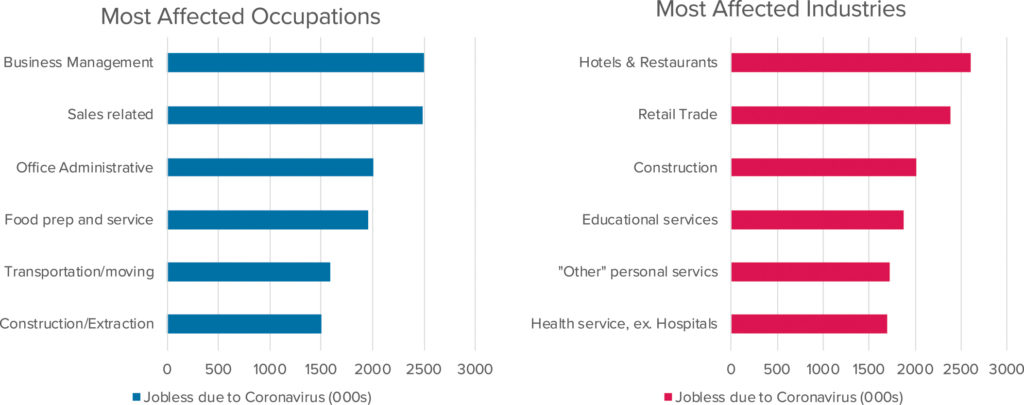
The distribution of job losses, meanwhile, is vastly uneven across the economy, as seen the chart “Hardest Hit Sectors.” The critical take-away from these Bureau of Labor Statistics data is that the headline news about job losses as concentrated in a few industries such as hotels, restaurants, and retail stores, large employing low-wage workers, gives a very incomplete picture of the labor force impacts. Millions have been laid off in a variety of economic sectors, and across a wide range of skills.13

Hardest Hit Sectors Through June 2020

Concern is growing that a significant proportion of the job losses may be permanent as the downturn lengthens. Businesses that were sustained by the relief package passed by Congress in the Spring are now finding those supports expiring. Consequently, the U.S. Chamber of Commerce (a private organization) reports that 58 percent of small business owners find themselves at risk of closing permanently. This has broad economic ramifications, as the U.S. Small Business Administration (a government department) estimates that firms employing fewer than 500 employees account for 44 percent of the nation’s economic activity.14

The upshot is a mixed story. The bad news in the employment picture should not be minimized.
However, slack labor resources can, under innovative policy management, become a Schumpeterian opportunity to redeploy those resources creatively to address national needs in infrastructure, education, and healthcare. The conclusion of this essay will address that opportunity.

What the Capital Markets – and the Fed – Are Telling Us

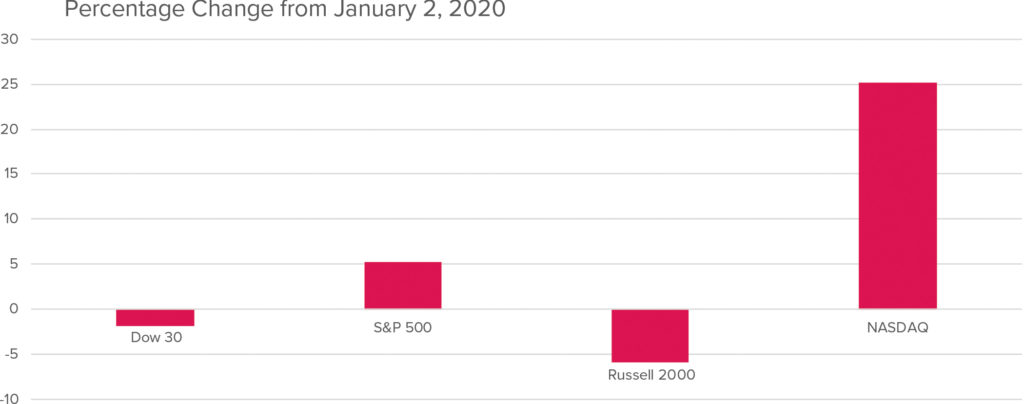
It is a commonplace maxim amongst economists that “the stock market is not the same as the economy.” Yet investor preferences do give a meaningful glimpse at economic expectations. The various indexes tracking the equities markets describe decidedly uneven results for the year 2020, thus far.15 On a positive note, all the major indicators have rebounded sharply from the initial Coronavirus shock that sent them plummeting in March. The Dow 30 (popularly still referred to as the Dow-Jones Industrial Average)16 is still down 1.9 percent since the start of the year, though, reflecting the drag of several of its components tied to transportation, heavy equipment, retail, restaurants, and entertainment. The Russell 2000, a broad index of small-capitalization stocks, has fared even worse, posting a 5.9 percent decline from early January to mid-August.

Equities Markets Expect Mixed Performance Overall, But Strong Tech Growth

The S&P 500, on the other hand, is up 5.3 percent, a good sign for the large capitalization stocks representing $27 trillion listed on U.S. exchanges. The S&P performance reflects its mix of firms, with a significant weighting of financial firms, technology giants, and consumer brands, and has consistently produced annualized returns in the 11 to 15 percent range over the past 50 years.

Perhaps more importantly, the NASDAQ composite index, heavily weighted toward larger information technology firms, is leading with a 25.2 percent gain since the start of 2020. Admittedly, the NASDAQ has been the most volatile of the equities indexes, partly owing to its industry concentration limiting the hedge of diversification. That weighting, however, is benefiting this sector as trends such as work-from-home, remote learning, and on-line shopping are key functional responses to pandemic infection risk. It may be that, long range, adaptation to the public health crisis will cause some permanent residual shifts in the way Americans live, work, learn, and shop. The greater the length of the pandemic itself, the more likely such changes are likely to be imprinted on the economy as a whole.17

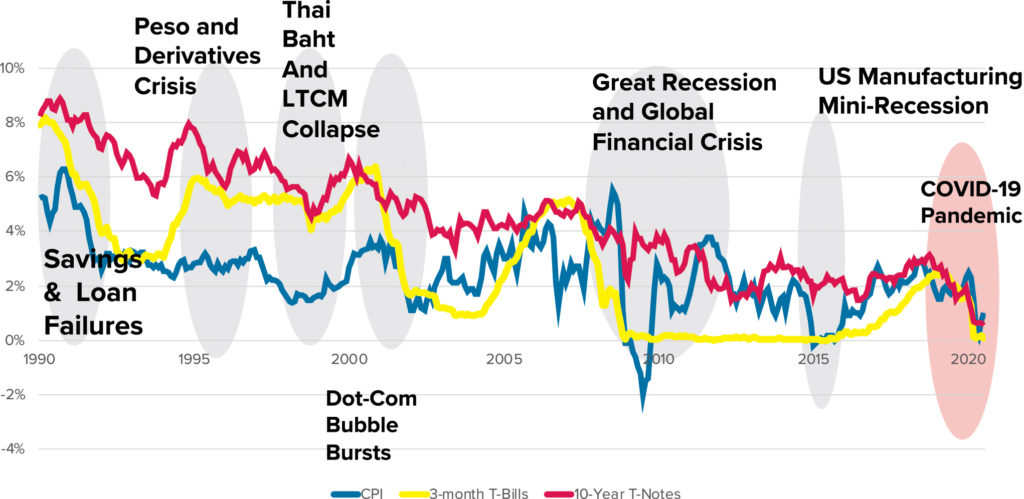
No doubt the improvement in stock prices is, in part, a result of the quick and decisive move by the Federal Reserve to drop interest rates once again toward the ‘zero bound.’ This is the seventh time in thirty years that the U.S central bank has had to intervene in a crisis. The Fed is becoming more expert and creative in applying its tools in times of trouble. It also means that it has learned that remedies must not only be supplied, but also sustained. (See the chart, “Thirty Years of Crisis Management at the Fed.”)

Thirty Years of Crisis Management at the Fed

Fed Chairman Jerome Powell has expressed the determination to do “whatever it takes” to assist the economy as the pandemic continues on. The response to the Great Recession demonstrates that once committing to dropping interest rates toward zero, the Fed is more than willing to hold them there until there is decisive evidence of economic improvement.18 One element in such willingness is the long-term evidence that the fear that monetary accommodation will lead inexorably to inflation has proven false over recent decades.

The consequence right now is that we can reasonably anticipate a period of low-cost capital until the economy has gotten back on its feet. By the measure of a return of GDP to 2019 levels, that will likely take until 2022, according to the consensus forecast of the Blue Chip Economists survey (as of August 10, 2020).
And even if the nation avoids slipping into a double-dip downturn (a “W” recession)19, the Congressional Budget Office projects that it will take until mid-2025 before employment gains take up the existing slack in the labor market, much less show the net increases we might have expected prior to the pandemic.20

Technology Seen as a Bright Spot for Many Local Economies

As the NASDAQ performance suggests, the unevenness of the 2020 economic adjustment does have hopeful elements amid the torrent of troubling news. Technology is one of those brighter spots. Shelter-in-place protocols have been a boon to firms providing a bridge for a population coping with the suddenly obligatory regimen of social distancing. In addition to strengthening the “virtual world”, the tech firms are impacting IRL (the world “in real life”). Amazon, for instance, reports that it has hired 175,000 fulfillment workers to cope with surging demand for deliveries. Facebook, in early August, announced a 730,000 sq. ft. office lease in New York City, meaning that all five “FAANG” tech giants (Facebook, Apple, Amazon, Netflix, and Google) have expanded this year in Manhattan or Brooklyn.21

It is not merely a New York story. As seen in the “Tech Hubs” table, employment services specializing in the tech sector identify a disparate set of metro areas attractive for tech workers, a growth sector of the labor market during a time of job contraction. Those cities are, generally speaking, those identified by research as 24-hour or 18-hour cities, or more descriptively as vibrant urban centers.22

Technology Hub Metros

Best Cities for Tech Jobs

Emerging Tech Cities

Atlanta

Austin

Baltimore

San Francisco

New York City

Detroit

San Diego

Boston

Houston

Portland

Seattle

Miami

Los Angeles

Chicago

Philadelphia

Denver

Dallas

Phoenix

Source: Career Karma

In the first weeks of the pandemic, there was much discussion about how the impact of COVID-19 would disadvantage such cities, due to density characteristics including high-rise buildings, public transportation, and clustering of high-occupancy entertainment venues. Two things have mitigated such assumptions as the months have passed. First, we are seeing evidence from around the world that mass transit systems such as those found in Paris, Milan, Hong Kong, and Tokyo do not exacerbate Coronavirus contagion, if riders and system employees take appropriate precautions.23 And, secondly, in the United States we are seeing that automobile-based metro areas and even low-density rural counties are just as susceptible to viral outbreaks as dense city centers.24 Leaping to conclusions is human nature, but no substitute for strategic thinking.25

Initial Evidence from Housing: Economic Structure Rather than Metropolitan Geography Key to Location Choice

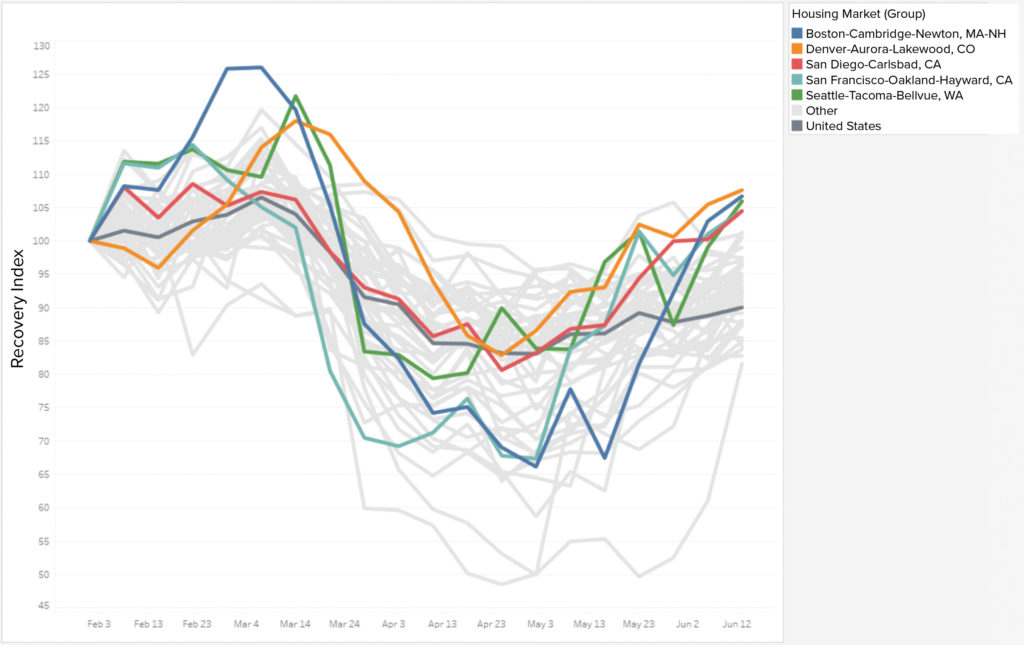
A final word on the “tech metros”: we should not be thinking of the central business districts alone as where benefit appears. The concept of the Metropolitan Statistical Area, as originally developed, saw a metro area as being a mutually interactive network of a core area and its associated suburbs. That is still a useful definition to keep in mind. As far as city/suburb/rural residential demand is concerned, NAR’s research department indicates some surprising strength on the housing front, with some marginal advantage to suburbs at the moment but with expectations that the major geographic categories will track in harmony in the coming year or so. REALTOR.com data shows remarkable consonance in urban core/suburban/rural and town homebuyer traffic both before and during the pandemic,26 and an indication that tech hubs including Boston, Denver, San Diego, San Francisco, and Seattle are ahead of the curve in a housing recovery.27

COVID-era Homebuying Traffic: Differences in Degree, but Similarity in Pattern

Managing the Disruption with both Schumpeter and Marshall

Virtually every economic forecast issued in the midst of the COVID-19 crisis bears the caution, “Current projections are subject to an unusually high degree of uncertainty.” The course of the pandemic, the efficacy and coordination of monetary and fiscal policy, the response of the financial markets, and the frictions stemming from a U.S. presidential election season: all make for exceptional caution on the part of forecasters.

Thus it seems best to outline a few possible (but not guaranteed) courses of action that have some demonstrable successes during an era of disruption.

From a Schumpeterian perspective, what can be creative in the midst of this discontinuous change in the economy? There are the lessons alluded to from the leadership of the Roosevelt, Truman, and Eisenhower administrations.28

Franklin D. Roosevelt, faced with unemployment above 20 percent and a crisis of private capital, turned to the slack in the labor market and converted joblessness into a pool of human resources that could be put to productive use. If indeed there are some millions of jobs that have evaporated and are unlikely to return to private employment for several years, does it not make sense to find useful work to be paid for by the government? As it is, hundreds of billions of dollars are being committed just to provide households with some spendable income. Roosevelt funded lasting improvements to the nation’s environment through the Civilian Conservation Corps, enhanced America’s cultural heritage in music and the arts through the Works Progress Administration, and deployed workers with financial expertise to reform and restructure the banking system, in the process establishing oversight agencies such as the Securities Exchange Commission, the Federal Deposit Insurance Corporation, and the Social Security Administration. Such programs not only reduced unemployment in the short term, but had positive generational effects for the nation as a whole.

Harry S. Truman, faced with a potential depression when troops serving during World War II demobilized, instead crafted the GI Bill of Rights. This legislation encouraged soldiers to enroll in colleges and universities to gain the skills necessary for a restructured post-war economy. This was less a program of cash support than it was an investment in human capital. A similar need for educational investment exists today, especially as the U.S. winds down the post-9/11 wars that have vastly expanded the Defense budget. During the pandemic, the Army Corps of Engineers (for instance) was widely praised for its ability to augment medical facilities in Coronavirus hot spots. Training our military – in active service and on reserve – to place their skills to work in the civilian world – so that over the course of a working career they might bring key engineering, emergency medicine, logistics, and organizational talents to the economy – would be a contemporary application of the same principles.

Dwight D. Eisenhower looked at the sorry state of 1950s U.S. infrastructure and led the nation to create its Interstate Highway System. He also encouraged investment in science that paved the way for America’s space program that progressed swiftly from unmanned satellites, to the 1960s era Mercury, Gemini, and Apollo astronaut missions. Right now, the nation’s infrastructure deficiencies amount to $4.5 trillion of needed investment, according to the American Society of Civil Engineers.29 Federally funded Research and Development, meanwhile, has fallen from 1.8 percent of GDP at its peak in 1963, to just 0.6 percent in recent years.30 Both our aging infrastructure and our pullback on scientific funding go a long way to accounting for America’s pallid record in productivity gains over the past few decades.

Instead of dwelling on the “destruction” element of the situation, a Schumpeterian approach would look to such past successful programs as an indicator for creative, transformative economic interventions. From a funding perspective, there could be no better time than 2020, when the Federal government can issue 30 year bonds at an interest rate below 1.4 percent. It would be difficult NOT to achieve an attractive overall rate of return leveraging such a low cost of public debt.

At the same time, a refocusing on America’s cities would be a key step in adopting a sound Marshallian economic approach. This is incremental, since the economic ascendance of cities has been a consistent trend in U.S. history. As it is, the top ten metros account for 32 percent of total U.S. GDP.31 It makes good sense to build from this strong foundation.

The dynamic that accounts for this metropolitan dominance is another important concept identified by Marshall, namely, agglomeration. The interactions that are promoted by bringing industries and labor markets into proximity have been – and should continue to be – particularly fertile in stimulating innovation, the essential ingredient in re-establishing economic growth in an uncertain future. The contrary impetus to spreading out activity to smaller places not only dilutes the benefit of agglomeration but hinders the return of social vitality. And, as the evidence of the past several months shows, it does not effectively mitigate the spread of the Coronavirus into places of lower density.

Shifting focus toward essentials is another instance where there is ample opportunity for incremental gains, also well delineated by Marshall, who wrote in Principles, “It is common to distinguish necessaries, comforts, and luxuries; the first class includes all things required to meet wants that must be satisfied, while the latter consist of things that meet wants of a less urgent character.”32

The burdens of the pandemic have fallen disproportionately on America’s lower-income workers, the blue-collar sector, those without college degrees, women, and even healthcare workers. These are the members of the economy, of society itself, that are most at risk of food insecurity, housing displacement, reduced access to medical care as employment-based health insurance lapses, and difficulty in re-entering the ranks of the employed as businesses shut their doors.33

A Marshallian economics would prioritize attention and action on ‘the necessaries’ rather than ‘wants of a less urgent character.’ Hewing to such priorities would, not incidentally, bolster renewed effective demand for both residential and commercial real estate.

These are not at odds with the Schumpeterian steps suggested earlier. A program of public works (including but not restricted to infrastructure), funding for R&D advancing the technological frontier, using military training to address the nation’s skills gap, and expanding the educational support needed to gain access to growth industries are all incremental steps in service of the ‘creative’ side of creative destruction. They echo one of Marshall’s core arguments for capital investment: “The most valuable of all capital is that invested in human being.”34 •

Source: “Had Enough ‘Disruption’ Yet? Economic Reflections After the (First) Summer of COVID-19“

Filed Under: All News

Legal Tenants Lead in the Return to Office

April 14, 2021 by CARNM

The occupancy rates for law firms are 10 percentage points higher than the average.

As vaccinations become more widespread, executives are beginning to target a return to office later this year.

But some professions are moving faster than others. According to Kastle’s Back to Work Barometer, which tracks the return to office in ten major cities, the occupancy rates for law firms are 10 percentage points higher than the average.

“In talking with our law firm clients, we are hearing many factors that have made remote work more challenging for this sector, including paper-heavy office systems and generally being slower to adopt new technologies,” Kastle CEO Haniel Lynn said in a prepared statement. “In looking at a return to the office, these and other workplace or cultural factors could also come into play for greater in person activity.”

Through its Kastle Back to Work Barometer, the company has been tracking the anonymized activity of 341,000 unique office credential holders in major cities. Of those credential holders, 31,582 are in the legal industry.

“For many of our members, some firms never closed at the beginning of the pandemic,” Association of Legal Administrators Executive Director April Campbell, JD said in a prepared statement. “Different local government guidance on what workers were deemed essential meant that in some cities that sometimes included law firms. There have also been concerns about the ability to onboard new employees and conduct new associate training remotely, so we’re seeing law firms in the office at higher rates.”

However, not all law firms plan to go back to business as usual. Last year, Jeff Schneider, a managing partner at Miami-based law firm Levine Kellogg Lehman Schneider + Grossman, told GlobeSt.com that the firm was considering shrinking its space.

“The biggest expenses for every law firm are space, personnel and insurance,” Schneider says. “Now we have an opportunity to cut one of them by a lot. Even if it’s not a 50% [reduction in office costs], but a 20%, 30% or 40% savings, that’s a massive cut. In addition to that, you end up with a much happier workforce.”

In Grant Thornton’s 2021 Q1 CFO survey, the firm asked executives if there were any unexpected benefits to the pandemic. Sixty percent of respondents pointed to improved flexible and remote work environments.

Most of these CFOs aren’t planning to return to old business models, according to Grant Thornton. Respondents to the survey say that these executives plan to target travel and real estate facilities for permanent cuts. “It seems at least some of the shift to remote and virtual work environments is here to stay,” according to Grant Thornton.

Source: “Legal Tenants Lead in the Return to Office“

Filed Under: All News

  • « Go to Previous Page
  • Page 1
  • Interim pages omitted …
  • Page 3
  • Page 4
  • Page 5
  • Page 6
  • Page 7
  • Interim pages omitted …
  • Page 9
  • Go to Next Page »
  • Search Property
  • Join CARNM
  • CARNM Login
  • NMAR Forms
  • All News
  • All Events
  • Education
  • Contact Us
  • About Us
  • FAQ
  • Issues/Concerns
6739 Academy Road NE, Ste 310
Albuquerque, NM 87109
admin@carnm.realtor(505) 503-7807

© 2026, Content: © 2021 Commercial Association of REALTORS® New Mexico. All rights reserved. Website by CARRISTO