The current US immigration system not only doesn’t work but is not being fixed. That said, given that the race to the White House is on, immigration is sure to play a starring role in the unfolding presidential drama. Rather than rehash stale ideas – anchor babies, border patrols, and the like – below are several proposals that use market forces and not bureaucratic solutions to solve several different immigration problems in ways that not only improve our competiveness but also our balance sheet.
At present, the majority of legal immigrants who arrive do so on the basis of family reunification. Fewer than 20% of immigrants obtain green cards based on marketable skills. Instead, allocate immigration visas based primarily on occupational needs. Observe which occupations and industries are experiencing a combination of fast wage growth, lowest unemployment rates and high vacancy rates and allocate entry visas accordingly while keeping existing caps. In this way visas will go to those who skills are in shortest supply.
As for temporary H-2B non-agricultural worker visas and H-1B (high tech) visas, eliminate the quotas on them as is the case with H-2A agricultural visas. If American businesses need temporary workers, they should get them after showing that there are insufficient workers currently available. Depriving firms of workers benefits no one. As for concerns that these new workers will depress wages of existing workers, that concern is not borne out by research. Moreover, by allocating visas based on employment shortages, unanticipated downward wage pressure should be reduced.
Next, create a new visa, a U-Visa, for those who are here but undocumented. The visa would allow the holder and their family to stay and work here. The catch, the visa would not lead to citizenship and would have an annual fee. I suspect that a fair price would be about $500 to $700/year. Assuming a few million were bought, this program would bring in $1 to $2 billion annually. Charging for the visa discourages those without jobs from staying. Moreover, this approach would be bundled with severe penalties for employers caught knowingly employing illegals. Absent a job, illegals will find it difficult to remain here.
Lastly, abolish the EB-5 program that allows foreigners to invest their way into the US. At present, depending upon the location of the investment, between $500,000 and $1 million must be invested and shown to create or maintain 10 jobs. After seven years, the investor may then apply to become a naturalized US citizen. This process is convoluted, requires bureaucracy and infrastructure, lends itself to substantial fraud and because the number of visas is capped at 10,000, the wait time is several years. Instead, simply sell citizenship via an auction, similar to the way Treasury securities are sold. The households that would apply would have means, and charging for a passport would allow us to allocate this scarce resource to those who want it most. Given that Malta charges roughly $700,000 for a passport and St. Kitts and Nevis $250,000, I bet the Treasury could net close to a million per applicant with the current quota intact and raise nearly $10 billion/year.
While you may or may not agree with these proposed solutions, the point is markets and market signals can solve difficult social problems if only given a chance. It’s not as if the status quo couldn’t stand a re-think.
By: Elliot Eisenberg (GraphsandLaughs)
Click here to view source website.
August 2015 Commercial Market Trends
View a New Mexico Market Trends Summary Report, which includes August 2015 Commercial Market Trends. This report includes total number of listings, asking lease rates, asking sales prices, days on the market and total square feet available.
Disclaimer: All statistics have been gathered from user-loaded listings and user-reported transactions. We have not verified accuracy and make no guarantees. By using the information, the user acknowledges that the data may contain errors or other nonconformities. Brokers should diligently and independently verify the specifics of the information you are using.
Opposing Views on Albuquerque Rapid Transit to Get Public Airing
Albuquerque’s plan for a rapid transit corridor on Central Avenue from Tramway to Unser will be a topic of debate this week at the University of New Mexico Law School.
The public is invited to the “Bus Rapid Transit Debate” on Thursday from 6-7:30 p.m. in Room 2401 at the School of Law at 1117 Stanford NE.
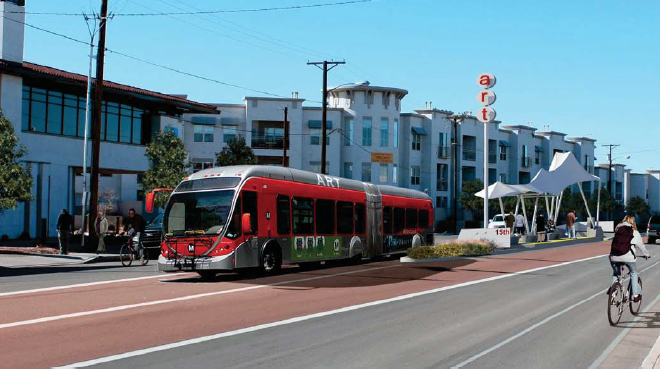
A rendering shows what a rapid transit station would look like at 15th Street and Central west of Downtown.D’Val Westphal of the Albuquerque Journal will moderate the discussion between rapid transit supporter Paul Silverman, CEO at commerical development company Geltmore LLC, and rapid transit skeptic Paul Gessing of the Rio Grande Foundation.
The city is seeking $80 million in federal funding and plans on spending around $20 million of its own funds to build a new Albuquerque Rapid Transit bus system that would operate in the middle of Central Avenue. Construction could start as early as February.
ART PROJECT TIMELINE
Nov. 2014
Conceptual build
March 2015
Project development
May 2015
Sell ABQ GRT Bonds
Aug. 2015
Submit Small Starts grant application
Feb. 2016
Design complete and early construction begins
May 2016
Construction begins
Sept. 2017
Service starts
By: Mike English (Albuquerque Business First)
Click here to view source article.
Catylist CIE and RPR Training – October 14th or 15th
|
Learn to improve your skills!
|
|
Catylist CIE & RPR Commercial Training!
|
Leverage technology that measures, predicts, and targets the right location for a client, whether representing a client looking to start or expand a business. REALTORS® have access to this one-stop shop for comprehensive market data focused on demographics, psychographics and consumer spending.
|

Catylist will highlight recent system updates and new features for the CARNM CIE, followed by a Question & Answer session.
|

|
|
|
|
All sessions have identical content.
Please select one session that fits your schedule/location and indicate in your RSVP.
|

|
|