• Skip to primary navigation
  • Skip to main content

CARNM

Commercial Association of REALTORS® - CARNM New Mexico

  • Property Search
    • Search Properties
      • For Sale
      • For Lease
      • For Sale or Lease
      • Start Your Search
    • Location & Type
      • Albuquerque
      • Rio Rancho
      • Las Cruces
      • Santa Fe
      • Industry Types
  • Members
    • New Member
      • About Us
      • Getting Started in Commercial
      • Join CARNM
      • Orientation
    • Resources
      • Find A Broker
      • Code of Ethics
      • Governing Documents
      • NMAR Forms
      • CARNM Forms
      • RPAC
      • Needs & Wants
      • CARNM Directory
      • REALTOR® Benefits
      • Foreign Broker Violation
    • Designations
      • CCIM
      • IREM
      • SIOR
    • Issues/Concerns
      • FAQ
      • Ombuds Process
      • Professional Standards
      • Issues/Concerns
      • Foreign Broker Violation
  • About
    • About
      • About Us
      • Join CARNM
      • Sponsors
      • Contact Us
    • People
      • 2026 Board Members
      • Past Presidents
      • REALTORS® of the Year
      • President’s Award Recipients
      • Founder’s Award Recipients
    • Issues/Concerns
      • FAQ
      • Ombuds Process
      • Professional Standards
      • Issues/Concerns
      • Foreign Broker Violation
  • Education
    • Courses
      • Register
      • All Education
    • Resources
      • NMREC Licensing
      • Code of Ethics
      • NAR Educational Opportunities
      • CCIM Education
      • IREM Education
      • SIOR Educuation
  • News & Events
    • News
      • All News
      • Market Trends
    • Events
      • All Events Calendar
      • Education
      • CCIM Events
      • LIN Marketing Meeting
      • Thank Yous
  • CARNM Login
  • Show Search
Hide Search

Archives for May 2015

May 2015 Commercial Market Trends

May 31, 2015 by mcarristo

View a New Mexico Market Trends Summary Report, which includes May 2015 Commercial Market Trends. This report includes total number of listings, asking lease rates, asking sales prices, days on the market and total square feet available.

Disclaimer: All statistics have been gathered from user-loaded listings and user-reported transactions. We have not verified accuracy and make no guarantees. By using the information, the user acknowledges that the data may contain errors or other nonconformities. Brokers should diligently and independently verify the specifics of the information you are using.

Filed Under: Market Trends

High-Speed Internet Gaps Leave Rural New Mexicans Lacking a 'Basic Right'

May 30, 2015 by mcarristo

Gaps in high-speed Internet leave rural New Mexicans lacking a ‘basic right’
Juanito Jimenez, an artist living in Tesuque, said he does not have access to standard Internet options. His family accesses the Internet using a limited Verizon data plan. They have to monitor every bit of data they use or face steep overage charges. Clyde Mueller/The New Mexican

Alan Cozzens could sympathize when he read recently that Taos residents were complaining about paying $70 a month for Internet service that provides sluggish download speeds of 10 Megabits per second. But if you want to know what slow is, he said, drive an hour south to his home in the Pojoaque Valley, where the fastest service he can get is 3 Mbps — at a cost of $96 a month.
Gaps in high-speed Internet leave rural New Mexicans lacking a ‘basic right’
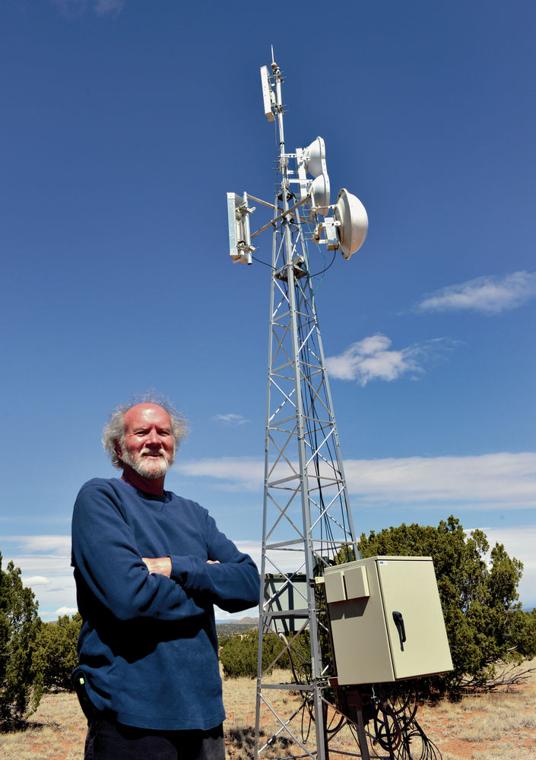
Phil Curnutt, a member of the La Cañada Wireless Association, is shown Friday near an aggregation tower near N.M. 14. The association provides wireless access to about 400 residents in and around the Eldorado subdivision. Clyde Mueller/The New Mexican

“It’s not the money,” Cozzens said. “It’s the principle of the matter. They’re taking advantage of us, and we have no remedy. None.”

At a time when high-speed Internet has become as essential to the everyday lives of most Americans as telephone and mail service, many rural communities in New Mexico are stuck with services that provide achingly slow speeds at prices exceeding much faster plans in urban areas. Cozzens, for example, could get Internet service 16 time faster for $18 less if he lived in Albuquerque. In New York, he could get 300 Mbps for about $30 less.
The high prices paid by many rural residents for slow Internet stem from a combination of factors, including a lack of competition and government incentives and the high cost of installing fiber-optic cable in far-reaching, thinly populated areas.
The chairman of the Federal Communications Commission last week proposed a dramatic expansion of a federal subsidy program designed to ensure that low-income Americans have reliable, high-speed Internet. The changes, if passed by the commission, could help close the so-called “digital divide” between the economically comfortable and the poor.
But the proposal doesn’t address the gaping divide between urban and rural residents. And despite hundreds of millions of dollars in federal stimulus money spent over the last few years to spread fixed broadband to rural areas, an estimated 14 million people in rural areas continue to lack access, according to the FCC.
For some Northern New Mexico residents, that means relying on costly cellular data plans that severely hinder their Internet usage.
Juanito Jimenez, an accomplished artist in the Spanish Colonial style, says neither Comcast nor Century Link offers service to his Tesuque home off County Road 74. Jimenez said some of his neighbors do rely on Internet provided by satellite companies such as Dish, but those services often cost as much as DSL or cable for a fraction of the speed.
He and his family rely on a Verizon cellphone plan to use the Internet, and they have to monitor every bit of data they use or face steep overage charges. That makes ordinary luxuries like streaming TV shows and films on sites like Netflix cost prohibitive.
“It shouldn’t be like this,” Jimenez said. “We live seven miles away from Santa Fe. It’s hard to fathom.”
Dee Davis, president of the Center for Rural Strategies, a nonprofit group that seeks to improve social and economic conditions for rural communities, said access to the Internet should be seen as a “basic right.”
That begs a basic question: If the industry won’t provide the service, who will?
Davis said he doesn’t believe government should be obligated to provide it as a utility, though some cities like Chattanooga, Tenn., have built their own networks to great success, using federal economic stimulus funds. In contrast, some states such as Texas have laws that prevent municipalities from providing Internet service as a utility. What’s most important, Davis said, is that the government play a stronger role in regulating the industry, ensuring that everyone has access to broadband at a fair price.
“If the market was going to work for rural communities, it would have done so already,” Davis said.
Infrastructure’s high price
In 2009, President Barack Obama signed into law the $787 billion stimulus package, which included $7.2 billion for broadband grant and loan programs, putting particular emphasis on broadband access in rural areas. New Mexico has received more than $170 million of that money targeted at laying down fiber-optic cables and creating networks around the state as the backbone of future high-speed networks.
Publicly subsidized fiber-optic backbones are supposed to ease the cost of getting broadband to people in rural and even underserved urban areas while “reducing costs for the consumer,” according to the federal grant applications for projects serving Taos, Rio Arriba, Los Alamos and Santa Fe counties.
But the cost of running fiber from the backbone fiber-optic cable, known as the middle mile, to the doorsteps of small businesses and residential customers remains high, especially if they live in scattered homes well off the beaten path.
“It is very expensive for telecoms and cables companies to build infrastructure to individual homes,” said Duncan Sill, manager of REDI Net, a $10 million federally subsidized fiber network that is supposed to serve Rio Arriba, Los Alamos and parts of Santa Fe County. REDI Net is managed by a coalition of county and pueblo governments and was built to provide broadband to 110 anchor institutions such as hospitals, emergency responders, schools and community centers. To date, the service is reaching 70 of those institutions, Sill said.
Private service providers such as CenturyLink and Cyber Mesa can tap into REDI Net and bring the broadband to customers like Cozzens and Jimenez.
But just because the fiber-optic cable is available doesn’t mean it is easy or cheap to hook into. Some of the nodes are on pueblo land or housed in a competitor’s building.
“We have a right to interconnect, but we don’t have a place to [connect to] that’s economically feasible,” said Cyber Mesa’s Jane Hill.
In Taos County, Kit Carson Electric Cooperative used a $45 million federal grant and a $19 million loan to lay in fiber-optic cable across the county, from Sipapu north to the Colorado border, with a goal of taking the fiber right to customers’ homes and small businesses. So far, 332 out of thousands of cooperative members have the new broadband service.
Some customers have complained about the costs, while others see a lot of benefits despite the high monthly price tag.
Sipapu Ski & Summer Resort was “scabbed in” to an old Kit Carson Electric fiber cable two weeks ago and now “we’re flyin’,” said John Paul Bradley, Sipapu’s mountain manager. “We’re not even on the new cable yet, but we will be eventually.”
Bradley said the resort previously relied on satellite and wireless that provided only about a 5 Mbps download speed. Increasingly, the resort’s customers were showing up expecting Internet service for all of their devices. “We were chewing up a month’s worth of broadband in three or four days,” Bradley said. “We had to pay extra to get more.”
Bradley said the resort now gets a 35 to 40 Mbps download speed and only slightly slower upload speed. “It’s eliminated our guests not having Internet access,” Bradley said.
The price: $900 a month.
It’s steep, but as Kit Carson finishes laying in lines and the whole property is networked, including the campground and cabins, Bradley said the price will be worth it. “It’s way more expensive, but we don’t have to deal with bandwidth, paying for extra and struggling to meet our customer expectations.”
PRC exploring solutions
In the state’s eastern half, the local telephone cooperative Plateau is aggressively moving to put in fiber-optic cable and eventually connect every home and business. Plateau received nearly $28 million in stimulus funds to build or lease 1,890 miles of fiber and bring broadband to 270 institutions. To the communities lucky enough to have fiber running to their premises, like Fort Sumner, Plateau isn’t charging extra to connect.
Still, while Plateau wants to provide fiber to all of its members, “with the size of the service area, it is expected to take many years,” according to a statement on the cooperative’s website. The cooperative serves 25 counties in New Mexico and West Texas.
Prices and speeds still vary widely within Plateau’s service area. Estancia residents can get up to 100 Mbps download speeds for $50 a month, while the same speed costs $100 in Santa Rosa. Roy villagers can get up to 10 Mbps for $40 through DSL.
The new fiber cable went in three miles from the ranch house of Public Regulation Commissioner Pat Lyons, who represents the Eastern New Mexico region, too far away to boost his Internet speed. Still, he thinks the fiber cable means good things to come for rural communities struggling to attract jobs and opportunities. “It will enhance starting businesses in rural areas instead of urban areas,” Lyons said.
Michael Golino knows the connection between good Internet service and good business all to well. Golino runs a photo identification software company in Galisteo and has team members located around the world. Internet access, he said, is a must, which is why he shells out $98 a month for a spotty 3 Mbps download speed from Higher-Speed Internet in Moriarty.

Even at that higher price, he said, his service often slows to 0.4 Mbps — by comparison dial-up is 0.56 Mpbs — and something as simple as inclement weather can tank his Internet access. While speaking with The New Mexican, he joked that the phone call, a service he accessed via Internet, could disconnect at any time.
The PRC has put together a broadband task force, a group of telecom professionals and state Internet technology staffers, to look at ways to improve Internet access across New Mexico. The group’s recommendations are due to state regulators by June 10.

Finding funds to boost broadband
Different groups around the state have worked for a couple of years to identify the problems, costs and financing to boost broadband around New Mexico.
Les Montoya, manager of rural San Miguel County and president of the North East Regional Economic Development Organization, said his group is waiting for a baseline study from the state Department of Information Technology analyzing available broadband in the region and identifying possible funding sources for infrastructure.
The state received $4.7 million in federal funds to establish a broadband program that’s focused for the last couple of years on mapping broadband availability, promoting digital literacy and finding out why people don’t subscribe to the Internet in their homes. New Mexicans surveyed said the three biggest reasons they don’t have Internet at home was because they don’t have broadband access, can’t pay for the service or don’t have a computer.
Gar Clarke, who heads up the broadband division of the New Mexico Geospatial Program, a state division that maps Internet availability across the state, said part of the problem is the state doesn’t have a fund dedicated to investing in Internet infrastructure.
A bill that would have provided such a fund died in committee during the last legislative session. Without that money, the state can’t provide matching funds for federal grants, often a requirement to procure that money, and can’t invest in local community projects, Clarke said.
In Eldorado, a small community 15 miles southeast of Santa Fe, residents got fed up with poor Internet service. So about a decade ago, they banded together and started their own. The service, known as the La Cañada Wireless Association, provides wireless access to about 400 residents in and around the subdivision, said association president Joel Yelich. The group ties into lines from a CenturyLink hub in Santa Fe and then broadcasts WiFi signals to its customers from fixed points.
“On a small scale, it’s really not that difficult,” Yulich said.
Sharon Strover, an Internet expert and professor at the University of Texas at Austin, said that kind of system is becoming more common across the country as the cost to purchase and use the technology declines.
By no means is a fixed wireless system the perfect solution for rural communities. Yelich said transmissions can be affected by numerous factors such as terrain and inclement weather. Additionally, speeds for the La Cañada community vary from 1.5 to 3 Mpbs depending on the resident’s proximity to wireless transmitters.
But whereas Cozzens currently pays $50 for 1.5 Mpbs (and would pay $96 for 3 Mpbs) through CenturyLink, a major Internet provider in the Southwest, members of the La Cañada community only pay $30 a month for their service.
CenturyLink said it’s able to provide coverage for most of the Pojoaque Valley and other nearby portions of Northern New Mexico with Internet speeds ranging from 1.5 to 40 Mpbs.
Sara Spaulding, a spokeswoman for the company, said it doesn’t charge more in rural areas despite what some people might say. She said prices, however, do vary based on promotional contracts and bundled discounts, which could explain the differences in price.
“It’s not an apples-to-apples comparison,” Spaulding said.
Spaulding said the national company is developing infrastructure to “upgrade services as it makes good business sense.” The spokeswoman also said the company has had issues developing Internet services in Northern New Mexico because of right-of-way issues with tribal lands.
Those explanations don’t sit well with Cozzens, who recently saw his rates go up by a dollar.
“It must be really great to be an unregulated monopoly and get to stick it to your customers any time you feel like for as much as you want,” he said.
By: Chris Quintana and Staci Matlock (Santa Fe New Mexican)
Click here to view source article.

Filed Under: All News

Modest Growth Expected in Commercial Real Estate Markets

May 26, 2015 by mcarristo

WASHINGTON — A stronger labor market and increasing household formation should keep commercial real estate demand on a gradual incline, according to the National Association of Realtors® quarterly commercial real estate forecast.
National office vacancy rates are forecast to slightly decrease 0.1 percent over the coming year as the demand for office space slowly improves. The vacancy rate for industrial space is expected to decline 0.3 percent and retail space 0.4 percent as manufacturing output increases and low gas prices and slight income gains boost consumer spending. An influx in new apartment construction is forecast to cause an uptick (0.1 percent) in the multifamily vacancy rate.
Lawrence Yun, NAR chief economist, says commercial rents have risen at a moderate pace across the board for several quarters now and vacancy rates have been on a gradual decline. “The commercial real estate sector is on the path to recovery, but subpar economic growth, lack of financing available to small investors and the industry trend towards squeezing more employees into existing spaces will keep demand from meaningful acceleration,” he said. “The exception is multifamily housing, which remains the best performer with vacancy rates under 4 percent in several markets in the Northeast and in California.”
According to Yun, job growth and increasing household formation among young adults is supporting continued, robust demand for apartments. However, vacancies are expected to slightly rise over the next year as a higher-than-anticipated climb in multifamily completions is coming onto the market to meet that demand.
Looking ahead, Yun expects the economy to slowly pick up in upcoming quarters after severe winter weather, a widening trade gap and port disputes on the West Coast dragged on gross domestic product growth in the first quarter. “Similar to last year, economic growth will likely rebound as the year progresses, although perhaps not as robustly as what was seen in 2014. However, as long as jobs are being added at a respectable pace, gradual increases in demand for commercial spaces and leasing projects should continue.”
NAR’s latest Commercial Real Estate Outlook1 offers overall projections for four major commercial sectors and analyzes quarterly data in the office, industrial, retail and multifamily markets. Historic data for metro areas is provided by REIS Inc., a source of commercial real estate performance information.
According to NAR’s recent 2015 Commercial Lending Trends Survey, Realtor® commercial members in the past year managed transactions averaging $1.6 million per deal — frequently located in secondary and tertiary markets — and focused on small businesses and entrepreneurs.
Office Markets
Office vacancy rates are forecast to slightly decline from 15.6 percent in the second quarter to 15.5 percent in the second quarter of 2016.
The markets with the lowest office vacancy rates in the second quarter are New York City, at 8.9 percent; Washington, D.C., at 9.0 percent; San Francisco, at 10.6 percent; and Little Rock, Ark., and Portland, Ore. at 11.6 percent.
Office rents are projected to increase 3.4 percent this year and 3.7 percent in 2016. Net absorption of office space, which includes the leasing of new space coming on the market as well as space in existing properties, is likely to total 51.8 million square feet this year and 60.0 million in 2016.
Industrial Markets
Industrial vacancy rates are expected to fall from 8.4 percent in the second quarter to 8.1 percent in the second quarter of 2016.
The areas with the lowest industrial vacancy rates currently are Orange County, Calif., with a vacancy rate of 3.4 percent; Los Angeles, 3.6 percent; Miami, at 5.3 percent; Seattle, at 5.4 percent; and Palm Beach, Fla., at 5.5 percent.
Annual industrial rents should rise at a clip of 3.1 percent both this year and in 2016. Net absorption of industrial space nationally is expected to total 108.8 million square feet in 2015 and 104.9 million square feet next year.
Retail Markets
Vacancy rates in the retail market are expected to decline from 9.6 percent currently to 9.2 percent in the second quarter of 2016.
Currently, the markets with the lowest retail vacancy rates include San Francisco, at 3.0 percent; Orange County, Calif., and San Jose, Calif., at 4.6 percent; Fairfield County, Conn., at 4.7 percent; and Long Island, N.Y., 4.9 percent.
Average retail rents are forecast to rise 2.6 percent this year and 3.1 percent in 2016. Net absorption of retail space is likely to total 15.8 million square feet this year and jump to 21.1 million in 2016.
Multifamily Markets
The apartment rental market should see vacancy rates slightly increase from 4.3 percent currently to 4.4 percent in the second quarter of 2016. Vacancy rates below 5 percent are generally considered a landlord’s market, with demand justifying higher rent.
Areas with the lowest multifamily vacancy rates currently are San Bernardino-Riverside, Calif., at 2.5 percent; Sacramento, Calif., 2.6 percent; New Haven, Conn., and Providence, R.I. at 2.7 percent; and Cleveland, Ohio, Oakland-East Bay, Calif., and San Diego at 2.8 percent.
With an influx of new supply coming onto the market, average apartment rents are projected to increase 3.6 percent this year and at a slower pace of 3.3 percent in 2016. Multifamily net absorption is expected to total 172,524 units in 2015 and 153,747 next year.
The NAR commercial community includes commercial members; commercial real estate boards; commercial committees, subcommittees and forums; and the NAR commercial affiliate organizations — CCIM Institute, Institute of Real Estate Management, Realtors® Land Institute, Society of Industrial and Office Realtors®, and Counselors of Real Estate.
Approximately 70,000 NAR and institute affiliate members specialize in commercial brokerage and related services, and an additional 283,000 members offer commercial real estate services as a secondary business.
The National Association of Realtors®, “The Voice for Real Estate,” is America’s largest trade association, representing 1 million members involved in all aspects of the residential and commercial real estate industries.
By: Adam Desanctis (National Association of REALTORS®)
Click here to view source article.

Filed Under: All News

Lagging Real Estate Building Costs NM 1,900 Jobs

May 22, 2015 by mcarristo

Of the 21 projects the New Mexico Partnership tried to bring to the state in the last two years, it lost almost 40 percent of them because of real estate.
Those are the statistics found in a new spreadsheet from the New Mexico Partnership, the state’s economic development marketing group. Eight projects with the potential to hire 1,900 people didn’t come to the Land of Enchantment simply because there aren’t enough buildings, or the right kind of buildings, said Steve Vierck, president and CEO of the Partnership.
New Mexico Partnership markets the state at trade shows and meets with site selectors in the hopes of luring companies here. Lately, the organization has seen increased interest in companies wanting to move or expand here due to the state’s improved tax climate and the new closing fund that will go into effect this summer. But there’s a problem: There are few suitable office buildings, warehouses or spec spaces for them.
“Normally it’s labor, but (in this case) it’s existing buildings,” Vierck said. “Seventy percent of our prospects need an existing building. You have to have a hook, and a major challenge now is finding good buildings. There’s extreme scarcity.”
There are many vacant or under-leased buildings in the state, Vierck said, but most don’t fit the class-A requirements of companies, or they’re not large enough. He gave an example of one of the projects, code named “Symmetry,” which needed a plug-and-play building large enough to house up to 1,000 call center workers, with parking. None were available.
Santa Teresa, which has one of the few booming economies in the state, is particularly hurting — despite recent efforts to build a new business park there.
“We’re down to one building in Santa Teresa, one 8,000-square-foot building without a bathroom, and it’s that bad. I kid you not,” Vierck said. “But where there is an existing building, there’s keen interest. Multiple interest. Any large functional building, there’s interest.”
From Roswell to Farmington, many buildings still don’t meet requirements for industries the state is trying to attract, like manufacturing, Vierck said.
“Many are 20-foot clear (ceiling) heights. But our guys want 30 feet or more,” he said. Those buildings are scarce in New Mexico and developers have seemed reluctant to build large speculative buildings.
“Labor is a driver, but these guys want an existing building,” he said. “And then look at Phoenix. There’s a lot of good buildings there, and the price is going down, and we compete with them. Is price important? Yes.”
Of the projects that declined to come to New Mexico for reasons other than real estate, Vierck said, several were wooed by other states’ incentives, others could not find capital to finance their projects here and, for a couple, New Mexico didn’t have the right type of labor.
Vierck polled the companies about their reasons for not choosing New Mexico. Here’s what they said:

• Project Milan, a warehouse distribution site looking to hire 40:
“Lack of existing, suitable building/real estate.”

• Project Symmetry, a call center that was planning to hire 1,0000:
“Lack of large plug-play office buildings.”

• Project Distant, a call center that was planning to hire up to 500:
“Lack of building options for a training center.”

By: Dan Mayfield (Albuquerque Business First)
Click here to view source article.

Filed Under: All News

  • Page 1
  • Page 2
  • Page 3
  • Interim pages omitted …
  • Page 7
  • Go to Next Page »
  • Search Property
  • Join CARNM
  • CARNM Login
  • NMAR Forms
  • All News
  • All Events
  • Education
  • Contact Us
  • About Us
  • FAQ
  • Issues/Concerns
6739 Academy Road NE, Ste 310
Albuquerque, NM 87109
admin@carnm.realtor(505) 503-7807

© 2026, Content: © 2021 Commercial Association of REALTORS® New Mexico. All rights reserved. Website by CARRISTO