CARNM Member Participation Counts!
NAR Call to Action – Join Us and Contact Your U.S. Representative!
Next week the U.S. House of Representatives is scheduled to vote on H.R. 9 – The Innovation Act of 2015 which will take vital steps to protect the real estate industry from frivolous lawsuits brought by patent trolls. It is critical that you urge your Member of Congress to support this important legislation.
Contact your Member of Congress to Stop Patent Trolls
The National Association of Realtors is supporting H.R. 9 – The Innovation Act to close loopholes in our legal system that allows patent trolls to thrive. REALTORS® are targeted by patent trolls at alarming rates for simply using common business technologies like dropdown menus and search functions on websites or scan-to-email technologies found in every office scanner. Patent trolls exist solely to purchase old patents and to use the threat of expensive lawsuits to extort money from legitimate businesses. Congress must pass common-sense comprehensive patent litigation reform to protect Main Street businesses and REALTORS® from patent troll abuse.
Contact your U.S. Representative and urge them to support H.R. 9, the Innovation Act
Thank you for your support on this important legislative issue.
Archives for July 2015
Economic Development Comp Plan Meetings 7/17 & 7/21
CARNM Members:
There have been several Focus Groups this week on the Comp Plan Update for the City of Albuquerque, and there are lots of activists and neighborhood groups that are attending but very few private sector types.
Could you please attend one of the following “Economic Development” Focus Groups? There are 3 economic development focus groups, each a slightly different flavor. Please reply all so others can volunteer and CARNM can be represented.
(Scroll Down for complete Schedule of Events)
Friday, July 17 | 8:30 – 10:00 a.m.
Focus Group 9 – Economic Development: Small Business/Entrepreneurship: Discuss updates related to entrepreneurship and support for small business development
Alvarado Transportation Center – 100 1st Street – SW Training Room
Friday, July 17 | 10:30 a.m. – 12:00 p.m.
Focus Group 10 – Education/ Economic Development: Workforce Development: Discuss how the Comp Plan should address job training, early childhood education & childcare
Alvarado Transportation Center – 100 1st Street – SW Training Room
Tuesday, July 21 | 10:30 a.m. – 12:00 p.m.
Focus Group 19 – Economic Development – Discuss how the Comp Plan should address economic development
MRCOG – 809 Copper Avenue NW – Board Room
Here’s a link that has the full menu of focus group options: http://abc-zone.com/next-steps-comp-plan
Like-Kind Exchanges – Integral to Residential and Commercial Real Estate Transactions
Real estate is an integral part of economic activity, with transactions providing avenues for exchange, development, and growth opportunities. Within this framework, like-kind exchanges (LKE) provide an important vehicle to sell and acquire property. The Internal Revenue Code (IRC) Section 1031 codifies that the tax owed on any gain after a sale may be deferred as long as the proceeds are reinvested in a similar property through a like-kind exchange. The Internal Revenue Service (IRS) makes note of the fact that while the gain “is tax-deferred […] it is not tax-free.”[1]
Like-kind exchanges are available to individuals, partnerships, corporations, limited liability companies, as well as trusts. The main requirement of a like-kind exchange is that the sale of one property and acquisition of another property must be part of an integrated transaction, rather than two individual transactions. In addition, while both real and personal property qualify, the properties must be similar, pursuant to specific criteria which delineate eligibility.
According to the IRS, “like kind property is property of the same nature, character or class. […] Most real estate will be like-kind to other real estate.”[2] Generally, a parcel of land with a rental house may be exchanged for vacant land. Similarly, an office building may be exchanged for an industrial warehouse or a retail shopping center.
Like-kind exchanges (LKE) feature prominently in NAR members’ real estate transactions, as well as their clients. As most REALTORS are small business owners, and as they represent through their clients a wide swath of small businesses across the country, LKE transactions reflect both the diversity and character of Main Street.
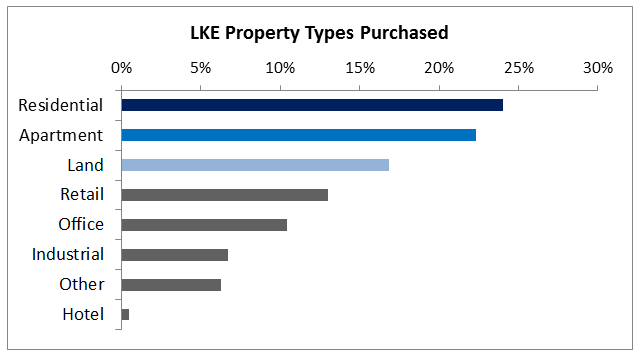
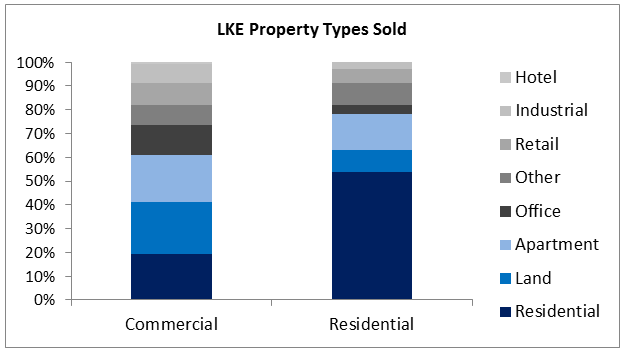
The Like-Kind Exchanges: Real Estate Market Perspectives 2015 report illustrates the full property spectrum which touches every facet of the American economy. Based on REALTORS® responses, residential properties comprised the largest proportion of recent deals, accounting for 27 percent of disposed properties and 24 percent of purchased properties, respectively. Apartments accounted for about one-in-five sale transactions, and 22 percent of acquisitions. Apartments ranked third in disposals and second in purchases, trading ranking spots with land.
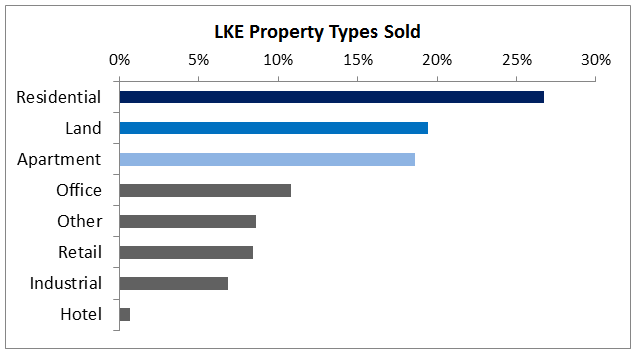
Land assets accounted for 19 percent of disposals and 17 percent of acquisitions. Retail properties accounted for 13 percent of acquisitions and 8 percent of disposals. Office buildings comprised 11 percent of properties disposed and 10 percent of properties acquired. Industrial buildings made up 7 percent of both total disposals and acquisitions. Hotel transactions were a minor share of all transactions.
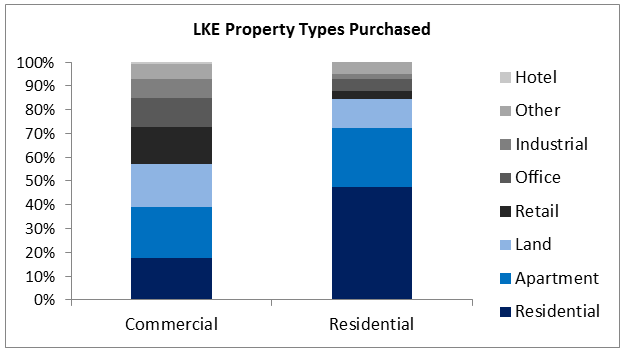
Properties disposed and purchased through like-kind exchanges mirrored NAR members’ practice specialty areas. Residential members handled a significantly larger share of residential properties, which comprised 54 percent of dispositions and 48 percent of acquisitions. Residential members also participated in a noticeable share of apartment transactions, accounting for 15 percent of dispositions and 25 percent of acquisitions. Conversely, commercial members were more active across the commercial property types—office, land, retail, apartment and industrial.
To access the Like-Kind Exchanges: Real Estate Market Perspectives 2015 report, visithttp://www.realtor.org/reports/like-kind-exchange-survey.
By: George Ratiu and Erin Fitzpatrick (Economists’ Outlook)
Click here to view source article.
Repurposing Commercial Properties with a Purpose
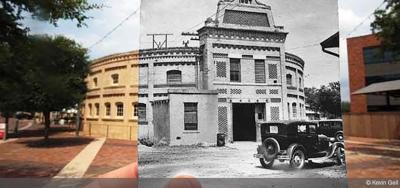
Human beings have been repurposing buildings since the dawn of civilization. Conquerors and evangelizers alike have shrewdly understood not only the efficiency but also the power in reusing temples and other buildings that had already been infused with meaning.
In a similar vein, real estate professionals should understand how to translate the importance of their community’s older buildings, which may have long outlived their initial usefulness, into places that will have meaning in that community’s future. Rather than building new, updating anything from defunct car dealerships to shuttered factories can make for a more authentic commercial district that better serves the people who live, work, and play there. “It’s about taking the best of what we’ve got and breathing new life into it,” says Anna Hudson, a sales associate and historic planning expert with Yndo Commercial Real Estate in San Antonio, Texas. “Each city, each town, only has one beginning, with a finite number of original buildings. Once they’re gone, they’re gone.”
Gauging Demand
Having spent decades working on historic preservation issues, Hudson sees distinct potential these days for existing commercial properties in urban environments. “As millennials and empty nesters move into the city, there’s going to be more demand,” she says, noting a growing interest in mixed-use projects. She particularly admires Pearl, a redevelopment project that transformed a pre-Prohibition brewery (once the largest in Texas) into a riverfront destination for San Antonio diners, shoppers, and revelers. “It is its own little neighborhood,” she says. “You could have a different date night every night of the week.”
Though typically associated with cities that have an extensive history, commercial redevelopment can thrive anywhere with quality building stock from structures built as recently as the 1970s, Hudson says, noting an example in her own city. The HemisFair Park Area Redevelopment Corporation is examining ways to increase usage of green spaces and revitalize downtown by using structures built for a World’s Fair held in San Antonio in 1968.
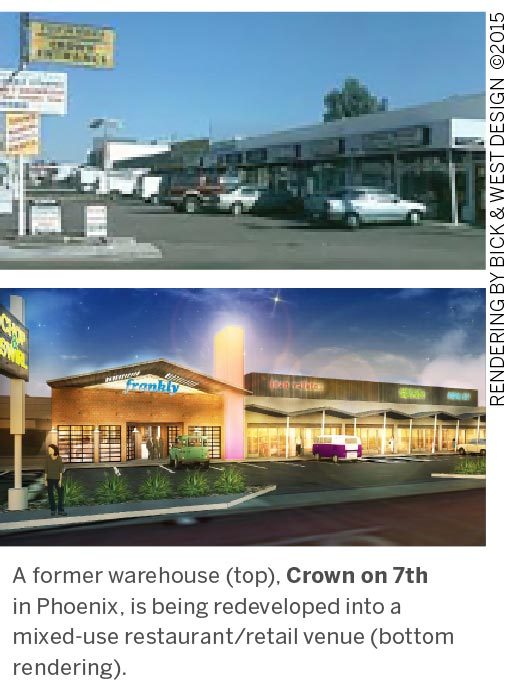
Where historic properties are harder to find, people may be more receptive to such projects precisely due to that scarcity. Dan Noma Jr., designated broker for Venture REI, a real estate investment company based in Chandler, Ariz., says he’s seen this play out in the redevelopment of the Crown Imports building in Phoenix. Venture REI and two other developers partnered to buy the warehouse, built in 1959, for $1.8 million and will invest $6 million to redevelop it as a mixed-use restaurant and retail venue. “Our tenants were looking for something unique. They were tired of the typical cookie-cutter buildings in our area,” Noma says. “We don’t have a lot of old properties, with Arizona being a newer state, and there aren’t a lot of developers with the experience.”
Noma says the efforts they made to preserve massive exposed beams and rich wood trusses in the building helped attract top-tier tenants that offset the costs of what they’re branding as Crown on 7th. “We knew we’d have to get restaurants, because they pay more and tend to stay longer. It wasn’t going to work with a couple of dry cleaners and a gym,” he says. “You’ve got to be strategically thinking about your tenant demographic from the outset.”
Crunching the Numbers
Repurposing an older structure can easily cost more than building new, but there are ways to reduce costs besides attracting deep-pocketed tenants. Hudson says that by the time they apply both state and federal tax incentives for redeveloping older buildings, savvy developers in her area can write off as much as 45 percent of qualified expenses on a project. “It can be more expensive [to redevelop], but in the long run these projects tend to pay off,” she says. However, she adds that obtaining tax breaks requires preserving a property in accordance with local laws. “If you’re not taking advantage of tax credits, you have more flexibility.”
Noma didn’t get any tax credits for Crown on 7th, but says municipal officials were eager to see the property redeveloped and helped the project along in other ways, such as by widening the road around the development. “The city’s been really receptive and supportive,” he says. “They really like taking these older buildings and repurposing them, so they’ve been a good partner.”
Indeed, municipalities often welcome redevelopment projects because they transform vacant or underused buildings into spaces that contribute to city coffers. Latitude 360 CEO Brent Brown says his Jacksonville, Fla.–based company’s business model—reimagining empty big box stores or underused shopping malls into gaming and entertainment destinations—can transform a neighborhood. “The economic impact is substantial,” he says. “We started in the depths of recession, and we were able to take over vacant retail big boxes that were just sitting in these markets and generate millions and millions of dollars in sales tax revenue and provide jobs for hundreds and hundreds of employees.”
However, Noma says no matter how well you plan out the financials, you should also build some flexibility into your cost-benefit analysis for the inevitable surprises that come up. “We had to replace part of the roof where we hadn’t planned on it, just to get the suite sizes that we wanted for our tenants. So we’ve had to borrow in other places in our budget [to cover that],” he says. “Being able to roll with the punches is important. Things do balance out in the end.”
Hudson agrees real estate pros in this niche should be ready for unexpected delays and outlays. “There are always going to be surprises,” she says. “These buildings have changed so much over time and as you start peeling back those layers of history, you may find, ‘Oh wow, there’s a sewer line there!’ ” But she notes the surprises can be pleasant too, such as finding out that a drop ceiling had been covering beautiful stained glass windows.
Designing Neighborhood Rebirth
Sometimes a repurposing project can be part of a larger effort. By the time Quicken Loans established its new headquarters in downtown Detroit, its parent company, Rock Ventures, had repurposed so many buildings that it decided to form a design group called dPop! to offer similar solutions to other corporations and businesses looking to rethink vintage office space. The new company took up residence in the basement of Chrysler House, a white brick and terra-cotta skyscraper designed by famed Chicago architect Daniel Burnham in the first decade of the 20th century. The basement had been a shooting range for security officers wanting to keep skills sharp at the former Dime Savings Bank of Detroit, which once owned the building.
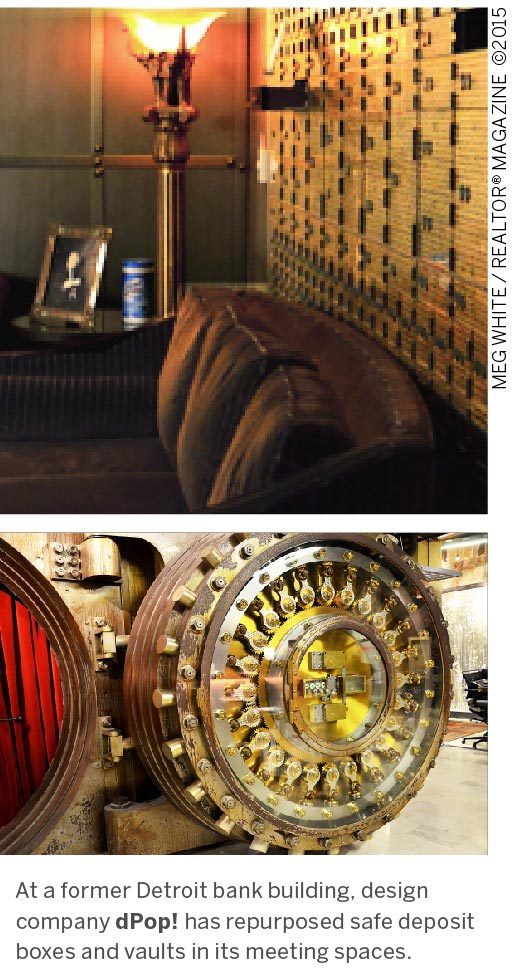
The offices of dPop! merge glittering bank features with an industrial-chic aesthetic that seems natural in the subterranean space. Meeting rooms are flanked by repurposed bank vaults and safe deposit boxes. dPop!’s designers salvaged hardwood planks in a lounge area and built a whimsical wall of vintage items they found in the space before the renovations began. The structural design choices—such as creating a skylight out of the sidewalk above—allow a once-dark basement to shine and also highlight the company’s commitment to cultivating innovation through the open layout.
Jeffrey Howard Brown, a dPop! creative administrator, says the resurgence of commercial space in the city has a revitalizing effect on a whole web of industries flocking to the area. “What’s happening in Detroit is amazing. There’s a renewed sense of excitement that’s been dormant for a while,” he says. “We’re all rooting for each other to succeed, even when we’re competitors.”
Since moving Quicken Loans from the suburbs to the city, Rock Ventures has purchased more than 70 Detroit properties and brought more than 130 other tenants into various locations in the city. Eric King, a Quicken Loans vice president, says the excitement is contagious for employees who see business coming back to the Motor City. “Of course, you’ve got to have high–quality buildings, but this is a better experience than being out in the suburbs in a strip mall,” he says. “[Employees] love it because they see the difference it’s making to the community. Everything that we’ve given to Detroit, we’ve gotten back in terms of how team members feel about what they’re doing.”
Successful redevelopment projects require getting the community on board, so it’s important to reach out during the planning process. That communication is not just to warn residents about coming changes, Hudson says: “You learn so much when you go to the neighborhoods. They’re going to have stories.” Knowing how locals interacted with the building in the past can provide insight into how best to highlight that history in the building’s rebirth and help determine which historic elements are important to retain.
Community outreach can also help you determine if your project will pay off in the long run. To ensure the development is sustainable, Hudson suggests talking to area residents early on to make sure what you’re planning is something they need and want. “Be honest about what it is [because] it’s got to make financial sense for them to use it,” she says.
Brown says Latitude 360 gets calls every week from mall owners and developers with properties that are ripe for redevelopment, but it doesn’t take them at their word. Latitude 360 partners with commercial real estate practitioners on the ground to help them evaluate prospects. “We use CBRE [Group], mainly, to represent us in different markets,” he says. “When we look at a location, we”l fly people out there and do a competitive analysis of the area.” He says they look at psychographic data to find out if locals are likely to patronize the development.
Partner With Experts
Another key part of the repurposing puzzle is assembling partnerships with experts. “It’s all about getting the right team,” Hudson says. “Find architects and developers who are experienced in doing redevelopment.” Hudson also recommends identifying and being in close contact with historic preservation offices at the state and local levels. On the national level, she suggests the Urban Land Institute and the Congress for the New Urbanism as helpful resources.
Teaming with experts can also provide a public relations boost that helps build confidence locally. Noma says his company was eager to work with Niels Kreipke—owner of Desert Viking Companies based in Chandler, Ariz.—because he’s seen as a leader who understands the importance of reuse. “He did all the redevelopment of downtown Chandler some 16 years ago,” Noma says. “Cities and municipalities in the area have sought him out.”
While repurposing is experiencing something of a renaissance right now, Hudson doesn’t see it as a passing trend. “As long as there are empty buildings with character and the green movement continues its path, adaptive reuse is going to continue,” she says. “The greenest building is the one that’s already built, and adaptive reuse is cost-effective.”
By: Meg White (REALTORMag)
Click here to view source article.