• Skip to primary navigation
  • Skip to main content

CARNM

Commercial Association of REALTORS® - CARNM New Mexico

  • Property Search
    • Search Properties
      • For Sale
      • For Lease
      • For Sale or Lease
      • Start Your Search
    • Location & Type
      • Albuquerque
      • Rio Rancho
      • Las Cruces
      • Santa Fe
      • Industry Types
  • Members
    • New Member
      • About Us
      • Getting Started in Commercial
      • Join CARNM
      • Orientation
    • Resources
      • Find A Broker
      • Code of Ethics
      • Governing Documents
      • NMAR Forms
      • CARNM Forms
      • RPAC
      • Needs & Wants
      • CARNM Directory
      • REALTOR® Benefits
      • Foreign Broker Violation
    • Designations
      • CCIM
      • IREM
      • SIOR
    • Issues/Concerns
      • FAQ
      • Ombuds Process
      • Professional Standards
      • Issues/Concerns
      • Foreign Broker Violation
  • About
    • About
      • About Us
      • Join CARNM
      • Sponsors
      • Contact Us
    • People
      • 2026 Board Members
      • Past Presidents
      • REALTORS® of the Year
      • President’s Award Recipients
      • Founder’s Award Recipients
    • Issues/Concerns
      • FAQ
      • Ombuds Process
      • Professional Standards
      • Issues/Concerns
      • Foreign Broker Violation
  • Education
    • Courses
      • Register
      • All Education
    • Resources
      • NMREC Licensing
      • Code of Ethics
      • NAR Educational Opportunities
      • CCIM Education
      • IREM Education
      • SIOR Educuation
  • News & Events
    • News
      • All News
      • Market Trends
    • Events
      • All Events Calendar
      • Education
      • CCIM Events
      • LIN Marketing Meeting
      • Thank Yous
  • CARNM Login
  • Show Search
Hide Search

Archives for August 2016

Economists' Perspectives on the Commercial Real Estate Industry

August 9, 2016 by CARNM

We asked some of the most highly-respected economists what the commercial real estate industry would look like for the next twelve months. Here are their individual takes.

Two Major Disconnects

by Lawrence Yun, NAR Chief Economist

We need to be mindful of two major disconnects that are present in the commercial real estate market. First, large properties with high price points have been doing much better than small properties with low price points. This trend came about because the smaller-size deals require lending principally from local community banks, and the new financial regulations have greatly raised the cost of doing business for the smaller guys. Fortunately though, after a lengthy wait, the small property deals are occurring and increasing due to steady job creation in the economy. So, as long as job creation continues there should be more deals in the making for commercial practitioners.
The second big disconnect is between solid commercial market fundamentals and worrisome property prices. Vacancy rates have been falling and rents have been rising—these are solid fundamentals. However, due to plentiful funds via Wall Street, pension funds, insurance companies, and other institutional money, big “trophy” properties in major cities have been bid up so high that the cap rates barely make sense. Therefore, when interest rates rise in 2017, the high-end property prices look vulnerable to some correction.

The Market is Hung but Cash Still Flows

by Jim Costello, CRE, Senior Vice President Real Capital Analytics (RCA)

The commercial property markets saw the highest ever 60-day period of transaction activity from December of 2015 through January of 2016. It is unlikely that we will see the same pace into the end of this year as buyers and sellers move apart on expectations. Still, deals will continue to happen and pricing will continue to remain tight.
Deal volume grew at double-digit rates from 2012 to 2015 as falling cap rates and low interest rates allowed buyers and sellers to see eye-to-eye on asset pricing. In recent months, however, the cap rate declines have stalled and interest rates, while not yet climbing, are expected to rise at some point. Transaction activity is down as potential buyers are underwriting with more caution in the current environment.
Still, current owners of commercial property are not leveraged to extreme levels as was seen before the Global Financial Crisis. Without some outside calamity that undermines the economy, properties will still be cash flowing and owners are not always going to be motivated to sell.
With greater differences on buyer and seller pricing expectations moving forward, the market is likely to be hung for a while, with lower overall volume but prices close to current levels.

Commercial Real Estate Performance: Good, Not Great

by Sara Rutledge, Director of Research, National Council of Real Estate Investment Fiduciaries (NCREIF)

Trends in the NCREIF Property Index (NPI) database suggest performance may have peaked. The quarterly NPI total return has edged down for more than the past four quarters to a level in-line its long-term average on deceleration in both the income return and appreciation. Appreciation strengthened to a cycle peak for the year in 2015, but has been trending down for the past two quarters. The annual income return has been slowly trending down over the past five years with market values rising faster than income. Yet, commercial real estate remains an attractive relative performer across asset classes, outperforming equities.
Occupancy among NPI properties stands at its highest level since 2001 and annual net operating income growth continues at an above-average pace. Market fundamentals differ by property type with apartment and office further along in their cycles than industrial and retail. This combination of attractive relative performance to other asset classes and strong fundamentals is supportive of capital flows into the sector, keeping cap rates low. Thus, the near-term outlook for commercial real estate performance is continued moderation. Simply put: performance should be good, not great.

Buildings Will Stay Rented and Value Will Increase

by Mark Dotzour, former Chief Economist and Director of Research for the Real Estate Center at Texas A&M and freelance economist

There are always two things on the commercial real estate investor’s mind: will my buildings stay rented and what will happen to the value in the next twelve months. While the US economy is getting aged, I think we still have maybe two more years of sluggish expansion that will continue to generate tenants. Property values are likely to continue to increase for quality commercial real estate because of the unprecedented manipulation and distortion of the credit markets by central banks in Europe, Japan, and the US. With bond yields further declining, commercial real estate will remain very attractive to global investors.

Pay it Forward: CRE Maintains in 2017

by Kenneth P. Riggs, Jr., CCIM, CRE, Chairman & President of the Real Estate Research Corporation (RERC)

Commercial real estate’s role as a foundation during uncertain times almost ensures that it will continue to be an attractive investment for the next 12 months. As a tangible asset that derives a majority of its return through annual dividends, commercial real estate is extremely attractive as we look to the future. Global uncertainties, including the assorted financial and political concerns like the UK exit from the EU, terrorism, and a slowdown in China, will continue. These, along with the challenges in the U.S. economy, with a rate of growth that is expected to remain stubbornly slow, will continue to be major headwinds for the global financial and capital markets. Commercial real estate will continue to be supported by historically low long-term interest rates. In addition, there are spouts of optimism through improved space market fundamentals and with supply and demand balances continuing to improve on a broad market perspective.
Commercial real estate will also continue to gain strength in the secondary and tertiary investment markets, as they finally rebound from the credit crisis of 2008 and reach a new normal. These gains will be especially bolstered by their local housing markets, which are expected to continue to demonstrate strength over the next year. Strength in the housing markets will result in an amazing ripple effect on local economies, as demand for labor from the trade professions and other skilled workers will drive growth in employment, personal income, and consumer spending.


Editor’s Note:

As a whole, these economists felt capital hungry for yield will meet a global economic slowdown at the cross-roads of the U.S. economy spurring modest but positive growth which is expected to bolster commercial real estate through a late-cycle that will continue to reward investment. As a commercial real estate professional continue to stay abreast of market developments through reports like NAR’s Quarterly Forecast so you can be best-prepared to handle any trends and their potential impact on your local business.
Edited By: Lawrence Yun (National Association of REALTORS®)
Click here to view source article.
Filed Under: All News

Community: The Maker Movement

August 9, 2016 by CARNM

On Common Ground is a NAR publication devoted to presenting a wide range of views on smart growth, with the goal of encouraging dialog among REALTORS®, elected officials, and other interested citizens. With an eye towards issues like sustainability and walkability that appeal to modern consumers, it’s an excellent resource for commercial real estate practitioners interested in smart growth and community building. Enjoy this article from a recent issue and view all issues of On Common Ground by visiting www.realtor.org/publications/on-common-ground.
Alexandra Ferguson, CEO of her eponymous line of custom pillows and décor, started as a small, home-based business. “I first sold my pillows on Etsy, so I’m as homegrown as it gets,” says Ferguson. When it was time to expand, Ferguson had a hard time finding an inexpensive, light manufacturing spot in Westchester, New York. “I decided to look in Brooklyn and Queens as the talent I needed could be found in those areas,” she says. She ended up moving into a 4,000-square-foot raw industrial loft space in Industry City, an innovation and manufacturing district situated on the waterfront in Sunset Park, Brooklyn.
Industry City is transforming ground floor and lower levels into a pedestrian-friendly series of shops, showrooms, event spaces and courtyards, loosely organized around themes such as food and food production, children and family, and home goods, while providing ample loading docks and service ground for upper floor innovation economy and manufacturing tenants. These mixed-use maker spaces, developing around the United States, are becoming a popular choice for real estate developers hoping to revitalize communities and accommodate small manufacturers.
More and more cities and real estate developers are creating spaces for small-scale manufacturing. Small manufacturers, or makers, in textiles, wood, metal, and electronics need places that are appropriate in scale, which are affordable, and that meet local zoning and building codes. Maker spaces can provide some shared facilities and equipment, as well as mentoring and assistance in running a business.

A Resurgence

“We are seeing a resurgence of small, local producers who are harnessing low-cost technology and changing markets to sell hundreds and thousands of locally produced consumer products,” says Ilana Preuss, founder of Recast City, a company that brings together small-scale manufacturers and community developers to strengthen neighborhoods, build real estate value, and create more job opportunities for residents.
Documented by Chris Anderson, author of “Makers: ffe New Industrial Revolution,” and seen across the country today, these companies are often businesses with fewer than 20 employees and sell both in local markets and globally online. In an interview with Forbes Magazine, Anderson notes, that, “Until a few years ago, you just didn’t have access to production. The world is oriented around companies, and manufacturing was expensive and consuming.” All of that is changing.
According to its study, “The Federal Role in Supporting Manufacturing,” by the Pratt Center for Community Development and Brookings Institute, despite recent recessionary shocks, manufacturing continues to play a central role in the American economy and still serves as a gateway to the middle class for a sizeable segment of the nation’s population. Today, says the report, approximately 11.7 million Americans are employed by the country’s 300,000 manufacturing firms, and over 7 million additional jobs are supported by manufacturing-related activities, including jobs in transportation, wholesaling, and service industries, such as accounting, consulting, real estate and finance.
The report goes on to say, “Unlike the days when large companies dominated the nation’s commodity production, today’s manufacturing landscape is largely occupied by decentralized networks of small, specialized firms — many of which are hidden in plain sight in America’s urban areas. In fact, in 2007, of the approximately 51,422 manufacturers in the United States employing fewer than 20 people, over a third were located in the nation’s 10 largest cities alone. These businesses make an astonishing range of products — from high-tech medical equipment to designer coats, artisanal food products to specialized coatings — and serve a spectrum of customers and markets, including small suppliers, contractors, the consumer public, and large original equipment manufacturers (OEMs).”
“There is a rebirth of modern manufacturing; I call it the innovation economy and that’s where the job growth is,” says Andrew Kimball, CEO of Industry City. New technology allows people to manufacture in small spaces,” he says. “There’s a blurring of technology, manufacturing and design. The good news for cities is that these kinds of businesses start small and often grow over time. They employ people who need jobs the most, jobs that are broadly accessible to those with a broad range of educational backgrounds,” says Kimball.
That’s the case with Ferguson, who has a “one-stop, supere fficient space that includes her office, photo studio space, manufacturing, warehouse and shipping all from one place.” In addition, Industry City has efficiencies built in, such as the ability to outsource to other suppliers who are in her same building. Her business grew from one employee to five employees in the short 18 months she’s been in Industry City.
Note: Continue this article at On Common Ground.
By: National Association of REALTORS® 
Click here to view source article.

Filed Under: All News

Research: Diverging Trends in Market Performance

August 9, 2016 by CARNM

With a slowdown in global economic activity, financial market volatility and a contentious presidential campaign, commercial real estate investors have taken a step back in the early months of 2016.

The U.S. economy sputtered during the first quarter of 2016, with gross domestic product advancing at a weak 1.0 percent annual rate. The corporate outlook took a downward turn, while international trade bore the brunt of a soft economic environment and rising dollar. However, the markets remained divided along valuation lines, with small cap commercial real estate maintaining momentum against the broader moderation.
2016-08-05-ratiu-analysis-header-700w

Small Cap Markets Maintain Momentum

Commercial sales transactions span the price spectrum, but tend to be measured and reported based on size. Commercial real estate deals at the higher end—$2.5 million and above—comprise a large share of investment sales, and generally receive most of the press coverage. Smaller commercial transactions tend to be obscured given their size. However, the REALTORS® Commercial Real Estate Market Trends shines the spotlight on small cap commercial real estate markets.
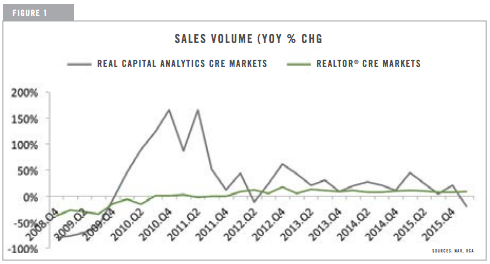
Commercial transactions in large cap markets dropped in Q1 of 2016. The volume of commercial sales totaled $111 billion, a 20 percent year-over-year decrease, according to Real Capital Analytics (RCA). The nominal decline was partly due to unusually high portfolio deals which closed in the first quarter of 2015. Investor hesitation was evident in pricing, as cap rates were flat for the past three quarters, at 6.7 percent. Prices in markets covered by RCA gained 8.6 percent during the first quarter of 2016. The advance was driven by strong appreciation in values of retail and apartment properties, which advanced 11.8 percent and 11.2 percent, respectively. Prices for office properties in central business districts (CBD) advanced at a solid 10.5 percent.
Sales Volume YOY % Change
In comparison, commercial real estate in small cap markets maintained its upward momentum during the first quarter, with REALTORS® reporting continued improvement in fundamentals and investment sales. The volume of investment sales in REALTOR® markets totaled $51.6 billion during the first quarter, 8.5 percent higher than the first quarter of 2015. Inventory shortage drove price growth, with commercial properties exchanging hands at average prices 5.1 percent higher compared with the same period in 2015. Average capitalization rates declined to an average 7.2 percent across all property types, a 57 basis point compression on a yearly basis. (See Figure 1)

Lending Conditions Tighten

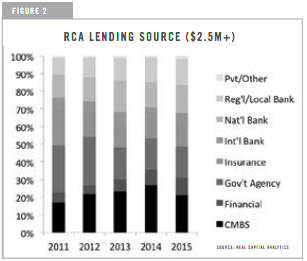
RCA Lending Source graph
While capital markets proved favorable during 2015, this year investors are finding soft spots in debt markets. In the large cap commercial real estate space, most sources of funding remain active, competing for market share. The main exceptions have been issuers of commercial mortgage backed securities (CMBS), who have tamped down the origination flow, with $19.0 billion in new issues during the first quarter of 2016, down 29.6 percent year-over-year. Based on RCA data, CMBS originators accounted for about one-in-five transactions at the high end of the market, followed by government-sponsored enterprises (GSEs). The third largest funding source comprised of national banks, with 16.0 percent of total transactions. Regional and local banks made up 15.0 percent of total volume. (See Figure 2)
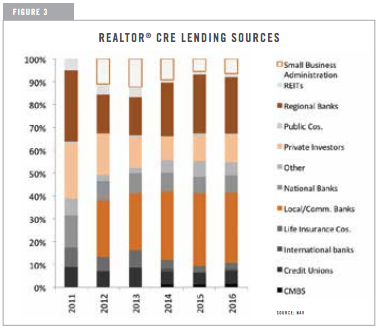
REALTOR® CRE Lending Sources
Based on the REALTORS® Commercial Real Estate Lending Trends 2016, capital markets display a fundamentally different landscape. Local and community banks were the largest lending group in 2015, accounting for 31.0 percent of transactions. Regional banks were the second largest capital source in 2015, with 25.0 percent of REALTORS®’ commercial deals. Private investors were the third main capital providers, accounting for 12.0 percent of deals during 2015. National banks came in fourth place, with 8.0 percent market share. (See Figure 3)
The data highlights the marked differences in large cap versus small cap markets. Debt financing represents a much-larger portion of capital in small cap markets. For regional and community banks—which account for 56.0 percent of all capital in REALTOR® markets—compliance costs stemming from financial regulations have made a stronger impact on available capital for deals. With rising operating costs and higher capital reserve requirements for loans, regional and community banks have been more cautious, resulting in tightening of capital.

Over the past months, over a third of REALTORS® reported tightening lending conditions, compared with 22.0 percent in 2014 and 28.0 percent in 2013. In addition, 59.0 percent reported insufficient bank capital remains an obstacle to sales in their markets. (See Figure 4)

Outlook

Looking ahead at the second half of 2016, the GDP annual rate of growth will pick up modestly. However, in light of the weak first quarter, the annual growth is pegged at 1.6 percent. Payroll employment is projected to post 1.6 percent annual growth rate for the year, with the unemployment rate estimated to fall to 4.7 percent by the end of 2016. Commercial fundamentals continue on an expansionary path, with three of the four core sectors tilting in landlords’ favor. On the investment side, financial markets’ jitters about interest rates will likely dampen the sales pace in large cap markets. In small cap markets, increased scrutiny from banking regulators has already tightened lending conditions.
However, in light of current global uncertainty, U.S. commercial real estate is likely to remain an attractive alternative for investors this year. Investors will probably take a more measured approach, leading to a moderation in prices. With cap rates at very low levels and interest rates expected to rise, the price slowdown is projected to impact Class A assets in top-tier markets, where inventory shortages and crowding of capital have led to the recent runups. Properties in smaller markets, where the recovery only began in 2013 are likely to see continued price appreciation.
By: George Ratiu (Commercial Connections Magazine)
Click here to view source article.
Filed Under: All News

CARNM Commercial Source: Experts Glean More Value From Commercial Real Estate Deals by Debbie Dupes CCIM & Sean McMullan CCIM

August 7, 2016 by CARNM

CCIMS are Your Allies in Complex Field

Albuquerque-Homestyle-08-07-2016_Page_01

By: Debbie Dupes CCIM of CBRE & Sean McMullan CCIM of McMullan & Co. Real Estate LLC (HomeStyle Magazine by The Albuquerque Journal)

If you are considering investing in commercial real estate, seek the knowledge of a New Mexico CCIM. 

Commercial real estate is a very dynamic and complicated industry. Whether you are a new investor with capital to invest in commercial real estate or an experienced investor adding properties to your portfolio to lease or sell, it is important to understand the ever-changing market.
A Certified Commercial Investment Member (CCIM) can help you choose the right location, analyze multiple financing opportunities, negotiate the deal, and comprehend the tax benefits or tax consequences of the deal. Just like you have an attorney to help you navigate through the legal world and an accountant to help you with your finances, a CCIM is your best ally to find the right investment property and help you through the transaction.
With proven industry experience, unparalleled education, cutting edge technology and a network of thousands of other industry experts, a commercial real estate broker with a CCIM designation brings an exceptional level of real-world experiences, skills, resources and tools. Working with a CCIM gives you confidence that you are making the right decisions and maximizes the value of your real estate investment.
For more than 40 years, CCIMs have been recognized as experts in commercial real estate. Each CCIM has successfully completed a graduate-level program comprised of 200 hours of education.They have mastered such theories and issues such as time value of money,measuring investment performance, cashflow, analyzing the best use of a site, property supply and demand, evaluating and managing risk, and whether it is better to lease or own. A CCIM has also proven that they are experienced and able to apply their knowledge to each transaction.
In New Mexico, there are over 80CCIMs that can more accurately navigate real estate decisions and seek out future opportunities and wealth building for their clients by understanding and analyzing problems and solutions relative to the investor’s goals. All across America and in 30 countries all over the world, CCIMs encompass a diverse group of real estate professionals including brokers, leasing agents, lenders, asset managers, property managers, attorneys and other allied commercial real estate professionals.
If you are considering investing in commercial real estate and want the assurance that you are making the best decisions and maximizing your return,seek the expertise of a New Mexico CCIM. For more information about CCIM or to find a CCIM, go to chapters. ccim.com/newmexico.
 
Click here to view source article.

Click here to view source PDF.

Filed Under: All News

  • « Go to Previous Page
  • Page 1
  • Page 2
  • Page 3
  • Page 4
  • Page 5
  • Page 6
  • Go to Next Page »
  • Search Property
  • Join CARNM
  • CARNM Login
  • NMAR Forms
  • All News
  • All Events
  • Education
  • Contact Us
  • About Us
  • FAQ
  • Issues/Concerns
6739 Academy Road NE, Ste 310
Albuquerque, NM 87109
admin@carnm.realtor(505) 503-7807

© 2026, Content: © 2021 Commercial Association of REALTORS® New Mexico. All rights reserved. Website by CARRISTO