• Skip to primary navigation
  • Skip to main content

CARNM

Commercial Association of REALTORS® - CARNM New Mexico

  • Property Search
    • Search Properties
      • For Sale
      • For Lease
      • For Sale or Lease
      • Start Your Search
    • Location & Type
      • Albuquerque
      • Rio Rancho
      • Las Cruces
      • Santa Fe
      • Industry Types
  • Members
    • New Member
      • About Us
      • Getting Started in Commercial
      • Join CARNM
      • Orientation
    • Resources
      • Find A Broker
      • Code of Ethics
      • Governing Documents
      • NMAR Forms
      • CARNM Forms
      • RPAC
      • Needs & Wants
      • CARNM Directory
      • REALTOR® Benefits
      • Foreign Broker Violation
    • Designations
      • CCIM
      • IREM
      • SIOR
    • Issues/Concerns
      • FAQ
      • Ombuds Process
      • Professional Standards
      • Issues/Concerns
      • Foreign Broker Violation
  • About
    • About
      • About Us
      • Join CARNM
      • Sponsors
      • Contact Us
    • People
      • 2026 Board Members
      • Past Presidents
      • REALTORS® of the Year
      • President’s Award Recipients
      • Founder’s Award Recipients
    • Issues/Concerns
      • FAQ
      • Ombuds Process
      • Professional Standards
      • Issues/Concerns
      • Foreign Broker Violation
  • Education
    • Courses
      • Register
      • All Education
    • Resources
      • NMREC Licensing
      • Code of Ethics
      • NAR Educational Opportunities
      • CCIM Education
      • IREM Education
      • SIOR Educuation
  • News & Events
    • News
      • All News
      • Market Trends
    • Events
      • All Events Calendar
      • Education
      • CCIM Events
      • LIN Marketing Meeting
      • Thank Yous
  • CARNM Login
  • Show Search
Hide Search

Archives for October 2016

Nob Hill Neighborhood Announced "Great Place in America" by American Planning Association

October 21, 2016 by CARNM

Announcing the 2016 Great Places in America!

APA is proud to announce the 2016 Great Places in America. These 15 places — in communities large and small — celebrate stories of exemplary planning that have resulted in stronger, healthier, and more just communities.
i-heart-planning
Congratulations to Nob Hill for being named a Great Neighborhood in America by the American Planning Association (APA). Nob Hill was selected because of its rich culture, historical preservation, amazing community events and forward thinking planning with projects like ART.
Learn more about the other Great Neighborhoods in America selected by the APA.

Read about what makes Nob Hill great!

Summary

Nob Hill in Albuquerque sprung up around the golden age of road trips and cruising inspired by Route 66, which now serves as its Central Avenue. The community has played a central role in much of the preservation and bustling culture the neighborhood knows today. Progressive city planning efforts — past and present — are also creating an even greater Nob Hill.

A classic car show in Summer 2015 along Central Avenue in Nob Hill. Photo by Eric Williams, City of Albuquerque.

Designated Area

Nob Hill is bound by Lomas Boulevard to the north, Girard Boulevard to the west, Washington Street to the east, and Coal Avenue to the south.
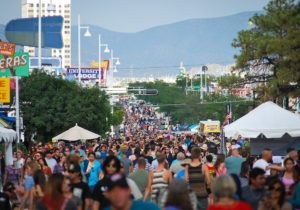
A look down Central Avenue in Nob Hill during a street party. Photo courtesy the City of Albuquerque.

Planning Excellence

Get your kicks … in Nob Hill. This quirky Southwestern neighborhood revolves around the culture of old Route 66, now known as Central Avenue for its position as the main artery and “Premium Transit Corridor” of the neighborhood.
The busy stretch of street is filled with local shops, restaurants, and businesses decked out in unique southwestern style buildings and neon signs that harken back to the 1950s and the height of Route 66.
Community leaders and local groups have been fundamental to the neighborhood’s revitalization and exciting cultural scene. Residents and local businesses have pushed for planning efforts to strengthen the neighborhood. These community grassroots efforts resulted in the creation of Nob Hill Main Street Inc., a neighborhood-based revitalization organization.
Today, the group continues to work to preserve historic buildings, some of which are known for their Southwestern pueblo/mission design. It also strives to make the street more pedestrian friendly and welcoming for residents and visitors alike.
The planning successes of Nob Hill extend beyond its commitment to preservation. Nob Hill is the backdrop for two City of Albuquerque forward-looking visions — construction of a rapid transit route along Central Avenue, along with an update to the city’s comprehensive plan, and simplifying zoning in Albuquerque by implementing an Integrated Development Ordinance.
The Albuquerque Rapid Transit project, better known as ART, is expected to create jobs, spur growth, and encourage the development of better pedestrian infrastructure like other rapid transit projects of its kind. ART will be the first rapid transit project in country to use electric buses — a move that will not only create a cleaner and quieter Nob Hill, but also protect the character of the community from fossil fuels. The Federal Transit Administration recently approved the start of construction for the ART project in Nob Hill.
The Twinkle Light Parade cruising down Central Avenue in Nob Hill. Photo courtesy the City of Albuquerque.

Defining Characteristics, Features

  • Nob Hill remains diverse and affordable. Rental prices have been stable over the past 10 years, and the neighborhood has maintained its percentage of Hispanic/Latino residents at 26 percent.
  • There are significant plans to continue improvements and efforts to revitalize the portion of Nob Hill east of Carlisle.
  • Transit routes run on all sides of the neighborhood and up and down Central Avenue. Bike lanes are also a feature of the neighborhood.
  • Nob Hill has strong pedestrian connections to local businesses via sidewalks and paths. Solid pedestrian infrastructure is due in part to Albuquerque’s gridded street design.
  • In conjunction with Anthea @ Nob Hill, the City of Albuquerque Planning Department’s Metropolitan Redevelopment Agency is redeveloping a vacant Route 66 motel site in Nob Hill into a new mixed-use facility. The De Anza Motor Lodge will offer boutique hotel space, retail, and restaurants while preserving precious Zuni Shalako murals and historic building facades that face Central Avenue. The project is slated to begin in early 2017.

Events

  • Route 66 Summerfest in Nob Hill celebrates 1950s culture through jazz music, swing dancing, and scrumptious barbecue.
  • The Twinkle Light Parade, which goes through Nob Hill, is a family-friendly holiday event featuring dozens of floats, marching bands, equestrian clubs, fire trucks, car clubs, businesses, and Mr. and Mrs. Claus. The parade dazzles audiences with over 300,000 lights.

Pertinent Plans and Documents

  • Nob Hill/Highland Sector Development Plan (2006)
  • Central/Highland/Upper Nob Hill Metropolitan Redevelopment Plan (2005)
  • Albuquerque Rapid Transit Project
  • Route 66 Action Plan (2014)
  • ABC-Z Project (Comprehensive Plan Update and IDO Creation)

Upcoming/Planned Planning Activities

Nob Hill celebrates its 100th anniversary in 2016, just in time for APA’s New Mexico Chapter conference in Albuquerque.
By: American Planning Association 
Click here to view source article.

Filed Under: All News

U.S. Mall Investors Set to Lose Billions as Retail Gloom Deepens

October 21, 2016 by CARNM

A woman walks by a discount sign at an Abercrombie & Fitch store at a shopping mall in Garden City, New York, U.S. on November 28, 2014. REUTERS/Shannon Stapleton/File Photo

Online Shopping Continues to Crush U.S. Department Stores

(Reuters/IFR) – The dramatic shift to online shopping that has crushed U.S. department stores in recent years now threatens the investors who a decade ago funded the vast expanse of brick and mortar emporiums that many Americans no longer visit.
Weak September core retail sales, which strip out auto and gasoline sales, provide a window into the pain the holders of mall debt face in coming months as retailers with a physical presence keep discounting to stave off lagging sales.
Some $128 billion of commercial real estate loans – more than one-quarter of which went to finance malls a decade ago – are due to refinance between now and the end of 2017, according to Morningstar Credit Ratings.
Wells Fargo estimates that about $38 billion of these loans were taken out by retailers, bundled into commercial mortgage-backed securities (CMBS) and sold to institutional investors.
Morgan Stanley, Deutsche Bank and other underwriters now reckon about half of all CMBS maturing in 2017 could struggle to get financing on current terms. Commercial mortgage debt often only pays off the interest and the principal must be refinanced.
The blame lies with online shopping and widespread discounting, which have shrunk profit margins and increased store closures, such as Aeropostale’s bankruptcy filing in May, making it harder for mall operators to meet their debt obligations.
Between the end of 2009 and this July e-commerce doubled its share of the retail pie and while overall sales have risen a cumulative 31 percent, department store sales have plunged 17 percent, according to Commerce Department data.
According to Howard Davidowitz, chairman of Davidowitz & Associates Inc, which has provided consulting and investment banking services for the retail industry since 1981, half the 1,100 U.S. regional malls will close over the next decade.

TOO MUCH

A surplus of stores are fighting for survival as the ubiquitous discount signs attest, he said.
“When there is too much, and we have too much, then the only differentiator is price. That’s why they’re all going into bankruptcy and closing all these stores,” Davidowitz said.
The crunch in the CMBS market means holders of non-performing debt, such as pensions or hedge funds, stand to lose money.
The mall owners, mostly real estate investment trusts (REITs), have avoided major losses because they can often shed their debt through an easy foreclosure process.
“You have a lot of volume that won’t be able to refi,” said Ann Hambly founder and chief executive of 1st Service Solutions, which works with borrowers when CMBS loans need to be restructured.
Cumulative losses from mostly 10-year CMBS loans issued in 2005 through 2007 already reach $32.6 billion, a big jump from the average $1.23 billion incurred annually in the prior decade, according to Wells Fargo.
The CMBS industry is bracing for losses to spike as loan servicers struggle to extract any value from problematic malls, particularly those based in less affluent areas.
In January, for example, investors recouped just 4 percent of a $136 million CMBS loan from 2006 on the Citadel Mall in Colorado Springs, Colorado.
Investor worries about exposure to struggling malls and retailers intensified in August when Macy’s said it would close 100 stores, prompting increased hedging and widening spreads on the junk-rated bonds made up of riskier commercial mortgages.
Adding to the stress, new rules, set to be introduced on Dec. 24, will make it constlier for banks to sell CMBS debt. The rules require banks to hold at least 5 percent of each new deal they create, or find a qualified investor to assume the risk.
This has already roughly halved new CMBS issuance in 2016 and loan brokers say the packaged debt financing is now only available to the nation’s best malls. Investors too are demanding greater prudence in CMBS underwriting.
Mall owners who failed to meet debt payments in the past would just hand over the keys because the borrowers contributed little, if any, of their own money. The terms often shielded other assets from being seized as collateral to repay the debt.
Dodging the overall trend, retail rents for premier shopping centers located in affluent areas continue to rise. Vacant retail space at malls is at its lowest rate since 2010, according to research by Cushman & Wakefield.
The low vacancy rate reflects the ability of some malls to fill the void left by store closings by offering space to dollar stores and discounters.
That is, however, little consolation for investors.
“With the retail consolidation that we have ahead of us, malls have a fair amount of pain left to come,” Edward Dittmer, a CMBS analyst at Morningstar, said.
Eds: Carmel Crimmins and Tomasz Janowski (Reuters)
Click here to view source article.

Filed Under: All News

CARNM Commercial Source: Triple Net Lease Investments by Tim House

October 20, 2016 by CARNM

In this installment of CARNM Commercial Source, featured in HomeStyle Magazine by Albuquerque Journal, by Tim House of SVN Team Southwest explains triple net leases and tips on how to invest.

homestyle-10-21-16-tim-house-triple-net-lease-png_page_1

By: Tim House of SVN Team Southwest (HomeStyle Magazine by Albuquerque Journal)

Investment Tips

The uncertainty of traditional investment classes and lack of a meaningful return have generated tremendous investor interest in net-leased, single-tenant real estate here in Albuquerque and across the nation. These properties, often referred to as NNN or STNL, are typically freestanding buildings leased to national tenants on a long-term lease of 10 to 25 years. The typical tenants are widely varied and most are household names such as AutoZone, McDonalds, Walgreen’s, Dollar General and FedEx.

Lease Structures

The appeal of investing in a NNN property includes predictable income, lower-risk income, capital preservation, tax deferment, hedge against inflation and pride of ownership. Honestly, who among us wouldn’t want to own the Starbuck’s store down the street that pays a great monthly rent like clockwork every month? Telling our friends that we owned it
would be a bonus.
The NNN lease structure requires that the tenant pays rent monthly as well as pay the property taxes, property insurance and property maintenance. The benefit of little or no management responsibilities cannot be understated, especially if the property is located in another city or state. Couple these benefits with tax advantages and the ability to defer capital gains through the use of a 1031 Exchange, and it is easy to see the appeal.

Property Offerings

Property offerings are generally separated by the quality of the tenant and by the type of business they are in. The first category is retail and restaurants, including quick service, casual dining, drug stores, auto parts stores, dollar stores and home improvement stores. The second category is industrial, including distribution and service centers. The third category is medical office buildings, such as dialysis centers and urgent care.

Tenant Ratings

Tenants are rated as credit tenants or non-credit tenants by rating companies like
Standard & Poor, Moody’s, or Fitch Group. The most desirable tenants are rated as institutional-grade investments such as CVS and McDonald’s. Non-credit tenants are rated below investment grade or not rated by the agencies. These unrated tenants can be local, regional or national companies. Some very good tenants are not rated because they carry no debt. An example of an unrated tenant is Sprouts Farmers Market.
Major factors to consider prior to investing in a NNN leased property include income yield, also known as return on investment; income stability, or length of the lease and rental increases; income quality, drawn from the tenant strength, credit rating and financial statements; lease provisions, such as landlord responsibilities and tenant responsibilities; location factors, like traffic count, visibility, ease of access, and complimentary neighboring businesses; demographics, such as population and income; and the nature of improvements including age, condition and conversion for another use.

The Devil is in the Details

In closing, net-leased investment properties offer a solid avenue for stable income, wealth
building, estate planning and flexibility. These investments provide more control than the equities market and allow the ability to exchange management-intense real estate for a very low-effort investment. Remember that the devil is in the details and a qualified commercial real estate broker with specialized knowledge can greatly assist you on your journey.
Click here to view source article.
Click here to view source PDF (full issue).
Click here to view source PDF (article only).

Filed Under: All News

Economics Expert Slightly More Optimistic for Next Fiscal Year

October 17, 2016 by CARNM

By: Bruce Krasnow (Santa Fe New Mexican)
At the start of the 2016 legislative session, New Mexico State University economics professor Jim Peach was asked about his expectations for the state economy and what that might mean for government budgets.
Peach’s answer was not especially popular: “I would simply count on no new money,” he told the Legislative Finance Committee in January.
It turned out Peach was right, and even overly optimistic — in the weeks that followed, the state cut its revenue forecast and slashed spending to fight off a deficit, a process that didn’t end until lawmakers finally trimmed another 5 percent from most spending during a special session in early October.
Peach was back before lawmakers last week to discuss a new analysis by the Arrowhead Center at NMSU on economic base jobs in the state. But lawmakers couldn’t resist asking him about the outlook for the state’s economy in the coming fiscal year, which begins July 1, 2017.
“Fiscal year 2018 looks better than it has. My guess is we’re going to be OK,” he said. But he also added, “I’m an eternal optimist because I’m a Cubs fan.”
Peach said the state still is far too reliant on revenues from the volatile energy sector, which might contribute as much as a third of all the general fund dollars in one form or another. But crude oil prices are staying in the range of forecasters, $45 to $50 a barrel, and production levels are so far holding up in the Permian Basin.
And if prices can increase just a little, the state will see even more production for crude, and that means more exploration and employment, he said.
But the short-term news won’t solve more systemic problems, such as a higher-education system that lags neighboring states in terms of quality and a workforce that lacks in necessary skills. “We’re going to be further behind unless we change our ways,” he told lawmakers.
If it seems like New Mexico has been attracting a relatively high number of call center jobs, it’s part of a regional trend with more Western states seeing a growth in call center employment.
“Even when the state loses a call center, another seems to open in its place,” writes Adam Garcia and Ashley Leach, economists with the Department of Workforce Solutions in the agency’s September Labor Market Review.
As of 2015, the state had 58 call centers with a total 5,637 jobs. This represents just under 1 percent of total employment, which is actually less than Utah, with call center employment at 1.5 percent, and Arizona at 1.3 percent. In fact, all the states west of the Mississippi except for Washington and California had a higher percentage of call center jobs than the national average, with Idaho, Utah and Arizona having the highest concentration of such jobs in the United States, according to the analysis.
Sandoval County has a particularly high concentration of call center jobs, with 2,249 jobs totaling 10.5 percent of private employment. The average weekly wage of a call center employee was $569 statewide but $736 in Sandoval County.
Since Comcast is Santa Fe’s cable provider, it’s important to note that the company recently settled a dispute with the FCC over customer complaints.
Comcast agreed to pay a $2.3 million civil penalty and agreed to more transparency in the way it charges customers, especially with new services and price increases for existing services.
According to CNN Money, Comcast must send customers notifications “every time a new charge or service is added to their bill.”
The company also has to tell customers how to block the additional services or equipment, and is barred from referring an account to collections or suspending an account that has a disputed charge.
Click here for more on the economic predictions.
Click here to view source article.

Filed Under: All News

  • « Go to Previous Page
  • Page 1
  • Page 2
  • Page 3
  • Page 4
  • Interim pages omitted …
  • Page 6
  • Go to Next Page »
  • Search Property
  • Join CARNM
  • CARNM Login
  • NMAR Forms
  • All News
  • All Events
  • Education
  • Contact Us
  • About Us
  • FAQ
  • Issues/Concerns
6739 Academy Road NE, Ste 310
Albuquerque, NM 87109
admin@carnm.realtor(505) 503-7807

© 2026, Content: © 2021 Commercial Association of REALTORS® New Mexico. All rights reserved. Website by CARRISTO