• Skip to primary navigation
  • Skip to main content

CARNM

Commercial Association of REALTORS® - CARNM New Mexico

  • Property Search
    • Search Properties
      • For Sale
      • For Lease
      • For Sale or Lease
      • Start Your Search
    • Location & Type
      • Albuquerque
      • Rio Rancho
      • Las Cruces
      • Santa Fe
      • Industry Types
  • Members
    • New Member
      • About Us
      • Getting Started in Commercial
      • Join CARNM
      • Orientation
    • Resources
      • Find A Broker
      • Code of Ethics
      • Governing Documents
      • NMAR Forms
      • CARNM Forms
      • RPAC
      • Needs & Wants
      • CARNM Directory
      • REALTOR® Benefits
      • Foreign Broker Violation
    • Designations
      • CCIM
      • IREM
      • SIOR
    • Issues/Concerns
      • FAQ
      • Ombuds Process
      • Professional Standards
      • Issues/Concerns
      • Foreign Broker Violation
  • About
    • About
      • About Us
      • Join CARNM
      • Sponsors
      • Contact Us
    • People
      • 2026 Board Members
      • Past Presidents
      • REALTORS® of the Year
      • President’s Award Recipients
      • Founder’s Award Recipients
    • Issues/Concerns
      • FAQ
      • Ombuds Process
      • Professional Standards
      • Issues/Concerns
      • Foreign Broker Violation
  • Education
    • Courses
      • Register
      • All Education
    • Resources
      • NMREC Licensing
      • Code of Ethics
      • NAR Educational Opportunities
      • CCIM Education
      • IREM Education
      • SIOR Educuation
  • News & Events
    • News
      • All News
      • Market Trends
    • Events
      • All Events Calendar
      • Education
      • CCIM Events
      • LIN Marketing Meeting
      • Thank Yous
  • CARNM Login
  • Show Search
Hide Search

Archives for February 2017

CARNM Commercial Source: Steps to Owning Commercial Real Estate by Justine Deshayes

February 24, 2017 by CARNM

Understanding Loans for Future Commercial Developments


By: Justine Deshayes, CCIM of Wells Fargo (Albuquerque Journal HomeStyle Magazine)
A new year brings new goals for business owners and investors. Many share the goal of acquiring, constructing or refinancing commercial real estate (CRE). Despite the rate increase by the Federal Government in December, rates still remain at low historical levels, which make it a smart financial decision to obtain financing.
There are several financing vehicles, including insurance companies, pension funds, private investors and other capital sources. Though there are numerous lending options, two are most commonly utilized: conventional and SBA.

Conventional Bank Loans

Conventional commercial real estate loans are applicable to both owner-occupied or investor properties. “Owner-occupied” is defined as the borrower’ s business occupying 51 percent or more of the building square footage.

US Small Business Administration (SBA) Loans

Only owner-occupied buildings qualify for SBA loans, ¬not investor properties.SBA loans are not actually made by theSBA; rather, lenders make commercial loans that adhere to the SBA’s guidelines, and in turn, the SBA guarantees a portion of that loan. This eliminates some of the risk to the third-party lender. This SBA guarantee allows lenders to provide financing with longer terms and better rates, as well as the option to put less money down.There are two real estate loan options offered by the SBA: the 7(a) and 504. The7(a) is SBA’s most common loan program, but speak to your lender to discern which better fits your objectives. It’s important to note that only certain lenders are part of the SBA’s Preferred Lenders Program (PLP). This is part of SBA’s effort to streamline procedures and delegates thefinal credit decision (and most servicing) to carefully selected PLP lenders.

Lending Risks

A few inherent real estate lending risks a lender can face are repayment risks; which can be the main risk to most lenders, completion risk, borrower/individual guarantor risk and re-leasing/rollover risk.Other risks to lookout for are market risk, and competitive position risk. 

Topics Lenders Should Explain

Understanding what type of loan you’re getting is crucial; so don’t hesitate to ask your lender to explain questions you might have. If you’re not sure what to look for, a few things to ask could be, loan-to-value ratio, debt service coverage ratio, interest rates and fees, personal guarantees and prepayment terms. 

What to Prepare for Your Lender

Things to prepare to get your loan moving faster are your personal financialstatements, leases, and resumes for principals and business overview. Three years are preferred for business profit and loss statements, most recent business interim statement and personal and business federal income tax returns. Owning commercial real estate can be your biggest and bestfinancial goal for 2017, seeking a lender’s advice and assistance can help make that dream possible.

By: Justine Deshayes, CCIM (Albuquerque Journal HomeStyle Magazine)

Click here to view source article.

Click here to view source PDF (article only).

Click here to view source PDF (full issue).

Filed Under: All News

Commercial Real Estate Outlook Q1:2017

February 23, 2017 by CARNM

NAR’s latest Commercial Real Estate Outlook offers overall projections for four major commercial sectors and analyzes quarterly data in the office, industrial, retail and multifamily markets.

Highlights

  • The decline in large cap CRE sales volume which began at the beginning of 2016 continued into the fourth quarter of this year.
  • While sales of single assets declined nine percent, portfolio sales dropped 29 percent in the last quarter, a trend which characterized most of the year.
  • Commercial real estate in small cap markets continued on a divergent path, with sales volume accelerating during the fourth quarter of 2016.
  • REALTORS® reported continued improvement in fundamentals and investment sales.

By: National Association of REALTOR®
Click here to view source article.

Filed Under: All News

Strengthening Economy Encourages Various Development Trends

February 23, 2017 by CARNM

These four projects span price points and regions of the country, each targeting a particular demand.

Capitol Lofts, Phoenix

With the economy strong over the past few years, many residential developments that had been stalled for a lack of funds have now opened or are nearing completion since financing has once again become available. And the projects span all price points and regions of the country.
While several developers focused on rental buildings during the downturn when money was tight, the condominium segment has returned with vigor, especially at the high end. But rentals continue to flourish now, too, with some still targeting millennials who are willing to spend more monthly and trade large apartment units for more shared amenity spaces. Even affordable apartment buildings are becoming more prevalent, sometimes as part of live–work complexes for artists in urban downtowns.
Developers building in popular transit-oriented-developments (TODs) are frequently finding that residents in these neighborhoods like having an electronic message board in the lobby or mailroom that relays mass-transit bus and train schedules. But a twist on the latest amenities package may be coming to your area soon: Some buildings, especially in urban locations, are beginning to encourage residents to take advantage of existing neighborhood facilities and thereby become more integrated into their communities, says architect Cecil Baker, whose eponymous firm designed One Riverside (see below), a condominium under construction in Philadelphia. This change could make highly valued square footage available for better uses. Baker expects gyms, however, to remain popular, because fitness continues to be important to many demographics.
The four developments featured here offer a taste of just some of the projects reflecting these various trends.
Plans are in the works for Capitol Lofts, highly desired affordable loft-style housing in downtown Phoenix. The project, developed by Carmel, Calif.–based Cassiano Development, will be located near mass transit and a university campus.

Capitol Lofts, Phoenix

Not surprisingly, buyers lined up for these affordable housing apartments when the project opened in downtown Phoenix last month. Developer Saul Siegel of Cassiano Development in Carmel, Calif., wanted to cater to the underserved urban-Phoenix first-time buyers’ market.
At a starting price of $165,000 for a 572- to 877-square-foot loft, 60% of the 65 hip studios and one-bedrooms—some with a balcony or patio—were quickly reserved. Most have 20-foot-high ceilings.
“Affordable housing is a critical element for an urban area to grow,” says Siegel.
Shared amenities include a lobby, meeting room, fitness center, outdoor landscaped patio, bike storage, EV-charging stations, and recreation area. Customized upgrades include a half bath in the loft area, Murphy beds, and other higher-quality door and surface materials.
To qualify for a unit, buyers need to make a minimum annual income of $27,000.
“Many didn’t know they could afford to do this and be able to spend less than they would on rent,” says Kristin Bickley, director of sales with Realty Executives, which is marketing and selling the property. Capitol Lofts’ appeal also lies in the local mass-transit options, its active neighborhood, and the growth in nearby Arizona State University’s downtown campus.
Construction on Capitol Lofts will begin this May, with completion scheduled for summer 2018.

Near New York City’s newly opened Second Avenue Subway, health-oriented condo Citizen360 offers young and older affluent buyers alike an array of amenities, with shared spaces including a pool, on-site parking, and a kids’/grandkids’ playroom.

Citizen360, Manhattan

Citizen360 is a swank condominium building located on New York City’s Upper East Side at 360 E. 89th St. in the bustling Yorkville neighborhood, near the new Second Avenue subway line.
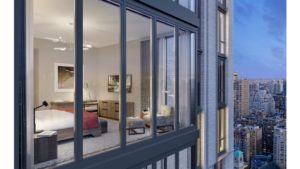
Developed by Anbau, based in New York City, and designed by SHoP Architects and high-end holistic decorator Clodagh, the 34-story, 84-unit building was designed for a variety of demographics seeking living quarters that would foster wellness despite the homeowners’ busy urban lives. To achieve that, there is a wellness lounge with state-of-the-art fitness and yoga studios, an infrared sauna, and, in the lobby, a living wall and water feature for feng shui elements. But there are other features that will spark attention from all ages—a private dining room and catering kitchen, a playroom for kids with an art studio, a multimedia studio/screening room, a lounge with fireplace, and on-site automated parking that quickly retrieves cars.
The condos range from one- to four-bedrooms; prices start at $1.3 million and go up to $12 million. Among the noteworthy features in the condo units themselves are extra half baths in even the one-bedrooms, smoked-walnut kitchen cabinets, kitchen islands with a waterfall edge, and teak vanities in the bathrooms.
Completion is scheduled for the end of 2017.

Students can start living well while still near campus in today’s newest entrants in student housing development, including HERE Kansas, by CA Ventures. Among the building’s nonstudy perks: a basketball court, a coffee bar, and an infinity-edge pool.

HERE Kansas, Lawrence, Kan.

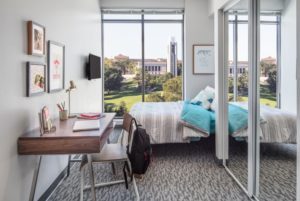
College and university students continue to benefit from private-sector developers having realized the importance of providing housing options that are close by campus, competitively priced, and safe. A cadre of developers knows this market intimately and which amenities work best. In fact, the student housing market in the U.S., which numbers about 20 million, has seen billions pumped in from wealth funds, pensions, and private equity, totaling about $6 billion to $7 billion. In addition, student housing REITs have outperformed other REIT indices by 19% for this segment in the U.S., according to Savills World Research.
At HERE Kansas, Chicago-based developer CA Ventures designed an eight-story, 624-bed building that demonstrates the success of infill university residential product. The site lies just six minutes on foot from the University of Kansas’ Memorial Union community center or is a shuttle bus ride away.
CA Ventures knew the value of having retail square footage on-site with a coffee shop and pizza parlor, along with personalized features to localize the property, says J.J. Smith, president, CA Student Living, the developer’s investment and development equity arm. Accordingly, HERE Kansas houses a basketball court, fitness center, coffee bar, infinity-edge pool, outdoor deck, fire pit, theater, and bike storage.
The building opened last August, and its beds were quickly leased. Prices vary by unit: A room with one bed in a four-bedroom/two-bath suite is $679 per bed, for example. A private, one-bedroom residence on the penthouse level costs $1,299 a month.

In downtown Philadelphia, the 22-story One Riverside condo, designed by Cecil Baker + Partners, welcomes its first occupants this April with a prime site by a park and river and its own landscaped garden.

One Riverside, Philadelphia

Picking up on the trend of both young and older professionals with and without children, plus empty nesters, taking advantage of urban living, architects Cecil Baker + Partners in Philadelphia designed a cutting-edge condominium building in what has become a prime downtown location for developer Dranoff Properties, also locally based.
The site, a former parking lot and, longer ago, a troubled area known as Needle Park, was cleaned up and transformed as 24/7 urban living gained popularity. The site is now touted for being part of Fitler Square, opposite the Schuylkill River, by a park that includes bike and walking trails, as well as being near the Philadelphia Museum of Art. Dubbed One Riverside, the building stands 22 stories high and features a modern window-wall façade with light metal panels and a more-traditional brick-and-travertine base. Its views of the city and river in both directions are unobstructed “forever,” unusual for an urban site.
The first buyers will move in this April as the building is completed in stages, and the finishing timetable is expected to be late summer. Among the trends the property reflects: The condos were designed for some buyers who wanted to combine units for more space. Instead of the original 82 planned units, 68 are anticipated, along with 18 layouts instead of the original eight.
“This is something the marketplace dictated after the condo market became viable again,” says architect Cecil Baker. “Originally, the building was conceived as a rental of 147 units, but after money became available for condos, the shift was made,” Baker says. “Many buyers also liked the building because they wanted to live on one floor after selling a brownstone in the city or after moving in from large suburban homes.”
Other perks at One Riverside: a motor court to provide easy drop-off and pickup; a 60-foot-long indoor pool with sundeck; a private, landscaped garden; a hospitality suite for overnight guests; and concealed underground parking.
The condos, priced from $715,000 to $7 million and numbering one to five bedrooms each, feature 10-foot-high ceilings; terraces; floor-to-ceiling, sound-insulated glass walls for spectacular day- and nighttime views of the city and its sequence of bridges; and different color and material palettes to accommodate various design styles and tastes.
“People don’t have to settle for drywall and [solid surfacing]; they see what’s available elsewhere and want it in their own homes,” Baker says.
Already, 75% of the condos have sold. The building includes a 10-year tax abatement.
By: Barbara Ballinger (Multifamily Executive)
Click here to view source article.

Filed Under: All News

Stable Growth Expected for Commercial Real Estate in 2017

February 23, 2017 by CARNM

WASHINGTON (February 23, 2017) — Steered ahead by strengthening demand in smaller markets, the commercial real estate sector should remain on stable ground in 2017 and offer decent returns for investors, according to the latest National Association of Realtors® quarterly commercial real estate forecast.
National office vacancy rates are forecast by Realtors® to retreat 1.1 percent to 12.1 percent over the coming year as job growth in business and professional services brings increased need for office space. The vacancy rate for industrial space is expected to decline 1.3 percent to 7.1 percent, and retail availability to decrease 0.7 percent to 11.2 percent. Only the multifamily sector is predicted to have little change to its vacancy rate over the next year as new apartment completions keep openings mostly flat at 6.5 percent.
Lawrence Yun, NAR chief economist, says the U.S. economy is poised for slight improvement in 2017. “Last year was the 11th year in a row of subpar GDP growth, but renewed corporate optimism leading to a focus on investment and a desperately needed boost in residential construction should pave the way for modest expansion this year of around 2.4 percent,” he said. “Steady hiring and low local unemployment levels are finally supporting higher wages and increased spending, which in turn bodes well for sustained demand for all commercial property types.”
The apartment sector is expected to preserve its status as a top performer this year simply because ongoing supply and affordability challenges are keeping the nation’s low homeownership rate from seeing meaningful improvement. Even with a small uptick in the vacancy rate as new building completions catch up with demand, rents will likely maintain their solid growth in most of the country.
“Especially in the costliest metro areas, higher home prices and mortgage rates are squeezing the budget for many renters looking to buy and inevitably forcing them to sign a lease for at least another year,” said Yun.
According to Yun, commercial property prices — especially in Class A assets in larger markets — surpassed pre-crisis levels last year because of aggressive bidding and lower inventory levels. However, with the Federal Reserve expected to raise short-term rates three times in 2017, a minor price correction may be in store this year as cap rates move higher.
“Similar to the biggest ongoing challenges in the residential market, supply and demand imbalances continue to put upward pressure on commercial property prices as investors search for yield in smaller markets,” said Yun. “Realtors® are increasingly citing inventory shortages as their top concern as the pace of new projects slows in large cities and middle-tier and smaller markets see a growing appetite for space.”
The latest Realtors® Commercial Real Estate Market Survey highlighted the strong underlying demand for commercial properties up to $2.5 million, where most transactions from NAR’s commercial members reside. Compared to a year ago, sales volume rose 12.9 percent, prices increased 5.5 percent and the average transaction value equaled $1.1 million.
NAR’s most recent Business Creation Index (BCI) also showed a positive trend for smaller commercial businesses. Created to monitor local economic conditions from the perspective of NAR’s commercial members, December’s BCI found that Realtors® reported more business openings and fewer closings over the past year in their market.
Yun says at least in the short term, the possibility of a more tax-friendly business environment combined with the positive benefits of 1031 exchanges could quicken the pace of economic growth and support stronger commercial market fundamentals. The industrial sector — already enjoying increased demand from the soaring popularity of e-commerce — could see a further decline in vacancy rates if increased manufacturing comes to fruition and accelerates the need for more warehouse space.
“The positive direction for commercial real estate this year will be guided by the steadily expanding U.S. economy, which has legs to grow and continues to be one of the top economic performers and safest bets in the world,” concluded Yun.
NAR’s latest Commercial Real Estate Outlook 1 offers overall projections for four major commercial sectors and analyzes quarterly data in the office, industrial, retail and multifamily markets.
The NAR commercial community includes commercial members, real estate boards, committees, subcommittees and forums; and NAR commercial affiliate organizations — CCIM Institute, Institute of Real Estate Management, Realtors® Land Institute, Society of Industrial and Office Realtors®, and Counselors of Real Estate.
Approximately 70,000 NAR members specialize in commercial real estate brokerage and related services including property management, counseling, and appraisal. In addition, more than 200,000 members are involved in commercial transactions as a secondary business.
The National Association of Realtors®, “The Voice for Real Estate,” is America’s largest trade association, representing more than 1.1 million members involved in all aspects of the residential and commercial real estate industries.
By: Adam DeSanctis (National Association of REALTORS®)
Click here to view source article.

Filed Under: All News

  • « Go to Previous Page
  • Page 1
  • Page 2
  • Page 3
  • Page 4
  • Page 5
  • Go to Next Page »
  • Search Property
  • Join CARNM
  • CARNM Login
  • NMAR Forms
  • All News
  • All Events
  • Education
  • Contact Us
  • About Us
  • FAQ
  • Issues/Concerns
6739 Academy Road NE, Ste 310
Albuquerque, NM 87109
admin@carnm.realtor(505) 503-7807

© 2026, Content: © 2021 Commercial Association of REALTORS® New Mexico. All rights reserved. Website by CARRISTO