
• Skip to primary navigation
  • Skip to main content

CARNM

Commercial Association of REALTORS® - CARNM New Mexico

  • Property Search
    • Search Properties
      • For Sale
      • For Lease
      • For Sale or Lease
      • Start Your Search
    • Location & Type
      • Albuquerque
      • Rio Rancho
      • Las Cruces
      • Santa Fe
      • Industry Types
  • Members
    • New Member
      • About Us
      • Getting Started in Commercial
      • Join CARNM
      • Orientation
    • Resources
      • Find A Broker
      • Code of Ethics
      • Governing Documents
      • NMAR Forms
      • CARNM Forms
      • RPAC
      • Needs & Wants
      • CARNM Directory
      • REALTOR® Benefits
      • Foreign Broker Violation
    • Designations
      • CCIM
      • IREM
      • SIOR
    • Issues/Concerns
      • FAQ
      • Ombuds Process
      • Professional Standards
      • Issues/Concerns
      • Foreign Broker Violation
  • About
    • About
      • About Us
      • Join CARNM
      • Sponsors
      • Contact Us
    • People
      • 2026 Board Members
      • Past Presidents
      • REALTORS® of the Year
      • President’s Award Recipients
      • Founder’s Award Recipients
    • Issues/Concerns
      • FAQ
      • Ombuds Process
      • Professional Standards
      • Issues/Concerns
      • Foreign Broker Violation
  • Education
    • Courses
      • Register
      • All Education
    • Resources
      • NMREC Licensing
      • Code of Ethics
      • NAR Educational Opportunities
      • CCIM Education
      • IREM Education
      • SIOR Educuation
  • News & Events
    • News
      • All News
      • Market Trends
    • Events
      • All Events Calendar
      • Education
      • CCIM Events
      • LIN Marketing Meeting
      • Thank Yous
  • CARNM Login
  • Show Search
Hide Search

Archives for September 2017

NM Grapples With Diversity, Job Growth

September 11, 2017 by CARNM


Hotel Chaco pastry chef Deirdre Lane, left, and baker Janessa Perez prepare pastry at the new hotel in Albuquerque’s Old Town. (Marla Brose/Albuquerque Journal)
Here are a couple of goals that unite leaders in the state, regardless of party affiliation: Bring more jobs to New Mexico and diversify the state’s economy.
It’s been something of a mantra since at least the Great Recession, which officially ended in summer 2009 but continues to traumatize the state’s economy. The recession, plus an overall loss of government jobs and a plunge in oil prices several years ago, has caused a clarion call to lure new businesses to New Mexico and to increase the share of private sector jobs in the state’s employment picture.
So how have we been doing?
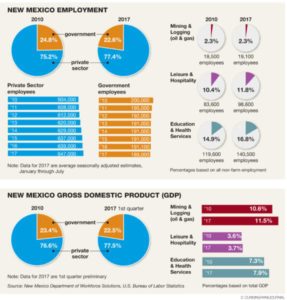
When it comes to job growth, the number of non-farm jobs in the state has increased by 3.7 percent since the end of 2010, just before Gov. Susana Martinez took office, according to the U.S. Bureau of Labor Statistics. That translates to 29,800 new jobs, and that’s good news for the people hired to fill those positions and the businesses they frequent.
But job growth nationally for that period was more than three times higher, at 12 percent. And the total number of jobs in the state is still 2 percent below the number New Mexico had just before the recession started.

Matthew Christie sets a table at a Hotel Chaco restaurant. While hospitality-related jobs have been on the upswing in New Mexico, growth in the state’s overall private sector has been muted. (Marla Brose/Albuquerque Journal)
Diversification? It depends on whom you’re asking.
It’s not a pretty picture, according to two leading economists at the state’s largest universities.
While private sector jobs make up a larger share of the state’s employment picture than in 2010, that has more to do with the government sector shrinking than it does creation of new jobs, said Jeff Mitchell, director of the University of New Mexico’s Bureau of Business & Economic Research.
“The reason why private sector jobs account for more of the total number of jobs is not because we’re creating private sector jobs,” he said. “It’s because we’re not creating government sector jobs.”
“There’s no evidence of diversification as a result of creating private sector jobs.”

Lab technician Matt Garcia was among the new employees at Southwest Labs, an Albuquerque drug-testing business that opened in June. The state’s health services sector has seen a growing number of jobs. (Adolphe Pierre-Louis/Albuquerque Journal)
As of the first quarter of this year, New Mexico ranked second last in the nation for the percentage of its GDP attributed to the private sector. In the bottom spot was Washington, D.C.
Jim Peach, New Mexico State University economist, adds another statistic to the mix: a state unemployment rate – 6.3 percent in July – that’s been stuck in the basement compared to the rest of the nation.
“For measuring an economy, there is no way to spin this as a good news story,” Peach said.
The Journal’s request for an interview with Martinez received this emailed response from spokesman Michael Lonergan: “Unfortunately, we don’t have availability for an interview in the Governor’s calendar at this time.”
But Matt Geisel, the state’s economic development secretary, pointed out that the loss in government jobs has been more than outweighed by an increase in private sector jobs. In fact, he said, for every one government job lost (total: 11,000), nearly four private jobs (total: 43,000) have taken its place.
“It’s showing that the reforms and the actions are helping us steer our destiny,” Geisel said in an interview.
And, he said, the 1 percent growth in jobs over the past year is evidence the state is headed in the right direction with “incremental, positive progress.”
Shifting from oil, gas
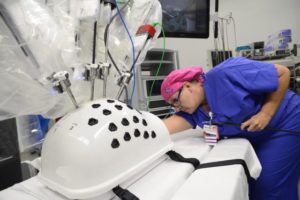
Melissa Yelton, a surgical tech at Lovelace Women’s Hospital, works with a surgical robot used in minimally invasive surgeries. (Marla Brose/Albuquerque Journal)

State leaders look to diversify New Mexico’s economy as a way to shield the state from the vagaries of the oil and gas industry and from a shrinking number of government jobs, especially at the state and local levels.
While oil and gas prices are starting to recover from the low of $30 a barrel after the plunge began in 2014, it’s no more than a modest recovery and smaller producers in New Mexico’s oil patch are struggling to hold on.
In the government area, state and local jobs have been shed as a consequence of low-growth revenues that have strangled government coffers.
Martinez, who took office in January 2011, has been consistent in saying that from “day one” her goal has been to grow and diversify the economy by boosting the number of private sector jobs.
“Through a relentless commitment to reforms – balancing budgets, cutting taxes and streamlining regulations – we’re growing and diversifying our economy, and competing for jobs and investment with neighboring states like never before – and even beating them,” Martinez said last month when announcing that the state was No. 3 in the nation for growth in gross domestic product in the first quarter of 2017.
However, the main reason for the state’s 2.8 percent growth during that most recent quarter was a boost in the oil and gas industry, according to the U.S. Department of Commerce.
Looking at the private sector as a whole, the percentage that makes up the state’s GDP has gone up about 1 percentage point: from 76.6 percent of total GDP in 2010 to 77.5 percent as of the first quarter of this year.
GDP is considered among the broadest measures of economic health.
Slow private sector gains
Another way to look at how much the state has diversified is through its employment numbers – in other words, where the jobs are.

Server Emma Nicholson outlines dessert options for customers at a restaurant in Hotel Chaco. (Steve Sinovic/For the Albuquerque Journal)
In terms of sheer numbers, July brought good news in the number of private sector jobs, with a 1.8 percent increase compared to the year before, according to the state’s most recent jobs report. Fastest-growing industries were education and health services, leisure and hospitality and construction, which has been on the upswing since last November.
And private sector employment, as a percentage of total employment, has indeed gone up since 2010, according to the state Department of Workforce Solutions and the U.S. Bureau of Labor Statistics:
• In 2010: About 75 percent of New Mexicans employed held private sector jobs; 24.8 percent held government positions.
• In July 2017: Private sector employment was at 77.4 percent; government, 22.6 percent of employment.
But the overall employment pie has been growing so slowly – 1 percent over last year, according to the most recent state figures – that the increased share of private sector jobs is primarily just a reflection of the drop in the government share, Mitchell and Peach said.
“How fast are we creating private sector jobs?” Mitchell said. “The answer to that is we are creating private sector jobs very, very slowly.”
Ben Cloutier, spokesman for the state Economic Development Department, pointed to a recent announcement by the governor that the film industry has injected more than a half billion dollars into New Mexico’s economy.
In addition, the state “just saw its fifth straight year of record-shattering tourism numbers,” Cloutier said. In 2015, that industry “generated the largest economic impact in state history for the sixth straight year, injecting $6.3 billion into New Mexico’s economy and supporting more than 90,000 jobs. Those jobs generated $2.4 billion in salaries.”
Narrowing tax base
Peach adds a cautionary note when it comes to diversification, which he calls a “mixed bag in terms of economic growth.”
That’s because of wages.
Jobs in the oil and gas industry and in the government sector tend to be relatively high-paying compared to overall wages paid in New Mexico.
“Diversification, if it means looking more like the national economy in New Mexico, would mean reducing the proportion of workers in these high-wage industries,” he said. “That doesn’t mean we shouldn’t try to get some other industries here. It just means the standard measures of diversity may not be what we want to go after.”
“If you want fast growth, you want not diversification but concentration in fast-growing, high-wage industries,” Peach said.
Mitchell said the real importance in diversifying New Mexico’s economy is to protect state revenues.
Cuts in personal income taxes and corporate taxes during the past couple of decades have narrowed the state’s tax base, and private sector economic activity remains limited, he said.
“We’ve narrowed our tax base, and we’ve become increasingly dependent on oil and gas, over which we have no control,” Mitchell said.
“That’s where diversification really matters,” he said.
By: Ellen Marks (Albuquerque Journal)
Click here to view source article.

Filed Under: All News

August 2017 Commercial Market Trends

September 7, 2017 by mcarristo

View a New Mexico Market Trends Summary Report, which includes August 2017 Commercial Market Trends. This report includes the total number of listings, asking lease rates, asking sales prices, days on the market and total square feet available.

Disclaimer: All statistics have been gathered from user-loaded listings and user-reported transactions. We have not verified accuracy and make no guarantees. By using the information, the user acknowledges that the data may contain errors or other nonconformities. Brokers should diligently and independently verify the specifics of the information you are using.

Filed Under: Market Trends

Berry to Amazon Chief: ‘Jeff, Come Home’

September 7, 2017 by CARNM

Amazon, bursting out of its Seattle headquarters, is hunting for a second home. Must haves: A prime location, close to transit, with plenty of space to grow.
The company said Thursday it will spend more than $5 billion to build another headquarters in North America to house as many as 50,000 employees. It plans to also stay in its sprawling Seattle headquarters, with the new space “a full equal” to that, said founder and CEO Jeff Bezos.
Albuquerque Mayor Richard Berry said his administration plans to pitch the metropolitan area as the perfect new home for Amazon.
Among the metro area’s virtues are available land that is affordable, a reliable power grid, a workforce that has shown it can handle large construction projects and an environment that doesn’t have “earthquakes, hurricanes, tornadoes, tsunamis,” Berry said.
The investment Facebook is making at its data center in Los Lunas shows the area has “every bit the capability” of other areas for a large-scale tech project, he said.
But Albuquerque has something no other city can claim: Bezos was born here.
“Jeff, come home,” Berry said. “We’d love to have you.”
Amazon’s announcement highlights how fast the e-commerce giant is expanding, and its need to find fresh talent to fuel that growth. With the lure of so many new jobs, city and state leaders were already lining up Thursday to say they planned to apply. Among them: Chicago, Philadelphia and Toronto. They have a little more than a month to do so through a special website , and Amazon said it will make a decision next year.
Its requirements could rule out some places: Amazon wants to be near a metropolitan area with more than a million people; be able to attract top technical talent; be within 45 minutes of an international airport; have direct access to mass transit; and be able to expand that headquarters to as much as 8 million square feet in the next decade. That’s about the same size as its current home in Seattle, which has 33 buildings, 23 restaurants and houses 40,000 employees.
The Albuquerque area, which includes Rio Rancho, Los Lunas and Belen, has about 900,000 residents, which Berry said was “right there as a metro area.”
“They’re so big in Seattle, they’re running out of room,” said Kevin Sharer, a corporate strategy professor at Harvard Business School.
Amazon said it will hire up to 50,000 new full-time employees at the second headquarters over the next 15 years, and they would make an average pay of more than $100,000 a year.
The company is hoping for something else from its second hometown: tax breaks, grants and other incentives. A section of the proposal that outlines those says “the initial cost and the ongoing cost of doing business are critical decision drivers.”
Brad Badertscher, an accounting professor at the University of Notre Dame, said the public search appeared to be a way to start a bidding war among cities.
“This was like an open letter to city leaders saying, ‘Who wants Amazon and all our jobs?’” Badertscher said. “This is Jeff Bezos doing what he does best: adding shareholder value and getting the most bang for the buck.”
Amazon gets tax breaks when cities compete for its massive warehouses, where it packs and ships orders. The company received at least $241 million in subsidies from local and state government after opening facilities in 29 different U.S. cities in 2015 and 2016, according to an analysis by Good Jobs First, a group that tracks economic development deals.
In explaining why it was holding a public process, Amazon said on its site that it wanted “to find a city that is excited to work with us and where our customers, employees, and the community can all benefit.”
Bezos has crowdsourced major decisions before – in June, just before Amazon announced its plan to buy organic grocer Whole Foods, the billionaire took to Twitter seeking ideas for a philanthropic strategy to give away some of his fortune. And tech companies have been known to set places in competition with each other: In vying to land Google’s ultra-fast broadband network, many cities used stunts and gimmickry to get the company’s attention. Topeka even informally renamed itself “Google, Kansas.”
Amazon.com Inc. said its search is open to any metropolitan area in North America, but declined to say how open it was to going outside the United States. Jed Kolko, the chief economist at job site Indeed, noted that the company’s request for proposals mentions “provinces” several times — a clear sign it would consider a Canadian metro area.
Kolko also said an East Coast locale could bring it closer to the company’s offices in Europe.
Amazon’s arrival might transform an area: Until 10 years ago, the neighborhood near Seattle’s campus just north of downtown was dotted with auto parts stores and low-rent apartments. Now it’s a booming pocket of high-rise office complexes, sleek apartment buildings and tony restaurants.
And the company keeps growing. Amazon has said it will hire 100,000 people by the middle of next year, adding to its current worldwide staff of more than 380,000. It announced plans to build three new warehouses that pack and ship packages in New York, Ohio and Oregon. And it recently paid close to $14 billion for Whole Foods and its more than 465 stores.
The Whole Foods headquarters in Austin is far smaller than what Amazon said it’s looking for — the flagship hub is also a full-service grocery store with shoppers who compete for parking spaces. Even its larger corporate campus that stretches down the surrounding blocks may be too small for the space Amazon would want for a second headquarters.
In Seattle, its rise has not been without critics, who say the influx of mostly well-heeled tech workers has caused housing prices to skyrocket, clogged the streets with traffic and changed the city for the worse. The Seattle Times reported Thursday that the median price for a house in August in Seattle was $730,000, up almost 17 percent in a year.
That itself may be a factor. Amazon may be looking for a spot where it’s not as expensive for its employees to live, said Rita McGrath, a professor at the Columbia Business School in New York.
“It’s hard to attract people if they can’t afford the housing available locally,” she said.
By: Journal staff and wire reports (Albuquerque Journal)
Click here to view source article.

Filed Under: All News

NM Already Recovering From Export Dip, Experts Say

September 7, 2017 by CARNM

El Paso-based development company Franklin Mountain Management LLC expects to open this new, 183,000-square-foot spec building at the Santa Teresa industrial park in southern New Mexico early next year. Local trade advocates say it is an indication of the area\’s growing strength in trade with Mexico. (Photo courtesy of Franklin Mountain Management.)

The impact of President Trump’s America-first trade policies took a bite out of New Mexico’s surging exports to Mexico last fall and winter, but local trade experts say exports are on the upswing again.

The election’s effects are still evident in the latest statistics from the U.S. Commerce Department, which show New Mexico sales to its southern neighbor down 9 percent in the first half of 2017 compared with the same period last year. Exports to Mexico totaled $810.7 million from January to June, down from $890.3 million in the first six months of 2016.

But experts say that’s misleading because trade with Mexico was surging in early 2016. The state must still fully recover from the downturn following the elections, but since then, it’s generally gone back to business as usual, with companies now either holding steady or climbing in sales, said Jerry Pacheco, executive director of the International Business Accelerator at Santa Teresa.

“From about November to February, things were practically dead as everyone struggled to understand what was going on, and many companies froze their inventories,” Pacheco said. “But after February, people decided to get on with life.”

Worldwide, New Mexico’s total exports are down by about 11 percent in the first half of 2017, from $1.96 billion to $1.74 billion, thanks largely to a plunge in sales to Israel this year.

Exports to Israel fell from $314.3 million in first-half 2016 to just $6.8 million this year, generally reflecting the ups and downs of sales from Intel Corp.’s plant in Rio Rancho.

The Commerce Department doesn’t publish quarterly statistics that might show an upswing in exports to Mexico in the second quarter. But sales for the first half of 2017 already surpass more than half of the total $1.58 billion that New Mexico exported across the border in 2016.

“At the current pace, we expect to do at least as much if not more than last year,” Pacheco said.

That reflects renewed confidence among export businesses about renegotiation of the North American Free Trade Accord, which began in August .

Trump’s early threats to pull out of NAFTA contributed to a huge devaluation in the Mexican peso, making U.S. exports there more expensive. That, plus general uncertainty about NAFTA, fueled the initial trade slump.

But border businesses are more confident now, said Robert Queen, director of the Commerce Department’s New Mexico Export Assistance Center in El Paso.

“Early this year, there was a lot of concern,” Queen said. “But now that we’re into negotiations, businesses are more comfortable and eager to see a final deal.”

In fact, three new companies have moved into Santa Teresa’s industrial parks since the spring. A new, 183,000-square-foot spec building is also under construction there, Pacheco said.

By: Kevin Robinson-Avila (Albuquerque Journal)
Click here to view source article.

Filed Under: All News

  • « Go to Previous Page
  • Page 1
  • Interim pages omitted …
  • Page 3
  • Page 4
  • Page 5
  • Page 6
  • Page 7
  • Go to Next Page »
  • Search Property
  • Join CARNM
  • CARNM Login
  • NMAR Forms
  • All News
  • All Events
  • Education
  • Contact Us
  • About Us
  • FAQ
  • Issues/Concerns
6739 Academy Road NE, Ste 310
Albuquerque, NM 87109
admin@carnm.realtor(505) 503-7807

© 2026, Content: © 2021 Commercial Association of REALTORS® New Mexico. All rights reserved. Website by CARRISTO