
• Skip to primary navigation
  • Skip to main content

CARNM

Commercial Association of REALTORS® - CARNM New Mexico

  • Property Search
    • Search Properties
      • For Sale
      • For Lease
      • For Sale or Lease
      • Start Your Search
    • Location & Type
      • Albuquerque
      • Rio Rancho
      • Las Cruces
      • Santa Fe
      • Industry Types
  • Members
    • New Member
      • About Us
      • Getting Started in Commercial
      • Join CARNM
      • Orientation
    • Resources
      • Find A Broker
      • Code of Ethics
      • Governing Documents
      • NMAR Forms
      • CARNM Forms
      • RPAC
      • Needs & Wants
      • CARNM Directory
      • REALTOR® Benefits
      • Foreign Broker Violation
    • Designations
      • CCIM
      • IREM
      • SIOR
    • Issues/Concerns
      • FAQ
      • Ombuds Process
      • Professional Standards
      • Issues/Concerns
      • Foreign Broker Violation
  • About
    • About
      • About Us
      • Join CARNM
      • Sponsors
      • Contact Us
    • People
      • 2026 Board Members
      • Past Presidents
      • REALTORS® of the Year
      • President’s Award Recipients
      • Founder’s Award Recipients
    • Issues/Concerns
      • FAQ
      • Ombuds Process
      • Professional Standards
      • Issues/Concerns
      • Foreign Broker Violation
  • Education
    • Courses
      • Register
      • All Education
    • Resources
      • NMREC Licensing
      • Code of Ethics
      • NAR Educational Opportunities
      • CCIM Education
      • IREM Education
      • SIOR Educuation
  • News & Events
    • News
      • All News
      • Market Trends
    • Events
      • All Events Calendar
      • Education
      • CCIM Events
      • LIN Marketing Meeting
      • Thank Yous
  • CARNM Login
  • Show Search
Hide Search

Archives for October 2017

Downsizing to Downtown: Boomers Hitting the Road

October 3, 2017 by CARNM


We’ve talked about Millennials seeking the Work, Live, Play mantra as they locate to communities. Ironically, Baby Boomers have similar lifestyle preferences with walkability to entertainment and amenities as their core preferences.
The Wall Street Journal recently published It’s OK to Party When You Turn 60. According to the article, more people are celebrating age rather than lamenting getting older. Also, 4.3 million babies were born sixty years ago. There are now more baby boomers than ever turning sixty with an approximate rate of 491 per hour.
For Baby Boomers, an active economy is a leading driver when considering a move to urban living. They tend to downsize to communities where there are part time job opportunities as well as nearby shopping, dining, healthcare, and recreational activities.
According to a Swanepoel T3 Group study, Commercial Real Estate ALERT: Analysis of the Latest Emerging Risks and Trends, Boomers are actively seeking rental apartment units no different than Millennials or in some cases purchasing condominiums in downtown areas. “Both desire to live in loft and high-rise buildings and are competing for the same pool of rental housing and supply that is still trying to catch up with demand in most markets.”
Since affordability is a differentiator for these generations, investors, developers and REALTORS® are once again turning to a more robust analysis of demographic and economic patterns to determine how to improve communities to accommodate specific interests and budgets.
So how do REALTORS® discover the right locations to accommodate the needs of this large demographic?
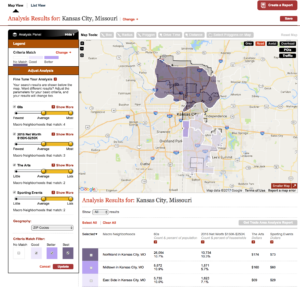
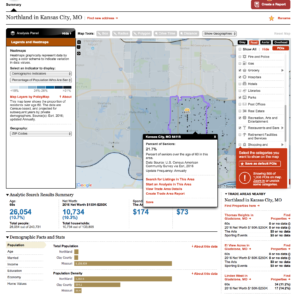
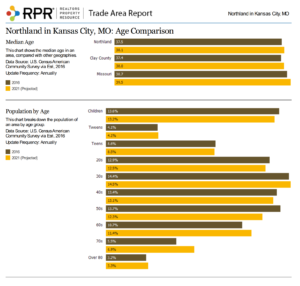
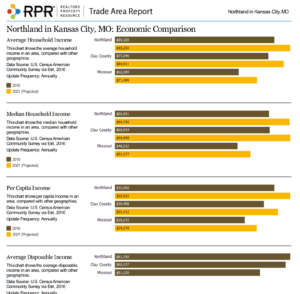
RPR data allows REALTORS® to research trends for 60-somethings with a specific net worth, who spend money on theater, movies, or sporting events. If an investor is looking to revitalize an existing building or break ground on a new apartment development in close proximity to existing healthcare facilities, groceries, restaurants, gyms, or theaters, REALTORS® have the ability to populate maps with visual data showing properties and existing businesses with demographic, economic and spending habits layered underneath to ensure site selection.
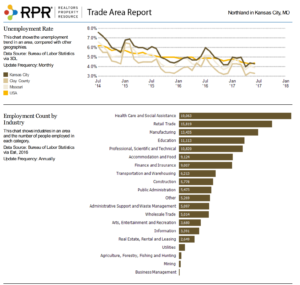
Land developers can even perform a quick analysis of a project with Valuate’s back-of-the envelope analysis, choosing to look at the project as a unit or FAR-based summary. With on-the-spot generation, RPR Mobile™ provides a profile on the unemployment rate and dominant industries to be quickly pulled so a client gets immediate stats via text or onsite.
Ready to build communities fit for baby boomers downsizing to downtown?
It’s easy with RPR analysis and Trade Area Reports.
By: REALTORS Property Resource (RPR)
Click here to view source article.

Filed Under: All News

Three Ways Trump’s Immigration Plan Could Affect the CRE Industry

October 3, 2017 by CARNM

NREI interviewed several real estate experts on the implications of the policy.
President Donald Trump campaigned on the promise of reforming U.S. immigration policy. Last month, he announced his support for legislation, sponsored by Republicans, which would cut the amount of legal immigrants allowed into the U.S. in half over the next decade. The proposal, which still has to make its way through Congress, also calls for limits on the number of refugees allowed into the country and the creation of a point-based system for determining who can lawfully immigrate.
But how would any of these changes affect commercial real estate? NREI interviewed several real estate experts on the implications of the policy on the industry. Overall, they say that restricting immigration would create a chain effect that would hinder economic growth and, in turn, growth in the commercial real estate sector. “All across the board in real estate, immigration is one of the supporting legs of that part of the economy,” says Peter C. Burley, a counselor of real estate.
It could harm the labor market
Maintaining a steady flow of immigrants into the U.S. helps provide more workers for employers, according to the experts. Foreign-born workers represented 17 percent of U.S. private employment as of July—up from about 15 percent in February 2009.  Meanwhile, in about two years, there will be a decrease in native-born residents of working age, according to a recent Cushman & Wakefield report addressing the effects of the proposal on the industry. “We are an industry that disproportionately relies on this group as a work force,” says Revathi Greenwood, head of research, Americas, at Cushman & Wakefield. The report notes that immigrants make up the bulk of construction workers, for example, filling 25 percent of those positions. Even then, the construction industry faces a dearth of employees, particularly in the South, where immigration has played a key role in the construction labor force, says Ryan Severino, chief economist at commercial real estate services firm JLL. “We generally need more workers to build more things,” he notes.
Immigrants also make up a significant percentage of hotel workers, Severino says. If hotels have a hard time attracting employees, it makes labor more expensive and businesses more difficult to run, Severino notes. The office sector could also take a hit—many employers, including those in the tech sector, are clamoring for more H1-B visas, which allow them to hire foreign workers for certain jobs, Severino notes. If these companies have a hard time finding highly educated, specialized workers, the effect could extend to their office space needs, he says.
The business and management sectors have seen the most growth of workers who are foreign-born, compounding the effect immigration restrictions could have on the office sector, says Greenwood. About 3.5 million foreign-born residents work in those fields, according to the Cushman & Wakefield report.
Related to the immigration overhaul is the future of the EB-5 visa program, which allows foreign investors who invest in a business that employs at least 10 Americans to become permanent residents in the United States. The program, which has faced criticism, is awaiting permanent renewal. It’s a move that Marty Cummins, president of New Smyrna Beach, Fla.-based Florida EB-5 Investments LLC, which helps immigrants seeking permanent residency status through that program, supports. “The more investors we have, the more businesses will be funded by foreign investors,” he says. The election of Trump poses as a benefit to business and the economy, Cummins says. But he cautions against restricting legal immigration: “A rejection in EB-5 visas and a reduction of visas in general will probably hurt the American economy.”
Multifamily housing could take a hit
While a large portion of immigrants own homes, the rest are renters, Burley notes. “That affects the multifamily market pretty strongly,” Burley says. While class-A apartment vacancy rates have been rising over the past three to four years, class-C and class-B apartments—many of which are rented to newcomers to the country—have not, Severino notes. Any restriction on the number of immigrants, therefore, could have a dampening effect on that segment of the apartment market, Severino adds.
This impact might not only be seen in big cities like New York or San Francisco, which have traditionally attracted scores of immigrants. For example, Detroit saw a high percentage of its native-born population flee after the city went bankrupt, but immigrants from the Middle East have bolstered the economy and the real estate market there because of the cluster effect, Burley notes.
Immigrants made up around 28 percent of all household growth over the past two decades, according to a 2016 report from the Urban Land Institute (ULI). “Without sustained immigration, the housing market could weaken, and in many markets the impact could be dramatic,” the report states.
It could hurt the growth of cities and other communities
The native-born populations in Los Angeles and New York dropped between 1995 and 2015, according to the Cushman & Wakefield report. Over those two decades, population growth in gateway cities proved “highly dependent upon international immigration,” the report notes. In fact, in the top 10 U.S. cities, a third of the population are immigrants, and cities including Salt Lake, Indianapolis and El Paso, Texas can point to immigrants as leading the surge of their populations, notes Greenwood. A lot of the country’s GDP is driven by cities, which in turn are fueled by immigrant growth: “Cities are really kind of the engines of growth,” she says.
When immigrants come to America, they tend to live in established ethnic communities. Areas experiencing significant immigrant growth can see boosts not only in housing demand, but in other sectors, too, including retail and commercial businesses, according to the ULI.
By: Mary Diduch (National RE Investor)
Click here to view source article.

Filed Under: All News

September 2017 Commercial Market Trends

October 3, 2017 by mcarristo

View a New Mexico Market Trends Summary Report, which includes September 2017 Commercial Market Trends. This report includes the total number of listings, asking lease rates, asking sales prices, days on the market and total square feet available.

Disclaimer: All statistics have been gathered from user-loaded listings and user-reported transactions. We have not verified accuracy and make no guarantees. By using the information, the user acknowledges that the data may contain errors or other nonconformities. Brokers should diligently and independently verify the specifics of the information you are using.

Filed Under: Market Trends

  • « Go to Previous Page
  • Page 1
  • Interim pages omitted …
  • Page 7
  • Page 8
  • Page 9
  • Search Property
  • Join CARNM
  • CARNM Login
  • NMAR Forms
  • All News
  • All Events
  • Education
  • Contact Us
  • About Us
  • FAQ
  • Issues/Concerns
6739 Academy Road NE, Ste 310
Albuquerque, NM 87109
admin@carnm.realtor(505) 503-7807

© 2026, Content: © 2021 Commercial Association of REALTORS® New Mexico. All rights reserved. Website by CARRISTO