• Skip to primary navigation
  • Skip to main content

CARNM

Commercial Association of REALTORS® - CARNM New Mexico

  • Property Search
    • Search Properties
      • For Sale
      • For Lease
      • For Sale or Lease
      • Start Your Search
    • Location & Type
      • Albuquerque
      • Rio Rancho
      • Las Cruces
      • Santa Fe
      • Industry Types
  • Members
    • New Member
      • About Us
      • Getting Started in Commercial
      • Join CARNM
      • Orientation
    • Resources
      • Find A Broker
      • Code of Ethics
      • Governing Documents
      • NMAR Forms
      • CARNM Forms
      • RPAC
      • Needs & Wants
      • CARNM Directory
      • REALTOR® Benefits
      • Foreign Broker Violation
    • Designations
      • CCIM
      • IREM
      • SIOR
    • Issues/Concerns
      • FAQ
      • Ombuds Process
      • Professional Standards
      • Issues/Concerns
      • Foreign Broker Violation
  • About
    • About
      • About Us
      • Join CARNM
      • Sponsors
      • Contact Us
    • People
      • 2026 Board Members
      • Past Presidents
      • REALTORS® of the Year
      • President’s Award Recipients
      • Founder’s Award Recipients
    • Issues/Concerns
      • FAQ
      • Ombuds Process
      • Professional Standards
      • Issues/Concerns
      • Foreign Broker Violation
  • Education
    • Courses
      • Register
      • All Education
    • Resources
      • NMREC Licensing
      • Code of Ethics
      • NAR Educational Opportunities
      • CCIM Education
      • IREM Education
      • SIOR Educuation
  • News & Events
    • News
      • All News
      • Market Trends
    • Events
      • All Events Calendar
      • Education
      • CCIM Events
      • LIN Marketing Meeting
      • Thank Yous
  • CARNM Login
  • Show Search
Hide Search

Archives for October 2017

Albuquerque City Elections – Thank You for the Hard Work in Defeating the Proposed Ordinance!

October 10, 2017 by CARNM

As you are probably aware, the Albuquerque Coalition for a Healthy Economy (ACHE) spent the last few months fighting the Albuquerque Healthy Workforce Ordinance, which CARNM supported along with NAR, RANM, GAAR, and RECPAC. We would like to thank everyone for supporting this effort since we were able to successfully defeat the ordinance.
The final vote was very close at 46,051 to 45,333. View all results.
Congratulations and thank you to all who helped fight the proposed ordinance. We would also like to specially thank ACHE for the hard work in this defeat.
Together, we helped save Albuquerque’s businesses!
Filed Under: All News

From Soup Kitchen to High-Tech Makerspace

October 9, 2017 by CARNM


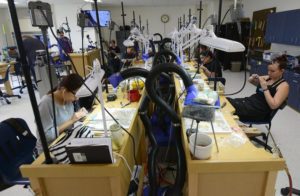
The ground floor of the new FUSE Makerspace includes a huge range of high-tech equipment and tools for working with wood, metal, electronics and more. (Adolphe Pierre-Louis/Albuquerque Journal)
The old Noonday Ministries soup kitchen at Central and Broadway Downtown has gone from feeding the homeless to feeding creative innovation and entrepreneurship in the heart of Albuquerque.

Central New Mexico Community College invested $1.2 million to convert the building into a premier community makerspace where people can turn bright ideas into new products and services. The newly remodeled, 13,000-square-foot FUSE Makerspace officially opened its doors on Sept. 26 as a key component of Innovate ABQ, the public-private partnership project that aims to transform the old 7-acre First Baptist Church property Downtown into a high-tech research and development hub for entrepreneurship and startup incubation.

The facility, located on the southwest corner of the site, sits kitty-corner to the new six-story Lobo Rainforest building that the University of New Mexico inaugurated in August. It will provide Rainforest-based innovators, entrepreneurs, scientists and engineers direct access to cutting-edge equipment and tools to prototype new products and technologies. It will also offer the Albuquerque community in general an affordable makerspace for aspiring entrepreneurs and even hobbyists to create custom-made goods for almost any Main Street business.

“The FUSE Makerspace fits in perfectly with the Innovate ABQ vision to create a central location where creativity, entrepreneurship and education combine to support an economic resurgence in central New Mexico,” said CNM President Kathie Winograd.

CNM originally launched FUSE in 2016 at a 3,000-square-foot space on campus. But that rapidly grew cramped with more than 300 users taking advantage of all the equipment, tools, training and mentoring services it offers.

In response, a range of partners stepped up to help remodel the Noon Day Ministries building, allowing FUSE to relocate into a much more spacious spot smack in the center of Innovate ABQ. Donations came from both public and private entities, including the W.K Kellogg and the Albuquerque Community foundations, the New Mexico Gas Co.’s parent firm Emera, Intel Corp., the Air Force Research Laboratory and the city.

“This addition to our innovation district builds on the transformation of Downtown as a place for ideas to take shape and businesses to be born and grow,” said Mayor Richard Berry in a statement commemorating the FUSE inauguration. “With FUSE’s relocation right across the parking lot from UNM’s Rainforest building, the opportunities for collaboration among creative and technical minds will be increased exponentially.”

The makerspace includes cutting-edge machinery, equipment and tools for creative endeavors from computer-aided design to wood cutting, jewelry making and screen printing.

“It runs the full gamut from high-tech machinery to artistic makerspace equipment,” said Kyle Lee, executive director of CNM Ingenuity, which manages commercial activities for the college. “We have fully equipped shops for wood and metal cutting and melding, including laser cutters and computer-programmed tools to slice things into unique and sophisticated shapes. We also just added a new metal bending and cutting tool.”

There’s a paper and textile printing lab, equipment for robotics and electronics fabrication, and a rapid-prototyping lab with rows of 3-D printers.

The jewelry-making lab also offers state-of-the-art tools, such as centrifugal and vacuum kiln-casting equipment, a 20-ton hydraulic press to form metal, and a Micro TIG Welder to weld jewelry under a microscope.

Apart from equipment, FUSE offers broad business support services, including training programs, mentoring, and technical assistance in things like patent filings, startup creation, marketing, and production runs. Additional support is available through the ABQid business accelerator, which is moving into an upstairs space at FUSE, plus networking opportunities through workshops and events, and offices for incubating new companies.

To date, FUSE has helped nearly a dozen companies get off the ground, including startups that produce custom-built snowboards and guitars.

Marty Bonacci, who founded the snowboard-building firm Custom Cult LLC, said FUSE allowed him to create a high-tech production line to rapidly design uniquely-shaped snowboards based on customer specifications.

“It would cost like $3,000 to $4,000 to set up a production line in a commercial machine shop, but in the makerspace, it was about one-tenth that cost,” Bonacci said. “It saved us a ton of money.”

Bonacci also partnered with Matthew Barbato to launch Rt. 66 Guitar Works through FUSE. They make old-style, mid-20th Century guitars and amps from scratch at the makerspace, taking custom orders that run from a low of $120 up to $999.

“We specialize in making modern versions of vintage guitars, both electric and folk,” Barbato said. “We’ve also built templates with instructions on Plexiglas for people to make their own guitars in their garage. That’s become our biggest seller, with about 600 orders to date.”

For CNM, the FUSE makerspace is just the first step in the college’s entrance into Innovate ABQ. CNM also expects to move its Deep Dive Coding training program and its IGNITE business accelerator into the old, 71,000-square-foot church sanctuary on the southeast corner of the First Baptist Church site, Lee said.

Innovate ABQ developers expect to begin remodeling that building next year into a high-tech, multi-use facility for startups and entrepreneurial programs.

By: Kevin Robinson-Avila (ABQ Journal)
Click here to view source article.

Filed Under: All News

New Cannabis Law Attracting Real Estate Investors to Golden State

October 6, 2017 by CARNM

The biggest challenge for cannabis real estate investors is finding capital to finance investments.
The state of California will begin issuing temporary licenses for “cannabis commercial activity” on Jan. 1, 2018, with permanent licensing to follow within 120 days. This highly anticipated event is attracting private real estate investors from across the U.S. who want to take advantage of the opportunity opened with the legalization of cannabis use in the sixth largest market in the world.
The new law provides opportunities to invest in cannabis business operations, notes Jim Fitzpatrick, a former Costa Mesa planning commissioner who heads a consulting firm called Solutioneers. Both experienced industry operators and Wall Street investors hope to cash in on the Golden State’s cannabis-related investment opportunities, he notes.
His company prepares applications for cannabis businesses and offers investors access to cannabis real estate financing and assistance in identifying compliant properties. To be compliant, real estate used for dispensaries, for instance, must be located at least 1,000 feet from schools, churches, parks and other dispensaries.
The combined market for legal medical and adult cannabis use is projected to grow by compounded annual rate of 18.5 percent, from $2.76 billion in 2015 to $6.5 billion by 2020, according to a report co-produced by New Frontier Data and ARCVIEW Market Research. That’s not even figuring in revenue from real estate, technology development or the overall economic impact of the cannabis market.
In addition, cannabis commercial activities will add significant revenue to state and local government coffers from licensing fees and other taxes. The state charges a15 percent excise tax on cannabis sales and taxes cannabis cultivation at $148 per lb. for “flowers” (buds) and $44 per lb. for “leaves” (plant trimmings used to produce cannabinoid-based products, such as oil, edibles, bills and vapes.
Local governments will collect sales on cannabis purchases and may impose other taxes, as well, notes Max Mikalonis, legislative advocate for the cannabis industry at K Street Consulting, which provides licensing and real estate compliance advisory services. Local governments are already licensing to cannabis businesses, because the state requires proof the local jurisdiction has authorized the business before issuing a state license.
“Real estate provides a conservative way for investors to participate in the cannabis market without actually ‘touching a leaf,’” says Aaron Hertzberg, a partner and general counsel for Calcannholdings Inc. His company is a cannabis real estate investment firm focused on creating a chain of cannabis dispensaries throughout Southern California. The company is repositioning retail space in compliant locations as attractive storefronts, and is inviting private investors to participate in projects. It currently has two locally licensed dispensaries in Long Beach and is working on others in Los Angeles and Bellflower in Los Angeles County, Santa Ana in Orange County and Lemon Grove in San Diego County.
“We’re seeing a ‘land rush’ for light industrial warehouses,” says Mikalonis. “The biggest demand is for cultivation space. Prices for warehouse space have skyrocketed over the last 12 – 24 months, based on cities going legal.”
Growers in the Bay Area are paying $2 per sq. ft. or more for warehouse space, he adds.
Mikalonis warns growers against signing long-term leases for warehouse space at high rents. Noting that indoor cultivation is power-intensive, he points out that warehouse rents shot up when Colorado legalized cannabis for adult use, but indoor growers lost their shirts when the market was flooded with cannabis and the price dropped significantly
According to Bob Costello, a commercial real estate broker based in Denver, warehouse rents initially escalated four times from what they were previous to Colorado voters legalizing cannabis. He said that Denver— the state’s “pot utopia”— required indoor pot cultivation in areas zoned for plant husbandry. When other states legalized cannabis too, the price of pot dropped from $4,000 per pound to $1,000 per pound, he says. As a result, growers moved their operations into greenhouses, which rent for a fraction of the cost of warehouses, and provide similar growing conditions with less power than indoor cultivation.
The biggest challenge for cannabis real estate investors, notes Hertzberg, is finding capital to finance investments, as federally-licensed banks and institutional capital will not invest in real estate assets used for cannabis commercial activity, because it is an illegal according to federal law.
High-net-worth individuals or family office investors finance most cannabis real estate assets, he says. Fitzpatrick’s company has formed a relationship with L2 Capital, a private equity family office investor, to connect his clients with financing. Mikalonis notes that his firm’s Southern California division, Quantum Management, matches investor clients with cannabis real estate ownership-sharing opportunities and is working with real estate investors to form REITs focused on cannabis assets.
California state and local governments are currently developing rules for regulating cannabis businesses based on the Medicinal and Adult-Use Cannabis Regulation and Safety Act, which was enacted by the state in June to create one regulatory system for both types of cannabis uses.
All businesses engaging in commercial cannabis activity must secure a license, permit or other authorization from the local jurisdiction, before the state will issue a license.
Obtaining local licenses for dispensaries presents the greatest challenge for the cannabis industry, according to all three experts. Hertzberg says that the dispensary application process is financially risky because it requires a significant upfront investment without certainty of success. This includes the cost of acquiring or leasing a property, architectural fees and non-refundable state and local government application fees, which vary from $5,000 to $50,000.
The uncertainty is due to the limited number of dispensaries cities will allow and varying methods used to approve applications. Licensing may involve a lottery system, majority vote by the city council and/or be based on the application’s merits, Hertzberg says. He notes that Santa Monica will license two dispensaries, Culver City three and Long Beach 32.
Operators usually also incur a fee for a consultant to handle the license application process, which Hertzberg notes involves about 1,000 pages of information about the applicant and proposed dispensary operation, such as proof of financial ability, property description and design plans, fire protection and security plans, and proposed community benefits. Community benefits might include hiring city residents, providing a pharmacist to advise medical marijuana patients about the type of products most effective for their ailments or making donations to local schools or charities.
Los Angeles recently published a draft of rules for regulating cannabis businesses. The draft ordinance sets forth requirements for dispensaries, including hiring local residents, hours dispensaries can be open, where they can be located; records cannabis businesses must keep and the security and fire protection systems they must install.
The LA Weekly reported that the city’s legal dispensaries were supposed to receive licensing priority, but the ordinance fails to meet that obligation. As a result, these dispensaries may have to shut down until they can obtain a license. The city controller recently released a map of 139 “compliant pot shops,” which may indicate a plan to rectify this oversight, noted another LA Weekly report.
Fitzpatrick notes that it will take six to 18 months for Los Angeles to finalize its cannabis rules, because ordinances require two readings, a 60-day public airing, and potentially revisions, before licensing can begin. He believes cannabis operators and real estate investors may flock to neighboring, smaller cities, where voters approved measures that provide greater licensing certainty than in Los Angeles.
Measure X passed by Costa Mesa, Calif. voters, for instance, sets up a straightforward licensing process that does not require city council approval, thereby providing the advantage of a quicker time to market. The measure also offers cannabis manufacturers a Type 7 license, which permits use of volatile extraction methods.
By: Patricia Kirk (National RE Investor)
Click here to view source article.

Filed Under: All News

U.S. Rents Are Getting More Affordable—as the Renters Get Richer

October 5, 2017 by CARNM

One reason for the shift is that wealthier families are increasingly likely to rent, allowing landlords to raise prices without raising the risk that their tenants won’t pay.
Following the Great Recession, the cost of rental housing took a growing bite out of U.S. household budgets, as increasing demand for rental units pushed up prices. Now the share of households considered burdened by high rents is falling, according to a report from New York University’s Furman Center for Real Estate & Urban Policy.
That’s good news. But the dynamics driving improved affordability are a mixed bag.
One reason for the shift is that wealthier families are increasingly likely to rent, allowing landlords to raise prices without raising the risk that their tenants won’t pay. As the chart shows, the number of households that spend 30 percent of their income on rent (considered cost-burdened) and the share that spend half their income on rent (considered severely cost-burdened) are still historically high.
Twenty-one percent of households earning at least 120 percent of the area median income rented in 2015, up from 15 percent in 2006; families with children and households where at least one member has a bachelor’s degree also became more likely to rent over the course of the decade.
“More people are choosing to rent, and disproportionately so among the higher-education, higher-income groups,” said Sewin Chan, a professor of public policy at NYU and co-author of the report. “It seems extremely likely that they’re driving up rents.”
Not all cities benefited from better affordability; of 53 metros with at least 1 million people, one in three recorded an increase in the number of cost-burdened households. Fifty-nine percent of Miami renters spent at least 30 percent of their income on rent, the highest in the U.S.
One positive from the report is that rental affordability improved across income levels, with the rent-burden rate falling fastest for households earning between 50 percent and 80 percent of their area median income. Those earning less than half their median area income saw more modest improvement, though, and there’s currently a shortage of more than 7 million housing units affordable to the poorest U.S. households, according to the National Low Income Housing Coalition.
Households that moved, meanwhile, probably saw their rent go up.  Across the 53 metros included in the Furman Center report, households that had moved in the 12 months preceding the Census Bureau’s 2015 American Community Survey reported paying rents that were 5 percent higher than the renter population at large. But renters in the big metros shown in the chart above faced much steeper hikes.
By: Bloomberg (National RE Investor)
Click here to view source article.

Filed Under: All News

  • « Go to Previous Page
  • Page 1
  • Interim pages omitted …
  • Page 5
  • Page 6
  • Page 7
  • Page 8
  • Page 9
  • Go to Next Page »
  • Search Property
  • Join CARNM
  • CARNM Login
  • NMAR Forms
  • All News
  • All Events
  • Education
  • Contact Us
  • About Us
  • FAQ
  • Issues/Concerns
6739 Academy Road NE, Ste 310
Albuquerque, NM 87109
admin@carnm.realtor(505) 503-7807

© 2026, Content: © 2021 Commercial Association of REALTORS® New Mexico. All rights reserved. Website by CARRISTO