• Skip to primary navigation
  • Skip to main content

CARNM

Commercial Association of REALTORS® - CARNM New Mexico

  • Property Search
    • Search Properties
      • For Sale
      • For Lease
      • For Sale or Lease
      • Start Your Search
    • Location & Type
      • Albuquerque
      • Rio Rancho
      • Las Cruces
      • Santa Fe
      • Industry Types
  • Members
    • New Member
      • About Us
      • Getting Started in Commercial
      • Join CARNM
      • Orientation
    • Resources
      • Find A Broker
      • Code of Ethics
      • Governing Documents
      • NMAR Forms
      • CARNM Forms
      • RPAC
      • Needs & Wants
      • CARNM Directory
      • REALTOR® Benefits
      • Foreign Broker Violation
    • Designations
      • CCIM
      • IREM
      • SIOR
    • Issues/Concerns
      • FAQ
      • Ombuds Process
      • Professional Standards
      • Issues/Concerns
      • Foreign Broker Violation
  • About
    • About
      • About Us
      • Join CARNM
      • Sponsors
      • Contact Us
    • People
      • 2026 Board Members
      • Past Presidents
      • REALTORS® of the Year
      • President’s Award Recipients
      • Founder’s Award Recipients
    • Issues/Concerns
      • FAQ
      • Ombuds Process
      • Professional Standards
      • Issues/Concerns
      • Foreign Broker Violation
  • Education
    • Courses
      • Register
      • All Education
    • Resources
      • NMREC Licensing
      • Code of Ethics
      • NAR Educational Opportunities
      • CCIM Education
      • IREM Education
      • SIOR Educuation
  • News & Events
    • News
      • All News
      • Market Trends
    • Events
      • All Events Calendar
      • Education
      • CCIM Events
      • LIN Marketing Meeting
      • Thank Yous
  • CARNM Login
  • Show Search
Hide Search

Archives for October 2017

In 2030, Offices Will Be Valued Entirely Differently

October 18, 2017 by CARNM

Forget finishes and floor plates. The very nature of office product is changing, moving away from long leases with huge tenant improvement allowances toward a business model that looks more like a multifamily asset on paper. What does that change mean for landlords and asset managers?

Increased competition from office space alternatives and increased tenant demand for shorter leases are changing office buildings’ cash flow and valuation. With less time to amortize an investment, TI allowances are shrinking, and office valuation is starting to look more like hospitality or multifamily.
“Companies are increasingly reluctant to plan for longer than three years, so now you’ve got this industry that has subsisted and valued assets on long-term leases finding it much harder to get those,” Adaptive Office principal Jeffrey Langdon said.
Across every industry, businesses are consolidating their space. Even law firms, a holdout in the densification trend, are now lowering their space requirements. The result is shorter terms and smaller offices, which will change how an office building’s cash flow looks on paper.
According to Langdon, who will discuss the future of commercial real estate at NAIOP’s Office Evolution event on Nov. 9 in Brooklyn, landlords’ leverage is shrinking. As they build in flexibility to draw in tenants, the focus of valuation is shifting from average term length to a backward valuation model.
“An office building will be backward valued on its trailing profitability, as opposed to a strictly forward valuation basis,” Langdon said.
The current model comes down to the capital-intensive nature of the business. Expenses going into typical tenant turnover are very high, requiring a longer lease to amortize the expenditure. With the push for lower terms, the model will shift to decrease spending between tenant turnover.
In the multifamily industry, turnover happens every year. Owners put on a new coat of paint, replace the carpets and the unit is ready to go again. In hospitality they clean the sheets, scrub the room and turn it over the next day. While those are extremes, that is where office space could be headed.

“In 2030 you’ll have pre-existing neutral space, very much like two- or three-bedroom apartments, all very adaptable,” Langdon said.
The offices will have more standardization, cutting down on costs.
“Office assets will start [to] look more like a hotel or multifamily asset on paper,” Langdon said.
Office developers and owners are not quite buying it.
“The investment community will need to get comfortable with this new way of thinking first,” Parkway Managing Director Mike Fransen said. “I tend to think it will be a bit of a hybrid.”
Owners will need proof that there is predictable cash flow and turnover for their asset. That means more permanent groups in co-working space and proof flexible space can earn premiums. Fransen, who is also speaking at NAIOP’s Office Evolution, sees where providing office space is headed, but does not expect the core business model to change rapidly.
“It will take time. There’s still so much term on so many leases, many extending out past 2030,” Fransen said.
In Fransen’s eyes, nothing will ever totally replace office space. He thinks landlords have to own that and demonstrate that nothing can be a substitute for getting a team together in the same place, face-to-face, with undistracted interaction.
“It’s a question of what’s going to be on the metaphorical store shelves of an office building. Landlords will package up office portfolios to attract every level of consumer,” Fransen said. Fransen thinks short-term flexible office space will continue to rise in prominence, but large corporations signing long-term leases will likely remain a core component of the business model. Office buildings will have both, making them harder to properly value.
Bisnow is the exclusive media partner of NAIOP’s Office Evolution conference in Brooklyn Nov. 9 and 10
By: Kyle Hagerty (Bisnow)
Click here to view source article.
Filed Under: All News

Industrial Rides High

October 17, 2017 by CARNM

E-commerce leads a roster of supporting players, contributing to its sustained growth.

The industrial market is riding the coattails of explosive growth occurring in the e-commerce sector. But while e-commerce may be grabbing the spotlight and stealing the show, a much bigger supporting cast of industries is helping to power this expansion.
E-commerce certainly deserves top billing for its role in not only fueling demand for space, but for spurring transformative change across the entire supply chain of modern distribution and fulfillment centers. This includes central hub locations that are within easy reach of both workers and the last mile of customer delivery.

“The primary driver of industrial development has been the e-commerce sector in the Cincinnati and Columbus [Ohio] markets,” says Loren M. DeFilippo, CCIM, director of research | Ohio for Colliers International in Cincinnati. “Demand for modern Class A logistics facilities has driven vacancy rates to historically low levels.”The Cincinnati metro area reported an overall industrial vacancy rate of 3.5 percent in first quarter 2017, with more strong demand ahead. Earlier this year, Amazon announced that it had signed an agreement with the Cincinnati/Northern Kentucky International Airport, and the online behemoth plans to invest $1.5 billion to create a Prime Air cargo hub that will include a 3 million-square-foot distribution facility and 350,000-sf loading wing, as well as creating 2,000 jobs. That hub is expected to attract more online retailers to the region, DeFilippo adds.
E-commerce, distribution, and third-party logistics continue to dominate the national industrial market, accounting for about 25 percent of all leasing activity, according to JLL. However, the lion’s share of activity – the other 75 percent – is widespread across many sectors from medical device manufacturing to food processing.
“As a general take on things, the economy tends to be in a pretty good place, and a lot of businesses are benefiting from that,” says Ryan Severino, chief economist at JLL. GDP has been growing at a rate of 1.5 to 2 percent, and consumer spending remains healthy.
“I usually take the temperature of the confidence level of the principals of the company, and people are more optimistic,” adds Arnold Ng, CCIM, president of Apex Commercial Real Estate in Torrance, Calif. “They are not as resistant to expanding. They are willing to take on more risk, and people are being a little more aggressive in making moves.”
Industrial is outperforming other property types for vacancies and rent growth, and the latest forecast from the Spring 2017 ULI Consensus Forecast remains positive. Industrial vacancies are expected to improve 20 basis points to reach 8 percent by year-end, where it will hold steady in 2018 before climbing slightly to 8.4 percent by the end of 2019. Rent growth for industrial is expected to slow after peaking at 6.6 percent in 2016, but remain above the expected rate of inflation at 4.6 percent in 2017, 3.8 percent in 2018, and 3 percent in 2019, according to the ULI report.

Solid Foundation

Consumer spending is a big piece of the U.S. economy – a lynchpin in the demand for industrial space. It is important to note that despite the explosive growth of e-commerce, nearly 90 percent of all sales are still occurring within brick-and-mortar stores, according to Severino. Regardless of whether consumers are shopping online or in stores, that spending is fueling activity all through the supply chain from manufacturing and imports through distribution and logistics.
“While consumers spend money, there is going to be demand on a whole bunch of different industries,” he adds.
Users looking for industrial space run the gamut from traditional manufacturers to nontraditional players, such as marijuana growers, churches, and trampoline parks. The nontraditional participants often seek to occupy industrial space, which is less expensive than retail, as long as they can pass the conditional use permit hurdles, according to Ng. “In our market, we have seen indoor sports facilities create demand for industrial as well,” he says.
Advanced manufacturing continues to be an important staple for the industrial market. For example, Ohio is home to operations for GE Aviation and auto manufacturers, such as Toyota and Honda. Those manufacturers attract demand from suppliers locating near their big clients.
“Automotive is stable right now, but we have to see what happens to the whole automobile industry during the next 10 years with the self-driving cars movement,” DeFilippo says.

Spurring Growth

Edmonton, Alberta, has a robust industrial market with demand ranging from pet food to pot. Champion Petfoods recently announced a new 400,000-sf facility planned for the western part of Edmonton that will open in 2019.
Ford Canada also announced plans for a new 400,000-sf auto parts distribution center south of Edmonton in 2018, notes Carla M. Voss, CCIM, an associate at RE/MAX Commercial Capital in Edmonton. “As the economy in Alberta has been profoundly affected with the downturn in oil prices in the last three years, this has opened up different opportunities, such as the legalization of marijuana in 2016,” Voss says.
The marijuana industry is igniting demand for space near the Edmonton International Airport. For example, Aurora Sky is building an 800,000-sf owner/user distribution facility to be completed during fourth quarter 2017. The facility is expected to be one of the most advanced production facilities in the world, according to Voss.
The legalization of marijuana is taking off in the U.S. with 26 states that currently have laws broadly legalizing cannabis in some form. Three other states will soon join them after recently passing measures permitting use of medical marijuana. Seven states and the District of Columbia have adopted the most expansive laws, legalizing marijuana for recreational use.
The marijuana companies typically are looking for large industrial warehouses for growing facilities, as well as processing, storage, and distribution. Companies are going into both new and existing facilities, as long as they have the correct zoning and are located the appropriate distance away from schools.
Certain cities are more friendly toward the emerging marijuana industry, and those cities and landlords that are more receptive to its use will attract demand and higher rents from these types of users as early adopters, Ng notes.

U.S. Industrial Volume & Pricing

All closed U.S. sales; cap rates augmented by refinance data.
2017 YTD data through May 2017

Year # Props $ Volume Avg Cap Rates Avg PPSF
2001 1,659 16,354,332,714 9.1% $53
2002 1,634 13,398,166,970 8.8% $48
2003 1,801 15,995,405,859 8.6% $49
2004 2,631 25,214,317,846 8.0% $56
2005 5,285 49,754,205,198 7.6% $60
2006 5,564 52,457,053,562 7.1% $67
2007 5,757 60,881,884,484 6.8% $70
2008 3,112 26,222,292,662 7.5% $66
2009 1,376 10,324,862,181 8.2% $55
2010 2,382 21,222,639,760 8.3% $53
2011 4,123 35,251,524,420 7.8% $55
2012 4,142 37,466,592,214 7.5% $59
2013 4,564 46,690,966,912 7.5% $63
2014 5,587 50,534,342,898 7.1% $68
2015 7,544 78,301,973,152 6.8% $74
2016 5,823 60,064,781,120 6.8% $78
2017 (thru May) 2,175 22,527,963,315 6.9% $83

Source: Real Capital Analytics, 2017

Top 10 Markets for Warehouse Space Under Construction
 Under Construction 
 
  Existing Space 
Availability Rate 
 Market Space (sf) 
Precommitted 
Inland Empire, Calif. 24,442,934 27.0% 6.8%
Dallas/Ft. Worth 14,687,355 21.5% 9.1%
Atlanta 14,174,507 39.4% 8.8%
Pennsylvania I-78/I-81 Corridor 13,482,425 32.8% 8.7%
Chicago 10,393,149 51.3% 8.4%
New Jersey 9,169,747 43.3% 6.4%
Kansas City, Mo. 7,183,755 54.0% 9.4%
Los Angeles 5,796,992 26.9% 3.7%
Indianapolis 4,168,823 50.6% 8.5%
Denver 3,233,676 70.3% 9.3%
Total 106,733,363 36.4% –

Source: CBRE Research, 2017

New Supply

Construction ramped up during the last few years, and steady demand for development continues in the pipeline, especially from e-commerce, third-party logistics, and retail users. Almost half of the 167 msf of U.S. warehouse space under construction in the first quarter – 72 msf – is already precommitted to tenants, according to a CBRE report.
The top three markets for warehouse space under construction include:

  • Inland Empire, Calif., at 24.4 msf
  • Dallas/Fort Worth at 14.7 msf
  • Atlanta at 14.2 msf

Construction of speculative distribution facilities in Ohio markets has increased in each of the past three years and will approach record levels in 2017. “Spec development has increased exponentially just trying to keep up with the demand,” DeFilippo says.
Cincinnati has close to 2.5 msf of new space coming online in the second and third quarters, with no preleasing. However, demand is still outpacing supply and continuing to push rental rates higher.
Investors also have an appetite to redevelop or repurpose obsolete buildings to create industrial facilities that are closer to the population for last-mile fulfillment. Much discussion has centered on whether vacant big-box retail stores, such as a Kmart or Sears, could be repurposed as industrial distribution and fulfillment centers.
Zoning and land costs are two potential stumbling blocks. However, there are cases where those conversions are moving forward successfully. For example, a shuttered Kmart was demolished in Cincinnati and replaced by a build-to-suit industrial building for a local supplier to the trucking industry.
In Cleveland, an Atlanta-based developer is looking at a vacant regional mall site on which to construct a 600,000- to 700,000-sf distribution facility for an undisclosed national company, DeFilippo notes.
Infill locations are attractive due to the high demand and barriers to entry for new competition. Historically, very few people worked in industrial warehouse facilities. Today, many individuals operate in these fulfillment and distribution centers, and they want to work in facilities that are close to amenities and are not parked out in a greenfield in the middle of nowhere.
“The employers, including Amazon, are going to look at space much the way an office employer does,” says Scott Crowe, chief investment strategist and portfolio manager at CenterSquare Investment Management in New York City. “How is this space going to help me attract employees, hire people, and keep them happy?”
For example, CenterSquare recently acquired a former Quaker Oats facility just outside of Harrisburg, Pa. The Class A industrial market is situated on all of the major road arteries, which make it very easy to reach the entire northeast within a one-day drive, Crowe notes. CenterSquare plans to completely gut the facility and raise ceiling heights.
“The way to avoid competition is to add value by accessing assets that need some form of transformation, active management, and capital investment,” Crowe says.
Although the pace of growth may be slowing, it appears that the stage is set for more expansion ahead, with developers, investors, and space users all remaining relatively active.
“I think we are years away from the end of the cycle,” Crowe adds. “And I think we are going to be surprised about how long the cycle lasts, because it has been a very muted recovery, and risk aversion due to the global financial crisis has forced a lot of discipline into markets in general, including commercial real estate.”
By: Beth Mattson-Teig (CCIM)
Click here to view source article.

Filed Under: All News

Business Aviation: Flying to Meet Prospective Clients Face-to-Face Spurs Business Expansion

October 17, 2017 by CARNM

Time is one of the most valuable resources commercial real estate professionals possess. From impressing clients to growing and managing real estate portfolios, bandwidth remains limited. With only 24 hours in a day, investing time wisely is critical to success.
For individuals looking to maximize their time while growing their business, private aviation serves as one of the best tools. Those in the business refer to private aviation as business aviation.  By flying private, either on a company-owned aircraft or through charter services, commercial real estate professionals can simplify the travel process, use their time efficiently, and experience increased business growth.

Achieve Business Growth

According to the National Association of Realtors’ 2016 Q4 Commercial Real Estate Market Survey, the volume of investment sales has accelerated, with 69 percent of Realtors reporting closed transactions. As the economy remains on the upswing and the real estate market capitalizes, finding new ways to extend commercial real estate professionals’ reach to out-of-market areas becomes a critical strategy for building business.
It’s no coincidence 88 percent of the top 50 companies in the Forbes Global 2000 are business aircraft users, according to a study by NEXA  Advisors LLC. Business growth is the  No. 1 reason companies invest in business aviation. Their employees can arrive where and when they need to be. They also recognize the immeasurable value of a face-to-face meeting.
Relationships drive business in the commercial real estate industry. While technology has opened the lines of communication, nothing can replace personal contact.

Increase Access

Not all business occurs in Los Angeles, Chicago, or New York City. Often, clients are based in smaller markets, such as Eden Prairie, Minn. Private aviation provides increased access to secondary and tertiary areas. In fact, commercial flights can only access roughly 500 airports, while private flights have access to more than 5,000 airports.
When time and business are on the line, the ability to arrive at the desired location quickly is desirable. Often what spurs companies to first use business aviation, specifically charter, is an issue professionals didn’t anticipate, such as taking a last-minute trip to survey a new job or visit a client during a crisis.
When examining the cost of a charter service, it’s surprisingly close to the cost of flying commercial. Last-minute commercial flights can range from $600 to $1,200, round-trip. By using a charter option to go the same distance, the total cost of this flight for up to six people comes to about $6,500 or $1,083 each.

Boost Talent Acquisition

According to ManpowerGroup, 40 percent of all global employers report talent shortages. As these workforce shortages continue to expand and affect the industry, companies must have initiatives in place to attract and retain top talent.
The opportunity to travel is an effective recruitment tool. However, relentless business travel can wear down even the most dedicated employee and contribute to the turnover of talented individuals.
Business aviation gives employees the ability to take a business trip and return in time for dinner. They will experience less burnout.
If a business isn’t looking to hire, but instead wants to capitalize on the time and bandwidth of its current team members, business aviation can allow these employees to use their time to build business and create winning strategies.
According to a National Business Aviation Association survey, passengers are 20 percent more productive on board a company aircraft than in the office. This is particularly important as the use of laptops, iPads, and other business tools on commercial flights comes under scrutiny for safety reasons. When commercial real estate professionals fly private, they can work on any device of their choosing.
Helping employees create true work and life balance leads to continuous growth for businesses by creating a happier, more productive workforce.

Maximize Efficiencies

Whether looking for efficiencies in time or budget, business aviation helps commercial real estate professionals do more with less. For example, once last-minute pricing, rental cars, and hotels are accounted for, making the jump to flying private is often a cost-effective alternative to the commercial route. And while the value of being there can’t be directly quantified, it is worthwhile when cultivating relationships and often can result in increased revenue opportunities through deals that may not close without travel.
Business aviation allows commercial real estate professionals to wisely invest their time, capital, and people. Whether through the purchase of an aircraft or reservations on a charter, employees go places quickly and effectively, while growing the business.
By: Angelo Fiataruolo (CCIM)
Click here to view source article.

Filed Under: All News

Student Housing: Higher Enrollment Propels Investment Opportunities in Student Housing

October 17, 2017 by CARNM

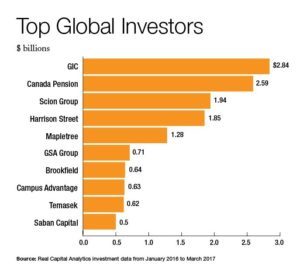
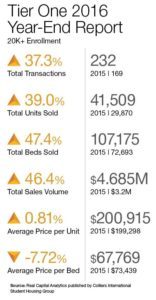
Big investors continue to find higher return on investment in student housing than multifamily or office properties. For example, Singapore’s sovereign wealth fund recorded $16.2 billion of student housing purchases in 2016 and an additional $3.3 billion of transactions in Q1 2017, according to Real Capital Analytics.
“Student housing is a whole different world than residences for families or seniors,” says Will Baker, senior vice president and managing director at Walker & Dunlop in Birmingham, Ala. “We look at each college campus individually and evaluate the trends, such as enrollment growth, competition for student housing on- and off-campus, and which students are required to live on campus.”

Currently, Baker foresees favorable conditions for financing student housing. In 2016, Walker & Dunlop lent $1.6 billion for student housing developments.
However, he expects a decrease in supply after 2017, based on more restrictive construction financing terms. While Baker doesn’t believe student housing is recession-proof, he calls it “recession resistant.”
Attracted by student housing’s stability, other top global investors in student housing include GIC, Canada Pension, Scion Group, and Campus Advantage. Nationally, higher numbers of international students flowing into U.S. colleges continue to fuel optimism. Students from China and India top the list, according to Oxford Economics.

Sunbelt Rising

Nationally, most new units are springing up off-campus, in mixed-use development high rises with retail on the ground level. The most desirable locations are close enough for students to walk to campus or commute quickly by light rail.
Boosts in student enrollment drive student housing, with the heaviest activity in the Sunbelt states, according to Scott Streiff, executive vice president at JLL Capital Markets in St. Paul, Minn. “During the last 20 years, the Sunbelt states have built triple the number of new student housing units compared to the rest of the U.S.,” says Streiff, who specializes in multifamily and student housing.
Streiff points to data from AxioMetrics that show about 450,000 student housing units have been constructed in the south and southeastern U.S. during the past two decades. Securing second place, the Midwest boasts 150,000 new student housing units.
While most construction has been in high-amenity student housing during the past five years, the next level of growth will be for more moderately priced student housing, according to Sonny Ginsberg, co-founder of Ginsberg Jacobs LLC in Chicago. “There’s room for growth in next 20 percent of student housing,” he says. “The saturation level differs in this space for students with more limited housing budgets.”

The cycle for high-amenity student housing has been hot for several years. Signaling a slight slowdown, underwriting for loans is getting tighter, and new construction requires more equity now than a few years ago, says Ginsberg, who represents lenders in student housing and also conducts retail leasing for CA Ventures.

Small Investors Beware

While cities like Boston and Chicago are home to multiple universities, secondary and tertiary markets serve as hubs for most campuses and experience higher demand for student housing.
“College towns have become tech centers and have turned into year-round communities in smaller markets, especially in the Midwest,” Ginsberg says.
While student housing holds continued luster for investors, it is not easy money, according to Jim Tansey, CCIM, managing broker of Lockard Commercial in Coralville, Iowa. Currently, Tansey brokers transactions and develops retail opportunities for the University of Iowa campus in Iowa City, Iowa. Previously, he was an owner of student housing properties.
“We work to educate small investors about student housing, which is not a quick-profit investment,” he says. “Cap rates are below market, and undergraduate students are not good caretakers of properties.”
Likening student housing to an arms race,  he says as an owner it’s tough to keep up with needed renovations and desirable new amenities. As an alternative, Tansey finds the student-specific retail market is a good niche for investment.
While Iowa City is a tertiary market, Tansey is working with more big players because “lots of opportunities in the primary and secondary markets are picked over.”
On the upside for investment, “student housing does well when the economy is strong and is stable in down cycles,” Tansey says.

Building Reputation

Establishing and maintaining a good reputation at universities is a top priority. Those colleges attract high-quality students, drawing from greater numbers of applicants.
“Due to the substantial capital investment required to develop and establish real estate investments, it is risky for an investor to be the first to move into areas where a particular university has not established its gravitational pull for attracting other viable commercial endeavors,” says Mario Guevara, CCIM, real estate project manager at Silver City Partners Ltd. in Winter Park, Fla.
The management of student housing investments requires providing capital management, overseeing the property, and keeping up with the local economic pulse. “Due to constantly evolving tastes, student housing assets have to comply and conform to market trends, which usually means large capital infusions,” he says.
In Guevara’s market, the University of Central Florida hit its stride in the 1990s and has been strengthening its undergraduate and graduate programs ever since. Through its 54 years of operations, increasing numbers of its graduates have found good jobs locally.
For instance, UCF provides many engineers to nearby Cape Canaveral. Specialized positions in the military, Walt Disney World, and other entertainment businesses are other good employers for UCF graduates.
Describing the Orlando metro area as “bursting at the seams,” Guevara sees UCF spurring multiple offshoots, which create opportunities for other businesses to flourish. In turn, this propels demand for more commercial property development.

Midwest Hub

College towns like Columbus, Ohio, often have more than one major university to support the expansion of student housing, as well as other commercial property development. Yet even with 20 universities and colleges in the Columbus metro area, The Ohio State University stands out for its consistently robust enrollment growth – between 5 and 10 percent annually. During the past five years, higher numbers of students have fueled nearly $2 billion in construction.
Of that budget, 25 percent was invested in renovations and newly built on-campus dorms to support Ohio State’s mandate in 2016 for sophomores to live in on-campus university housing. Previously, only freshmen had to live on-campus.
Despite the loss of sophomores to on-campus housing, Steve Reynolds, CCIM, predicts 10,000 more residential units will be added to the core urban center of Columbus. “I don’t see any reason for student housing to slow down here,” says Reynolds, owner of Pinnacle Associates in Grandview Heights, Ohio. “If the economy tanks, Ohio State enrollment will not decrease from 66,000 students to 33,000.”
As an investor in student housing, he advises buyers “to buy right, sell right, and know what you’re buying into, such as student housing built close to campus.”

Retail Gems

In the past decade, some large universities show significant shifts in students living on campus versus commuting students. For example, the University of Minnesota in Minneapolis traditionally had 80 percent commuter students, and now it has a 50/50 split between commuters and on-site dwellers.
As a result, student housing has expanded by 5,000 units in the last five years. Along with additional housing has come the need for more retail, which is targeted for students’ tastes and budgets.
On the retail side of student housing, Barry Brottlund, CCIM, has seen mixed-use projects change the commercial property dynamic near the University of Minnesota’s campus.“The merchandise mix for students has to be determined carefully,” says Brottlund, principal at InSite Commercial Real Estate in Vadnais Heights, Minn.
For example, near the University of Minnesota campus, Target has plenty of bedding, potato chips, nuts, and beef jerky, with a smorgasbord of sandwiches and highly caffeinated drinks. Students gravitate toward local ethnic restaurants, mobile phone service providers, fitness centers, and coffee shops like Starbucks, according to Brottlund.
With their busy schedules, students want retail shopping close by – saving them time, money, and resources, he says. “What doesn’t sell well are soft goods, especially fashionable clothing,”  Brottlund says.
While student housing continues its solid performance for multiple investors, caution is creeping into some local markets for U.S. universities. Investors have to evaluate each market individually and look closely at trends for each college.
By: Sara S. Ptterson (CCIM)
Click here to view source article.

Filed Under: All News

  • « Go to Previous Page
  • Page 1
  • Interim pages omitted …
  • Page 3
  • Page 4
  • Page 5
  • Page 6
  • Page 7
  • Interim pages omitted …
  • Page 9
  • Go to Next Page »
  • Search Property
  • Join CARNM
  • CARNM Login
  • NMAR Forms
  • All News
  • All Events
  • Education
  • Contact Us
  • About Us
  • FAQ
  • Issues/Concerns
6739 Academy Road NE, Ste 310
Albuquerque, NM 87109
admin@carnm.realtor(505) 503-7807

© 2026, Content: © 2021 Commercial Association of REALTORS® New Mexico. All rights reserved. Website by CARRISTO