• Skip to primary navigation
  • Skip to main content

CARNM

Commercial Association of REALTORS® - CARNM New Mexico

  • Property Search
    • Search Properties
      • For Sale
      • For Lease
      • For Sale or Lease
      • Start Your Search
    • Location & Type
      • Albuquerque
      • Rio Rancho
      • Las Cruces
      • Santa Fe
      • Industry Types
  • Members
    • New Member
      • About Us
      • Getting Started in Commercial
      • Join CARNM
      • Orientation
    • Resources
      • Find A Broker
      • Code of Ethics
      • Governing Documents
      • NMAR Forms
      • CARNM Forms
      • RPAC
      • Needs & Wants
      • CARNM Directory
      • REALTOR® Benefits
      • Foreign Broker Violation
    • Designations
      • CCIM
      • IREM
      • SIOR
    • Issues/Concerns
      • FAQ
      • Ombuds Process
      • Professional Standards
      • Issues/Concerns
      • Foreign Broker Violation
  • About
    • About
      • About Us
      • Join CARNM
      • Sponsors
      • Contact Us
    • People
      • 2026 Board Members
      • Past Presidents
      • REALTORS® of the Year
      • President’s Award Recipients
      • Founder’s Award Recipients
    • Issues/Concerns
      • FAQ
      • Ombuds Process
      • Professional Standards
      • Issues/Concerns
      • Foreign Broker Violation
  • Education
    • Courses
      • Register
      • All Education
    • Resources
      • NMREC Licensing
      • Code of Ethics
      • NAR Educational Opportunities
      • CCIM Education
      • IREM Education
      • SIOR Educuation
  • News & Events
    • News
      • All News
      • Market Trends
    • Events
      • All Events Calendar
      • Education
      • CCIM Events
      • LIN Marketing Meeting
      • Thank Yous
  • CARNM Login
  • Show Search
Hide Search

Archives for April 2018

Gap Between Industrial Supply, Demand Narrows

April 12, 2018 by CARNM

Underlying economic conditions remain intact, with demand still robust and the supply pipeline strong.


Industrial’s story for the last few years has been nothing but growth and then more growth. Now, new numbers from CBRE Econometrics Advisors show that the distance between strong demand and what was once limited supply is beginning to tighten.
To be sure, net absorption continued to outpace completions in the first quarter of 2018 but the gap has narrowed, it said in a report. Net absorption and completions over four quarters were 215 million and 204 million square feet, respectively, meaning that excess demand was 11 million square feet — down significantly from 100 million square feet in Q1 2017. Going forward, a strong pipeline will mean that the demand-supply gap will likely fluctuate around zero, CBRE said.
“Underlying economic conditions for the industrial sector remain intact, with demand still robust and the supply pipeline strong,” Timothy H. Savage, Senior Managing Economist at CBRE Econometrics Advisors, said in a prepared statement.
Currently the availability rate for CBRE Econometric Advisors’ industrial Sum of Markets fell 6 basis points in the first quarter of 2018 to 7.3%, for an availability rate that was down 20 basis points over the year. Preliminary data for the quarter indicate net absorption of 42 million square feet with completions totalling 35 million square feet.
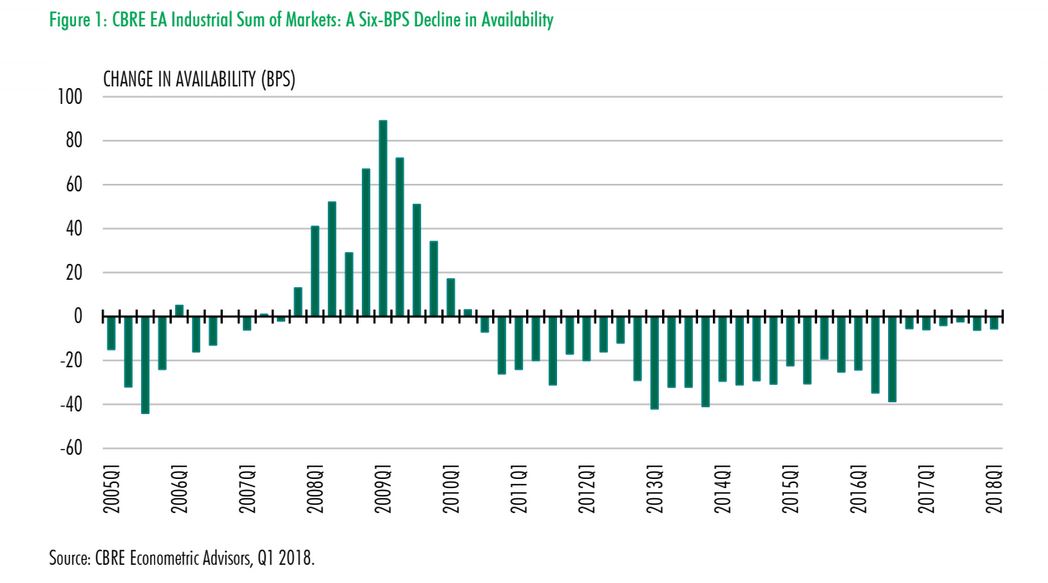
Except for this latest — and preliminary — data point, completions have registered above the 45 million to 50 million square feet threshold six times in the past eight quarters, the report said. Historically, whenever completions have remained in this range consistently, the availability rate has flattened out for some time before increasing.

Market by Market

The report found that availability declined in 31 markets during the quarter, rose in 25 and was unchanged in eight.
Some of the quarter’s largest year-over-year declines were recorded in Dayton (-300 bps), Sacramento (-290), Tucson (-230), Jacksonville (-220), Memphis (-220) and Phoenix (-180).
Notable year-over-year increases were seen in Wilmington (520), Louisville (210), Austin (210), Charlotte (140), Pittsburgh (140), Allentown (120) and Dallas (110).
By: Erika Morphy (GlobeSt)
Click here to view source article.

Filed Under: All News

Why Landlords And Property Managers Can Benefit From The Coworking Boom

April 12, 2018 by CARNM

The coworking industry has seen unprecedented growth the past few years, enjoying rapid expansion across some of America’s most economically valuable cities and there are three specific and palpable reasons why.

The coworking industry has seen unprecedented growth the past few years, enjoying rapid expansion across some of America’s most economically valuable cities. In fact, according to Deskmag, the number of coworking locations has also grown globally from 1,130 spaces in 2011 to 13,800 in 2017. With the rising prominence of the market, companies that take advantage of coworking have seen major benefits to their business—outsourced office management, seamless entry into new markets, gorgeous design, and well-maintained and flexible work environments.
While companies of all sizes — from start-ups to enterprises — are taking advantage of the coworking movement, there are other stakeholders that stand to benefit from the coworking boom—both landlords and property managers. Some of the most prominent landlords and property managers in the world have begun to invest in the coworking industry.
There are three specific and palpable reasons why:
Technology Innovation is Now a Built-In Expectation
The first significant advantage for landlords is the ability to provide its tenants with the latest technology and innovation that coworking offers. From virtual doormen and smart conference rooms, to meditation spaces and remote check-ins, there is a growing expectation that buildings offer access to the latest technological advances. With all of the other current challenges to maintaining a building, keeping up with shifts in innovation isn’t always the priority.
Those priorities may be changing. A growing number of workers want the benefits of technology integrated into their workspaces in order to operate more efficiently and provide more flexible work environments. In fact, a recent Dell and Intel study showed that globally, 57% of people expect to be working in a smart office within the next five years.
That’s where coworking comes in. The ability for a landlord to partner with a coworking platform allows them to work directly with an expert to keep their office building up-to-date on the technology front, lending to a higher competitive advantage.
Better Offices, Better Build-Outs, Higher Property Values
Gone are the days when a company could simply move desks and chairs into a space and call it an office. Contemporary interior design is a core consideration for any company looking to create a productive environment for its employees. More than that, it’s standard practice for landlords to increase building amenities in order to raise building value significantly.
As people spend more time at work, companies require space that is designed efficiently for many different personality types and work styles. That’s a big job for a property manager to take on. Through coworking, landlords can essentially outsource their interior design needs, giving their tenants beautiful spaces and amenities they may not have access to with a typical lease.
Plus, when a company grows and needs more office space, the first place they’re going to look is in the building they already occupy. If building management has a standard build out already in place, there is a greater likelihood the current tenant expands within the building, resulting in lower turnover and upgrade costs for landlords.
Cross country expansion, Minus the U-haul
One of the best and most frequent uses for coworking spaces is rapidly expanding businesses in need of remote offices, satellite locations or short-term work space. If a landlord creates a partnership with a coworking platform, the potential exists to grow its relationship with its tenants beyond a single lease, especially if the property management group has multiple locations.
The coworking company is incentivised to fill the space so landlords will never need to worry about an empty office floor. With more and more companies looking at coworking as an option  – 1.7 million people are projected to work in coworking spaces by the end of 2018 — these partnerships could lend themselves to a much greater beneficial relationship. In short, the pay off doesn’t have to stop at one lease signing.
Coworking produces more revenue and higher net operating income than traditional market leases do for a similar amount of space. Increasingly, providers and landlords are partnering to share in the upside. Landlord partners have seen increased property values, better tenant retention and better building credibility due to working coworking partners.
What was once considered a fad is proving itself to be a permanent solution for many growing companies. While these businesses and their employees reap the benefits, landlords and property managers can also capitalize on this growing industry.
By: Jamie Hodari (GlobeSt)
Click here to view source article.

Filed Under: All News

Prices Keep Rising for Apartment Properties, Forcing Investors into Smaller Markets

April 10, 2018 by CARNM

The search for yield is leading investors to smaller properties in smaller markets.
Investors keep looking for apartment buildings to buy at good prices. The search is leading them to smaller properties in smaller markets.
“Things continue to be very good in multifamily,” says John Sebree, national director of the national multi housing group with brokerage firm Marcus & Millichap.
The amount of money multifamily investors are spending has stabilized at a high level. Investors continue to accept relatively low yields on their acquisitions, even though interest rates rose substantially in 2017 and are expected to rise further. Part of the reason is that apartment rents continue to rise across the country, attracting investors to bid for new properties.
Last year, the volume of investment sales in the sector started slow and finished strong, so that the full-year was roughly equal to that achieved in 2016, with $152.7 billion in transactions, according to Real Capital Analytics (RCA), a New York City-based research firm. That was down just 4.0 percent from $159.1 billion the year before “We had about an equal volume of transactions in 2017 and 2016,” says Lee Everett, senior managing consultant for research firm CoStar.
So far, 2018 seems to be continuing at the same level. January was a busy month for the multifamily sector, with $9.9 billion in sales. February was slower, with $8.1 billion. Together they add up to roughly the same total as last year. “Volume is about the same as it was at this early point in 2017,” according to RCA.
The total dollar amount is high compared to the historic average, though it is lower than the volume achieved during the peak of the cycle in 2015. “The velocity of investment is still above 2014—and no one was complaining about low velocity of sales in 2014. We are still at a high level of velocity,” says Sebree.
Prices are high and rising for apartment properties, according to RCA’s Commercial Property Price Index (CPPI). The index rose 7.3 percent for properties in the six major metropolitan areas over the 12 months that ended in February. The index rose even more sharply—12.4 percent—in non-major metropolitan areas over the same period.
These high prices are keeping the yields produced by apartment properties very low, despite rising rents. The interest rates that investors have to pay on long-term loans have also risen, and are expected to rise more. Eventually, this should have an effect on the yields investors are willing to accept. But cap rates on deals for apartment properties remain at historic lows, averaging well under 6.0 percent, according to RCA.
“There is scant evidence of an uptick in apartment cap rates yet,” according to RCA.
Long-term interest rates are expected to rise in 2018 as raises to short-term rates by the Federal Reserve ripple through the economy, eventually pushing long-term rates higher and supporting higher cap rates. “The only variable we are monitoring right now is the 10-year Treasury. Over the next couple of years, it is going to drift up,” says Sebree.
In the meanwhile, investors are hunting for higher yields and properties that are likely to appreciate in value. The search is pushing them to smaller assets, often located in smaller markets. As a result, CoStar’s “equal-weighted” index of prices for apartment properties has risen more quickly than CoStar’s “value-weighted” index over the last two years.
“Fewer trophy assets are now trading,” says  Everett. “More investors are moving to workforce housing.”
Investors also remain enthusiastic about the apartment sector overall. The fundamental demand for rental housing continues to be strong, says Sebree. “I see absolutely nothing that changes that,” he notes. “Most owners see a pretty good runway ahead of them.”
Construction delays have also helped protect the apartment sector from overbuilding. Mid-rise apartment buildings are now taking an extra six months, on average, to complete. That’s twice as long as the average delays experienced at the same time last year.
Some of the uncertainties that hung over the sector last year have resolved. For example, the tax reform that passed recently could have removed many provisions that multifamily investors depend on. But the final version of the reform that became law turned out to be very favorable to the apartment sector.
By: Bendix Anderson (National RE Investor)
Click here to view source article.

Filed Under: All News

Amazon HQ2: A Reset Button for Site Selection

April 10, 2018 by CARNM

1Q18 Commercial Real Estate Insights Report


Dear Reader:
This year, CCIM Institute is thrilled to announce a new partnership with the Alabama Center for Real Estate to bring you our new Commercial Real Estate Insights series. Since its founding more than 50 years ago, CCIM Institute has been a force and a champion of careful financial, market, and investment analysis, and fiduciary-level professionalism in all phases of the commercial real estate transaction. With this inaugural report, the Institute renews its commitment to providing thought leadership at the highest level to the industry during a time of historic change.
To ensure success, we have invited K.C. Conway to author these white papers and to serve as CCIM Institute chief economist. K.C. previously served as chief economist for Colliers International – US, and he is a regular advisor to the Federal Reserve, FDIC, FHLB, and top commercial real estate organizations.
A thinker and a futurist, K.C. brings a valuable perspective that sets him apart from other industry economists. Through his work at the Alabama Center for Real Estate and dozens of speaking appearances across the country each year, he’s uniquely focused on issues affecting commercial real estate professionals in secondary and tertiary markets – the markets where most CCIMs are based.
The Commercial Real Estate Insights reports are designed to start a conversation that will ultimately help CCIMs and their clients adapt in an evolving industry. If you’re not a CCIM, I encourage you to learn more about the CCIM designation program and our other education offerings at www.ccim.com.
With the support of our members and partners like the Alabama Center for Real Estate, we look forward to bringing you valuable insights for many years to come.
Sincerely,
David P. Wilson, CCIM
2018 President
CCIM Institute

Key Ideas

  1. Traditional industries that communities relied on for the past three decades for job and revenue growth, such as retail and financial services, are being replaced. The Amazon HQ2 RFP is an early blueprint for how this process will play out, and it has given 238 cities a chance to illustrate what makes them attractive.
  2. With its HQ2 RFP, Amazon has probably altered how corporate relocations and expansions will occur in the next decade. A close reading of the RFP reveals that the search seems less about incentives and more about workforce solutions and corporate culture fit. Other rising and transformative technology companies may use similar criteria for future site selections.
  3. Workforce availability is the most important factor driving corporate relocation and expansion decisions today. Tomorrow’s growth companies need that skilled workforce. Without it, their growth stalls out.
  4. Amazon and other expanding companies are moving east to follow the growth. Most of Amazon’s business customers in the U.S. reside east of the Rocky Mountains. Amazon and other companies are looking to “The Golden Triangle” because it produces approximately one-half the U.S. annual GDP and a skilled workforce, and it’s the epicenter of America’s new supply chain.
  5. Commercial real estate professionals have a key role to play in the new era of site selection. But capitalizing on new opportunities requires a deep understanding of market analysis fundamentals, economic principles, and the new factors driving corporate site selection decisions.

The Evolving Site Selection Process

Amazon’s HQ2 site selection process is more than just a point along a timeline charting its evolution as one of the world’s most transformative companies. It is a reset button that will likely have implications far beyond Amazon.
Not since Walt Disney’s success with Disneyland in California in the 1950s and his decision to hit the reset button and redevelop his amusement park vision in Florida have we seen such a noteworthy business expansion. Just as Disney outgrew its transformative concept in Southern California ­- remaking the amusement park model ­- Amazon is turning upside down the traditional retail sales and supply-chain model.
The legacy of the Amazon HQ2 search will be less about which MSA prevailed and more about how it was a watershed moment in how and why companies make site selection decisions.
Workforce availability has become the key factor driving corporate expansions1.
At the same time, real estate market conditions, such as real estate values and vacancy rates, have become less critical in the decision process. Does this mean commercial real estate professionals will have less of a role to play in corporate relocation decisions? Absolutely not. However, it does mean that commercial real estate professionals will have to update their site analysis skills. Companies like Amazon are more concerned about where to find the tens of thousands of skilled employees than traffic counts, office and warehouse availability rates, and facility construction costs. Those that pick up on this shift will be more engaged with corporate site selection decisions and searches than those who stick to a traditional approach.
External Factors Impacting Relocations
Communities can no longer look to new malls and retail shopping center development to add employment and put revenue in the municipal coffers from sales taxes, nor can they count on growth in the financial services industry to add good-paying middle-class jobs at branch banks or in mortgage lending. Technology is disrupting both the traditional retail and financial services industries business models.
So what is going to replace these growth engines? The answer is technology, e-commerce, and logistics companies, such as Amazon. The Amazon HQ2 RFP is a blueprint for how these companies will locate major facilities in the coming years.

Disruptors Are Becoming Growth Engines

Amazon’s HQ2 RFP process has garnered headlines because Amazon itself is playing an ever larger role in everything we consume. Throughout 2017, Amazon was the big disruptor, venturing into new businesses such as grocery and livestreaming sports. It also surpassed Macy’s to become the largest apparel retailer in the U.S. Recode, a leading technology news publication, identified Amazon founder Jeff Bezos as the person who “mattered the most” in 2017 among technology, business, and media leaders2.
All of this growth translates into revenue and jobs that put Amazon high among Fortune 500 ranking of companies. In the 2017 rankings, it moved to No. 12, up from No. 18 in 2016, thanks to a 27 percent increase in revenues to $136 billion, and an almost 300-percent increase in profits to $2.37 billion. And with more than 340,000 employees and the promise of 50,000 more with HQ2, Amazon has increasing influence on the U.S. and global economies.
But the response to the Amazon HQ2 RFP by nearly two-thirds of U.S. MSAs was due less to a realistic promise of 50,000 Amazon jobs and more to a desire by communities across North America to identify what makes them attractive to fast-growing companies. In other words, participation in the Amazon RFP was an opportunity for communities across North America to raise their hands and tell what was great about them in an increasingly tech-oriented economy.
But how deep a bench is out there for other Amazons in the making?
In 2017, 57 startups attained billion-dollar valuations, according to PitchBook. This is part of an unprecedented run that started in 2014, with 243 companies joining this club over the past four years – up from 54 during the preceding four-year period of 2010-2013.
startups-reached-1b
These fast-growing tech companies that attain billion-dollar valuations have been dubbed “unicorns,” though it’s clearly not the rare feat that it once was3. To distinguish the “unicorns among the unicorns,” industry analysts have started to use the terms decacorn and super-unicorn. A decacorn is a fast-growing tech company with at least a $10 billion valuation; a super-unicorn is a rapidly expanding tech company that has achieved a $100 billion valuation.
Prior decades have given birth to only a handful of tech super-unicorns, such as Google and Amazon in the 1990s; Cisco in the 1980s; and Apple, Oracle, and Microsoft in the 1970s. Each major wave of technology innovation has given rise to one or more super-unicorns. They are the companies changing how we live and/or work.
It is the rising unicorns’ attention that most of the 238 Amazon HQ2 RFP respondents were aiming to capture. Communities with an attractive technology infrastructure, skilled workforce, and logistics offering want burgeoning unicorns to take notice of them regardless of whether they win Amazon’s HQ2. There are hundreds of unicorns out there that may be decacorns or super-unicorns in the making across multiple sectors, from vertical agriculture to fitness to experiential retail and beyond4. MSAs across North America are vying for their favor.

The New RFP: A Closer Look

The Amazon HQ2 search process is pioneering a more transparent process for corporate expansions that will be emulated by other expanding and transformative companies. But beyond increasing transparency and competition, the HQ2 RFP document emphasizes a remarkable idea:
The search is less about incentives and more about workforce solutions and corporate culture fit.
amazon-hq2-proposal-applicants
Although 238 MSAs in North America submitted response proposals, less than 50 met the criteria laid out in the RFP. Many analyses by credible real estate data and advisory companies failed to recognize just how influential the RFP is, preferring to rank contenders based on other criteria.
Amazon positioned its four guiding principles at the core of the HQ2 RFP. Those principles are:

  • customer obsession rather than competitor focus;
  • passion for invention;
  • commitment to operational excellence;
  • and long-term thinking.

Amazon and expanding unicorn and super-unicorn companies rely on a large, skilled millennial workforce. These companies care about the impact of their business on the community and their workplace environment as much as profitability to attract and retain that workforce. Without it, their growth stalls out. Proximity to primary centers of education, affordability and quality of life (especially for the millennial generation), and cultural fit are now the key factors for site selection. If cities want to incubate, grow, or attract one or more of these rising and transformative companies, community leaders need to come to the table with workforce solutions.
Amazon also emphasized its guiding principles in its RFP to encourage competing communities to address any deficiencies related to these principles. RFP respondents were given the chance to align incentives with areas of weakness, such as mitigation of property tax escalation risk in a locale that has fiscal and operational challenges or mitigation of transportation deficiencies resulting from short-term planning. MSAs that failed to demonstrate innovation and problem solving in areas such as transportation, secondary schools, and affordable housing probably do not have a cultural fit with Amazon and will not be finalists in the HQ2 search.
Consider Atlanta. Despite being the odds-on favorite for the HQ2 selection, it has significant hurdles to overcome. It has failed to address its traffic congestion, develop a regional transportation plan, or pass a Transportation Special Purpose Local Option Sales Tax to fund transportation projects. The spring 2017 I-85 bridge collapse highlighted how serious Atlanta’s traffic problems have become, and that those problems have been ignored.
This betrays a lack of the long-term thinking that Amazon and other expanding companies are seeking. It also means that states like Illinois, with its fiscal issues, have an operational hurdle to overcome, which does not bode well for Chicago. Challenges like these put select MSAs in California, Georgia, Florida, Illinois, and Michigan at a disadvantage.
Cities such as Pittsburgh; Phoenix; Denver; Orlando, Fla.; and Greenville, S.C. get high marks on core principles relating to passion for invention, long-term thinking, and operational excellence – as do Vancouver and Toronto.
The HQ2 RFP illustrates that understanding a company’s core principles and culture is key to any site selection opportunity.
Amazon also noted that it has “a preference for metropolitan areas with: i) more than 1.0 million people; ii) a stable and business-friendly environment; iii) an ability to attract and retain strong technical talent; and iv) communities that think big.” This section of the HQ2 RFP narrows the 238 contenders down to less than 50. How so? Only 53 U.S. MSAs have a population more than 1.0 million. Of those 53, fewer than 20 have or are in proximity to primary education institutions capable of providing the thousands of new skilled workers Amazon will need
to hire annually.
In the RFP’s Key Preferences and Decisions Drivers section, Amazon reveals additional criteria that will play a material role in the final HQ2 decision. In particular, this Capital and Operating Costs detail has been much overlooked in other HQ2 analyses: “Amazon is looking for a stable and business-friendly environment and tax structure which will be a high-priority consideration for the Project.”
This one statement likely takes the following areas out of contention for HQ2: Illinois (fiscal and property tax risks); Maryland (not known for its business-friendly environment, which almost cost them retention of the Marriott HQ in 2016); California; and most of the New England region. It bodes well for cities in Florida, Georgia, Tennessee, and Texas.
Logistics factors also narrow the field. On page 5 of the RFP, it states: “Travel time to an international airport with daily direct flights to Seattle, New York, San Francisco/Bay Area, and Washington, D.C., is also an important consideration.”
Atlanta probably gets the top ranking on this item with its Delta hub and the world’s busiest and most connected airport both domestically and internationally. Other metropolitan areas — such as Northern Virginia; Orlando, Fla.; Dallas; Denver; Phoenix; and Chicago — get high marks for air transportation and connectivity to critical Amazon markets.
Amazon also is committed to sustainability efforts, such as redeploying former brownfield sites, building to LEED standards, and relying on renewable energy. Most of the top 50 contending MSAs can deliver suitable sites and build to LEED standards, but Amazon is looking for more than that. It wants to be in markets deploying and advancing renewable energy, such as wind and solar, and with the ability to deploy a district energy system that uses recycled heat from, say, nearby data centers. In addition, optical fiber connectivity “is paramount for our future HQ2 location,” according to the HQ2 RFP.
Here again, Atlanta, Dallas, and Northern Virginia rate high as connected cities, with data-center hubs, modern electric grids, and innovative energy suppliers such as the Southern Company in Atlanta and Duke Energy in Virginia.
“Cultural Community Fit” and “Community/Quality of Life” round out Amazon’s defined preferences in the HQ2 RFP. These don’t translate to a red-vs.-blue-state criterion, nor a choice between a Sunbelt or four-seasons climate. However, it does suggest that Arizona, California, North Carolina, Illinois, and other states with immigration, gender-dedicated bathroom, sexual harassment, and fiscal stability headlines probably have a tougher hill to climb in the HQ2 competition and other companies’ future site selection processes.
The Amazon HQ2 RFP and future corporate search RFP documents are important economic blueprints to be digested by metropolitan leaders and economic development authorities as they try to understand how to attract growing, transformative companies.

The New Frontier for Growth

Putting aside the RFP requirements, Amazon is looking for a second HQ for at least two other reasons. First, following business fundamentals, it wants to be close to its customers. And second, it wants to move toward centers for economic growth.
The Business Case
Amazon now has more businesses using its products and services east of the Rocky Mountains than in the Western region of the U.S. in aggregate. This rather fundamental business principle – locate close to your customers – likely gives communities in the East and Midwest an advantage over communities in the West in the HQ2 site selection process.
What states are tops for businesses using Amazon products and services? While California remains the state with the most Amazon business customers, New York is now No. 2, followed by Texas, Illinois, and Florida. Massachusetts, New Jersey, Pennsylvania, and Washington (Amazon’s original HQ) are all tied for fifth. Amazon serves approximately 1.4 million businesses east of the Rocky Mountains vs. 860,000 in the West (see chart). Could this be a factor in Amazon’s decision to put its HQ2 east of the Rocky Mountains? Absolutely. And as Amazon experiences a similar growth in business clients outside of the U.S., it will drive the decision for a European and Latin American HQ3 and HQ4, respectively.
top-states-amazon
The Golden Triangle
To move toward centers of economic growth, Amazon also would do well to look east of the Rocky Mountains for its HQ2. More GDP growth now occurs in what I’ve labeled the “Golden Triangle” – a region encompassed by the Great Lakes to the north, Texas to the southwest, and Georgia, South Carolina, and Florida to the southeast.
The Golden Triangle produces approximately 50 percent of the U.S. annual GDP and an abundance of the skilled workforce that technology, e-commerce, and logistics companies are in desperate need to recruit. This area also contains more Post Panamax ports in North America with Class I rail connectivity and exudes logistics. The National Center for the Middle Market has defined a large portion of this Golden Triangle as the “Trustbelt” – a rebranding of a large part of what was formerly referred to as the “Rustbelt.”

Amazon HQ2 is going to follow this easterly growth. Due to the remaking of North America’s supply chain, retail disruption, the growth of e-commerce, and a focus on workforce availability and affordability by technology and logistics companies, the Golden Triangle has become a new frontier for growth, not just for Amazon, but also for other technology, auto, aerospace, manufacturing, and logistics companies. Recent examples include: Boeing’s expansion to Charleston, S.C., due to its deep-water port; Nike’s expansion to Memphis, Tenn., for access to FedEx and better supply-chain infrastructure; auto manufacturer expansions to South Carolina, Alabama, Georgia, and Tennessee for skilled workforces and supply-chain infrastructure; and Google’s expansion to Pittsburgh.
The “Golden Triangle” is the epicenter of America’s new supply chain, and Amazon and other transformative companies are taking notice.

Beyond HQ2: Markets to Watch

At the time of writing, Amazon has not yet announced the North American city that will be the site of its HQ2. But that news is expected shortly. Regardless of which city Amazon chooses, the HQ2 RFP points to the site selection criteria that other disruptive companies might use. I consider these MSAs to be the top contenders for corporate site selections in the coming years:

  1. Pittsburgh: Home to a major Google campus and universities, such as Carnegie Mellon, it’s also slated to be America’s first fully driverless-car-enabled MSA by 2020.
  2. Columbus, Ohio: It’s the epicenter for the National Center for Middle Market companies – the small- to mid-size businesses that Amazon so covets and which account for 35 percent to 40 percent of U.S. GDP and job growth. Plus, Ohio State University pioneered today’s graduate programs in logistics.
  3. Atlanta: It boasts three urban university campuses and the world’s busiest and most connected airport.
  4. Northern Virginia: The East Coast’s data center hub also benefits from its proximity to the nation’s lawmakers, two of the most connected international airports in the U.S., and numerous centers of primary education.
  5. Orlando: The Inland Empire of Florida is surrounded by a leading 21st-century workforce, an iconic international airport, and two notable universities – not to mention scientists and tech workers from the nearby Space Coast.
  6. Greenville/Spartanburg, S.C.: Home to BMW, its innovative logistics collaboration and deep-water port are attracting global manufacturing from the likes of Michelin, Boeing, Volvo, and Samsung.
  7. Charlotte, N.C.: This leading financial center is the only place in North America with intermodal rail and logistics inside its international airport.
  8. Dallas: It leads the nation in GDP and job growth, and benefits from unmatched air, land, and logistics connectivity.

These are just a few of the centers of growth east of the Rocky Mountains that are today’s Los Angeles, San Francisco, San Diego, and Seattle. But growing companies shouldn’t overlook the plethora of secondary MSAs in the East that are burgeoning economic powers in the auto, aerospace, e-commerce, healthcare, trade/ports, and telecom sectors, such as: Birmingham, Huntsville, and Montgomery, Ala.; Charleston, S.C.; Cleveland; Louisville, Ky.; Indianapolis; Jacksonville and Tampa Fla.; Memphis and Nashville, Tenn.; and Grand Rapids, Mich., among others. Influential companies may find that these smaller markets provide the best fit for their specific needs.

The Why for Commercial Real Estate Professionals

It’s become critical for commercial real estate professionals – brokers, developers, investors, and allied professionals – to understand this evolution in corporate site selection. Why? To round out the report, we reached out to CCIM instructors and site selection experts to weigh in.
Other Companies Will Follow
“The Amazon RFP process is a trendsetter,” says Mark Cypert, CCIM, a partner at Middleton Partners in Dallas and a CCIM instructor. “Other corporations are taking notice.” During 35 years in commercial real estate, Cypert has participated in 16.2 million square feet of office, industrial, and retail acquisition and development ventures with a total market capitalization of $2.1 billion. But he’s never seen a corporate site selection process quite like Amazon’s. Boeing’s relocation from Seattle to Chicago in 2001 is the only one that comes to mind, according to Cypert. “But that was 500 executives – not 50,000 jobs,” he adds.
Market Analysis Fundamentals Count
Cypert and other instructors now use the Amazon HQ2 RFP as a case study in their CI 102: Market Analysis for Commercial Investment Real Estate courses. “We teach the multiplier effect in CI 102,” he explains, referring to the spillover of demand to restaurants, hotels, transport, and other businesses. “One Amazon job will equal up to eight non-Amazon jobs.”
According to Cypert, it’s imperative for commercial real estate professionals to understand the multiplier effect and get in front of the market by forecasting the increased need for space across property types, from single-family homes to office space and beyond. It also pays to “know the local market, the players, and the capital sources,” he adds. Everyone in the market will benefit from the entry of Amazon or other big companies, but fully capitalizing on those opportunities requires a deep understanding of market analysis fundamentals – what Cypert calls “basic blocking and tackling.”
Economic Principles Drive Decisions
Gary Ralston, CCIM, managing partner of Coldwell Banker Commercial Saunders Ralston Dantzler Realty LLC and also a CI 102 instructor, identified a few other themes that emerge from the RFP, including office occupancy costs vs. labor costs. “If a company can increase labor productivity, then occupancy cost can be greatly mitigated,” Ralston explains. “A 10-percent gain in productivity might offset the rent.”
Amazon and other leading-edge office users will focus on MSAs and specific properties that foster employee productivity, according to Ralston.
To remain competitive, commercial real estate professionals and site selection experts need a thorough understanding of the economic principles upon which companies such as Amazon are basing key decisions, Ralston adds.
Commercial Real Estate Pros Can Offer A Unique Perspective
Competitive advantage in market analysis doesn’t always mean sitting behind a computer all day. CI 102 Instructor George E. Wilson, CCIM, of Adams & Wilson Development in Mount Pleasant, S.C., encourages students to pound the pavement and get a different sense of their market. A thorough understanding of the properties, the politics, the history, and humans behind it all gives commercial real estate professionals what they need to best meet the client’s site selection requirements, even as the clients change.
Of the Amazon RFP process, Wilson says: “This could be an eye-opening lesson for anyone involved in the site selection process, including economic development offices at the state and local level, corporate executives, real estate professionals, and municipality officials. But we don’t yet understand how successful this site selection process will be, and, more importantly, the long-term return on investment five, 10, or 15 years from now.”
What’s clear is that CCIMs and other commercial real estate professionals have a key role to play in this evolving process.
As corporate site selection changes, Cypert says, “Commercial real estate professionals must think creatively to identify potential locations that offer a corporate user what they need to succeed.”
Are your site selection analysis skills up-to-date to help your community secure an emerging unicorn, decacorn, or super-unicorn?
By: K.C. Conway (CCIM Institute)
Click here to view source article.


Filed Under: All News

  • « Go to Previous Page
  • Page 1
  • Interim pages omitted …
  • Page 3
  • Page 4
  • Page 5
  • Page 6
  • Page 7
  • Interim pages omitted …
  • Page 9
  • Go to Next Page »
  • Search Property
  • Join CARNM
  • CARNM Login
  • NMAR Forms
  • All News
  • All Events
  • Education
  • Contact Us
  • About Us
  • FAQ
  • Issues/Concerns
6739 Academy Road NE, Ste 310
Albuquerque, NM 87109
admin@carnm.realtor(505) 503-7807

© 2026, Content: © 2021 Commercial Association of REALTORS® New Mexico. All rights reserved. Website by CARRISTO

