• Skip to primary navigation
  • Skip to main content

CARNM

Commercial Association of REALTORS® - CARNM New Mexico

  • Property Search
    • Search Properties
      • For Sale
      • For Lease
      • For Sale or Lease
      • Start Your Search
    • Location & Type
      • Albuquerque
      • Rio Rancho
      • Las Cruces
      • Santa Fe
      • Industry Types
  • Members
    • New Member
      • About Us
      • Getting Started in Commercial
      • Join CARNM
      • Orientation
    • Resources
      • Find A Broker
      • Code of Ethics
      • Governing Documents
      • NMAR Forms
      • CARNM Forms
      • RPAC
      • Needs & Wants
      • CARNM Directory
      • REALTOR® Benefits
      • Foreign Broker Violation
    • Designations
      • CCIM
      • IREM
      • SIOR
    • Issues/Concerns
      • FAQ
      • Ombuds Process
      • Professional Standards
      • Issues/Concerns
      • Foreign Broker Violation
  • About
    • About
      • About Us
      • Join CARNM
      • Sponsors
      • Contact Us
    • People
      • 2026 Board Members
      • Past Presidents
      • REALTORS® of the Year
      • President’s Award Recipients
      • Founder’s Award Recipients
    • Issues/Concerns
      • FAQ
      • Ombuds Process
      • Professional Standards
      • Issues/Concerns
      • Foreign Broker Violation
  • Education
    • Courses
      • Register
      • All Education
    • Resources
      • NMREC Licensing
      • Code of Ethics
      • NAR Educational Opportunities
      • CCIM Education
      • IREM Education
      • SIOR Educuation
  • News & Events
    • News
      • All News
      • Market Trends
    • Events
      • All Events Calendar
      • Education
      • CCIM Events
      • LIN Marketing Meeting
      • Thank Yous
  • CARNM Login
  • Show Search
Hide Search

Archives for April 2018

Why Fast Food Chains And Medical Offices Are Proliferating

April 9, 2018 by CARNM

Top net lease developers share their perspectives with one advisor saying “the best real estate is covered up with bad buildings.”
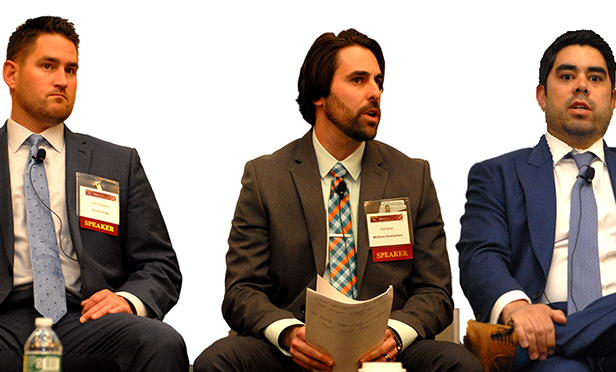
Mark Maughnan, Rob Barse, Ben Hidalgo

At the RealShare Net Lease Conference on April 5 in New York City, top professionals in the net lease development world openly shared what they look for when taking on projects. Panelist Mark Maughan, director of net lease investments at Sundance Bay, headquartered in Salt Lake City, UT, said his firm works with many developers and they must have a niche, for example, that’s geographic or tenant-based.

“Some developers are known in a specific region and tenants come to them. Some groups are really good at getting their preferred developer relationship with Dollar General or CVS and they’ll chase a specific tenant all over the country,” said Maughan. Developers can excel at doing value add, buying existing buildings and bringing in tenants. Sundance Bay looks at whether the tenants have a niche, a track record and a balance sheet.
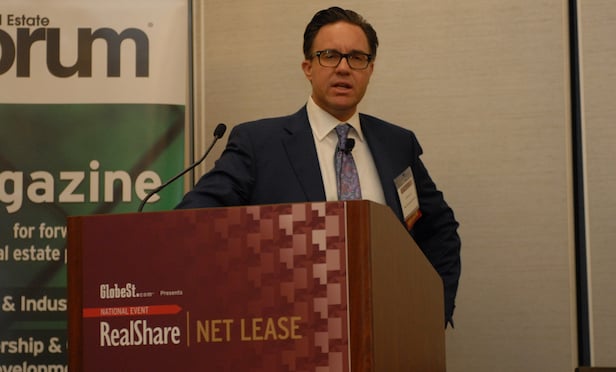
Matt Bear

The moderator of the “Increasing the Inventory: 2018 Sector Developments” panel Matt Bear founded Bear Real Estate Advisors, headquartered in Las Vegas, NV. When he said, “The best real estate is covered up with bad buildings,” the audience chuckled. Bear said the first 10 years of his career were in Las Vegas when the population literally doubled. “It was a market where you ‘Build it and they will come.’” He then asked, what are developers doing to increase their deals?

Panelist Ben Hidalgo, principal of Net Lease Development, based in Fort Worth, TX, focuses on franchises and single corporate tenants. He works with many national QSRs (quick service restaurants) including Arby’s, Starbucks, Steak ’n Shake, Taco Bell, to name only a few. Today’s challenge is finding good sites, according to Hidalgo.

“I think the pricing for retail land has doubled in the last three years and so the price makes it challenging to get tenants to pay because the rents have gotten really inflated,” said Hidalgo. “If you deal with franchisees it’s easier to get a deal quicker.”

Maughan said the tenant drives the business because unless you have a signed lease, the investor does not have a deal. The tenant also drives the timing of many deals. Landowners often want to sell their land in 90 days. But for the developer to close, they need to have a signed lease in hand.

“We’re starting to see more aggressive tenants that can actually meet these deadlines to get a deal done in the due diligence period which may be 90 days,” said Maughan. “So we look for a lot of QSR tenants that are franchisees of Taco Bell, Popeyes or whoever.”

Maughan also noted in that last two months a marked increase in the sales of medical net lease buildings. “It’s obvious. It’s the new retail. We’ve done a lot more medical last year like the Fresenius Medical office building. Our next deal will be an urban care facility in Texas. It’s definitely getting more attractive in this space, the ‘retailization of medical,’” said Maughan.

Developers who do really well, don’t take no for an answer observed Hidalgo. “The tenants are telling you they can’t pay that much. Your general contractor is telling you the cost is this much. There are so many things that you have to know about and keep pushing and pushing to make it all come together,” said Hidalgo. “There are a bunch of circles. You’ve got your lender, your equity partner, your construction, your tenant and you’ve got to get all of those circles to touch.”

Rob Barse, director of development at McShane Development, based in Edina, MN, said being a developer takes vision and creativity to see something, a property that others don’t or haven’t seen. “You need to see around corners, whether it’s predicting shifts in the local market, problems with your contractors, the engineers, your soils, and focus in on calculated risks, the due diligence process, handling a multidisciplinary process that can be pretty chaotic at times,” said Barse. “It’s a fun business to be in but you’ve got to separate yourself with grit and creativity.”

By: Betsy Kim (GlobeSt)
Click here to view source article.

Filed Under: All News

Cities Take the Lead on Sustainability

April 6, 2018 by CARNM

Now that the federal government has stepped back from a leadership role on climate change, cities are stepping up to meet the challenge of preserving the environment for future generations. In fact, cities have been leading the way for a number of years.
This makes sense. The federal government can certainly help, by reauthorizing the 179D tax deduction for energy upgrades in commercial buildings and through EPA and Department of Energy programs and research, for example. But cities are in a position to tailor an approach to sustainability for their specific industries, building types and climates, and they can tap into local citizens, groups and organizations that are passionate about the quality of life in their hometowns.

MORE THAN JUST COMFORT

Besides quality of life issues, risk mitigation is another important driver for cities. Moody’s Investor Services recently warned coastal cities that susceptibility to climate change impacts, including rising sea levels and severe storms, factors into their credit ratings. Currently, Moody’s seems more interested in transparency than action, and the ratings agency has yet to downgrade a municipality’s credit rating due to inaction. That could change, though, particularly if property values sink from climate-related events or if a city fails to make infrastructure investments to increase resiliency in the face of climate change.

CORPORATE CONTRIBUTIONS

Cities are not alone in their pursuit of sustainability leadership. Several organizations have been assisting them. For instance, STAR Communities offers the STAR Community Rating System™, a framework and certification program for evaluating local sustainability through economic, environmental and social measures. Cities such as Atlanta, Wichita, Tacoma, Cleveland, Birmingham, Tucson, St. Louis and Baltimore are among those engaged with STAR Communities.
Another organization, 2030 Districts®, focuses largely on urban downtowns. 2030 Districts commit to reducing building energy use, water consumption and transportation greenhouse gas emissions by 50 percent by the year 2030. They work toward this goal through public-private partnerships and collaboration. Austin, Detroit, Dallas, Los Angeles, Pittsburgh, San Antonio, Seattle and Denver are among the cities in the 2030 Districts Network.

“…Cities are in a position to tailor an approach to sustainability for their specific industries, building types and climates, and they can tap into local citizens, groups and organizations that are passionate about the quality of life in their hometowns.”

Companies are also assisting. They make investments in the locations in which they have operations, often working with the cities, counties and states in those areas. Many companies have realized that comprehensive sustainability strategies provide more benefits than positive public relations and goodwill with local residents. Green buildings and renewable energy installations can reduce expenses. Climate-related events such as wildfires and intense storms can disrupt their operations and supply chains, so they are interested in solutions that reduce those risks.
Technology companies are also a driving force behind the “smart cities” movement. Smart cities use cutting-edge energy technology, connected infrastructure, new distribution methods, driverless vehicles and data collection and analysis to advance livability and sustainability. Alphabet, Panasonic®, Hitachi®, IBM®, Schneider Electric™, Cisco® and other leading companies already provide products and solutions for smart cities.

BE AN ACTIVE PARTICIPANT

In a sense, a city is a collection of buildings in which people live, work and play—so property managers are in a unique position to participate in and gain from these developments. Find out what your city is doing in sustainability and the smart cities movement. Investigate incentives and track policy initiatives. Join your city in finding viable solutions to climate change impacts.
By: Todd Feist (JPM)
Click here to subscribe to the Journal of Property Management

Filed Under: All News

Creating an Orchestra of Diversity to Make Business Ring

April 6, 2018 by CARNM

Fifty-Seven percent of existing employees think their employer should do more to diversify its workforce. How does your workplace stack up?
Many people want to do business or work for companies that embrace diversity. High levels of workplace diversity have been found to have several positive effects such as reduced poverty rates, increased gross domestic product and improved governance. In fact, 85 percent of companies polled for a report commissioned by Forbes strongly agreed that diversity is a key driver of innovation.
When your organization incorporates the tapestry of differences, it builds stronger bonds with internal and external communities.

“If everyone is thinking alike, then somebody isn’t thinking.”

—GENERAL GEORGE S. PATTON


HOW DIVERSE IS DIVERSITY?

It’s crucial to recognize that diversity is not a matter of groups, but more individual differences. Everyone is unique, and when qualities are automatically attributed to those who have a certain trait in common with others, difficulties arise. Diversity comes down to the individual, not group affiliation. It’s not skin color, not the religion people do or do not practice, not their country of origin—true diversity is in the way people think and the way people behave. While a group of people can share similar characteristics, there will also be differences—and that’s one reason diversity can have conflicts.

“We can’t solve problems by using the same kind of thinking we used when we created them.”

ALBERT EINSTEIN


1 TAKE PERSONAL RESPONSIBILITY
Before you can help and support others in embracing differences, you must be a believer. Do what you need to do to remove your prejudices and be open and accepting of differences.
2 RECRUIT
External and internal programs should be developed to reach out to all walks of life. Ask employees for resources and networking groups to approach. Post open positions where different types of people will see them.
2 HIRE
In a fall 2014 Glassdoor survey, 67 percent of those polled said diversity was important to them when evaluating companies and job offers, with minority groups rating it as high as 89 percent. Yet, 57 percent of existing employees think their employer should do more to diversify its workforce.
Interviews should not only qualify for KSAs (knowledge, skills and abilities), but also look to bring in people who think differently. Diverse characteristics (e.g. religion, national origin, etc.) don’t guarantee diverse thinking (nor can you legally inquire about them)—you’ll have to purposely look for diverse thinking.
Write questions that help you discover how people think, not just what they think. Give candidates several scenarios and ask them how they would handle them—have them walk you through their process. Use “behaviorial-based” questions that ask them to describe a problem they have encountered and how they solved it—or to tell you of an idea they have implemented that worked and how they came up with it.

“Diversity may be the hardest thing for a society to live with, and perhaps the most dangerous thing for a society to be without.”

—WILLIAM SLOANE COFFIN JR.


4 MANAGE
Having a diverse workforce places more need on employers to manage in such a way that respects each individual’s perspective harmoniously. Leaders must create a culture where people feel they can be accepted for their authentic selves—where they are eager to share their ideas, even when they are opposite of others, and where others are eager to learn from those differences. It’s not that every thought or idea has to be “right,” but that leaders can identify components that have value and recognize that there is often more than one “right” answer.
There can be stress in dealing with people who are different than you, which is known as “diversity tension.” This tension exists when you work with cultures and situations that vary from your norm. Recognize this tension is a natural reaction and can be managed; reconcile differences, achieve agreement and learn to trust other people’s perspectives and beliefs. Encourage and reward differing opinions. Appoint mentors for those new to the team. If leaders and managers can’t handle conflict and disagreements in a positive way, no staff member will be able to, either.
5 SHAKE UP THE STATUS QUO
Encourage dissenting opinions. Ask questions to solicit disagreement. Make it acceptable to have differing opinions and express them. The best decisions and ideas often come when you eliminate the longest-standing traditions.

  • Did I include all considerations?
  • What am I missing?
  • What can go wrong?
  • Give me one negative aspect.
  • If this solution/answer/action wasn’t available, what else could be done?

6 HELP PEOPLE OVERCOME BIASES
For those who embrace diversity, it’s difficult to admit they may have biases or prejudices. However, it’s wise to recognize that we all are likely to have some biases in some form, at some time. No one is perfect and there may be biases just under the surface that a person doesn’t even know he or she has. Once acknowledged, you can keep your antenna up and tuned to identify them and thus, be able to do something to change course.
Incorrect or unfair biases are dangerous, and part of the danger is that people aren’t aware of, or deny, them. As a manager, you have your beliefs, plus the beliefs of your staff to manage. When inappropriate biases exist in the workplace, effectiveness is reduced, camaraderie is harmed, discrimination occurs and self-esteem suffers—nothing good comes of it.
Changing your (or others’) beliefs is not always easy. Sometimes, education and exposure are enough to move past sterotypes and remove biases. Sometimes, it’s deeper. The question is: How can you, as a manager, remove employees’ biases? A good first step, of course, is that all leaders of the organization strive to have beliefs that are not biased; that they embrace openness and acceptance and appreciation for differences. Have the CEO write a diversity statement that is posted on the company’s website and incorporate it into the HR handbook.
If biases and beliefs among your employees need addressing, or you’d like them to have more empathy for those who are different, I highly recommend you use an expert. A real expert—someone trained or experienced in how to remove biases—perhaps even a psychologist. Don’t play with this at work: Don’t believe you can read about diversity training and lead a talk that will change deep-seated prejudices. Incorrectly handled, feelings can get hurt, damage can be done to the workplace, or worse.

CONDUCT

Success goes beyond tolerance to honoring, embracing and incorporating people’s differences. The ultimate assessment of your inclusion efforts is the answer to: Are diverse ideas implemented? If the answer is “no,” the causes of inaction must be identified and hard changes might be needed.
Collect differing talents and put them together. Strive for decisions and ideas gathered from differing thoughts and opinions. Live in a multi-cultural world. That’s beautiful music.
By: Natalie Brecher, CPM (JPM)
Click here to subscribe to the Journal of Property Management

Filed Under: All News

Ambulatory Healthcare Mixes Well At The Mall

April 6, 2018 by CARNM

Hospital services are good drivers to bring customers to brick-and-mortar shopping centers says a RealShare Net Lease Conference panel.

“No business is internet-proof” said Stan Glantz, VP, Development & Construction at Katz Properties, LLC. However, the panel agreed that certain sectors including medical, industrial, entertainment and education require a brick-and-mortar presence to provide services.

Some companies are making a point to build mixed-use developments, so these types of businesses can bring new customers to other tenants’ businesses. Speakers in the session “‘Internet-Proof’ Net Lease Sectors: Industrial, Healthcare, Casual Dining & More” at the RealShare Net Lease Conference in New York City on April 4-5 explained ways disruption is changing businesses.

H. Guy Leibler, president of Simone Healthcare Development, said 30 or even 10 years ago, no one would think of adding hospital healthcare services to a shopping mall. But today, one of his clients, a regional hospital system is looking to take over an 80,000 square-foot Macy’s to build an ambulatory center in a shopping center and the mall owner is thrilled.

It will bring different people to shop at the Target, eat at the restaurants, get coffee and shop at the other stores, said Leibler. He added dentists, orthodontists and other medical specialists will bring in a new crop of people than who might otherwise come to shop.

Plus, people tend to go to medical appointments with a parent, a child or a friend. While the patient is having a procedure, instead of sitting in the waiting room, the companion can have lunch, coffee, a drink or make a few purchases at nearby stores.

Leibler said a major disruption in healthcare is the waning of the smaller practices of one to 10 physicians. Even working in medical practices of 15 to 20 is becoming more rare as now medical professionals are joining groups of 50 to 300, all referring patients to doctors within the same system in the same building.

Three years ago, Simone finished a bedless, ambulatory hospital for the Montefiore Health System, building a 200,000 square-foot facility, with 16 operating suites, a full radiology center, and doctors’ offices but without capacity for overnight stays. This is an important aspect of the healthcare system of Montefiore Medical Center, one of the largest employers in the state of New York, said Leibler.

Similarly, Simone finished developing a facility for the Mount Sinai Health System, bringing all of their medical practices in Long Island into one building. “It’s more efficient for the system to operate but it’s also better for the patients. They can see all of their physicians at one time,” said Leibler.

Simone also has net leases with CVS, the second largest retail pharmacy in the US. So, from Leibler’s perspective health services, although not bullet-proof, are going strong for CRE. However, he predicts small groups of doctors and the “fly by night” independent urgent care facilities and aesthetics centers will get pushed out or legislated out because the industry is rapidly changing.

“Growing up it was a gas station on every corner, then a bank, then an urgent care center. When you see that happening, you know you are at the top of the market because not every one of these urgent care centers is going to make it,” said Leibler. He added that he does not work with out-of-system healthcare because he is very credit aware and believes the next disruption will take these players out of the marketplace.

The RealShare Net Lease Conference capital markets panelist Kyle Gore said for investors looking at small balance retail, stores such as Dollar General and AutoZone would be vulnerable to an economic slowdown or recession.

Panelist Gene Colley, president of Royal Seal Companies, did not shy away from Family Dollar or Dollar General stores. He noted at least 30% of their market walks to these stores, implying a measurable need exists. But he asked whether local economies would sustain all the stores in operation advising investors to watch the stores which are potential investments.

Glantz pointed out that more than 90% of all retail sales occur at brick-and-mortar locations. The US Census Bureau reports e-commerce sales in 2017 accounted for 8.9% of total sales.

“With all the hype from the media about retail dying and retail changed by the internet, yes, it’s being changed. We all buy things on the internet but ultimately we want to see it, touch it, feel it, experience it and that’s being done in shopping centers,” said Glantz. “So, if retail dies we’re all in trouble because 66% of our US GDP is in personal consumption. So let’s not stop buying. Let’s keep the economy going.”

By: Betsy Kim (GlobeSt)
Click here to view source article.
Filed Under: All News

  • « Go to Previous Page
  • Page 1
  • Interim pages omitted …
  • Page 4
  • Page 5
  • Page 6
  • Page 7
  • Page 8
  • Page 9
  • Go to Next Page »
  • Search Property
  • Join CARNM
  • CARNM Login
  • NMAR Forms
  • All News
  • All Events
  • Education
  • Contact Us
  • About Us
  • FAQ
  • Issues/Concerns
6739 Academy Road NE, Ste 310
Albuquerque, NM 87109
admin@carnm.realtor(505) 503-7807

© 2026, Content: © 2021 Commercial Association of REALTORS® New Mexico. All rights reserved. Website by CARRISTO