• Skip to primary navigation
  • Skip to main content

CARNM

Commercial Association of REALTORS® - CARNM New Mexico

  • Property Search
    • Search Properties
      • For Sale
      • For Lease
      • For Sale or Lease
      • Start Your Search
    • Location & Type
      • Albuquerque
      • Rio Rancho
      • Las Cruces
      • Santa Fe
      • Industry Types
  • Members
    • New Member
      • About Us
      • Getting Started in Commercial
      • Join CARNM
      • Orientation
    • Resources
      • Find A Broker
      • Code of Ethics
      • Governing Documents
      • NMAR Forms
      • CARNM Forms
      • RPAC
      • Needs & Wants
      • CARNM Directory
      • REALTOR® Benefits
      • Foreign Broker Violation
    • Designations
      • CCIM
      • IREM
      • SIOR
    • Issues/Concerns
      • FAQ
      • Ombuds Process
      • Professional Standards
      • Issues/Concerns
      • Foreign Broker Violation
  • About
    • About
      • About Us
      • Join CARNM
      • Sponsors
      • Contact Us
    • People
      • 2026 Board Members
      • Past Presidents
      • REALTORS® of the Year
      • President’s Award Recipients
      • Founder’s Award Recipients
    • Issues/Concerns
      • FAQ
      • Ombuds Process
      • Professional Standards
      • Issues/Concerns
      • Foreign Broker Violation
  • Education
    • Courses
      • Register
      • All Education
    • Resources
      • NMREC Licensing
      • Code of Ethics
      • NAR Educational Opportunities
      • CCIM Education
      • IREM Education
      • SIOR Educuation
  • News & Events
    • News
      • All News
      • Market Trends
    • Events
      • All Events Calendar
      • Education
      • CCIM Events
      • LIN Marketing Meeting
      • Thank Yous
  • CARNM Login
  • Show Search
Hide Search

Archives for January 2019

2018: A Year of Opposing Forces and What’s Ahead

January 15, 2019 by CARNM

Although economic activity has been strong, and unemployment low, investors will tread carefully in the midst of the potential effects of the evolving trade tensions.

2018 has been a dynamic year. Opposing forces have been pulling at both ends of the economy, with commercial real estate and the capital markets watching the interest rates, trade cycle and politics with attentiveness and concern waiting to see what happens next. A strong economy and historically low unemployment have been pushing against higher interest rates and rising costs for raw materials, all while being challenged by fundamental shifts in the commercial real estate landscape. The capital markets became more liquid as many banks eased commercial real estate standards. At the same time, alternative financing sources, including private money, flowed into the space to capture a bigger piece of the CRE debt pie. Rising interest rates, concern of a potential trade war and related tariffs as well as increased competition in capital availability spooked some players in the market. This made room for an even broader array of capital sources willing to be more creative and flexible.
Keeping track of these market shifts isn’t easy. To remain nimble today and in the future, it is essential to understand these fluctuations and see their potential short- and long-term effects on capital availability and the overall commercial real estate market.
The Fundamentals
The U.S. economy grew steadily through the third quarter of this year. The Bureau of Economic Analysis estimates that the GDP grew at a healthy 4.2 percent in the second quarter and 3.5 percent in Q3. Meanwhile, unemployment has continued its steady decline dating back to 2009 when it hit a high of 10 percent. This year began with unemployment at 4.1 percent, and it hit a 10-year low in October at just 3.7 percent. But despite strong fundamentals, the ground is unstable. The threat of premature and excessive interest rate hikes is looming while the potential for a continuing and growing trade war lingers. These combine to make investors and the market uneasy.
In commercial real estate, we’re experiencing a range of opposing fundamentals and outlooks.
The media has been calling the death of retail for over a year, yet it continues to show improvement. In October, retail sales grew 4.6 percent in October, compared with a 4.2 percent rise in September. However the sector’s growth hasn’t entirely translated into growth in retail asset transactions as demand remained stable to weak depending on the market. Overall, multi-family remains strong while industrial and manufactured housing continues to heat up. Meanwhile, the office market stabilized with pricing and volume declining for the CBD and suburban markets in the first half of the year.
A Dance of Opposing Forces
While economic fundamentals have been very positive so far this year, the U.S. also saw the beginning of escalating trade tensions with its top three trading partners: China, Canada and Mexico.
Kicking things off was an investigation into steel and other imports by the U.S. federal government last year. Things got more intense when, in January, the first round of tariffs were imposed. This was followed by another round on steel imports and other products from China, Canada and Mexico. Each country retaliated with counter tariffs and barbs causing ripples of uncertainty in the potentially affected sectors.
The tariffs impacted the cost of raw materials used in everything from manufacturing to construction. Of course, these costs have to be absorbed somewhere, whether by the consumer or the seller. This could mean lower profits, leading to fewer resources to expand, invest and hire. It could even lead to an economic contraction. Moreover, the increase in construction costs, combined with the higher cost of capital, reduced labor supply and a maturing expansion are also impacting new construction starts. According to the 2019 Dodge Construction Outlook, total construction starts grew 11-14 percent each year from 2012 through 2015. That number dipped to 7 percent in 2016 and 2017. In 2018, it was just 3 percent.
While this may seem like more than enough potential strain on future growth, the Federal Reserve increased interest rates three times this year. We will have to wait to see if this affects trading activity in 2019.
The Money
Amidst the uncertainty, borrowers have been seeking shelter or, at the very least, options in the form of private money less impacted by federal regulations and political forces. This has created an opening for more “all cash” deals, and also more creative loan structures as borrowers opt for greater flexibility, perceived protection from the storm and a hedge of what may be down the pike. This trend has not been lost on the banking industry.
In Q1 of this year, a Federal Reserve survey of 72 domestic banks and 22 U.S. branches and agencies of foreign banks noted that U.S. banks had loosened lending standards for the first time in three years as a result of more aggressive competition from other banks or nonbank lenders. Later in the year, the survey reported that in Q2, banks had left lending standards relatively unchanged and had seen weaker demand for commercial real estate loans.
Meanwhile, the CMBS market has been experiencing new trends as well. New risk retention rules have sliced the number of CMBS lenders nearly in half.  But the wave of maturing loans needing refinancing has also decreased, with a combined impact of maintaining a competitive atmosphere. In addition, the retail market, which everyone is eyeing for potential default, has prompted a couple of CMBS lenders not to do retail deals at all.
Life insurance companies, typically traditional lenders, have also been impacted by the increased competition in the lending market in the form of tighter spreads. The decreased opportunities for profit, however, haven’t steered them away from the commercial real estate lending space. Life insurance companies, which tend to adhere to stricter underwriting rules, grew their overall investment in commercial mortgages in the U.S. by 8.4 percent in 2017 to $422 billion, compared with the previous year’s 7.5 percent growth rate, according to Fitch data. As long as the industry’s fundamentals remain stable, life insurance investments in the sector will remain strong.
The changing landscape has resulted in a shift in lending resources and perceived strength by the industry. The American Bankers Association’s 2018 Commercial Real Estate Survey Report indicated notable differences in who or what the surveyed bankers considered to be their biggest competition. The highest growth occurred with nonbank lenders and credit unions, which increased from 1 percent each to 5 percent and 7 percent, respectively, as well as large banks, which grew from 13 percent to 45 percent.
Source: 2018 ABA Commercial Real Estate Survey Report
Nonbank lenders have forged a predominant place in the conversation with more creative loan structures than traditional banks can, or are willing to, offer. For example, by delivering structured finance products like deferred interest loans, nonbank sources can offer borrowers more liquidity and lower loan costs with private money execution while providing debt investors an opportunity for safer senior mortgage investments in an increasingly uncertain economic environment. For borrowers seeking a more all-inclusive capital stack, sourcing mezzanine and preferred equity in the alternative financing space becomes instrumental in crossing the transactional finish line.
What’s Ahead
It’s important to remember that quarterly GDP growth estimates are measuring growth, or the lack of it, as laggard effects of previous forces. Although economic activity has been strong, and unemployment low, investors will tread carefully in the midst of the potential effects of the evolving trade tensions. This includes consequences like rising costs of raw materials, continued interest rate hikes, stock market volatility and any cyclical shift in the real estate industry.
While the commercial real estate landscape is riddled with opposing forces, many opportunities remain. To take advantage of them while hedging against the change we see on the horizon, it’s essential that investors look beyond the fundamentals and give themselves options. Considering all the forces that are affecting the market – securing alternative financing options that deliver greater structural creativity, speed of execution, shorter maturities to increase flexibility in a changing market and more intuitive lending practices – is one place to start.
By: Elliot M. Shirwo (GlobeSt)
Click here to view source article.
Filed Under: All News

Transforming Vacant Malls into Retail and Warehouse Hybrids

January 14, 2019 by CARNM

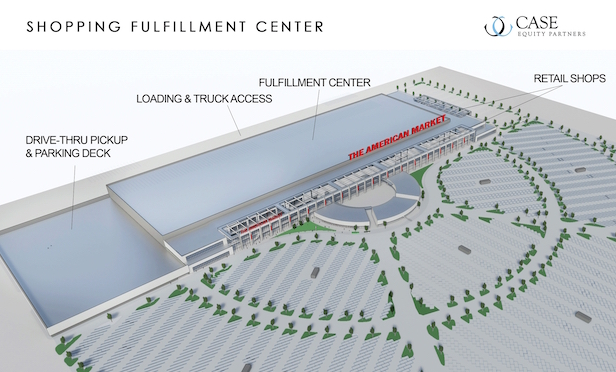
In a GlobeSt.com interview, Case Equity Partners explains how shopping fulfillment centers may become the newest form of retail.

JLL/ Case Equity Partner's SFC rendering by Lamar Johnson Collaborative
JLL/ Case Equity Partner’s SFC rendering by Lamar Johnson Collaborative

Case Equity Partners has combined the news of both the shuttered department stores and the demand for fulfillment warehouses to create a new retail solution. The real estate investment firm’s managing partner, Shlomo Chopp, has even filed a patent application for what their company has coined “shopping fulfillment centers” or SFCs.
Based in New York City, Case Equity is buying retail properties with vacant anchors focused in the Mid-Atlantic to bring to life this concept. JLL brokers in Chicago, Larry Kilduff and Janice Sellis, are representing the real estate company in their acquisitions.
In a GlobeSt.com interview, Chopp describes the centers: Imagine a vacant 100,000 square-foot department store, like a former Sears. Ten small retailers could lease the front 30,000 square feet in a highly curated, experiential environment. The rear 70,000 square feet would serve as a warehouse and fulfillment center for the onsite stores, digital customers at home, and satellite stores. As the group of retailers would be smaller, they wouldn’t require the large-scale Amazon-like industrial properties. Their warehouses would be less square footage, on-site and closer to the customer.
Shlomo Chopp, managing partner at Case Equity Partners
“The shoppers never have to worry that their product isn’t in stock and they can touch and feel prior to ordering.” Chopp says describing the omni-channel experience. Shoppers either walk out of the store with their product, order it from home and pick it up at the store, or buy it in the store and have it delivered to their homes.
Case Equity envisions an immersive, shopping and lifestyle center in the front with a high tech robotics fulfillment center in the rear. There is no upfront cost to the retailer except designing a retail store, similar to a “pop-up” location. The SFC would provide the logistics infrastructure. This would track and manage inventory, deliveries and returns. Thus, the age-old risks for retailers of leasing out space—guessing and hoping their sales will be high enough to make the rent is greatly reduced. In this new form of retail, Chopp says real estate landlords are not about leasing space but more about maximizing shoppers.
With the onsite fulfillment centers, Case Equity also anticipates that the costs and inconveniences associated with returned merchandise will greatly decrease. It’s not just the “glitz and glamour” of “experiential retail” that many brands have been trying to market, according to Chopp. He says it’s also functionality that allows for the best experience: convenience.
“As a real estate investor considering my options, retail scared me as retailers are experimenting and on shaky grounds, and industrial is way too frothy as a result of leases with e-commerce companies, many whom have yet to show a profit,” says Chopp. He points out both industries are missing the fact that the two largest retailers, Walmart and Amazon, have one thing in common—logistics superiority. Thus, thinking outside the box, Chopp says he created the SFC.
By: Betsy Kim (GlobeSt)
Click here to view source article.

Filed Under: All News

CNM, City Unite to Boost Film Program

January 11, 2019 by CARNM

Call it the Netflix effect.

Since the streaming giant purchased Albuquerque Studios in late 2018, there’s been buzz around the film industry.

And CNM and the city of Albuquerque are taking notice.

On Friday, the city of Albuquerque and Central New Mexico Community College signed a memorandum of understanding for a location in the Rail Yards to build the forthcoming CNM Film Production Center of Excellence.

CNM began its film production program 15 years ago and continues to grow it. 

Anticipating the impact Netflix will have on the local film industry, CNM President Kathie Winograd wanted to help train a sufficient workforce.

“The excitement of having Netflix here has made us dream even bigger and think about all the things we can do not only in the programs we have now,” Winograd said. “We see this as an opportunity to be nationally recognized and be the place not only for films … but we see this as the place to come for education.”

The Rail Yards has been a set for numerous films and TV productions, including “Terminator: Salvation,” “The Avengers,” “Better Call Saul” and “Breaking Bad.”

Mayor Tim Keller said the city has completed an environmental characterization of the site and submitted a voluntary remediation plan to the state.

The city is also moving forward with demolition of small non-historic structures and site improvements. And the city has submitted a state capital request for $15 million to support rail yard environmental remediation and site improvements.

Keller said, “With CNM, in this facility, we are bridging a number of things. One is a desire to revitalize Downtown and a desire to invest in our underserved communities. Then of course, we have this amazing Netflix (deal) and they have a huge workforce need. CNM provides that workforce.”

He said the center will be a place for students to practice filming.

“The idea of bringing hundreds of students each day will be the catalyst for the project,” he said.

Charlie O’Dowd, a CNM film instructor, said expansion of the film program at the school has a definite connection to the city and Netflix.

“The reality is there is training needed,” O’Dowd said. “CNM is doing the training already. This deal will apparently lead to buildings that are built to teach.”

Keller said the project is going to take a lot of work.

“These little pieces are extra special,” Keller said. “It’s going to really uplift the entire neighborhood and be the nexus of all things New Mexico.”

By: Adrian Gomez (ABQ Journal)
Click here to view source article.

Filed Under: All News

January 2019 CCIM Deal Making Session Properties

January 10, 2019 by CARNM

Thanks to all of the brokers, sponsors, and guests who attended the January 2019 CCIM NM Deal Making Session and to those who shared the January 2019 CCIM NM Properties.

Over 6 million dollars of commercial real estate properties available for sale were presented from all over New Mexico.
Click here to view source PDF.
Click here to view the Thank Yous.

Name Property, City Type Price
1. Dave Hill, CCIM
DJ Brigman
3721 Rutledge Rd NE Office $6,300,000
2. DJ Brigman
Dave Hill, CCIM
1837 Camino Del Llano, Belen Office/
Warehouse
$675,000
3. Tim With, CCIM, SIOR
John Ransom, CCIM, SIOR
3864 Masthead St NE Office $780,360
4. Gilbert Chavez
Eddie Costello
6610 Central & 6525 Cochiti Retail $450,000
5. Gilbert Chavez
Eddie Costello
7319 4th St NW Retail/
Office
$570,000
6. Shelly Branscom, CCIM
Rich Diller, CCIM, SIOR
8301 Broadway Blvd SE Industrial $1,700,000
7. Anne Apicella 1350 Jackie Rd SE, Rio Rancho Office $370,550
8. DJ Brigman
Dave Hill, CCIM
Keith Meyer, CCIM, SIOR
12910 Central Ave SE Retail $570,000
9. Ron Hensley
Steve Etkind
110 Main St SW, Los Lunas Business $1,750,000
10. Ron Hensley
Steve Etkind
6000 Gibson Blvd SE Business $1,500,000

Filed Under: All News

  • « Go to Previous Page
  • Page 1
  • Interim pages omitted …
  • Page 3
  • Page 4
  • Page 5
  • Page 6
  • Go to Next Page »
  • Search Property
  • Join CARNM
  • CARNM Login
  • NMAR Forms
  • All News
  • All Events
  • Education
  • Contact Us
  • About Us
  • FAQ
  • Issues/Concerns
6739 Academy Road NE, Ste 310
Albuquerque, NM 87109
admin@carnm.realtor(505) 503-7807

© 2026, Content: © 2021 Commercial Association of REALTORS® New Mexico. All rights reserved. Website by CARRISTO

