Property managers are coming up with new, creative ways to help commercial tenants in the COVID-19 era. Some are allowing move-out inspections via video conferencing while others are helping tenants to ramp back up as business starts to reopen, according to Angela Aeschliman, CPM, senior vice president of property and asset management with the Missner Group in Chicago. She presented during the Property Management Forum as part of the virtual 2020 REALTORS® Legislative Meetings on Monday.
Safety and risk management were key themes among the panelists who spoke. “As we’re starting to see businesses looking to come back in some form, tenants are communicating with landlords and property managers on what their expectations are and how they’re planning to operate in the new landscape with social distancing,” said Charlie Lee, associate counsel for the National Association of REALTORS®.
Lee advised practitioners to review existing commercial leases and what they’re obligated to provide tenants. Property managers who use a uniform template for leases can come up with a plan for making adjustments that apply to as many tenants as possible, Lee said. Some tenants may be looking for rent abatement or deferment, so it’s wise to have lease agreements reviewed by an attorney before having discussions with the tenants, he added.
Aeschliman, president of the Chicago chapter of the Institute of Real Estate Management, stressed the importance of asking questions about the tenants’ situations if they’re unable to pay rent. “Just because the lease calls out that the rent is due on the first [of the month] does not mean the tenant doesn’t have the right to request special arrangements in this environment,” she said. Speaking with tenants over the phone often works better than communicating via email, she stressed. Some tenants may have applied for relief and simply need a delay in payment date. Once you know what the tenant is doing to address the situation, you can communicate that to the building owner, she said.
As businesses begin to slowly reopen their doors to employees and the public, another way property managers can help is through maintenance and updates that mitigate risk, said Aeschliman. Some building owners are looking at installing touchless entries, card readers at elevators or doors, and increased janitorial services, she said. “When you communicate with your buildings and tenants, tell them what you are doing differently to minimize risks to both them and the building,” said Aeschliman.
Lee suggested assisting tenants with marketing. If it’s a restaurant, for instance, property managers could help find ways to let the public know the tenant’s business is open for takeout. It may be another year or more before restaurants can get back to serving customers without taking precautions to mitigate COVID-19. Many will have to limit the number of people who can dine in, Lee said. Unfortunately, the takeout model won’t work for all restaurants. If the business is forced to close permanently and end its lease early, it’s in everyone’s best interests to come up with a solution that works for both sides, he said.
Amy Hedgecock, a property manager with Fowler & Fowler, REALTORS®, in High Point, N.C., said an issue she’s seeing is deferred maintenance in occupied buildings. Her company has only been handling emergency maintenance requests. “Some of my vendors closer to retirement age don’t want to go out to occupied units,” she said.
Property managers have to make such decisions on delaying repairs a case-by-case basis, Lee said. It depends on what the tenants are asking for and whether it’s reasonable, considering the pandemic. If the issue is causing distress for the tenants or impacting their business, property managers should do what they can to have the repairs done safely. “We’re in an unprecedented time. There are no textbook answers for this,” he said.
Source: “Problem-Solving Strategies for Property Managers“
Archives for May 2020
Finding A Path Forward with CRE Data

Tips and insights for how investors can navigate markets and plan for the future in times of uncertainty.
While we are still learning the magnitude of COVID-19’s economic impact, we do know that the directional impact is undoubtedly negative. While we manage the day-to-day of life in a pandemic, under stress of increasing unemployment, personal isolation and an unprecedented health crisis, we are starting the daunting task of estimating the long term economic fallout that could stem from the global shut down.
The COVID-19 impact will push commercial property transaction activity back to levels not seen since 2015 for transaction count and 2012 for transaction volume. These estimates suggest that COVID-19 will cost the commercial property market 25 thousand transactions and $100 billion in deal volume.
Estimating the impact of COVID-19 on private commercial property markets is a challenge experts are beginning to take on. Commercial real estate professionals can take it upon themselves to navigate these times with data as well. With increased time spent on research and analysis of historical patterns, professionals are building out deal pipelines, returning to relationship building, and creating risk-informed plans for navigating the crisis.
Staying informed with Historical Analysis
Commercial brokers, investors, lenders and service providers alike are turning to data and historical patterns to inform their market strategies in 2020 & beyond. By looking back at past recessions, tracking property trends and diving into market analytics, professionals are identifying areas of opportunity and creating a better understanding of their own potential risk. Reonomy is in a unique position to facilitate the exchange of information and to guide us through these uncertain times.
Reonomy’s mission is to make property intelligence accessible for everyone, from the individual investor to the world’s largest enterprises. At our core is proprietary technology that synchronizes information from across a multitude of sources into a single, reliable platform.
In light of current events, we shifted our focus to data-backed thought leadership that leverages our vast dataset and property intelligence. Reonomy Research provides accessible, macro-level insights on commercial real estate trends, allowing you to keep a pulse on market trends.
The Off-Market Opportunity
By leveraging a more nuanced approach to prospecting and research, CRE teams can have a much better pulse on where opportunity lies in the market. A major aspect of any approach should include leveraging off-market data. You can continue to have success with your commercial real estate prospecting efforts by better understanding the world of properties that exist, not just the ones listed for sale. Some key tips for leveraging data in our current market include:
- Using your downtime to dive into deep levels of research.
- Taking time to understand nuance and eliminate the “unknowns.”
- Carefully prioritizing your research and outreach strategy.
Prospecting with Reonomy allows you to find ideal clients and properties based on very granular property-level, financial, and ownership details, or simply inform your forward looking strategies based on qualitative research and strong market understanding.
Other sources limit your market understanding to listings, but with a renewed focus on off-market property understanding, professionals are getting ahead of their long term impacts with in depth analysis and a plan based on data for moving forward.
Property Centric to Market Level Analysis
When dealing with times of uncertainty, the best way to arm yourself to find the right path forward is to increase your knowledge of potential outcomes, so you can plan for any potential outcome. Data access combined with property and market level research can help you better understand your current market stance, the risks you are taking on, and where you may be able to make key strategic decisions down the road.
As CRE professionals continue to navigate key business decisions during these uncertain times, our reliance on past property performance, market analytics in times of downturn, and data-based risk analysis are all helping to make decisions with confidence. So whether you are looking to sell, buy, identify opportunities or address market concerns for your clients and partners, data can keep you informed, in the loop, and at the top of your game.
Don’t be shy about giving Reonomy a try and speaking with their team!
Source: “Finding A Path Forward with CRE Data”
Commerce In the Time of Coronavirus
Creativity And Community Team To Overcome Daunting Times For Small Businesses
Hundreds of nonprofit organizations have worked for decades to advocate for small businesses, authentic places and vibrant activity in the urban core of America’s cities.
Now, in a time of record job loss and forced
closures of countless beloved small busi- nesses deemed “non-essential” in the time of COVID-19, the little guy needs more help than ever. The organizations fighting for their survival are called Business Improvement Districts (BIDs), Main Street alliances and Downtown Development Authorities (DDAs). They often self-tax to provide funding for extra security, cleanup crews, market- ing, entertainment and other support of classic corridors, downtowns and urban business clusters.
In areas where sit-down restaurants are reduced to curb- side pickup or delivery only, in a challenging time when shops that relied on foot traffic are trying to adapt to online sales, BIDs, DDAs and Main Streets are using creativity and community collaboration to keep small businesses afloat.
Dionne Baux is director of UrbanMain, a program of the National Main Street Center (NMSC) to empower under- resourced older and historic neighborhood commercial districts to restore economic vitality and promote qual- ity of life. NMSC is a subsidiary of the National Trust for Historic Preservation.
“The primary concern has to be the health and wellbeing of people. That being said, if businesses are in a position to move aspects of their business to e-commerce shopping opportunities, that is certainly encouraged, as is deliv- ery, curbside pickup, (encouraging patrons to buy) gift cards, etc.,” she said. “But until stay-at-home orders and congregation limitations are lifted, it will be difficult for non-essential small businesses to sustain themselves dur- ing this time.”
Now, in a time of record job loss and forced
closures of countless beloved small busi- nesses deemed “non-essential” in the time of COVID-19, the little guy needs more help than ever. The organizations fighting for their survival are called Business Improvement Districts (BIDs), Main Street alliances and Downtown Development Authorities (DDAs). They often self-tax to provide funding for extra security, cleanup crews, market- ing, entertainment and other support of classic corridors, downtowns and urban business clusters.
In areas where sit-down restaurants are reduced to curb- side pickup or delivery only, in a challenging time when shops that relied on foot traffic are trying to adapt to online sales, BIDs, DDAs and Main Streets are using creativity and community collaboration to keep small businesses afloat.
Dionne Baux is director of UrbanMain, a program of the National Main Street Center (NMSC) to empower under- resourced older and historic neighborhood commercial districts to restore economic vitality and promote qual- ity of life. NMSC is a subsidiary of the National Trust for Historic Preservation.
“The primary concern has to be the health and wellbeing of people. That being said, if businesses are in a position to move aspects of their business to e-commerce shopping opportunities, that is certainly encouraged, as is deliv- ery, curbside pickup, (encouraging patrons to buy) gift cards, etc.,” she said. “But until stay-at-home orders and congregation limitations are lifted, it will be difficult for non-essential small businesses to sustain themselves dur- ing this time.”
Baux quoted NMSC’s Main Street Small Business sur- vey that underscored the simple fact that minimizing permanent business closures is critical to downtown and district recovery.
“Small business financial assistance programs should not only address revenues, but expenses as well. The survey reveals 60 percent of respondents have less than 5 months remaining of likely business survival. Thus, there is the need to not only address the revenue side of the income state- ment, but find ways to reduce expenses,” the survey states.
Baux noted 66 percent of survey responders indicated a need to suspend some expenses in the interim while they are mandated to be closed. These typically consist of rents, utilities and other operating fees.
“Main Street programs should engage with city officials on programs at the local level, in which there may be influence and/or control over utility operations, parking fees, etc.,” the survey advises. “In addition, while small business operations are being negatively impacted dur- ing this time, property owners represent a key stakeholder group. Main Street programs are also encouraged to dia- logue with property owners as partners to help retain small business tenants, and continue as a connector and educator on programs at the federal level designed to sus- pend mortgage payments.”
Bill Fuller, co-founder and co-managing partner of the urban development company Barlington Group, has played a huge role in elevating Miami’s famous Calle Ocho in Little Havana from a careworn corridor to a vibrant center of art, culture and retail that draws nearly three million visitors per year. As one of the area’s largest landlords, and co-founder of the Little Havana Merchant Alliance, he and his tenants have been hit hard by Coro- navirus stay-at-home and closure-of-business orders.
Baux noted 66 percent of survey responders indicated a need to suspend some expenses in the interim while they are mandated to be closed. These typically consist of rents, utilities and other operating fees.
“Main Street programs should engage with city officials on programs at the local level, in which there may be influence and/or control over utility operations, parking fees, etc.,” the survey advises. “In addition, while small business operations are being negatively impacted dur- ing this time, property owners represent a key stakeholder group. Main Street programs are also encouraged to dia- logue with property owners as partners to help retain small business tenants, and continue as a connector and educator on programs at the federal level designed to sus- pend mortgage payments.”
Bill Fuller, co-founder and co-managing partner of the urban development company Barlington Group, has played a huge role in elevating Miami’s famous Calle Ocho in Little Havana from a careworn corridor to a vibrant center of art, culture and retail that draws nearly three million visitors per year. As one of the area’s largest landlords, and co-founder of the Little Havana Merchant Alliance, he and his tenants have been hit hard by Coro- navirus stay-at-home and closure-of-business orders.
Main Streets are using creativity and community collaboration.
“From a landlord’s perspective, I have taken the time to understand webinars and literature on loan programs. My CFO is helping tenants secure loans, access grants and understand any federal, state or local assistance to small businesses,” Fuller said. “Everybody should be funded by end of May.”Fuller, through Barlington and the separate Madroom Hos- pitality, has invested in many of the restaurants, bars, shops and cultural activities he and his partners have recruited to Little Havana. So, he is feeling the impact not just as a landlord but as a business owner that employs cooks, bar- tenders, waiters, bussers and other hospitality staff.
The Ball & Chain, a food and beverage hotspot that has been written about in The New York Times, has retained 25 percent of its staff. Another Madroom concept, the revived historic Taquerias El Mexicano, also is operating with a reduced crew.
The Ball & Chain, a food and beverage hotspot that has been written about in The New York Times, has retained 25 percent of its staff. Another Madroom concept, the revived historic Taquerias El Mexicano, also is operating with a reduced crew.
“We never had relationships with all the Uber Eats and Postmates delivery companies,” he said, noting that onsite dining and drinking drove revenue at the two Calle Ocho fixtures. “But we decided to stay open to provide as much employment as we could, via curbside pickup and delivery.
The Ball & Chain has a promotion that patrons get back 50 percent of money spent during the crisis, by submitting receipts, — toward purchases when the home of Latin food, music and culture fully reopens. There also is a promotion that $40 spent buys a $50 gift certificate and $80 buys a $100 plus a free t-shirt. The promotions generate buzz and much-needed revenue during the pandemic.
“I have found over 90 percent of our tenants, whether open or not, have come in saying ‘I can pay 20 percent, 30 percent’ — not saying ‘I’m giving you nothing.’ You know who your real friends are,” he said, noting his mom and pop tenants are making good faith efforts.
NMSC’s Baux said Main Street programs and BIDs are helping their retail constituents and customers navigate the changing environment, citing best practices exam- ples such as:
The Ball & Chain has a promotion that patrons get back 50 percent of money spent during the crisis, by submitting receipts, — toward purchases when the home of Latin food, music and culture fully reopens. There also is a promotion that $40 spent buys a $50 gift certificate and $80 buys a $100 plus a free t-shirt. The promotions generate buzz and much-needed revenue during the pandemic.
“I have found over 90 percent of our tenants, whether open or not, have come in saying ‘I can pay 20 percent, 30 percent’ — not saying ‘I’m giving you nothing.’ You know who your real friends are,” he said, noting his mom and pop tenants are making good faith efforts.
NMSC’s Baux said Main Street programs and BIDs are helping their retail constituents and customers navigate the changing environment, citing best practices exam- ples such as:
- Chicago’s Morgan Park Beverly Hills Association is connecting small businesses to local, state and federal resources. It’s marketing features local businesses that are providing curbside pickup, delivery services and online sales.
- Tenleytown Main Street in Washington, D.C., is pro- viding members with technical assistance to set up online sales and services while obtaining permits to support restaurant pick-up and carry-out zones. Ten- leytown is helping businesses apply for government grants and disaster assistance loans while issuing emer- gency small grants.
- In the San Diego area, the Leucadia 101, Encinitas 101 and Cardiff 101 Main Street organizations have a goal to raise $100,000 to provide grants to local small businesses. To create the Encinitas Support Fund, the trio is partnering with the Cardiff by the Sea Founda- tion and the Harbaugh Foundation.
- OurTownCoshocton,NMSC’spartnerinCoshocton, Ohio, helped two local businesses join forces to sew more than 1000 Personal Protective Equipment (PPE) masks. The two mom and pop businesses — Mercan- tile on Main and Rose of Sharon Retreat — saw an increase in online and curbside pick-up sales.
Future commerce may look different
“NMSC believes there will remain a craving, and perhaps due to social isolation, a greater appreciation for the social engagement aspects of shopping. From that stand point, the dynamic of experiential shopping may even expand,” Baux said of an ultimate silver lining.
“However, there will undoubtedly be some additional migration to e-commerce. As our survey shows, many small businesses (63 percent) have no e-commerce sales. This will need to change and traditional brick and mortar stores will need to build out a place-based and e-commerce experience for post-COVID-19 shoppers,” Baux advised. “There may be a call for more convenience-oriented shop- ping, such as home delivery and curbside, which may not disappear as consumers adapt to this experience.”
Georgia Petropoulos is the executive director of the Oakland Business Improvement District (OBID), which describes itself as Pittsburgh’s most ethnically diverse and lively neighborhood that is home to prestigious universities and museums; world-class hospitals; grand architecture; quaint coffee shops; international cuisine; and specialty shops.
“Like many cities across the country, our business district has been greatly impacted by the COVID-19 pandemic and our business owners have put out a herculean effort for survival,” she said. “Restaurants shifted service hours and redesigned menus to focus on takeout and delivery. Business owners have been creative with new promo- tions such as Salúd Juicery Oakland’s ‘Cup of Goodness’ program where the public can purchase smoothies for hospital doctors and nurses.”
“Our business owners are the life of our community and they need our help,” Petropoulos continued.
She said the BID stays in constant communication with its district community — by phone, text, survey, website, e-newsletter blasts and social media — while researching and communicating COVID-19 crisis help that is avail- able. The BID promotes the message to the public that Oakland is open for business.
“With the universities moving to online learning and the closure of our museums and library, we saw a huge decline in the university student, faculty and staff customers and the visitor population so we focused our efforts on the hospitals and on area residents. In partnership with our hospitals, we set up a food delivery program called Sup- port Oakland, where restaurants gain access to deliver to hospital employees,” Petropoulos said.
“NMSC believes there will remain a craving, and perhaps due to social isolation, a greater appreciation for the social engagement aspects of shopping. From that stand point, the dynamic of experiential shopping may even expand,” Baux said of an ultimate silver lining.
“However, there will undoubtedly be some additional migration to e-commerce. As our survey shows, many small businesses (63 percent) have no e-commerce sales. This will need to change and traditional brick and mortar stores will need to build out a place-based and e-commerce experience for post-COVID-19 shoppers,” Baux advised. “There may be a call for more convenience-oriented shop- ping, such as home delivery and curbside, which may not disappear as consumers adapt to this experience.”
Georgia Petropoulos is the executive director of the Oakland Business Improvement District (OBID), which describes itself as Pittsburgh’s most ethnically diverse and lively neighborhood that is home to prestigious universities and museums; world-class hospitals; grand architecture; quaint coffee shops; international cuisine; and specialty shops.
“Like many cities across the country, our business district has been greatly impacted by the COVID-19 pandemic and our business owners have put out a herculean effort for survival,” she said. “Restaurants shifted service hours and redesigned menus to focus on takeout and delivery. Business owners have been creative with new promo- tions such as Salúd Juicery Oakland’s ‘Cup of Goodness’ program where the public can purchase smoothies for hospital doctors and nurses.”
“Our business owners are the life of our community and they need our help,” Petropoulos continued.
She said the BID stays in constant communication with its district community — by phone, text, survey, website, e-newsletter blasts and social media — while researching and communicating COVID-19 crisis help that is avail- able. The BID promotes the message to the public that Oakland is open for business.
“With the universities moving to online learning and the closure of our museums and library, we saw a huge decline in the university student, faculty and staff customers and the visitor population so we focused our efforts on the hospitals and on area residents. In partnership with our hospitals, we set up a food delivery program called Sup- port Oakland, where restaurants gain access to deliver to hospital employees,” Petropoulos said.
Courtesy Oakland BID
OBID also is providing a lot of cleanups of streetscapes and disinfecting of pedestrian “walk” light buttons — to make the area safe for those patronizing the neighborhood.
“We are a dense urban district with no drive-through opportunities, but our restaurants have adapted wonder- fully. Many have removed tables and chairs to make room for customers waiting to maintain the required minimum 6-foot social distance inside while others with smaller spaces have restricted interior access and have set the tables up at the main entrance for quick and easy pick up,” she said.
Petropoulos said the Oakland and BIDs nationwide must create a new narrative of how density and the built envi- ronment impacts people, in respect to staying safe during a pandemic.
A new look for downtowns?
Charles Marohn is the founder and president of Strong Towns, a nonprofit making communities across the United States and Canada financially strong and resil- ient, and the author of “Strong Towns: A Bottom-Up Revolution to Rebuild American Prosperity.”
“What the current crisis is exposing is not, as some com- mentators have suggested, some previously unknown flaw
“We are a dense urban district with no drive-through opportunities, but our restaurants have adapted wonder- fully. Many have removed tables and chairs to make room for customers waiting to maintain the required minimum 6-foot social distance inside while others with smaller spaces have restricted interior access and have set the tables up at the main entrance for quick and easy pick up,” she said.
Petropoulos said the Oakland and BIDs nationwide must create a new narrative of how density and the built envi- ronment impacts people, in respect to staying safe during a pandemic.
A new look for downtowns?
Charles Marohn is the founder and president of Strong Towns, a nonprofit making communities across the United States and Canada financially strong and resil- ient, and the author of “Strong Towns: A Bottom-Up Revolution to Rebuild American Prosperity.”
“What the current crisis is exposing is not, as some com- mentators have suggested, some previously unknown flaw
in the traditional development pattern that humans have used for thousands of years and that has endured many infectious disease outbreaks. If anything, it is more likely to reveal the extreme fragility of the modern suburban experi- ment, and the financialized economy on which it depends,” said Marohn, an engineer, land planner and advocate of compact development.
He said when a local restaurant with a local landlord and a much more local supply chain cannot pay rent, it is in the interest of everyone involved to work it out. National chains that are announcing they cannot pay rent, “sets off a much more disruptive cascade of events that wipes out investors and jeopardizes bond markets.”
“Places with strong local economic ecosystems will endure and recover,” said Marohn. “The current crisis will also put a large strain on cities’ budgets, and this will be felt most acutely in those places where finances were already stretched by decades of low-returning development choices and deferred maintenance of overbuilt infrastructure.
“We’ve observed time and time again that the walkable, human scale, traditional pattern of development is the most financially productive approach to building human settlements, and these cities will be the most able, in the long recovery to come, to provide the services essential for their residents’ health and well-being.”
Tracy Sayegh Gabriel is an urbanist, planner and place- maker who serves as president and executive director of the Crystal City Business Improvement District, which enhances the vibrancy of Arlington — Virginia’s largest downtown.
“We are working with fitness studios and cultural insti- tutions in the neighborhood to develop a line-up of BID-sponsored virtual programming,” she said. “It is a lifeline for our small businesses that are struggling to make ends meet. These online events provide residents with new avenues to stay both mentally and physically healthy as they adjust to life spent predominantly at home.”
The BID has organized drives, produced informational webinars and launched a “Hometown Heroes” initiative that rewards the efforts of helpful community members with gift cards to local small businesses.
“We are actively encouraging and empowering the community to support those local businesses that have remained open for carry-out and delivery. We set up a webpage that aggregates operational information so that area residents can easily access it,” Gabriel said. “We have
He said when a local restaurant with a local landlord and a much more local supply chain cannot pay rent, it is in the interest of everyone involved to work it out. National chains that are announcing they cannot pay rent, “sets off a much more disruptive cascade of events that wipes out investors and jeopardizes bond markets.”
“Places with strong local economic ecosystems will endure and recover,” said Marohn. “The current crisis will also put a large strain on cities’ budgets, and this will be felt most acutely in those places where finances were already stretched by decades of low-returning development choices and deferred maintenance of overbuilt infrastructure.
“We’ve observed time and time again that the walkable, human scale, traditional pattern of development is the most financially productive approach to building human settlements, and these cities will be the most able, in the long recovery to come, to provide the services essential for their residents’ health and well-being.”
Tracy Sayegh Gabriel is an urbanist, planner and place- maker who serves as president and executive director of the Crystal City Business Improvement District, which enhances the vibrancy of Arlington — Virginia’s largest downtown.
“We are working with fitness studios and cultural insti- tutions in the neighborhood to develop a line-up of BID-sponsored virtual programming,” she said. “It is a lifeline for our small businesses that are struggling to make ends meet. These online events provide residents with new avenues to stay both mentally and physically healthy as they adjust to life spent predominantly at home.”
The BID has organized drives, produced informational webinars and launched a “Hometown Heroes” initiative that rewards the efforts of helpful community members with gift cards to local small businesses.
“We are actively encouraging and empowering the community to support those local businesses that have remained open for carry-out and delivery. We set up a webpage that aggregates operational information so that area residents can easily access it,” Gabriel said. “We have
also partnered with local government to designate nearly a dozen pick-up/delivery zones throughout the community to make it easier — and safer — for people to patronize these local establishments.
Local support for small businesses
Robert Gibbs is a professional planner, landscape archi- tect, real estate advisor and author of “Principles of Urban Retail Planning.” Based in Birmingham, Mich., he has consulted on more than 1,000 projects spanning all 50 states, including retail evaluations of all design, plan- ning, parking, signage, management and policy issues to improve the shopper experience and improve sales.
“DDAs are essential for competitive shopping districts, especially now. Cities without DDAs will face a slower recovery than others,” he said of development authori- ties. “DDAs can offer marketing for restaurant carry-out, online shopping and especially their service businesses.
He said DDAs throughout the nation must prepare exten- sive post-recession/pandemic marketing plans to launch the moment things start to return to normal.
To endure the crisis, Gibbs said landlords must offer free rent for several months and then reduce rents to 10 per- cent of gross sales.
“There is a glut of vacant shopping centers and office parks, and they need to be repurposed into dense, walk- able, mixed-use centers,” he said. “As regional malls are closing, many of their prime retailers are seeking down- towns to remain in the market. There are opportunities for cities to attract those prime retailers if they implement a business recruitment plan.”
Local support for small businesses
Robert Gibbs is a professional planner, landscape archi- tect, real estate advisor and author of “Principles of Urban Retail Planning.” Based in Birmingham, Mich., he has consulted on more than 1,000 projects spanning all 50 states, including retail evaluations of all design, plan- ning, parking, signage, management and policy issues to improve the shopper experience and improve sales.
“DDAs are essential for competitive shopping districts, especially now. Cities without DDAs will face a slower recovery than others,” he said of development authori- ties. “DDAs can offer marketing for restaurant carry-out, online shopping and especially their service businesses.
He said DDAs throughout the nation must prepare exten- sive post-recession/pandemic marketing plans to launch the moment things start to return to normal.
To endure the crisis, Gibbs said landlords must offer free rent for several months and then reduce rents to 10 per- cent of gross sales.
“There is a glut of vacant shopping centers and office parks, and they need to be repurposed into dense, walk- able, mixed-use centers,” he said. “As regional malls are closing, many of their prime retailers are seeking down- towns to remain in the market. There are opportunities for cities to attract those prime retailers if they implement a business recruitment plan.”
The Central Square Business Improvement District in Cambridge, Mass., partnered with two other small busi- ness organizations to create Grassroots Relief for Main Streets, a statewide campaign for legislation to support small businesses, arts organizations and nonprofits.
The BID quickly partnered with local restaurant owners to provide food for the social service providers within its boundaries. In one week, Tracy Chang (James Beard award nominee) and her team at PAGU made 900 meals for the shelters in Central Square. Chang quickly helped launch Off Their Plate, a nonprofit dedicated to restor- ing restaurant jobs and feeding the frontlines. It raised $2 million in a month.
The International Downtown Association underscores the importance of partnerships with local government, which can ensure quick turnaround on temporary rule changes to allow more ease of conducting business during COVID-19 restrictions. Downtown Santa Monica insti- tuted a temporary change in parking ordinances around restaurants to allow for easier pick up.
BIDS from Milwaukee to West Palm Beach have created lists of dozens of virtual events and activities to do, many powered by the local community. Milwaukee Down- town is working with museums, performing arts centers and universities to stream performances and lectures to strengthen community ties online.
Adapting quickly
Chad Emmerson, president and chief executive officer of Downtown Huntsville, Inc., said a quick lesson learned is that small businesses able to quickly evolve in crisis will do better.
The BID quickly partnered with local restaurant owners to provide food for the social service providers within its boundaries. In one week, Tracy Chang (James Beard award nominee) and her team at PAGU made 900 meals for the shelters in Central Square. Chang quickly helped launch Off Their Plate, a nonprofit dedicated to restor- ing restaurant jobs and feeding the frontlines. It raised $2 million in a month.
The International Downtown Association underscores the importance of partnerships with local government, which can ensure quick turnaround on temporary rule changes to allow more ease of conducting business during COVID-19 restrictions. Downtown Santa Monica insti- tuted a temporary change in parking ordinances around restaurants to allow for easier pick up.
BIDS from Milwaukee to West Palm Beach have created lists of dozens of virtual events and activities to do, many powered by the local community. Milwaukee Down- town is working with museums, performing arts centers and universities to stream performances and lectures to strengthen community ties online.
Adapting quickly
Chad Emmerson, president and chief executive officer of Downtown Huntsville, Inc., said a quick lesson learned is that small businesses able to quickly evolve in crisis will do better.
“We’ve found that the restaurants who create the most predictable and consistent experience are the ones that are rewarded with return business,” he said. “Are your online menus and hours of operation accurate? Do you answer phone and online orders in a timely way? When a customer chooses you to spend their scarcer dining dol- lars … when you say you’ll have it ready curbside, they don’t need a James Beard-level meal — they just need James Beard-level customer service.”
Emmerson said it is often easier and less expensive to have groceries delivered and cook at home, so small busi- ness owners should challenge themselves and their teams to make the curbside delivery a simple yet fun experience.
“This means that you need to make restaurant take-out more than a commodity. It needs to offer an emotional reprieve from the isolation we’re all experiencing,” he said. “Can you bring the meal to their car curbside in a unique way? Guests are looking for a human connection and a reason to smile. You can do that while still deliver- ing a predictable and consistent experience.”
Level the playing field
Kennedy Smith is a senior researcher with the Independent Business Initiative at the Institute for Local Self-Reliance, a nonprofit that champions the need for humanly scaled institutions and economies. She said Congress, state and local governments, foundations, civic institutions, crowd- funders and customers must get cash to small, locally owned businesses to keep them afloat — because most have less than a month of cash reserves on hand.
“It is vital to level the playing field between small, locally owned businesses and big box stores. Main Street
Emmerson said it is often easier and less expensive to have groceries delivered and cook at home, so small busi- ness owners should challenge themselves and their teams to make the curbside delivery a simple yet fun experience.
“This means that you need to make restaurant take-out more than a commodity. It needs to offer an emotional reprieve from the isolation we’re all experiencing,” he said. “Can you bring the meal to their car curbside in a unique way? Guests are looking for a human connection and a reason to smile. You can do that while still deliver- ing a predictable and consistent experience.”
Level the playing field
Kennedy Smith is a senior researcher with the Independent Business Initiative at the Institute for Local Self-Reliance, a nonprofit that champions the need for humanly scaled institutions and economies. She said Congress, state and local governments, foundations, civic institutions, crowd- funders and customers must get cash to small, locally owned businesses to keep them afloat — because most have less than a month of cash reserves on hand.
“It is vital to level the playing field between small, locally owned businesses and big box stores. Main Street
businesses are largely shuttered now and are conducting business in new and innovative ways to minimize person- to-person contact and to keep everyone safe. But, because they sell groceries and pharmaceuticals, big box stores have continued to let people in — and to let them in to all their departments, while Main Street bookstores, toy shops and clothing stores are scrambling to find inno- vative ways to continue serving their customers and to bring in revenue.”
Smith said small, locally owned businesses are finding very innovative ways to keep moving forward:
Smith said small, locally owned businesses are finding very innovative ways to keep moving forward:
- A hair salon in Alexandria, Va., is delivering a small bottle of hair coloring solution, plus some shampoo and conditioner, to customer homes, then following up with Zoom meetings to walk them through the process of touching up their roots.
- A bar in San Antonio is offering drive-through cock- tails and bottled beer and wine. With a $30 purchase, customers get a free hot dog from the hot dog stand next door and a free bottle of Stella Artois.
- A personal chef and caterer in Metuchen, N.J., now makes family-style meals serving four to six people, and, when delivering them, offers to deliver products from other downtown businesses as well.
- AprofessionalphotographerinCincinnatiisdonating her services to other small businesses to take photos of their merchandise for their websites.
The Cherry Creek North (CCN) BID, the first BID cre- ated in the state of Colorado, represents a neighborhood five minutes north of downtown Denver that touts the largest and most diverse shopping space between Chicago
and San Francisco. Out of the 260 retail and service busi- nesses in the BID, 70 percent — just more than 175 — are small retail businesses.
“It is imperative that we provide accurate information about available grant and loan programs to our constituents. We have created a Slack portal and opened it to the entire business community,” said Jenny Starkey, senior director of Marketing & Community Relations for CCN BID.
The BID invited critical resource providers to the virtual platform to ensure businesses have direct communication with representatives from the mayor’s office, city coun- cil, the Denver Metro Economic Development Office, Denver Chamber, Cherry Creek Chamber, Small Busi- ness Administration and Denver Police.
“Small businesses have long been the backbone of our national economy and of Cherry Creek North,” said Nick LeMasters, CCN BID president and CEO. “With the largest concentration of independent business in the inter- mountain west, Cherry Creek North has long served as an example of a unique, diverse and highly personalized neighborhood experience. It is our highest priority to ensure that our community retains relevancy in this ever- changing market so when the time comes to welcome back those that visit, work and play in Cherry Creek North, we can do so as a strong and resilient neighborhood.”
Source: “Commerce In the Time of Coronavirus”
“It is imperative that we provide accurate information about available grant and loan programs to our constituents. We have created a Slack portal and opened it to the entire business community,” said Jenny Starkey, senior director of Marketing & Community Relations for CCN BID.
The BID invited critical resource providers to the virtual platform to ensure businesses have direct communication with representatives from the mayor’s office, city coun- cil, the Denver Metro Economic Development Office, Denver Chamber, Cherry Creek Chamber, Small Busi- ness Administration and Denver Police.
“Small businesses have long been the backbone of our national economy and of Cherry Creek North,” said Nick LeMasters, CCN BID president and CEO. “With the largest concentration of independent business in the inter- mountain west, Cherry Creek North has long served as an example of a unique, diverse and highly personalized neighborhood experience. It is our highest priority to ensure that our community retains relevancy in this ever- changing market so when the time comes to welcome back those that visit, work and play in Cherry Creek North, we can do so as a strong and resilient neighborhood.”
Source: “Commerce In the Time of Coronavirus”
US Commercial Real Estate Prices Plunged in April, Mall Prices Collapsed
Tenants’ collapsing one after the other without replacement has a pernicious impact on property prices.
Before the coronavirus, some segments of commercial real estate (CRE) were red hot, others were hanging in there or declining, and one sector, malls, has been in deep trouble since 2016, with prices plunging. Then came the lockdowns. Property prices in every CRE segment fell in April, even those that were red hot. And prices of mall properties got crushed.
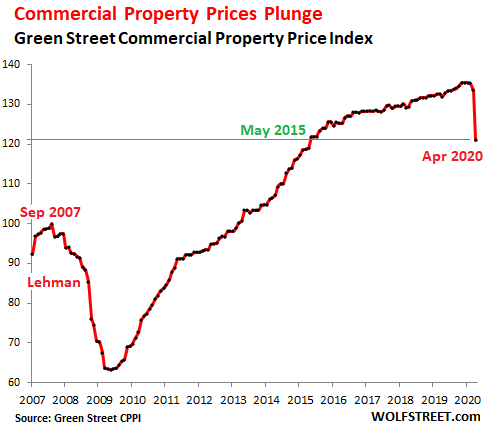
The overall Commercial Property Price Index (CPPI) by Green Street Advisorshad peaked in the period of November 2019 through January 2020. In February and March, it ticked down. In April it plunged 9.4% from March, the second largest percent-drop in the data going back to the 1990s. The largest drop was 10.9% in October 2008, following the Lehman bankruptcy. Since the peak in January, the index has dropped 10.7% and is back where it had first been in May 2015:
There is sudden chaos in the industry, and the index designed to capture movements in near-real time has trouble capturing the massive month-to-month upheaval.
“The exact numbers are debatable, but property pricing is down about 10%,” said Peter Rothemund, Managing Director at Green Street Advisors, in the report. “Some property types, industrial for example, are probably faring better than that. Retail and lodging values are most likely doing worse.”
“There’s been plenty of examples of blown deals and people walking away from deposits, but the best way for us to get a sense of where things would clear these days is by talking with people in the marketplace — buyers, sellers, brokers,” he said.
During Financial Crisis 1, CRE prices collapsed nearly 40%, according to the Green Street CPPI, including in the middle the 10.9% cliff-dive in October 2008, following the Lehman bankruptcy. From the bottom in May 2009, the index more than doubled to the peak in January 2020. Now it’s back to May 2015 level.
Prices of malls collapse, all CRE sectors get hit
The sub-index of the CPPI for malls collapsed by 20% in April from March, and is down 33% over the past 12 months. The index had peaked in 2016 and has since swooned by 45%. It’s by far the worst-performing sector of the CCPI.
The other segments of the CPPI all dropped in April, but some dropped from record highs such as Manufactured Home Parks (trailer parks) and student housing. Lodging has been weak since 2015:
| CPPI Sectors | Index | %, Apr from Mar |
%, 3 months | % YoY |
| Mall | 77.0 | -20% | -25% | -33% |
| Strip Retail | 95.5 | -15% | -15% | -13% |
| Apartment | 140.1 | -10% | -8% | -3% |
| Office | 107.2 | -9% | -8% | -6% |
| Industrial | 158.8 | -5% | -4% | 7% |
| Health Care | 132.8 | -5% | -7% | -5% |
| Lodging | 91.4 | -7% | -16% | -16% |
| Manufactured Home Park | 227.7 | -6% | -2% | 11% |
| Net Lease | 90.0 | -8% | -9% | -9% |
| Self-Storage | 175.7 | -5% | -6% | -2% |
| Student Housing | 136.5 | -12% | -12% | -9% |
The chart by Green Street Advisors (below is a 13-year version of the 23-year chart) shows to what extent prices of some property types have shot higher in recent years, particularly Manufactured Home Park (top gray line) while prices of mall properties (dark blue line) have collapsed. Even Industrial (green line, 3rd from the top in April), which includes warehouses and fulfillment centers that were red-hot due to the surge in ecommerce, has dropped in April. No category was spared:
The price collapse of mall properties will continue because tenants are collapsing.
Retail properties have been in a terrible mess for years, as their brick-and-mortar tenants succumbed one after the other to ecommerce. This has already wiped out categories such as CD and video stores, and it is wiping out the icons of American shopping: department stores and clothing stores, with some of the biggest chains having already gotten dismembered in bankruptcy court, including Sears Holdings. And even the survivors have shed tens of thousands of stores over the past three years, as “zombie malls” became a meme on the YouTube.
Now come the lockdowns, and the whole process that would have taken a few more years to play out is condensed into weeks and months. This is reflected in the 45% collapse of prices at mall properties since 2016, amplified by the 20% plunge in April.
The list of retailers now on the verge of filing for bankruptcy or having already filed since the lockdowns is getting longer by the day, as is the list of retailers that have announced permanent store closings since the lockdowns began.
This morning, Stage Stores [SSI], with over 700 stores, announced that it filed for Chapter 11 bankruptcy and plans to liquidate unless it can find a buyer.
Neiman Marcus, a luxury department store that last year still had 45 Neiman Marcus and Bergdorf Goodman stores and 24 Last Call stores, filed for bankruptcy last week, latest chapter in a long saga that now involves $5 billion in debt that resulted from a leveraged buyout in 2005 by private equity firms Warburg Pincus and TPG. They sold the retailer in 2013 to Ares Management and the Canada Pension Plan Investment Board (CPPIB) for $6 billion. Ares and CPPIB have been pummeling creditors with the threat of a bankruptcy filing since early 2017 in order to push them into a debt restructuring where they’d get a large haircut. Now they did.
J.C. Penney is preparing to file for bankruptcy as soon as this week and plans to permanently close about a quarter of its 850 or so stores, sources told Reuters last week. The company missed a $17-million debt payment last Thursday; its grace period expires this Tuesday and would trigger a default. It had already missed a $12-million debt payment on April 15; that grace period expires this Friday. J.C. Penney has long been on my list of bankruptcy candidates, causing me to write in July last year, I’m in Awe of How Long Zombies Like J.C. Penney Keep Getting New Money to Burn. But Bankruptcy Beckons .
Lord & Taylor, which has 38 department stores, said last week that it plans to liquidate its inventory once the lockdown allows it to reopen the stores as it will likely file for bankruptcy where it expects that its remaining assets will be liquidated.
J.Crew Group, which was subject to a leveraged buyout in 2011 by PE firms TPG and Leonard Green & Partners, filed for bankruptcy last week and hopes to avoid liquidation, after having come to an agreement with its creditors to reorganize its debts. Creditors will get 82% of the new company. These types of reorganizations lead to many stores being shuttered, and usually end up back in bankruptcy court for liquidation. Brick-and-mortar retailers are devilishly hard to restructure successfully.
Nordstrom, which has a thriving ecommerce business that was already over one-third of its total revenues before the lockdowns, announced last week that it is planning to shutter 16 of its stores.
It has been an intense litany that will continue. Tenants’ collapsing and disappearing one after the other without replacement has a pernicious impact on property prices. The whole CRE sector of mall properties will have to restructure, and much of it will have to be repurposed, and lenders and holders of commercial mortgage-backed securities will have to take their licks – but instead of having many years or even a decade to deal with it, hoping to get out of them before it happens, they’re caught up in it right now.
Source: “US Commercial Real Estate Prices Plunged in April, Mall Prices Collapsed“