• Skip to primary navigation
  • Skip to main content

CARNM

Commercial Association of REALTORS® - CARNM New Mexico

  • Property Search
    • Search Properties
      • For Sale
      • For Lease
      • For Sale or Lease
      • Start Your Search
    • Location & Type
      • Albuquerque
      • Rio Rancho
      • Las Cruces
      • Santa Fe
      • Industry Types
  • Members
    • New Member
      • About Us
      • Getting Started in Commercial
      • Join CARNM
      • Orientation
    • Resources
      • Find A Broker
      • Code of Ethics
      • Governing Documents
      • NMAR Forms
      • CARNM Forms
      • RPAC
      • Needs & Wants
      • CARNM Directory
      • REALTOR® Benefits
      • Foreign Broker Violation
    • Designations
      • CCIM
      • IREM
      • SIOR
    • Issues/Concerns
      • FAQ
      • Ombuds Process
      • Professional Standards
      • Issues/Concerns
      • Foreign Broker Violation
  • About
    • About
      • About Us
      • Join CARNM
      • Sponsors
      • Contact Us
    • People
      • 2026 Board Members
      • Past Presidents
      • REALTORS® of the Year
      • President’s Award Recipients
      • Founder’s Award Recipients
    • Issues/Concerns
      • FAQ
      • Ombuds Process
      • Professional Standards
      • Issues/Concerns
      • Foreign Broker Violation
  • Education
    • Courses
      • Register
      • All Education
    • Resources
      • NMREC Licensing
      • Code of Ethics
      • NAR Educational Opportunities
      • CCIM Education
      • IREM Education
      • SIOR Educuation
  • News & Events
    • News
      • All News
      • Market Trends
    • Events
      • All Events Calendar
      • Education
      • CCIM Events
      • LIN Marketing Meeting
      • Thank Yous
  • CARNM Login
  • Show Search
Hide Search

Archives for July 2021

The Flight of the Butterfly Is Coming to an End

July 15, 2021 by CARNM

As widespread U.S. vaccinations occur, the Butterfly Recovery of the past year will give way to a new Roaring 20s. It is very difficult to paint a scenario where this boom fails to materialize except if new COVID variants overcome vaccination progress. Individuals (and firms) have built up savings (reserves) and paid off debt, waiting for the opportunity to purchase the experiences (investments) they desire. Bank deposits rose a staggering 22% in 2020 due to widespread involuntary savings and generous government transfer payments. This pent-up demand centers around travel, leisure, and entertainment but also includes items like new clothes and personal care products and services (e.g., skin treatments and hair make-overs). After all, many people are still peacocks. Of course, things will not go back to full speed overnight, but look for an (unsustainable) boom over the next three years.

Resurgent demand will push employment upwards, though this will lag until September 2021 due to unduly sustained federal unemployment benefits for those who would have otherwise earned less than $20-25 per hour. Hiring has been slowed by several million jobs due to Federal unemployment insurance payouts, leaving about half of the unemployed with higher incomes than if they had gotten a job. The breakeven wage is roughly $20 per hour, with notably higher incomes for those previously employed at wages below this level. Those that were never employed are being drawn into employment far more quickly than those who were let go, as they do not qualify for unemployment compensation.

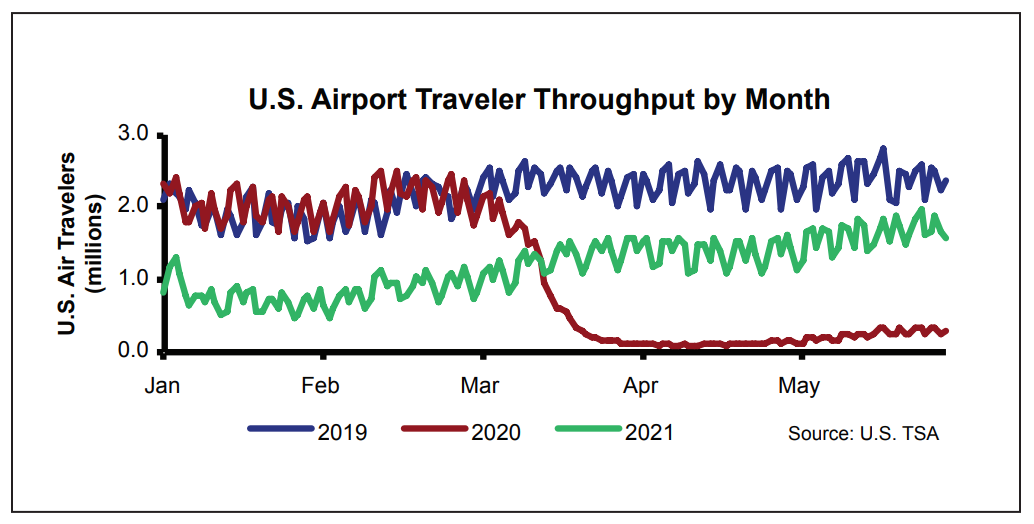
A broad cross-section of sectors is experiencing positive growth. Banks are generally performing well and have massive reserve cushions, which as we predicted, allowed loans outstanding to fall only 1.7% in 2020 despite enormous borrower stress. Meanwhile, airlines are hiring, and U.S. air traveler volume over the Memorial Day weekend was up to 72% of 2019 levels(from a low of 4%). Restaurants added an estimated 830,000 jobs over the last six months through May 2021, but the sector is still 14% below the prepandemic employment level. Google and JP Morgan joined the increasing number of firms saying, “Come back to the office this summer.” Morgan Stanley CEO James Gorman wants employees back in the office by Labor Day, ominously warning that the alternative is “a different kind of conversation,” noting that if employees feel safe in restaurants, they should feel even safer at work. In the U.K., office footfall has already risen to 45% of 2019 levels as people return, and in the U.S., they are up to about 25-30%. Ask yourself why you believe work-from-home is any more productive than virtual education? It is not. It allowed companies to tread water but not to move dramatically forward.
We remind you that as with employment, GDP growth, inflation, and many other aspects of economic performance in 2021 will be highly misleading in terms of “where we are.” Simply stated,

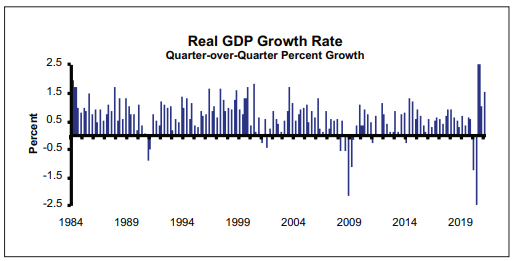
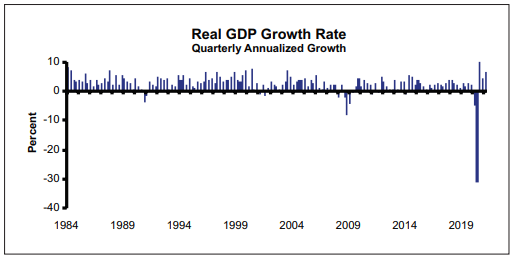
2020 was a bizarre year. After all, on April 20, 2020, the situation was so economically aberrant that the price of oil was negative. Thus, one needs to distinguish whether the quoted growth indicator is reported on a year-overyear, quarter-over-quarter, or annualized quarterover-quarter basis. For example, as the first shutdown ended, there were huge initial drops in both year-overyear and quarter-over-quarter growth rates, especially annualized quarter-over-quarter (which represents the decline that would occur if the quarterly rate prevailed for an entire year). Then, by the latter half of 2020, quarter-over-quarter growth was positive (especially annualized) while year-over-year growth was negative. Caveat emptor always applies to data consumers!

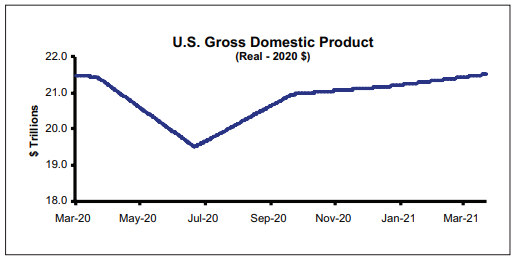
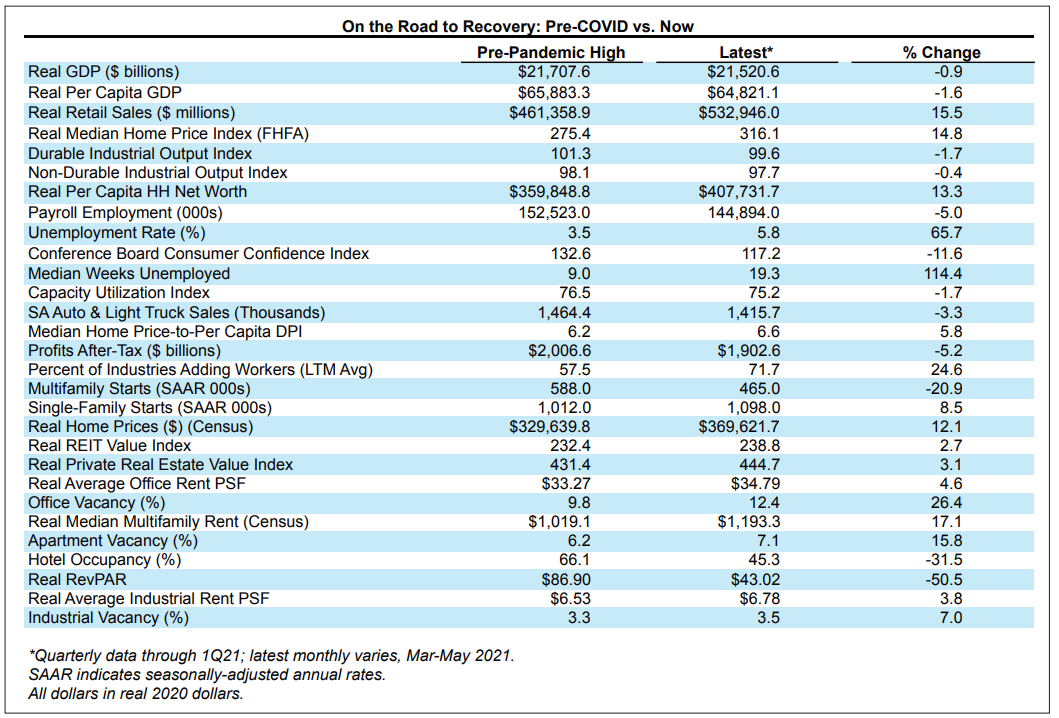
It is best to focus on where things stand versus year-end 2019 for quarterly data and February 2020 for monthly data, as these were the economic high-water marks. Until things normalize, focusing on quarterly and year-over-year gains will provide a distorted view of the economic reality. As the recovery plays out in 2021, large year-over-year growth will be heralded, while quarterover-quarter growth will be much lower. The Butterfly Recovery will end as widespread vaccination occurs and “life” returns. By late 2021, large, annualized quarterover-quarter changes will occur, while year-over-year growth will be modest. As of the first quarter of 2021, real GDP (2020 dollars) and real GDP per capita were 0.9% ($187 billion) and 1.3% ($865) below fourth-quarter 2019 levels, respectively. However, real GDP grew by 1.6% in the first quarter of 2021 and eked out 0.4% growth year-over year. This is welcome news, as it follows three consecutive quarters of negative year-over-year growth. That said, real GDP is still about 3.5% below where it would have been absent COVID. Meanwhile, almost 7.6 million net jobs were officially lost between February 2020 and May 2021, a 5% decrease. This compares to the nearly 22.8 million jobs recovered after the Financial Crisis.
It is essential to remember that this has not been a cyclical recession. Rather, it is a depression brought about by a combination of government mandates limiting economic activity and individual decisions to reduce activity due to COVID concerns. The trajectories of this decline and recovery have nothing to do with cyclical adjustments but rather depend on when governments allow us to do things and when we decide it is safe to do things. This unprecedented trajectory resembled the flight of a butterfly flying uphill until now. We are now (mid-June) at 175 million partially vaccinated (53% of the total population) and 145 million fully vaccinated (44%). As full vaccinations exceed 65% of adults, the Roaring 20s will begin. However, it is unclear whether certain parts of the country will reach this threshold given the large disparity in vaccination rates. As of mid-June, the top five states in the vaccination race were: Vermont (84% of 18+ population with at least one dose), Hawaii (82%), Massachusetts (81%), and Connecticut and New Jersey (each 77%). In contrast, Mississippi (45% of 18+ population with at least one dose), Alabama, U.S. Virgin Islands, and Louisiana (each 47%), and Wyoming (48%) lagged the national average.
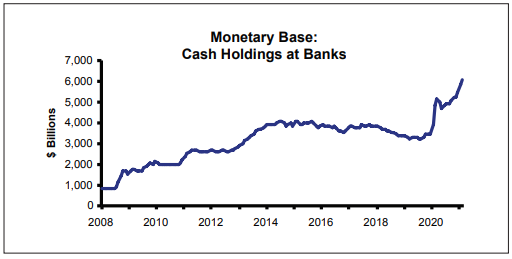
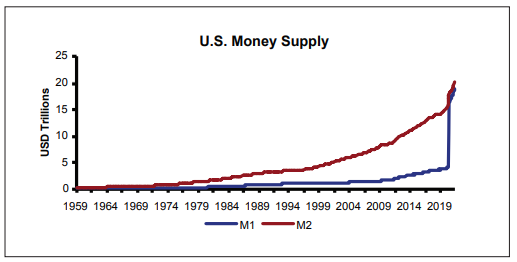
Most observers claim that there was no notable inflation from 2008-2019 even though the Fed increased the monetary base by $3.3 trillion (381%) via QE 1-3. They note that over the last decade, the Consumer Price Index rose by just 1.7% per annum. However, inflation for services and all goods in May 2021 jumped to 3.1% and 4.9%, respectively. In addition, the stock and housing markets displayed notable asset price inflation over the past 12 months. Short-term price pressures exist in many sectors, as many companies quickly reduced capacity as COVID set in. The poster child for this phenomenon is sawmills, where capacity reductions sent lumber prices skyrocketing even as timber remains plentiful. Capacity was slashed 10-40% in many sectors as the COVID shutdown set in, and as demand approaches 2019 levels, price spikes abound. But capacity will revert to 2019 levels over the next 24 months, neutralizing these price spikes. In addition, inflation has occurred in items like hotel rates and airline tickets as demand returns. In short, inflation of these prices has not been an issue when viewed versus 2019.
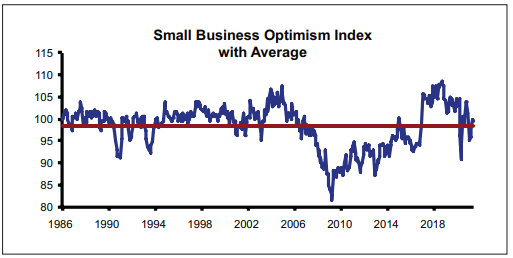
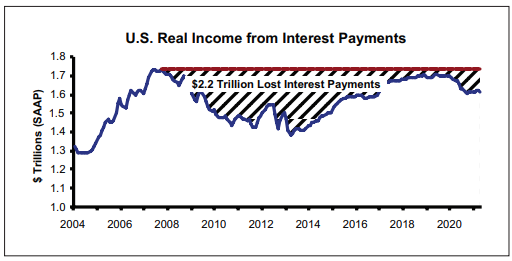
At nearly $1.7 trillion, real annualized personal interest income earned in April 2021 was slightly higher than where it stood a year earlier due to a long overdue (but insufficient) rise in interest rates. While the fed funds rate is still at a historically low level, the 10- year Treasury yield rose by over 100 bps year-over-year through June 2021, to 1.6%. In mid-June, Fed Chairman Jerome Powell described the latest Fed meeting as “talking about talking about (tapering),” raising the prospect that interest rate increases could occur prior to 2023. For now, key interest rates remain near historic lows as central banks soak up debt. Rates will remain low as global monetary authorities (including the Fed) will repress rates to keep government debt affordable. In the near term, this accommodation has little economic cost, but it ultimately crowds out private investment through reduced investment and gives money far too cheaply to the government.

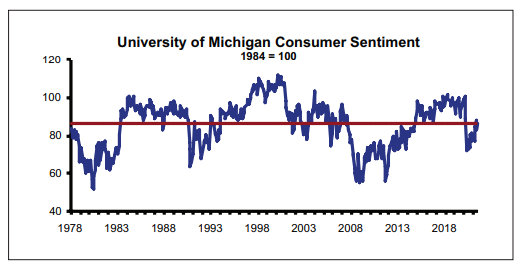
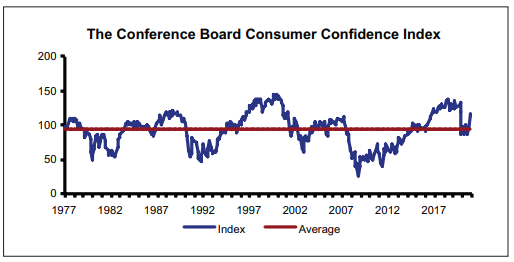
Prior to the pandemic, the Conference Board Consumer Confidence Index stood at 132.6 in February 2020. It dropped to 85.7 in April 2020 and is approaching full recovery, standing at 117.2 in May 2021. The current level is 3,130 bps and 2,290 bps above a year earlier and the long-term average (1977-present), respectively. Similarly, the University of Michigan Consumer Sentiment Index stood at 82.9 in May 2021, 330 bps below the 50-year average of 86.2 but above the 2020 depression low of 71.8. Consumers are dressed up and raring to go.
Source: “The Flight of the Butterfly Is Coming to an End“

Filed Under: All News

New Infrastructure Imperatives Emerge

July 14, 2021 by CARNM

The COVID-19 pandemic, climate change, and heightened societal interest in social and economic equity have redefined infrastructure imperatives beyond significant ongoing necessity for improved roads, bridges, airports, ports, mass transit, and other traditional infrastructure needs.

While our infrastructure focus in the 2021-22 Top Ten Issues Affecting Real Estate is on some new infrastructure imperatives, the need for enhanced investment in all areas of infrastructure remains high if we are going to maintain our strong economic competitive position. The American Society of Civil Engineers (ASCE) gives U.S. infrastructure a score of C-, classifying it as “poor” and “at risk,” while the World Economic Forum’s Global Competitiveness Report ranks the U.S. 13th in the world.

The ASCE also estimates our infrastructure funding “gap” in 2021 at $2.6 trillion, up 24% from 2017.1 Not only is public safety at risk from failed water systems, roads, dams, and other shortfalls, but the McKinsey Global Institute (MGI) estimated that fully closing the physical infrastructure gap could translate into 1.2 percent, or 1.5 million, more jobs across the economy. 2

The U.S. spends only 2.3 percent of GDP on infrastructure, while European countries spend 5 percent on average and China spends about 8 percent.”3 Despite ongoing needs, and new crisis needs, public (Fed, State and Local) infrastructure spending has fallen from 2.7% of GDP in 1980 to 2.3% in 2017, averaging 2.48% during that time period.4

The Impact of COVID-19 Pandemic on Infrastructure Needs

The COVID-19 pandemic has created emergency infrastructure needs in broadband access, supply chains, and health care systems.5

It has changed the way we live and work making broadband access a necessity. Medicine, shopping, school, work, government services, entertainment and most other aspects of life have accelerated their movement online. Even as the pandemic eases, full access and participation in our society in the future will require enhanced broadband access. This access will also provide society substantial flexibility to respond more effectively to future pandemics, disasters, and other events.

Broadband infrastructure investment will also address significant economic and social inequities in broadband access. Access is uneven and a source of present and future economic disadvantage. In 2019, Microsoft released a study showing that 162.8 million people were not using the internet at broadband speeds, a far higher figure than the 25 million the FCC estimated.6

The changes in how we access our products and services has radically changed supply chains and related infrastructure needs. New manufacturing, transit, delivery, information technology, and physical assets are needed to shore up the supply chains to reduce risk and promote business success. For example, in the first quarter of 2020, a shutdown of the Chinese manufacturing ecosystem caused 94% of Fortune 500 companies to report supply disruptions, with losses in the retail sector alone totaling $700 million.7

The drastic increase in last-mile deliveries to homes and businesses has also required businesses to create massive delivery systems, changed inventory storage and distribution requirements, and put significant demands on information systems. Automation, optimization, supply chain strategy, transparency and visibility are seen as the most important infrastructure areas to invest in the future.8

COVID-19 also exposed weaknesses in our healthcare system. This is not surprising as 40,000 jobs at state and local public health agencies have been eliminated since the 2008 recession and federal funding for emergency preparedness and response programs administered by the Centers for Disease Control and Prevention has been slashed by 50% over the past decade. Funding for our Strategic National Stockpile and Hospital Preparedness Program has declined 50% from 2004 to 2020.9

More healthcare infrastructure investment is needed in all these areas as well as improved information systems, physical structures, and organizational structures to reduce risks of failure in future epidemics and address social and economic disparities in healthcare access that were magnified during the COVID-19 crisis.

Real Estate Implications of COVID-19 Related Infrastructure Investments

Business and public sector service models increasingly require customers to have broadband and know-how to work online. Residential real estate buyers or renters will either blackball, or highly discount, properties with mediocre or limited broadband service. Broadband is no longer an amenity, but a minimum requirement, of all real estate, either by customer demand or government fiat.

Changes in supply chains as home or business delivery becomes an even more predominant way of receiving products and services will require real estate property owners to adapt their buildings and access/egress to address changes. Governments that anticipate changing volumes and types of transit on streets, parking requirements, and even zoning ordinances to address last-mile delivery needs will be rewarded. Real estate owners might also work together, independent or in partnership with government, to address these needs.

Healthcare infrastructure will be key in determining public health and safety in a community, increasingly important to real estate location decisions, especially for the increasing number of elderly people. Healthcare investment is also a huge center of job creation in the future, so communities fighting government and large private health care providers for their investment will benefit both in jobs and public safety. Many owners will need to update their ventilation systems and address a whole host of building health-related issues identified in certification standards like the WELL Building Standard.

The Impact of Climate Change on Infrastructure Needs

Climate change impacts infrastructure in two primary ways. First, governments and businesses are responding to future climate change by electrifying and promoting renewable energy. Second, governments and businesses are investing in climate resilience and adaptation in response to ongoing weather-related disasters.

Electrification and Renewables Infrastructure Investment

Governments are reducing carbon use by both promoting electrification of the transport sector (electromobility) and renewable energy.10 All 41 nations in the Organization for Economic Co-operation and Development (OECD) in the year ending March 2020 showed electricity use fell by 3.6%, but coal fell by 21.6%. Solar grew 15.6%, wind by 4% and gas by 2.7% (almost all in North America). Electro-mobility has had a growth rate of over 40% per year in the past decade, with predictions for how quickly the internal combustion engine will be phased out of new vehicles now coming down into the 2020s.11

As electrification and renewables increase, significant new infrastructure investment is needed in the electric grid—including recharging hubs, batteries, information systems, cyber-security, transmission and distribution lines, as well as electric vehicles, buses and rail cars. Additionally, buildings, which consume about 40% of total energy use, and water systems, which can represent 30% to 40% of a municipality’s energy bill, and up to 4% of total country energy use, need to be made more energy-efficient.12

Climate Resilience and Adaptation

Climate-resilient infrastructure is planned, design, built, and operated in a way that anticipates, prepares for, and adapts to changing climate conditions. Climate-resilient infrastructure should also be able to withstand, respond to, and recover quickly from climate-related disruptions.13

Extreme weather events—hurricanes, floods, droughts, and wildfires—have been increasing in number and cost in recent years. The Intergovernmental Panel on Climate Change, in its Fifth Assessment Report, concluded: “Many climate stresses that carry risk—particularly related to severe heat, heavy precipitation, and declining snowpack—will increase in frequency and/or severity in North America in the next decade. Together with climate hazards such as higher sea levels and associated storm surges, more intense droughts, and increased precipitation variability, these changes are projected to lead to increased stresses to water, agriculture, economic activities, and urban and rural settlements.”14

Climate resilience and adaptation infrastructure is not new, but in 2021 it has taken on an even more important role as federal support for such efforts has increased to match the significant efforts underway at the state and local level. Over half of the 50 largest cities in the U.S. and 33 states have adopted climate action plans that address climate resilience and adaptation.15, 16

With the 2020 Atlantic hurricane season the sixth-worst in the last 50 years, devasting wildfires around the world, and forecasts of increasingly severe extreme weather events in the future, climate-related infrastructure has taken on paramount importance for many cities and states. These investments are also supported by evidence that has found that every dollar invested in federally funded pre-disaster mitigation saves society $6.17

Real Estate Implications of Climate Change Infrastructure

Electrification of cities and building efficiency will become the new norm. Real estate owners that get out in front of these changes will profit and reduce costs of adaptation. Cities and neighborhoods that work to encourage electromobility will be prime investment locations as tenants and their employees move to electric vehicles, bikes, scooters and other modes of transit. Cities and neighborhoods that adopt electric buses, rail and other forms of mass transit will be cleaner, quieter, and less polluted. Property owners located near charging hubs or that provide charging opportunities will be rewarded.

Real estate owners and tenants must also be ready to ramp up energy efficiency and renewable energy, particularly solar, building off of initial efforts made in recent years. Staying current on new technologies, upcoming regulatory changes, subsidy programs, and other incentives will be key to maximizing success. Tenants and governments will, in most cases, reward action.

Climate resilience and adaptation infrastructure investments will likely have an even greater impact on real estate owners. Tenants, homeowners, insurance companies, and other customers have increasingly good access to easily available information about the weather-related risks a property faces. Local climate action plans and a myriad of online services enable homeowners and potential tenants to examine flooding, wildfire, and storm risks now and into the future. While many coastal locations have the most significant problems, no area of the country is immune. Cities and building owners that manage these issues well will profit. Due diligence and risk management are changed forever.

The Impact of Societal Focus on Social and Economic Equity on Infrastructure

There is growing activism, understanding and acknowledgement of how historic investments in infrastructure have disproportionately helped some communities and left out others.  From the millions of people with no or poor access to Broadband to even more serious lack of access to safe water as demonstrated in Flint, Michigan, and thousands of communities with similar problems that have been identified across the U.S., certain people and communities have felt the infrastructure deficit more severely than others.

Furthermore, planning for investment in roads, bridges, mass transit and other traditional infrastructure investment often negatively affects certain communities by building over or through them and otherwise ignoring their needs.  Employment opportunities from infrastructure investment have also not broadly benefited all communities.

There will always be winners and losers in the distribution of infrastructure spending, but with more heightened societal focus on issues of equity, real estate investors can expect enhanced focus on providing measurable public benefits and investment in some areas and communities that have been marginalized in the past, providing economic opportunity for those who follow these trends.

Conclusion

Infrastructure is a perennial Top Ten issue given the huge infrastructure deficit in the U.S. and other countries, the key role of infrastructure in job creation and public safety risk mitigation, and its role in determining geographic winners and losers. In 2021, COVID-19, climate change, and social and economic equity concerns have introduced a whole new set of key issues for real estate owners and tenants to master. •

Source: “New Infrastructure Imperatives Emerge“

Filed Under: All News

July 2021 CCIM Deal Making Session Properties

July 14, 2021 by CARNM

Thank you to all of the brokers, sponsors, and guests who attended the July 2021 CCIM NM Deal Making Session and to those who shared their properties.

Click here to view source PDF.

Click here to view the Thank Yous.

Name Property, City Type Price
1. Dave Hill, CCIM, SIOR

DJ Brigman

10510 Research Rd. SE, Albuquerque Office $1,980,000
2. Tai Bixby, CCIM 1620 Hospital Dr., Santa Fe Office $3,950,000


3. Randall Parish

John Algermissen

Jim Wible, CCIM

Keith Meyer, CCIM, SIOR

SEC Rio Bravo & Loris, Albuquerque Land N/A
4. Randy McMillan, CCIM, SIOR

Max Prestridge

Jacob Slavec, SIOR

Jake Redfearn

GSA Leased Buildings, Statewide Investment N/A
5. Bill Shattuck, CCIM Investment Portfolio, Deming Investment $4,459,816
6. Sarah Raboff
Jim Wible, CCIM
8920 Northeastern Blvd., Albuquerque Multi-Family $520,000
7. Tai Bixby, CCIM

Jim Wible, CCIM

Keith Meyer, CCIM, SIOR

NEQ Paseo Del Pueblo Sur & Paseo Del Canon E., Taos Land $1,000,000
8. Randall Parish

John Algermissen

Jim Wible, CCIM

Keith Meyer, CCIM, SIOR

3111 & 3125 Coors Blvd. SW, Albuquerque Land N/A
9. Chris Anderson SWC 25th St. Southern Blvd. NE,

Rio Rancho

Land $195,000
10. Riley McKee

Jim Wible, CCIM

Keith Meyer, CCIM, SIOR

204 Murray Rd. SE, Albuquerque Industrial $750,000

Filed Under: All News, Meetings

Emerging from the Pandemic: A Guide for Real Estate Family Businesses

July 12, 2021 by CARNM

This is the right time for family leaders to consider how well the business responded during the past year and what lessons could be learned.

As we begin to emerge from the devastation and tragedy of the pandemic, all Americans are dusting themselves off and looking to the future. We are all restarting our lives, making plans and perhaps using the lessons of the pandemic to change our priorities and behaviors going forward. Businesses are also regrouping, considering new strategies and directions, and a new approach to bringing employees together and creating culture. These changes are especially relevant for family businesses, where the personal and business goals often intersect.

Real estate family businesses are particularly intertwined with family dynamics, and many have been, and may continue to be, directly impacted by new patterns of demand for residential and commercial space, migration trends, and new areas of risk and opportunity in real estate investing. The economic and behavioral fallout from COVID-19 has had varying effects on each market, property type and building. As such, each real estate family business experienced different challenges.

Related: Urban Apartments Eye a Long Road to Recovery

This is the right time for family leaders to consider how the well the business responded during the past year and what lessons could be learned, particularly in the way the family communicated with one another as critical and often difficult decisions were made to preserve asset values and cash flow. This article provides guidance on areas of focus when rethinking both family and business matters in the post-pandemic real estate environment.

Reassessing investment strategies

Real estate owners have recognized that the pandemic shifted the demand for space across property types. Multifamily properties in gateway cities reliant on public transportation saw a significant out migration of tenants, not all of which will return. The pandemic accelerated the move of older millennials to the suburbs, and even before COVID-19 struck, new rent regulations in states such as California and New York made it more difficult to achieve required returns from apartment renovations. The oversupply of retail in many markets became even more pronounced. And the strength of office space demand is uncertain as tenants experiment with more permanent work-from-home or hybrid scenarios. Hotels suffered the most immediate impact of the lockdowns, and while leisure travel is coming back strong, the restoration of business and group travel demand is impossible to predict. Conversely, many industrial and self-storage properties are performing above pre-COVID-19 levels.

Related: A Faster Than Expected “Return to Office” Rollout Is Boosting Investors’ Confidence

The new market dynamics require refreshing real estate company strategy. Many owners are looking to new markets to find better opportunities, changing their investment targets to new property types, planning to repurpose space or searching for elusive distressed situations. Such strategic shifts can only be successful if the company has the right platform—local relationships, access to data, analytical tools and reporting, and capital availability—to optimally implement the changes. Companies are also taking a hard look at their existing portfolios, reforecasting budgets, modeling prospective cash flows and capital requirements, and potentially adjusting expected returns.

A key consideration in buy-hold-sell decisions today is a property’s ability to hedge against a likely inflationary period; that is, the owner has the ability to grow rents along with or exceeding the inflation rate. An assessment of property competitiveness and actual vs. market rent variances in the current environment will become even more important in the next few years. On the expense side, the cost of goods and services is already rising, particularly in construction and rehab. During the pandemic, management companies already made substantial efforts to trim operating expenses and boost efficiency. These efforts will become even more important in an inflationary environment that brings a continuous need to control costs.

Another consideration of heightened importance is whether the family business has devoted sufficient attention to the Environmental-Social-Governance (ESG) requirements of growing numbers of capital sources. A LEEDS certificate in the lobby is no longer enough. Investors are concerned with both reducing the portfolio’s carbon footprint and knowing the company has drafted principles and policies that provide equal opportunity to a diverse group of employees and benefit the community at large. ESG is changing the way all companies operate and communicate their efforts, creating accountability for vendor selection processes, employee advancement, tenant safety measures and, of course, carbon efficient building designs.

Monitoring liquidity

During the pandemic, the greatest concern for many property owners was liquidity; cash flow was squeezed by lower revenues and static expenses. Most owners were able to modify debt terms to ease the shortfall, and many achieved a total forbearance of payments. However, such modifications are temporary and ultimately, the payments and reserve balances must be made up. Management should particularly focus on mortgages with short-term maturities. While the debt markets are fully open, underwriting has tightened and, in some cases, interest rates are higher. If the value of your property has fallen in the last year, refinancing may be more difficult, depending on leverage. An equity infusion may be required to exit the loan as an alternative to expensive bridge financing.

Of particular concern in real estate family businesses, cash shortages often translated to a partial or full cut in distributions paid to family members and limited partner investors. Accordingly, company management should be updating their cash flow models, projecting revised short-term and longer-term income streams based on revised rent and occupancy assumptions, anticipated collection of past due rent, operating expenses, capital budgets and debt payments. In this way owners are prepared for communications with their lenders and can set expectations for family members and outside investors. The revised projections can also be used to monitor debt covenant compliance, an analysis that has also taken on greater importance.

Addressing vulnerabilities

The pandemic also brought to light two areas of required focus for real estate business leaders: fraud prevention and cybersecurity. Studies have shown that real estate had the second highest median fraud loss of any industry in 2020. Family businesses often do not have the same internal control and fraud prevention processes as institutional players. Further, the internal control environment can be weakened when employees are working from home. The stress caused by the pandemic, furloughs and pay reductions all have the potential to motivate employees to commit fraud.

All companies, irrespective of size, are vulnerable to cyberattacks. While not new, there are increasing numbers of publicized successful attacks on what would be thought of as companies with enhanced security. As family businesses implement more property technology alongside management and accounting software, they also have to invest in security platforms to control and protect the entire IT environment. Additional oversight, enhanced training (most security breaches result from unintended employee actions), avoidance and protocols for ransomware are all components of an effective IT security plan.

Family harmony

The challenges all families went through in the last year emphasize the importance of empathy and good communication. That is equally true in a family business, particularly in real estate, where property ownership is often shared among many people. Frequent family meetings and enhanced reporting can be used by leaders to explain changing strategies and the rationale for critical decisions that impact family members, including distributions. The more information that can be shared, the better—to preserve family harmony and avoid conflicts during difficult periods. It is possible that during the pandemic some family members had conflicting views on how the company should be dealing with tenants, vendors, lenders and investors. Providing a forum to air dissenting opinions and formally resolving such disputes can strengthen family bonds and avoid on-going resentment. Behaviors during the pandemic may have reinforced the need to create or refine family governance, including delegations of authority and richer reports.

The past year also stressed the need for enhanced emergency preparedness protocols. Tragically, some families may not have been sufficiently prepared for a sudden leadership succession, both within the family and among management company employees, and difficult decisions had to be made in the midst of the storm rather than during a period of calm waters. Family meetings afford the opportunity to assess skills sets and have honest discussions about the future leaders of the family business.

The realization that family members’ health or even lives could be vulnerable to sudden events outside their control is unsettling, and part of emergency preparedness is creating a “desk plan” for all members of the family. A desk plan organizes the information required if a family member dies or is incapacitated. It provides a roadmap to important information and documents that are essential for an easier transition during a difficult time. A typical desk plan includes the location of contact information, passwords, estate documents and investment account statements. For a real estate family, the desk plan should also provide access to property performance data, management contracts, lease databases and critical financial records. The availability of these documents will enable the heirs to maintain operations and mitigate any risk of business interruption.

Estate planning is also a critical to provide for and protect family members. Recently proposed changes to the taxation of capital gains and like-kind exchanges require careful monitoring as they would significantly impact the heirs of an estate with real estate holdings. If enacted as proposed, capital gains on assets held by the decedent would be triggered upon death, the current step-up in basis would be eliminated, the capital gains tax rate doubled and like-kind exchanges limited. This combination of changes would require significant liquidity to pay the gains taxes at death, and therefore might influence both real estate investment and tax strategies, as well as asset diversification.

Action steps: the post-pandemic checklist

As you dust off the pandemic and consider the future, have you taken the following actions for your business and your family?

Business checklist

  • Refreshed your business strategy
  • Assessed the adequacy of the business platform to support the company’s new direction
  • Reforecast property budgets and assessed cash needs
  • Analyzed the potential for refinancing loans with near-term maturities
  • Identified potential operating expense savings
  • Assessed the adequacy of internal controls
  • Competed the Real Estate Fraud Prevention Checklist
  • Analyzed ways to reduce the portfolio’s and the company’s carbon footprint
  • Created a statement of ESG principles

Family checklist

  • Held a family meeting to discuss the company’s performance during the pandemic
  • Reset family member expectations about investment returns and cash flows
  • Refreshed the family’s governance documentation, including succession plans
  • Considered ways to enhance family communication, including regular reporting
  • Developed emergency preparedness plans
  • Encouraged all members of the family to prepare a desk plan
  • Updated your estate plans
  • Spoken with your tax advisor about the proposed income tax changes

Source: “Emerging from the Pandemic: A Guide for Real Estate Family Businesses“

Filed Under: All News

  • « Go to Previous Page
  • Page 1
  • Interim pages omitted …
  • Page 3
  • Page 4
  • Page 5
  • Page 6
  • Page 7
  • Page 8
  • Go to Next Page »
  • Search Property
  • Join CARNM
  • CARNM Login
  • NMAR Forms
  • All News
  • All Events
  • Education
  • Contact Us
  • About Us
  • FAQ
  • Issues/Concerns
6739 Academy Road NE, Ste 310
Albuquerque, NM 87109
admin@carnm.realtor(505) 503-7807

© 2026, Content: © 2021 Commercial Association of REALTORS® New Mexico. All rights reserved. Website by CARRISTO