• Skip to primary navigation
  • Skip to main content

CARNM

Commercial Association of REALTORS® - CARNM New Mexico

  • Property Search
    • Search Properties
      • For Sale
      • For Lease
      • For Sale or Lease
      • Start Your Search
    • Location & Type
      • Albuquerque
      • Rio Rancho
      • Las Cruces
      • Santa Fe
      • Industry Types
  • Members
    • New Member
      • About Us
      • Getting Started in Commercial
      • Join CARNM
      • Orientation
    • Resources
      • Find A Broker
      • Code of Ethics
      • Governing Documents
      • NMAR Forms
      • CARNM Forms
      • RPAC
      • Needs & Wants
      • CARNM Directory
      • REALTOR® Benefits
      • Foreign Broker Violation
    • Designations
      • CCIM
      • IREM
      • SIOR
    • Issues/Concerns
      • FAQ
      • Ombuds Process
      • Professional Standards
      • Issues/Concerns
      • Foreign Broker Violation
  • About
    • About
      • About Us
      • Join CARNM
      • Sponsors
      • Contact Us
    • People
      • 2026 Board Members
      • Past Presidents
      • REALTORS® of the Year
      • President’s Award Recipients
      • Founder’s Award Recipients
    • Issues/Concerns
      • FAQ
      • Ombuds Process
      • Professional Standards
      • Issues/Concerns
      • Foreign Broker Violation
  • Education
    • Courses
      • Register
      • All Education
    • Resources
      • NMREC Licensing
      • Code of Ethics
      • NAR Educational Opportunities
      • CCIM Education
      • IREM Education
      • SIOR Educuation
  • News & Events
    • News
      • All News
      • Market Trends
    • Events
      • All Events Calendar
      • Education
      • CCIM Events
      • LIN Marketing Meeting
      • Thank Yous
  • CARNM Login
  • Show Search
Hide Search

Archives for August 2021

CRE’s Ongoing Problem: A Labor Shortage

August 12, 2021 by CARNM

Major demographic changes will require the industry to adopt new construction methods.

Commercial real estate is booming; second quarter data affirms it.

“Market confidence was high, with investor inquiries and newly launched deals recovering to near 2019-levels,” said Richard Barkham, Global Chief Economist for CBRE, in a statement sent to GlobeSt.com. “Going forward, while the delta variant and inflation concerns are seen as potential headwinds, we are yet to see this materialize in the investment market. Investors continue to be active and capital remains abundant for commercial real estate.”

The good news in short: There are more deals and even some improved news of prices on building commodities. Where things have been getting painful is in labor.

“Demand for labor is growing faster than supply is growing,” Ryan Severino, chief economist at JLL, tells GlobeSt.com.

In a new report, Severino noted that as of June 2021, the number of open jobs in the US was 10.1 million, “a new record.” Put differently, that’s 7% of total employment from July.

There are cyclical and structural issues affecting labor availability. The end of extended unemployment benefits, vaccinations, and the return of school-age children to classrooms—some of the cyclical factors—will both encourage and enable people to return to work.

It’s such structural issues as a falling birthrate, retirement of baby boomers, and falling legal immigration into the US that offer thornier problems across all geographies, skill types, and industries.

“The structural side is a lot harder to change,” Severino continued telling GlobeSt.com. “The shortage of workers in the construction industry is one of the factors, in addition to other inputs to construction, having a limiting impact. We are going to lose a lot of workers from industries that a lot of people think are old economy jobs, but they’re incredibly important to the real estate market.”

According to the Bureau of Labor Statistic’s June 2021 JOLTS report, construction saw 358,000 hires, 365,000 job separations, and still 339,000 job openings. The industry simply can’t get enough people in to satisfy labor needs.

It’s part of commercial real estate’s new normal with a pair of negative impacts. One is that more people working would mean more consumers expanding the economy and needing places to live and do business.

The other is not enough people to construct buildings. “A lot of the people working in areas like construction and transportation and utilities and trades will be leaving the workforce,” Severino says. “There’s no cloning to fill those positions.”

The other option is greater productivity, which will require a change in attitudes and planning. Over the last 20 years in real estate, according to Severino, there was sufficient labor. Companies didn’t have to think about how to become more efficient and weren’t pushed to increase pay. “Now that the pendulum is swinging, labor is going to get more expensive,” he says. “It probably means companies will have to invest in technology to raise productivity.”

“Do you do prefab? Do you do 3D printing? Is there a way for robots to participate?” Severino asks. “Nobody spent serious time thinking how to automate this stuff and make it more productive.” Now they may not have another choice.

Source: “CRE’s Ongoing Problem: A Labor Shortage“

Filed Under: All News

Cautious Optimism Returns to Seniors Housing Market

August 11, 2021 by CARNM

elderly woman facemask

Introduction

Seniors housing properties have begun to recover from the deep impacts COVID-19 had on the sector in 2020.

The seniors housing sector is continuing to deal with the lingering effects from the COVID-19 pandemic, including lower occupancies and higher expenses, which are squeezing net operating incomes and weighing on transaction activity. Yet the 2021 WMRE / NIC Seniors Housing Survey shows growing confidence in the sector’s outlook, including improving fundamentals and a rise in investment activity over the next 12 months.

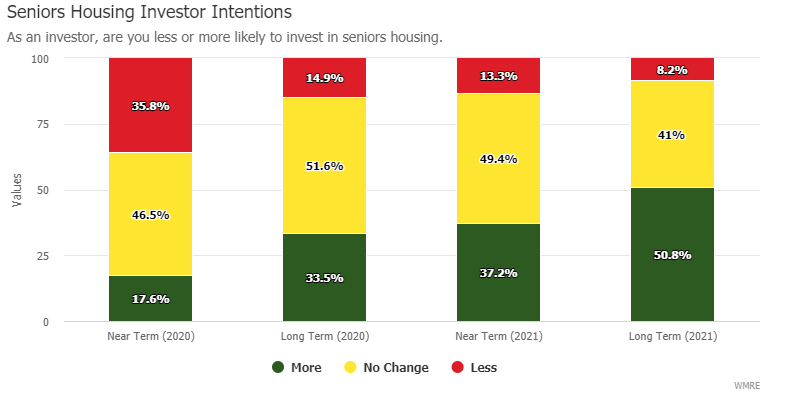
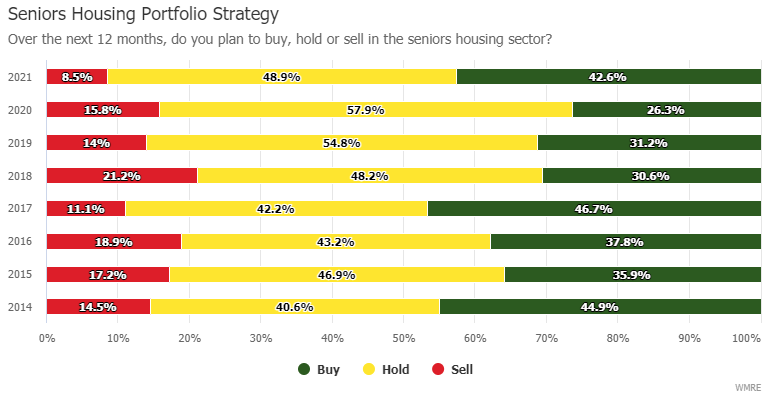
Capital that moved to the sidelines last year is preparing to get back on the playing field. In all, more than one-third of survey respondents said they plan to invest in seniors housing in the near term—double the 18 percent who planned near-term investments in the 2020 survey, which was conducted in the midst of the pandemic. Investors are even more bullish on their long-term investment plans. About half (51 percent) expect to invest more in seniors housing assets over the long-term, which is up from 34 percent a year ago.

“Part of that rebound is due to the underlying demographic characteristics, but the value proposition is still there,” says NIC Chief Economist Beth Burnham Mace. From an investor’s point of view, seniors housing diversifies portfolios, often performs counter-cyclical to the economy and has a track record of delivering favorable long-term returns. According to the NCREIF Property Index (NPI), seniors housing generated an 11.5 percent annualized total investment return for the 10-year period ending in first quarter of 2021. That compares favorably to the overall return of 8.8 percent for the NPI. “The appeal of seniors housing is still very much driven by the demographics story, and that story has brought in a lot of capital,” says Mace. The leading edge of baby boomers born between 1946 and 1964 are 75 today, whereas the average age that someone enters a seniors housing care facility is 82. So, the wave of demand is still several years away, but it is getting closer every day, she adds.

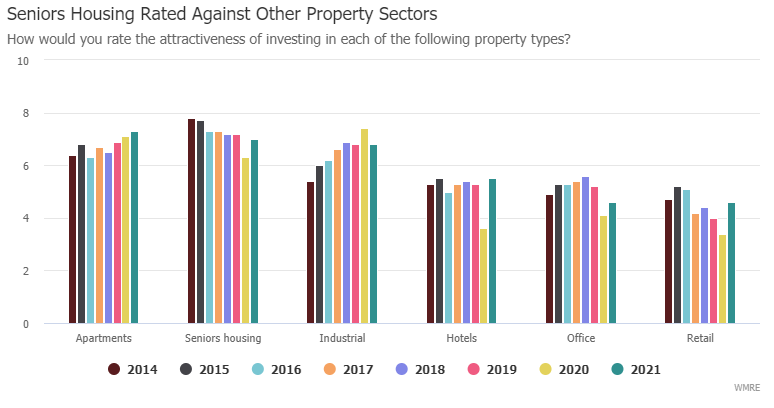
Despite challenges that have hindered the sector over the past year, respondents continue to view seniors housing favorably compared to other property types. On a scale of 1 to 10, seniors housing generated a mean score of 7.0, which was second only to apartments at 7.3 and even slightly ahead of industrial at 6.8. Although the current rating is an improvement from the 6.3 rating that seniors housing had in the 2020 survey, it still represents the second lowest level in the eight-year history of the survey.

“COVID has been extremely challenging for the senior housing industry given residents are highly vulnerable. That being said, the industry seems to have hit bottom early in ’21 and occupancy has been building since then,” says Lukas Hartwich, a managing director at Green Street Advisors. “The biggest tailwind for the industry continues to be the nascent demographic wave of seniors, which is just around the corner, while the biggest headwind will likely continue to be supply growth and labor cost pressure,” adds Hartwich.

Survey methodology: The WMRE /NIC research report on the seniors housing sector was conducted via an online survey distributed to WMRE readers in June. The 2021 survey results are based on responses from 189 participants. The majority of respondents hold top positions at their firms with 50 percent who said they were either an owner or C-suite executive. Respondents also represent a cross-section of different roles in the seniors housing sector, including investors, lenders, developers, brokers and owner/operators.

house money

Buyers Return to Market

Investment sales activity has picked up for seniors housing properties.

The pace of investment sales in 2021 is below pre-pandemic levels. According to Real Capital Analytics, seniors housing single asset, portfolio and entity level deals totaled $5.8 billion through May. Although that is on par with 2018 sales for the same period, it is about 21 percent behind the 2019 pace.

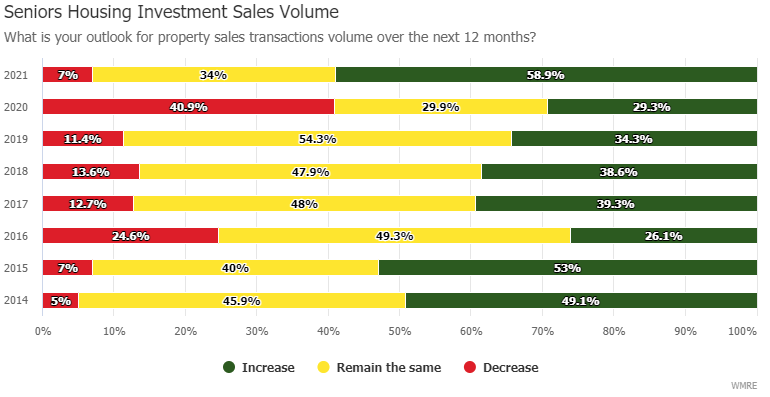
Respondents are more confident that transaction will accelerate over the next 12 months. A majority 59 percent think transaction volume will increase compared to 29 percent who held that view in the 2020 survey.

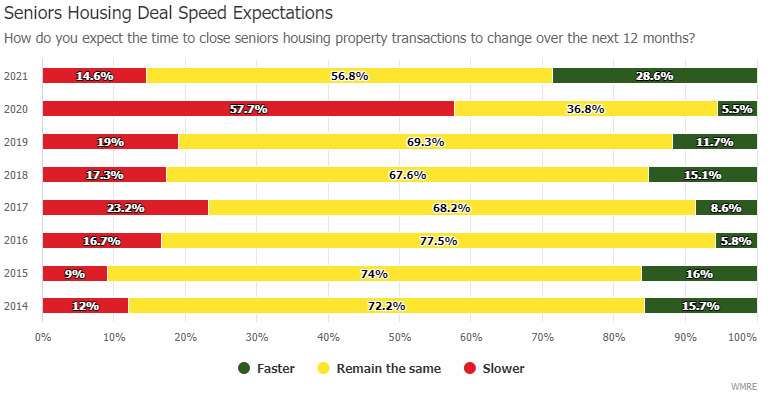
When asked about the change in time to close transactions, 57 percent expect it to remain the same over the next 12 months, while 29 percent said it could be faster and 15 percent anticipate slower closings.

“We know that the baby boomers are coming. The vaccine is in place; construction is down; and replacement costs are way up, and pent up demand is there,” says Mark Myers, managing director, investment sales at Walker & Dunlop. “At the same time, you have very inexpensive capital, and many buyers and sellers are still there waiting on the sidelines. As buyers reenter the space, demand will increase, pricing will increase, and this bodes well for very positive transaction activity over the next few quarters.”

In fact, investment sales have picked up significantly in the past two months with REITs leading that charge. Ventas announced in June that it was acquiring New Senior Invest Group in a deal valued at $2.3 billion. Welltower Inc. is acquiring a portfolio of 86 independent living (IL) and assisted living (AL) properties owned by Holiday Retirement for $1.58 billion. Another sign of the increasingly positive investment climate is that Bridge Investment Group, which has a seniors housing portfolio valued at roughly $4.5 billion, filed for an IPO in June.

Healthcare REITs are becoming more active on the external growth front both in terms of acquisitions and development. In addition to the recent wave of announcements, management teams are communicating that there is more to come, notes Hartwich. There are many factors that are driving the increase in REIT transaction activity. Part of the answer is that there are more willing sellers than there were in 2020. “Perhaps the biggest driver is the cost-of-capital advantage that many health care REITs enjoy,” he says. Several health care REITs have the ability to buy assets in the private market for 100 cents on the dollar with capital that is priced more richly, in some cases in excess of 125 cents on the dollar, he adds.

Outside of the REITs, sales activity has been slower to return. “What is holding things up is that COVID did have a dampening effect on occupancy,” says Myers. Some operators closed their doors for 12 months or more to protect their most vulnerable residents. Falling occupancy levels squeezes profit margins, which in turn impacts underwriting and pricing. Owners are more likely to hold assets that don’t have stabilized occupancies rather than sell at a discount.

“People aren’t going to wait for a full recovery to start going after buying opportunities. They’ve already started to do that,” says Myers. Pent-up demand following the Great Financial Crisis was like a switch turning on that saw a surge in commercial real estate in 2010 and beyond. “I think you’re going to see a similar thing happen here once properties regain occupancies, probably starting at the end of third quarter and beginning of fourth quarter,” he says.

housing growth arrow

The Sector Shifts to Recovery Mode

Respondents are bullish that fundamentals will improve over the next 12 months.

Twelve months ago, the outlook for seniors housing was decidedly bleaker. More than half of respondents in the 2020 survey considered seniors housing to be in a recession or a trough, while another one-fourth were not even sure of the cycle. Half of respondents (51 percent) now see the seniors housing sector in the recovery/expansion phase compared to 20 percent who think it is in a recession/trough, 18 percent who are unsure and 12 percent who believe it could be at the peak.

Naturally, there are questions about how quickly the seniors housing market will recover, and what that path of recovery will look like, notes Mace. “Until we see that inflection point where we start to see strong improvement, the low overall occupancy rates are still a significant concern in how quickly the market comes back,” she says.

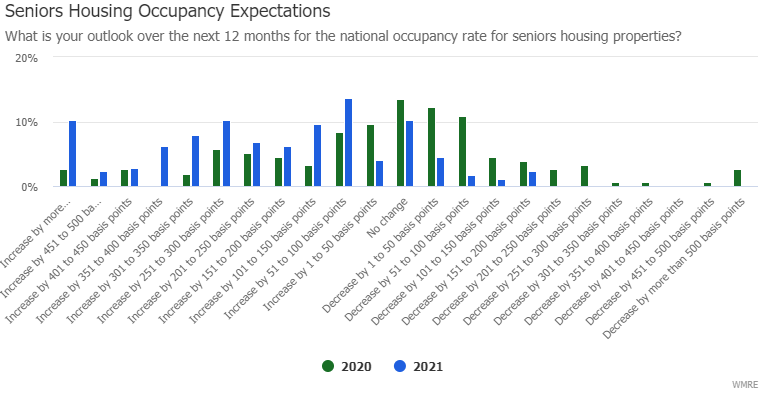
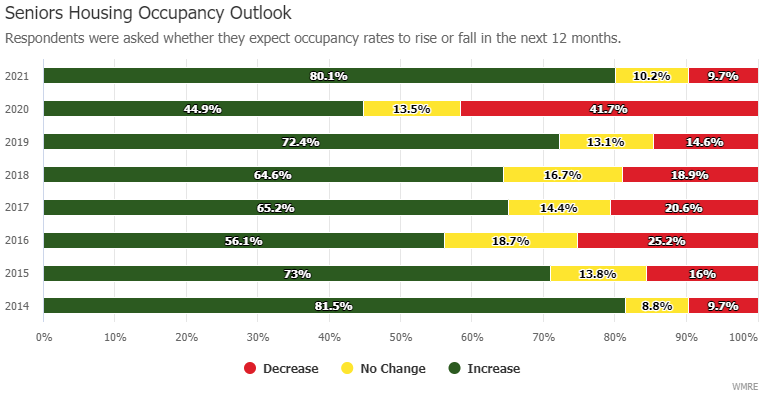
Survey results do show a surge in optimism for improving occupancies over the next 12 months. Eighty percent of respondents expect occupancies to rise. That is a big jump compared to the 45 percent who thought occupancies would rise in the 2020 survey.

According to NIC MAP data, powered by NIC MAP Vision, senior housing occupancy in the United States remained flat in second quarter at a record low of 78.8 percent. AL and IL properties both experienced little change in occupancy, with IL holding steady at 81.8 percent and assisted living inching up to 75.5 percent. However, there was positive quarterly absorption that was offset by new supply.

A deeper look at the NIC MAP data shows that a growing number of operators are reporting occupancy increases. In the second quarter of 2021, 47 percent of senior housing properties in the NIC MAP Primary Markets reported an increase in occupancy. During the height of the pandemic, that number was 22.5 percent. “We have anecdotes of improvement, but it hasn’t shown up yet in the data through second quarter. So, it is understandable that investors are approaching the sector with caution,” says Mace.

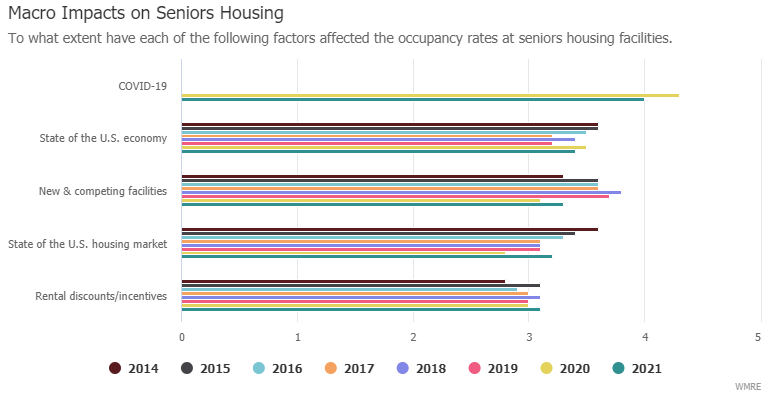
Despite high vaccination levels among senior housing residents, COVID-19 continues to have a significant impact on occupancy rates at seniors housing facilities. On a scale of 1 to 5 with 5 representing a significant impact, respondents rated COVID-19 as the biggest factor impacting occupancies at 4.0. That does show an improvement over the 4.3 in the 2020 survey.

It is likely that strength in the economy and hot housing market are providing a positive counterbalance to the negative leasing effects caused by COVID-19. In fact, the 3.2 rating on the housing market increased from 2.8 in 2020 and is also up slightly from the 3.1 rating from the prior three years.

Some seniors are taking advantage of the hot housing market to sell their home at potentially peak pricing and shift to rental housing. According to the National Association of Realtors, the median existing-home price for all housing types saw a record year-over-year increase of 23.6 percent in May with homes selling after an average of 17 days on the market.

COVID-19 cleaning

Greater Expenses Squeeze Profits

COVID-19 has boosted operational expenditures and many operators expect those higher costs to persist.

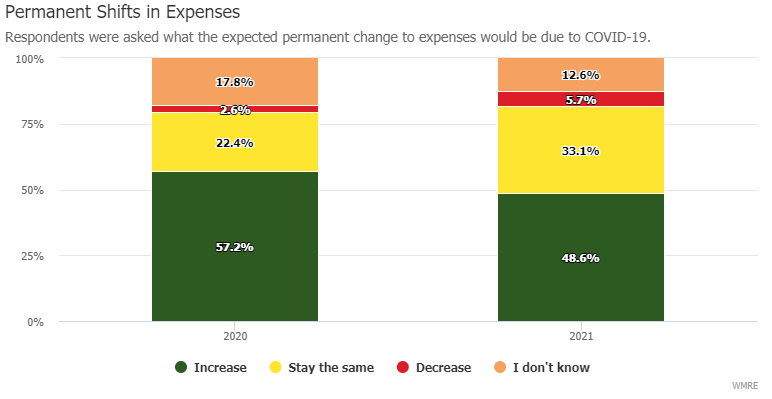
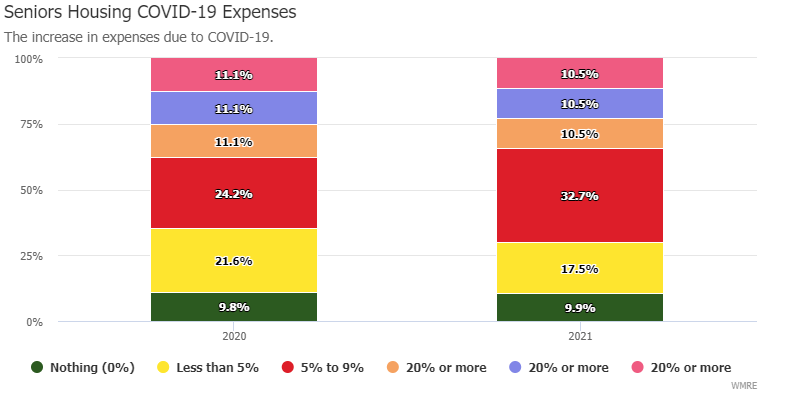
As operators work to regain leasing momentum, they face the added challenge of higher operating expenses. Consistent with the 2020 survey results, the vast majority of respondents (90 percent) saw an increase in their expenses with an estimated mean increase of 9.1 percent. Nearly half of respondents (49 percent) believe those COVID-19 related increases are likely to be permanent. It is notable that the percentage that hold that view has improved compared to 57 percent in the 2020 survey who expected the increased expenses to be permanent. One-third of current survey responds think that expenses are more likely to normalize, 6 percent believe expenses could decline and 13 percent remain unsure.

“Expense pressure is here to stay, and it’s stemming from a few places,” says Mace. Foremost, is labor. Data from the BLS on Average Hourly Earnings for AL properties, for example, were up 5.4 percent at year-end 2020 on a YOY basis. However, hourly earnings also were trending higher before the pandemic. A number of states have increased their minimum hourly wage rates, while difficulty in finding workers and reliance on higher cost temporary workers also are contributing to higher labor costs. Salary and labor expenses are about 60 percent of an operator’s expense load. On top of that is extreme pressure on expenses from insurance rates that are going up across the board as a consequence of the pandemic. There also are likely to be permanent changes associated with the pandemic, such as more focus on cleaning, sanitizing and maintaining a supply of PPE for preparedness of an infectious outbreak.

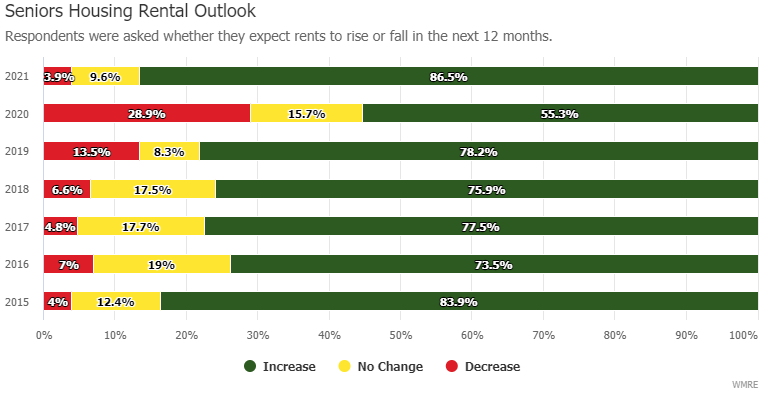
On a positive note, survey respondents are more optimistic on rent growth ahead. A majority of respondents (87 percent) expect an increase in rents over the next 12 months with an average increase of 261 basis points. That is a big shift compared to the 54 percent who thought rents were likely to rise a year ago, and it is more bullish than previous surveys where upwards pf 70 percent of respondents over the prior five years were confident that rents would continue to rise. According to NIC MAP data, asking rents grew by 1.2 percent in second quarter.

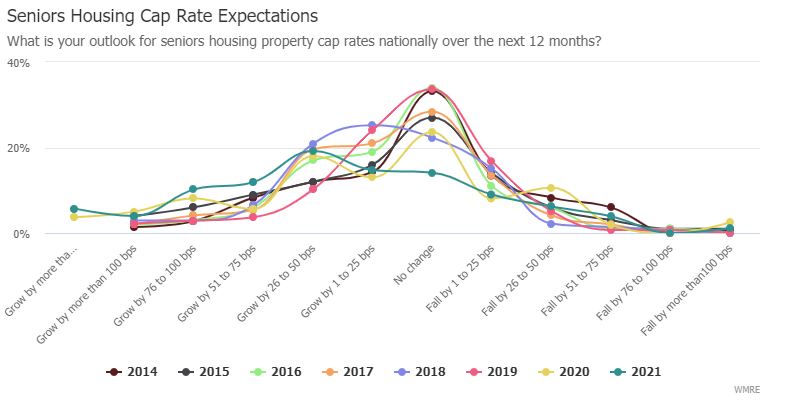
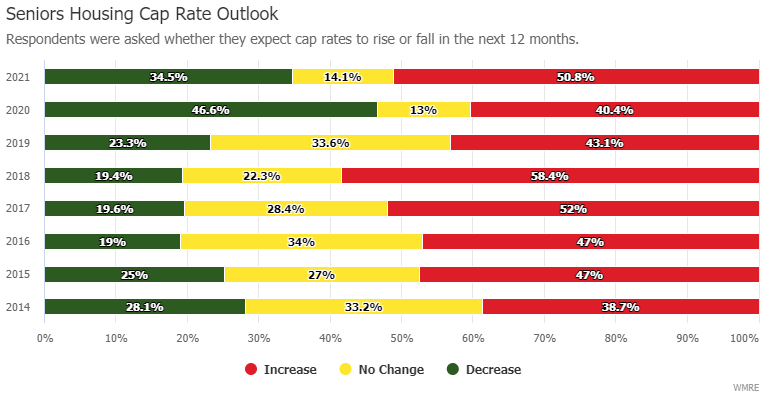
Pressure on NOI is making buyers understandably more cautious on cap rates they are willing to pay for assets. Two-thirds of investors expect cap rates to rise over the next 12 months. That shows a noticeable uptick compared to both 2020 and 2019 survey results where 53 percent and 43 percent respectively thought cap rates would increase in the coming year.

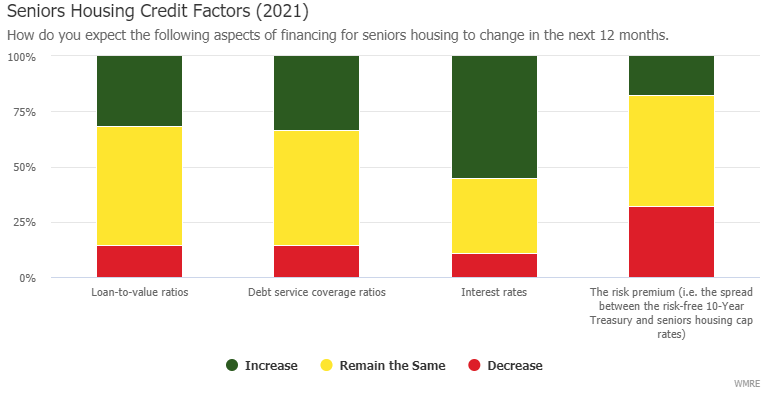
The outlook for higher cap rates is likely tied to anticipation of higher interest rates ahead. Nearly two-thirds of investors believe interest rates will increase over the next 12 months compared to 30 percent who said there will be no change and 5 percent who predict a decline. Additionally, 48 percent think the risk premium will rise, 40 percent anticipate no change and 13 percent believe the risk premium could decline.

house construction

Construction in the Sector Slows

Respondents do expect the pace of building to increase in the next 12 months.

A slowdown in construction and a reduced amount of new supply coming on to the market should help speed the recovery. Construction starts fell sharply after the start of the pandemic in second quarter 2020 and that more subdued pace has continued into second quarter 2021. According to NIC MAP data, construction as a percentage of inventory was 5.0 percent in first quarter, which has declined from levels of 6.6 percent prior to the pandemic in first quarter 2020.

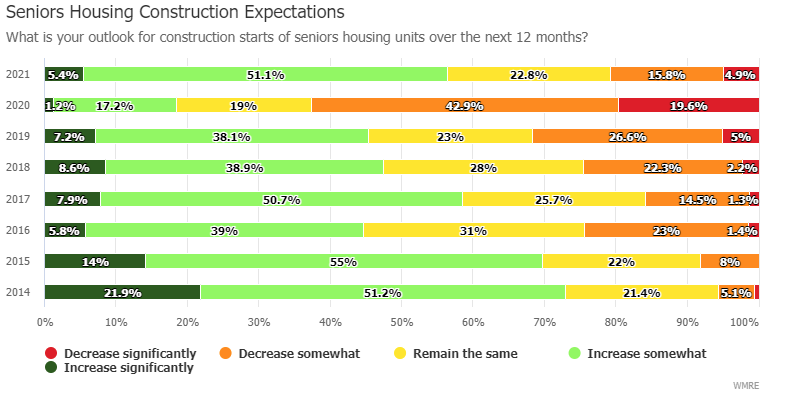
However, respondents expect to see construction pick-up. Fifty-six percent of respondents anticipate seniors housing construction starts to increase over the next 12 months compared to just 18 percent who predicted an increase in the 2020 survey. Nearly one in four respondents believe construction starts will remain the same in the coming year, while 21 percent think construction could decline.

Minneapolis-based Ryan Companies US Inc. is one developer that powered through the pandemic and sees more opportunities ahead. The firm typically averages five project starts per year, and the number of projects it kicked off during 2020 increased to seven. “There was a good opportunity for us to move forward with projects that, when they open two years from now, will have less competition pressure than we’ve had in the last five years,” says Julie Ferguson, senior vice president and sector leader, Senior Living at Ryan Companies US Inc.

Ryan Companies builds communities with a combination of IL, AL and memory care. Its current pipeline of active and planned projects spans 22 senior living developments totaling 4,000 units and valued at more than $1.5 billion in total project costs. Ferguson is not concerned about oversupply in markets that the company has targeted for growth, which include California, Florida, Illinois, Minnesota, Tennessee, Texas, Washington and Wisconsin. “We do heavy due diligence on where we locate communities, as do our peers as we are a very data driven industry,” says Ferguson. “So, while there is a lot of competition, we all look at things slightly differently.”

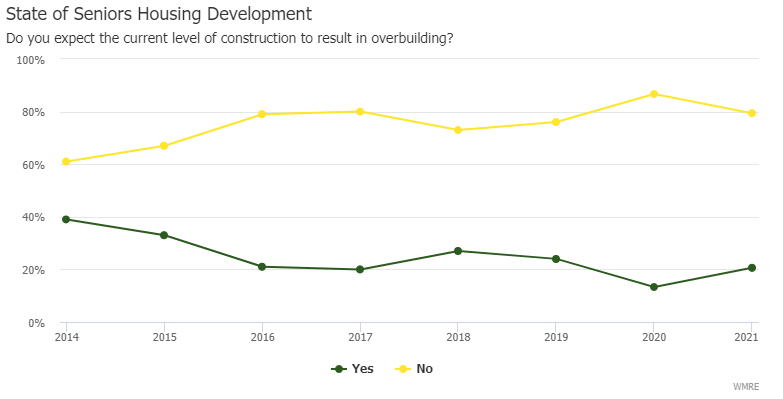
A majority of survey respondents (79 percent) do not think new construction will result in overbuilding. Although it represents a strong majority, sentiment has pulled back from a high of 87 percent in the 2020 survey who were not concerned about overbuilding. Higher construction costs could make it more difficult for some new projects to move forward, especially when also accounting for higher operating costs.

money houses

Capital Moves Off the Sidelines

Industry pros expect debt and equity to become more available in the next 12 months.

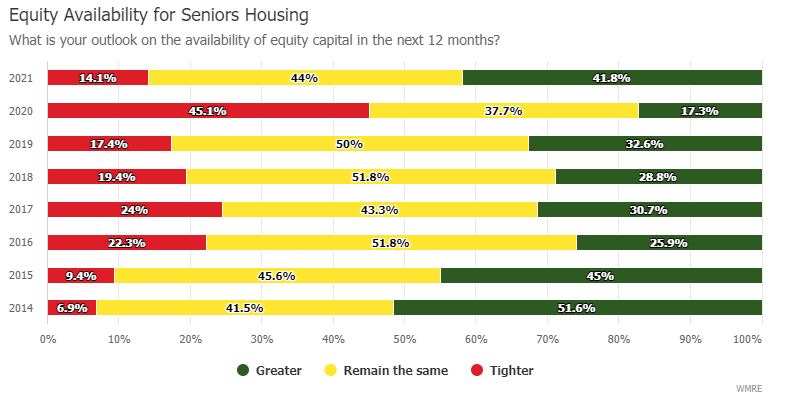
Money is starting to come back to the seniors housing sector after a near total shut-down in financing for new deals during the pandmic. Respondents expect the availability of both debt and equity to improve over the next 12 months. Although 44 percent think availability of equity will remain the same, 42 percent believe it will increase and only 14 percent anticipate a decline. That outlook is distinctly more favorable compared to the 2020 survey where 45 percent predicted that it would be more difficult to access equity.

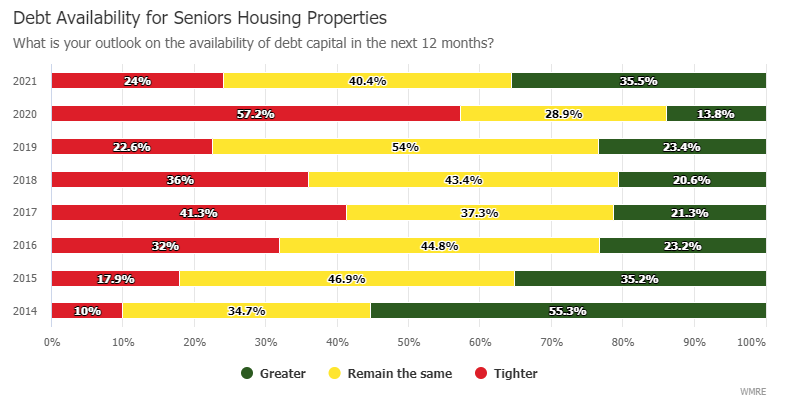
On the debt side, 40 percent believe there will be no change, while 36 percent said availability is likely to increase and 24 percent predict a decline. That sentiment also shows a marked improvement to 2020 when 57 percent thought availability of debt would be tighter.

“The liquidity in the capital markets right now is tremendous,” says Myers. Unlike the 2008 crisis, capital sources during the pandemic were not put at risk. So, when the vaccine came out and the public health crisis began to recede, those various capital sources remain well positioned. Banks, for example, are sitting on billions (if not trillions) in liquidity due to increased deposits from stimulus money. In addition, some of the mortgage REITs are borrowing at 77 basis points over LIBOR, notes Myers. “What you’re seeing is low cost of capital that is prompting investors to say, ‘let’s get something done, because there may never be a time when capital is this affordable again,” he says.

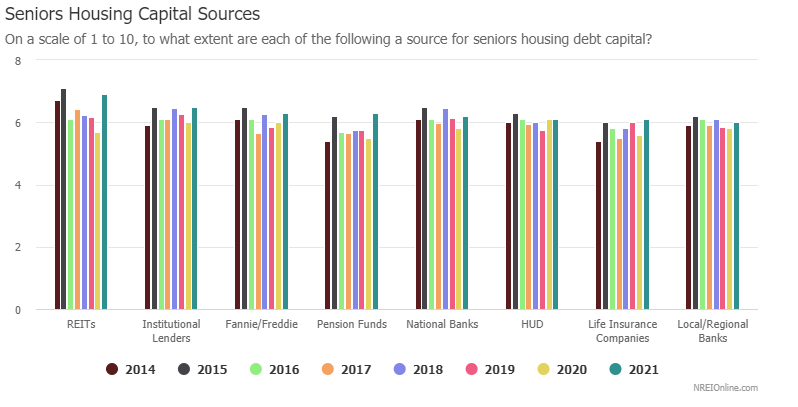
Although banks have traditionally been viewed as a top source of capital in prior surveys, the 2021 survey shows that REITs are now viewed as the most significant source by 42 percent of respondents followed by institutional lenders at 34 percent, pension funds at 32 percent and Fannie Mae/Freddie Mac at 31 percent. Banks rated lower in the survey with local/regional banks at 28 percent and national banks trailing at 24 percent.

That shift in sentiment could be a reflection of the “spottiness” in the bank financing market right now. Some banks have a lot of seniors housing loans on the books that were impacted by the pandemic that may have debt service coverage ratios (DSCRs) below 1.0x. Banks that have that exposure are not going to be willing to put a lot more capital into the market until occupancies improve, notes Stephanie Anderson, head of seniors housing and healthcare at Berkadia. Those banks that have less on their balance sheets are willing to do recourse loans at 1.0x DSCR in anticipation of lease-up ahead. However, anything below 1.0x DSCR is very difficult to achieve in the current market, she adds. According to Anderson, REITs also could be in favor because they are willing to provide higher leverage—up to 90 percent LTV.

Half of respondents predict no change to underwriting over the next 12 months, while 32 percent expect underwriting to become tighter and 18 percent who said standards are more likely to loosen. Although more than half of respondents expect no change to DSCRs and LTVs, 34 percent do think that DSCRs could increase, and 32 percent believe LTVs could increase.

There is a lot of equity capital, as well as a lot of B-piece mezzanine capital, on the sidelines waiting for more stabilization and “underwritable” deals. Investors are cautiously getting off the sidelines and those deals are coming out to the market for financing, notes Anderson. “Historically, seniors housing has been seasonal with more occupancy gains in third quarter. So, we’re coming up to a real test,” she says. Lenders will be watching those numbers closely to see if it will be a long road back or a quicker recovery. “If there is a lot of contraction in vacancy in third quarter, then I would expect that we will see everyone diving back in and loosening underwriting standards,” she adds.

Source: “Cautious Optimism Returns to Seniors Housing Market”

Filed Under: All News

Cushman & Wakefield CEO Expects ‘Full Recovery’ In Office Employment by Mid-2022

August 11, 2021 by CARNM

KEY POINTS
  • Cushman & Wakefield CEO Brett White told CNBC on Wednesday he’s seeing encouraging signs in the commercial real estate market as it overcomes significant coronavirus-related disruption.
  • “We expect full recovery of office employment in the U.S. middle of next year,” he said.
  • Vaccines are the “single largest determinant” of return-to-office plans and the overall health of the office market, White added


The CEO of commercial real estate brokerage firm Cushman & Wakefield told CNBC on Wednesday he’s seeing encouraging signs in the office market as it overcomes significant coronavirus-related disruption.

“We lost about 2.9 million office jobs in April, May of last year. We’ve recovered 2.2 million of those jobs and we expect full recovery of office employment in the U.S. middle of next year,” Brett White said on “Squawk on the Street.” “That’d be two years from the beginning of the pandemic and to put that into context … it took six years” after the 2008 financial crisis, he added.

Office building tours, which are seen as a leading indicator of future leasing revenue, are up by 80%, White said. Currently, he said 75% of leases are being signed for more than four years, while the remaining quarter are 10-year leases.

Major central business districts should see about 88% to 89% office occupancy levels in the next couple of years, he said, adding that the U.S. is experiencing an increase in knowledge-based working jobs that are offsetting a Covid-fueled rise in hybrid workers and people who may permanently work from home.

Before the pandemic, White said the average office floor space was about 65% occupied on a given day, stressing it’s “not reality” that every desk had someone working from it every day. “So we think that the data tells us through the office job employment numbers and forecasts, that we’re going to be back to a fairly stable, fairly regular office occupancy environment in the next couple of years,” White said.

The “single largest determinant” of employees’ return-to-office plans and the overall health of the office market is vaccines, White said, which he believes changed the mindset of most workers and company executives to prioritize a safe environment.

White said while most companies are still waiting to see how the highly transmissible delta variant impacts the trajectory of the epidemic, the recent surge in Covid cases places post-Labor Day plans to reopen offices around mid to late October. He said Cushman & Wakefield, which provides real estate services, delayed its reopening plans by a month.

Many companies, including Amazon, Apple and Lyft, have postponed their in-person fall work plans due to the recent surge in Covid cases fueled by the highly transmissible delta variant. More than a dozen large companies in the U.S. have recently announced vaccine mandates for some or all of their workers to curb the spread of the virus.

″It’s just an overall fundamental trend of movement back to normalcy. It’s going to be rocky, it’s going to be different in every marketplace. … The office space itself may be a little bit different. Hopefully it’s more fun to work in and the technology is better, but I think we’re going to feel a year from now, that for the most part all this is behind us,” White said.

Earlier this week, on Monday, Cushman & Wakefield announced a $150 million partnership with office-sharing firm WeWork. The deal is aimed at helping businesses and landlords evolve the workplace experience for employees in the new hybrid work landscape.

“Companies are thinking about space very differently,” White said. “I think companies realize that the office needs to be a place that attracts people to the office. It needs to be a place that’s fun to work. It needs to be a place that … is rich in technology to help the tenant’s experience within the building.”

Source: “Cushman & Wakefield CEO Expects ‘Full Recovery’ In Office Employment by Mid-2022“

Filed Under: All News

Tenant Needs Are Leading to Big Changes in the Office Sector

August 10, 2021 by CARNM

After what seemed like an eternity, the faucets have been turned on and office real estate projects have begun to flow, for some. This statement may seem a bit over the top, but considering deals were reduced to a trickle at the peak of the pandemic, the recent upticks in activity are a significant, and welcome, change. Organizations that had put the brakes on any moves in 2020 are now beginning to tour properties and execute leases. In many cases, companies are taking advantage of vacant offices to reimagine how their spaces should be designed post-COVID-19 with the goal of creating workplaces that entice employees to return to work. These new environments often include comfortable, collaborative areas where employees can gather together for brainstorming sessions and provide opportunities to become more productive than working from home can offer. Ultimately, this trend will result in a vastly improved office environment that employees will be excited to come to every day.

Improvements aren’t simply about quality, but also quantity. Organizations are analyzing the amount of office space they will need going forward, which has resulted in a large increase in the amount of sublease space hitting the market. Rather than reduce their footprint in response to a recession, tenants have decided to support a portion of the workforce that can permanently work from home. However, unlike in the past, today’s sublease terms are quite flexible and are now marketed to long-term prospects as well as the traditional short-term prospects. They offer below-market rental rates, immediate occupancy, free rent, and tenant improvement dollars. As we emerge from the pandemic, subleases are truly competitive to landlords. To compete, many Landlords in B+ and A- properties are becoming very aggressive, offering more and more free rent and lower rates. But interestingly, as tenants look for quality above all else, the true class-A buildings, outfitted with desirable amenities, have been able to hold their rental prices.

According to Jeremy Kronman, SIOR, Vice Chairman at CBRE, “one bright spot in office leasing the last 90 days has been the true trophy class office buildings. We are continuing to see a flight to quality where class-A space users are demanding the HVAC upgrades, touchless features, and amenities that the trophy buildings adapted during the pandemic, if they did not already have them in place, and where they can more easily coax their employees back to the office. A number of recently executed transactions have emerged where the employer/tenant wants to use this phase-in time as an opportunity to upgrade their employee’s working environment. At the top level of office space, the face rental rates have not been truly impacted.”

It is more important than ever for companies to have access to the most up-to-date market information about any region they reside. Society of Industrial and Office Realtors (SIOR) member brokers, located in 48 chapters around the world, are the local experts that have this information. Tenants need to know which landlords are willing to be competitive, and at the same time, landlords need to know what tenants are currently seeking in terms of timing, pricing, or sublease competition. Having access to brokers with recent market comparables will help all parties understand why rates in certain markets are skyrocketing, while other markets are seeing more tenant incentives than have ever been available. The office market is improving weekly and it is vital that organizations have market experts, such as SIORs, on their team to get started on the right path for the future.

Source: “Tenant Needs Are Leading to Big Changes in the Office Sector“

Filed Under: All News

  • « Go to Previous Page
  • Page 1
  • Interim pages omitted …
  • Page 4
  • Page 5
  • Page 6
  • Page 7
  • Page 8
  • Interim pages omitted …
  • Page 11
  • Go to Next Page »
  • Search Property
  • Join CARNM
  • CARNM Login
  • NMAR Forms
  • All News
  • All Events
  • Education
  • Contact Us
  • About Us
  • FAQ
  • Issues/Concerns
6739 Academy Road NE, Ste 310
Albuquerque, NM 87109
admin@carnm.realtor(505) 503-7807

© 2026, Content: © 2021 Commercial Association of REALTORS® New Mexico. All rights reserved. Website by CARRISTO