• Skip to primary navigation
  • Skip to main content

CARNM

Commercial Association of REALTORS® - CARNM New Mexico

  • Property Search
    • Search Properties
      • For Sale
      • For Lease
      • For Sale or Lease
      • Start Your Search
    • Location & Type
      • Albuquerque
      • Rio Rancho
      • Las Cruces
      • Santa Fe
      • Industry Types
  • Members
    • New Member
      • About Us
      • Getting Started in Commercial
      • Join CARNM
      • Orientation
    • Resources
      • Find A Broker
      • Code of Ethics
      • Governing Documents
      • NMAR Forms
      • CARNM Forms
      • RPAC
      • Needs & Wants
      • CARNM Directory
      • REALTOR® Benefits
      • Foreign Broker Violation
    • Designations
      • CCIM
      • IREM
      • SIOR
    • Issues/Concerns
      • FAQ
      • Ombuds Process
      • Professional Standards
      • Issues/Concerns
      • Foreign Broker Violation
  • About
    • About
      • About Us
      • Join CARNM
      • Sponsors
      • Contact Us
    • People
      • 2026 Board Members
      • Past Presidents
      • REALTORS® of the Year
      • President’s Award Recipients
      • Founder’s Award Recipients
    • Issues/Concerns
      • FAQ
      • Ombuds Process
      • Professional Standards
      • Issues/Concerns
      • Foreign Broker Violation
  • Education
    • Courses
      • Register
      • All Education
    • Resources
      • NMREC Licensing
      • Code of Ethics
      • NAR Educational Opportunities
      • CCIM Education
      • IREM Education
      • SIOR Educuation
  • News & Events
    • News
      • All News
      • Market Trends
    • Events
      • All Events Calendar
      • Education
      • CCIM Events
      • LIN Marketing Meeting
      • Thank Yous
  • CARNM Login
  • Show Search
Hide Search

Archives for May 2022

Commercial Cap Rates Likely to Keep Compressing in 2022 Despite Higher Interest Rates

May 17, 2022 by CARNM

Rising interest rates are likely to put some upward pressure on cap rates in 2022. However, the rise will be modest compared to the increase in the benchmark 91-day Treasury that has already increased by 1.3 percentage points as of the end of April from one year ago (2.7% as of April 26). This is because other factors are creating upward pressure on commercial real estate prices. The apartment market is likely to benefit from the higher mortgage rates due to increased demand for rental units. Reduced consumer spending will tend to lower the demand for industrial space but increased demand for warehouse space to minimize supply disruptions (just-in-case inventory management) could boost absorption. Inflation will hit consumer spending but retail stores providing essential services like the neighborhood centers will do better than retail stores providing non-essential services like high-end shopping malls. The continuing return to the office will also tend to minimize the decline in demand due to slower business formation.

Cap Rate Outlook in 2022

Cap Rate Trends As of 2022 Q1

Cap rates continued to compress across all core property types as of the first quarter of 2022 Q1 even as the benchmark 10-year T-note spiked to 2.8% as of April from 1.5% one year ago. The risk premium, which is calculated as the nominal cap rate less the 10-year Treasury Note yield, continued to compress across all property types. Though interest rates have been rising amid mounting inflation and the Fed’s efforts to control inflation by raising the federal funds rate (with anticipated rate increases every quarter), investors are factoring in the strong demand for commercial assets and local economic conditions. Nationally, employment conditions continue to improve, with 20 million jobs recovered of the 22.5 million jobs lost during 2020, and on average, there are nearly 2 job openings for every job seeker.1
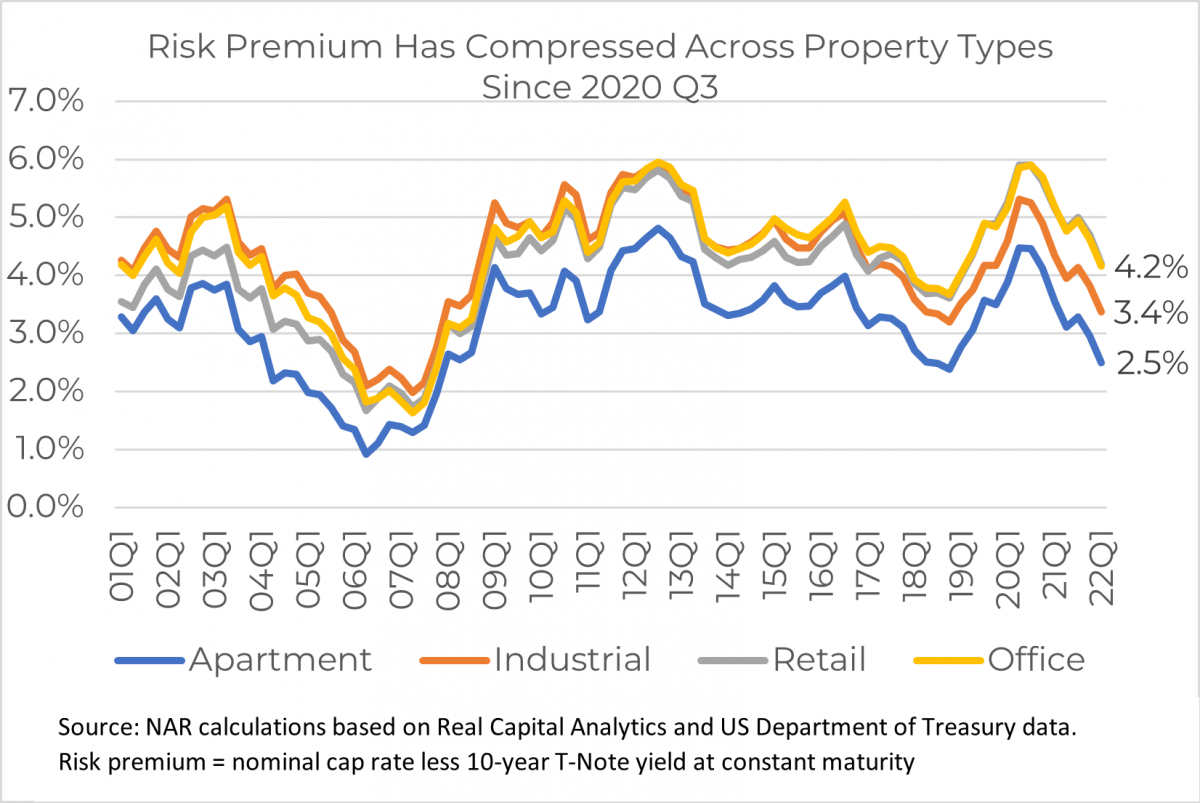
Risk Premium Has Compressed Across Property Types Since 2020 Q3

While cap rates are positively associated with the 10-year yield, cap rates don’t move in lock-step with it. For example, during the height of the pandemic in 2020 Q3, the risk spread for office and retail, which were the hardest hit assets after the economy went into a lockdown and many businesses remained closed, rose to as high as 6%. With an improving economy and the reopening of businesses, the risk-premium for office and retail assets has compressed to around 4%.

Because of the inverse relationship between cap rates and prices, the cap rate compression corresponds to a sharp rise in sales prices. As of 2022 Q1, office real estate prices are up 10% year-over-year on average while prices of retail real estate are up 16%. Industrial properties experienced the strongest price gain of 30% followed by apartment assets at 22%, according to the transaction-based commercial price indices reported by Real Capital Analytics.
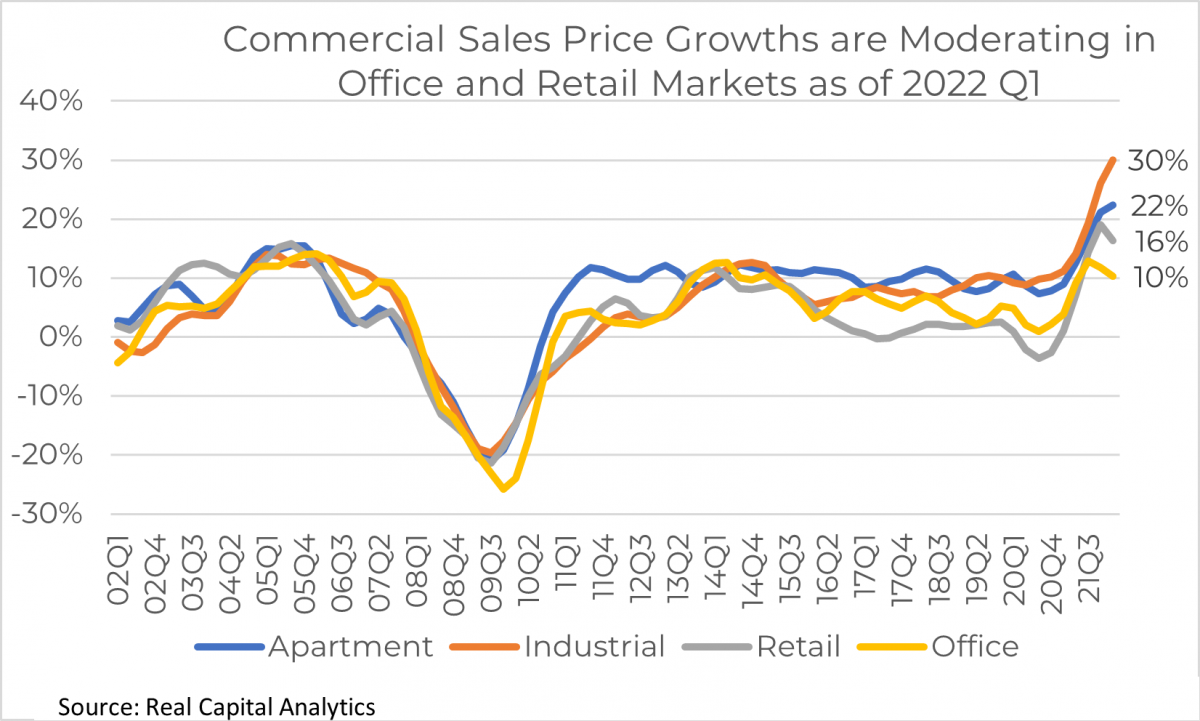
Commercial Sales Price Growth Are Moderating in Office and Retail Markets As of 2022 Q1

Modest Cap Rate Increased in 2022

As of 2022 Q1, the apartment market had the lowest risk premium at 2.5% (3.5% one year ago). Cap rates are likely to continue to compress or hold steady for the apartment market. This is because rising mortgage rates will tend to encourage renters who would have been able to afford a home to remain renters. About 2.6 million renter households ages 25 to 44 years old have been priced out as mortgage rates rose from 3% to over 5%. Moreover, apartment assets are a good hedge against inflation as rents are adjusted annually. In a period of high inflation, investors will look for assets that yield positive returns. Currently, multifamily asking rents are rising 11% year over year2 while single-family apartment rents are up 13% year-over-year.3 With strong apartment demand, cap rates are likely to hover at 4.5% from the 2021 Q1 level of 4.4%.  At the height of the pandemic in 2020 Q2, cap rates were at 5.2%.

Industrial cap rates have also trended downwards to 3.5% (4.3% one year ago). Absorption of industrial space is robust, with the vacancy rate at a low 4.1% and asking rents up 11% year-over-year, also resulting in real net rent growth. However, absorption has been tapered from about 150 million square feet (MSF) in 2021 to about 100 MSF as of 2022 Q2. Slower economic growth and high inflation are likely to slow consumer spending and manufacturing which will reduce the demand for industrial space. However, the shift from just-in-time inventory management to just-in-case inventory management as businesses seek to minimize supply chain disruptions could offset some of the decline in industrial space due to slower business formation. With a slight decrease in demand, cap rates are expected to tick up modestly to 5.7% from the current level of 5.3%. At the height of the pandemic in 2020 Q2, cap rates were at 6%.

Rising inflation will hit the retail sector the most, as consumers cut back on non-essential spending. However, neighborhood centers that are anchored around grocery stores are likely to do well. Moreover, the average vacancy rate is low, 4.5%, and this will tend to support commercial prices. But with slower consumer spending, cap rates are expected to rise to 6.3% from the current level of 6.1%.  At the height of the pandemic in 2020 Q2, cap rates were at 6.6%.

In the office market, the vacancy rate in this property market remains elevated at 12%. However, the higher demand for office space as more workers return to the office is expected to moderate the decline in demand due to slower new business formation. Cap rates are likely to hover at 6.3% from the current level of 6.1%. At the height of the pandemic in 2020 Q2, cap rates were at 6.5%.

Source: “Commercial Cap Rates Likely to Keep Compressing in 2022 Despite Higher Interest Rates“

Filed Under: All News

Will Inflation Derail the Recovery in Restaurant Dining and Leasing?

May 17, 2022 by CARNM

High inflation, including rising gas prices, can disrupt the improving performance of restaurant tenants.

Simmering demand from Americans who missed dining out during the pandemic boiled over in late 2021, resulting in more restaurant visits and increased consumer spending. But inflationary pressures could force consumers to economize, thereby jeopardizing the restaurant industry’s recovery and disrupting retail leasing momentum.

“The biggest shock to me is how well restaurants have been doing,” says Ryan Ash, project director for Vestar, a Phoenix-based shopping center owner with a 30 million-sq.-ft. portfolio located across the western United States. “When you look at their sales numbers, it’s just truly astonishing. Some of these groups are doing over $2,000 per foot in sales—far exceeding what they were posting in 2019 when the world was in a normal condition. They’re hitting percentage rent across the board for the most part, which is great for landlords.”

At the same time, Ash is uncertain as to what is driving the strong performance—the combination of restaurants partnering with delivery services or people spending more money on food. “Whatever it is, it’s really remarkable to see how great they’re doing.”

In the first quarter of 2021, the third round of stimulus payments, the arrival of COVID vaccines and relaxed pandemic restrictions helped increase online and physical visits to U.S. restaurants by 3.0 percent compared to the same period a year before, according to market research company The NPD Group.

But the trend reversed during the first quarter of 2022, with online and physical restaurant visits declining by 2.0 percent over the same period in 2021. Consumer restaurant spending, which reflects higher costs as opposed to increased visits, was up 4.0 percent in the first quarter compared to the year before, when spending rose by 7.0 percent.

“The comparison to last year’s gains in the first quarter and several factors in the macro-environment, including higher food and energy prices, contributed to the first quarter’s softness,” says David Portalatin, food industry advisor for NPD and author of Eating Patterns in America. “With the first quarter behind us, I’m optimistic that seasonal demand and the improving on-premises trends can help get the restaurant industry’s recovery back on track.”

But Portalatin’s expectations could end up unrealized. New data from Revenue Management Solutions shows restaurant traffic in April 2022 was down 9.4 percent year-over-year. The Tampa, Fla.-based restaurant data firm noted that sales haven’t been hit quite as hard because restaurants have raised menu prices to offset widespread inflation. However, lower traffic volume suggests that consumers may finally be reaching their limit.

Restaurants gobble up second generation space

At the beginning of the pandemic, restaurant sales and restaurant leasing activity took huge hits. Since early 2020, more than 100,000 restaurants have closed permanently due to the pandemic, according to the National Restaurant Association.

Though chain restaurants and independently owned eateries both suffered, many mom-and-pop operators lacked the financial wherewithal to survive the shutdowns and reduced foot traffic. Likewise, a large percentage of urban restaurants that relied on office workers to pay their rent shuttered their locations.

“A lot of the weaker players in the restaurant space didn’t survive the pandemic, and now we’re in a situation where the strong have gotten stronger,” says R.J. Hottovy, head of analytical research for Los Altos, Calif.-based Placer.ai, which provides location analytics and foot traffic data. “A lot of companies have very aggressive expansion plans—not just traditional stores, but also new formats.”

From 2015 to 2019, the amount of occupied restaurant space in the U.S. remained essentially flat, according to real estate data firm CoStar. In 2021, however, the amount of occupied restaurant space increased by 1.0 percent, and in the first quarter of 2022, it increased by 0.8 percent. “It’s taken some time, but restaurant leasing has come back,” says Kevin Cody, a strategic consultant with CoStar Advisory Services in Charlotte, N.C.

In recent months, restaurants have accounted for a greater share of leasing than their pre-pandemic average, Cody notes. As of April 2022, restaurants have accounted for almost 12 percent of retail leasing among major retail sectors since the start of 2021, according to CoStar. That number is well above the pre-pandemic average of 8.8 percent.

“There’s more restaurant space in the U.S. now than pre-pandemic,” Cody notes, adding that enclosed malls are the only retail property type with less restaurant space now than pre-pandemic. Open-air centers, meanwhile, have added restaurant space at the fastest rate of all retail property types since the end of 2020, followed by outlet centers, strip centers and neighborhood shopping centers.

Restaurant space at Vestar’s properties is almost fully occupied, according to Ash, who says the firm has experienced “insatiable demand” from restaurant operators. “Expanding national and regional chains are aggressively seeking space, particularly second-generation restaurant space,” he notes. “Because restaurant space is so incredibly expensive to build out, second generation space is a gem in the market. When we’ve had a pandemic-related closure, we have been able to backfill it almost instantaneously.”

With demand so strong, Vestar has been able to achieve strong rent growth from restaurant operators. Starting base rent for second generation space is at least 10 percent higher now than it was pre-pandemic, according to Ash. Moreover, his firm is “adamant” about annual rent increases and percentage rent clauses.

“Historically, landlords may have been a bit looser with percentage rent clauses, but in today’s world, when restaurants are hitting those percentage rent thresholds, it’s very important to keep that percentage rent clause in our leases going forward.”

Increased adoption of delivery and pick-up

Though most of the U.S. has abandoned mask mandates, millions of Americans still aren’t comfortable with indoor dining. And many who are comfortable with it don’t want to sit down in a restaurant every time they crave their favorite foods.

Pre-pandemic, 61 percent of restaurant traffic came from off-premises dining. During the height of COVID-19, it was 90 percent, according to the National Restaurant Association. While that number has gradually been shifting toward more on-premises dining, it might never go back to those pre-pandemic numbers.

Consulting firm Deloitte predicts that convenient off-premises dining has emerged as a permanent fixture in the restaurant sector. Almost two-thirds (64 percent) of consumers do not plan to return to their pre-pandemic habits of dining in restaurants within the next six months. Currently, 61 percent of consumers order takeout or delivery at least once per week, up from 29 percent one year ago and 18 percent prior to the pandemic.

While in-person restaurant activity is essentially back to normal levels, per OpenTable’s restaurant reservation data, and the National Restaurant Association’s foot traffic index, pick-up and delivery orders are likely to remain elevated, Cody predicts.

“Consumer preferences have long been trending towards a desire for greater convenience, as indicated by the growth of online shopping,” Cody says. “This long-term trend, coupled with the pandemic forcing many consumers to become more comfortable using these methods of ordering food, will keep the use of delivery and pick-up elevated, despite a renewed desire to return to eating at physical locations and socializing in person.”

As more people opt for delivery, one in four limited-service, family dining and fast casual operators plan to devote more resources to expanding their off-premises business, according to the National Restaurant Association. For example, fast-casual sandwich restaurant Schlotzsky’s recently opened its first Design 1000 restaurant.

With a drive-thru window on the driver side for traditional drive-thru ordering and a drive-thru window on the passenger side exclusively for first-party and third-party delivery pick-ups, the Design 1000 prototype is a nod to Schlotzsky’s commitment to off-premises access. Though it doesn’t offer any indoor seating, it features a walk-up ordering window.

While restaurants have historically contributed to dwell time at retail properties and generated foot traffic for nearby retailers, delivery and takeout lessen the positive impact.

“Is there as much cross shopping if someone just comes in and picks up food? Probably not,” says Daniel Goldware, senior vice president of leasing for Trademark Property Company, which owns 17 mixed-use properties totaling about 10.7 million sq. ft. across the country. “But I would suggest that takeout brings customers to the shopping center more often, which creates a sense of ease and familiarity with that center. Over time, that turns into awareness and eventually loyalty.”

Can’t catch a break?

Inflation is hitting consumers from every angle, including gas, groceries and rent. In April, the Consumer Price Index was 8.3 percent higher than last year. Historically, dining out has been the first place where Americans cut spending in an inflationary environment. A recent poll conducted by CNBC|Momentive found that more than half of Americans say higher prices have caused them to cut back on dining out in the last six months.

The restaurant industry should brace for even stronger headwinds, according to a new report, “Skyrocketing Gas Prices: What does this mean for restaurants?” Written by Joe Pawlak, managing principal of consumer research firm Technomic, the report detailed survey responses from 475 consumers across the U.S. who drive gas-powered vehicles.

Though gas prices have been elevated for much of the pandemic, they’ve only recently become particularly problematic for consumers. Russia’s invasion of Ukraine created a major spike in oil prices, driving up gas at the pump to more than $4 per gallon on average nationally, an increase of $1.40 compared to last year.

“Historical experience has shown that a spike in gas prices, especially those that result in $4-

plus per gallon, has an impact on consumer restaurant spending,” Pawlak writes, adding that every 50-cent increase in gas prices results in a $68 billion impact on consumer spending. “Based on our survey, a whopping 86 percent of consumers say that rising gas prices are having an effect on their spending on other goods and services, and half say that gas prices are having a significant impact.”

During periods of economic uncertainty, consumers typically cut back on restaurants and other leisure activities. High gas prices are driving the same behavior.

However, food-away-from-home prices are also high, which gives consumers a choice as to where they want to feel the pinch. Experts predict that, all things being equal, consumers will choose the convenience of dining out.

“Prior events and data support Technomic’s view that when consumers feel financially challenged, they don’t typically trade out of foodservice, but rather, they trade down,” Pawlak writes. “Instead of frequenting a higher-end restaurant, a consumer may opt for a less expensive casual dining or fast-casual experience. Or, instead of visiting a sit-down casual-dining restaurant, they move to a QSR.”

Source: “Will Inflation Derail the Recovery in Restaurant Dining and Leasing?“

Filed Under: All News

Investors, End-Users Compete for Last-Mile Warehouses as Rents Skyrocket

May 16, 2022 by CARNM

Rents for these facilities can often be 50 percent above those at distribution facilities in traditional locations.

Last-mile facilities, which were already highly prized in recent years, are emerging as perhaps the most desirable asset class for industrial real estate investors right now.

As WMRE’s recent industrial market study showed, the majority of investors surveyed in 2022 indicated a preference for last-mile warehouses and distribution facilities over warehouses positioned in traditional locations. More than 52 percent of those surveyed chose last-mile warehouses as the most in-demand industrial sub-sector vs. the previous four years, when facilities in traditional locations took that top spot.

What’s playing a role in this preference is investors’ focus on the value-add angle and the opportunity to profitably reposition existing assets, according to Al Pontius, San Francisco-based vice president and national director for office, industrial and healthcare with commercial real estate services firm Marcus & Millichap. Many investors are turning their efforts toward creating last-mile facilities out of older, functionally obsolete warehouses in dense population centers because rising rents in those areas will compensate for the capital invested in the repositioning.

The recent increase in interest rates has made such strategies more profitable than buying stabilized, fully lease assets, creating an opportunity to raise rents to match the current market, according to Pontius. For example, he notes that before the interest rate hike, an asset occupied by a good credit tenant with a seven-year lease would trade at a cap rate of 3.5 percent and the deal would still pencil out for investors because the interest rate would be just 3.0 percent and the investor could expect annual rent growth in the 2-percent range. “But an investor can’t make a deal with a 3.5 percent cap work now because the interest rate is at 5.0 percent, Pontius says.

There is also high demand for space in proximity to tenants’ customers, according to Chicago-based Joe Karmin, executive vice president with commercial real estate services firm Transwestern. He estimates that depending on location, last-mile distribution facilities can generate rents that are 20 to 50 percent above those at traditionally located warehouses—averaging at $12 per sq. ft. vs. $6 per sq. ft.  “We are seeing many investors looking at expanding parking and docks and doing intense renovations to make [buildings in last-mile locations] more suitable for high-end, last-mile users,” says Karmin.

If the site of an obsolete asset in the right location offers five acres of land or more, an investor may replace it with a modern distribution facility, which will generate rents double those of the older facilities, Karmin adds. (One exception are vintage facilities near airports, which can’t be replaced.)

Modern last-mile facilities, with clear height and parking, are the most sought after by end-users, according to Aaron Jodka, director of research, U.S. capital markets, with commercial real estate services firm Colliers International. As a result, developers and investors are competing for last-mile assets on sizable sites. “As industrial property values have increased in recent years, the economics have as well. It is now feasible to acquire under-utilized industrial and replace it with modern product in core and secondary markets, as rents have escalated rapidly across the country, allowing new construction to pencil out.”

Demand for modern last-mile space is so strong that developers that are building facilities on speculation often have tenants already committed before they break ground, Jodka adds.

All types of investors, including private equity, publicly-traded REITs, institutional investors and foreign investment funds, are now seeking opportunities in the last-mile marketplace. Even a handful of family office investors are chasing last-mile deals, according to Karmin.

As a result, last-mile assets that go on the block generate bidding wars involving both real estate investors and end-users, he notes. Karmin recently put a 15,000-sq.-ft. last-mile industrial building on the market in Chicago and within two days had multiple bids from investors and users. “Oftentimes, offers from investors are more appealing than users because they don’t have financing issues,” he notes.

Today, many end-users, both big and small, want to own their last-mile facilities, according to Jodka. For example, Amazon has been actively acquiring it own facilities in recent quarters.

Source: “Investors, End-Users Compete for Last-Mile Warehouses as Rents Skyrocket“

Filed Under: All News

The Dark Side of CRE M&A: Making IT Systems Work Together

May 13, 2022 by CARNM

Not only are there the traditional issues, but also a few novel twists.

When one company acquires another, it usually means a big expansion of its market.

It also meant something else that will become obvious over time: the pain of integrating IT systems.

“Running dual IT systems can be very costly so it is important to execute a strategy to optimize efficiencies following an acquisition,” James McPhillips, a partner in global outsourcing and technology transactions at law firm Pillsbury Winthrop Shaw Pittman, tells GlobeSt.com.

Any time M&A is in force, so is the need to reconcile different computing and other technology systems. Typically, systems don’t immediately talk to one another. Even if they use similar file formats—hardly a given—there’s a lot of work that goes into making things work together. Scheduling, inventories, business processes, and more will be completely different. One of the factors that led to Katerra’s bankruptcy filing in 2021 was the three-companies-per-year pace of acquisition and integration it tried to maintain.

Just integrating third-party software packages alone is tricky. “I see in a lot of companies, when they integrate outside software, usually the software doesn’t get full integration and then the people need to work with different software [packages],” Doris Pitilon, chief technology officer for last mile industrial real estate investment firm Faropoint, told GlobeSt.com in April 2022.

That is cumbersome and an annoyance. Bringing systems from an acquisition together with existing ones in the acquiring company makes bringing in outside software easy in comparison. The companies may be geographically separate, making manual workarounds far harder to pull off.

How the different companies treat data becomes one of the most confounding issues. For example, one program has information on “162 W. Avenue” and another might use “162 West Ave.” The two aren’t automatically the same to software.

Or there is the issue of data labels and what they refer to. Inventory value could mean value of first in, of last in, average, or some other measure. Without reconciling such issues, the “integrated” systems of the new entity may have significant errors in inventory management, accounting, customer relationship management, and other key areas.

“Integration challenges also magnify when a cross-border transaction occurs,” McPhillips adds.  “For example, if a US firm acquires a UK or European entity, then data privacy issues can complicate the integration because the US firm’s IT vendors may not meet EU and UK data privacy requirements, for example, GDPR.  If that is the case, then a complex remediation plan with the US firm’s vendors is likely required.”

All this can be magnified if the M&A is in commercial real estate.

“The integration challenges usually arise because of the sheer volume of vendors with whom a real estate firm does business,” McPhillips says.  “There could be hundreds if not thousands of IT vendors that require some sort of action—deciding whether to let a contract expire or amend it in order to fold in the new business, or keep the work separated.  Tackling such a huge effort requires a strategic plan that weighs factors like timing, cost, and risk.”

None of this means give up on M&A. Just be ready for the technical challenges that will likely appear.

Source: “The Dark Side of CRE M&A: Making IT Systems Work Together“

Filed Under: All News

  • « Go to Previous Page
  • Page 1
  • Interim pages omitted …
  • Page 5
  • Page 6
  • Page 7
  • Page 8
  • Page 9
  • Interim pages omitted …
  • Page 13
  • Go to Next Page »
  • Search Property
  • Join CARNM
  • CARNM Login
  • NMAR Forms
  • All News
  • All Events
  • Education
  • Contact Us
  • About Us
  • FAQ
  • Issues/Concerns
6739 Academy Road NE, Ste 310
Albuquerque, NM 87109
admin@carnm.realtor(505) 503-7807

© 2026, Content: © 2021 Commercial Association of REALTORS® New Mexico. All rights reserved. Website by CARRISTO