• Skip to primary navigation
  • Skip to main content

CARNM

Commercial Association of REALTORS® - CARNM New Mexico

  • Property Search
    • Search Properties
      • For Sale
      • For Lease
      • For Sale or Lease
      • Start Your Search
    • Location & Type
      • Albuquerque
      • Rio Rancho
      • Las Cruces
      • Santa Fe
      • Industry Types
  • Members
    • New Member
      • About Us
      • Getting Started in Commercial
      • Join CARNM
      • Orientation
    • Resources
      • Find A Broker
      • Code of Ethics
      • Governing Documents
      • NMAR Forms
      • CARNM Forms
      • RPAC
      • Needs & Wants
      • CARNM Directory
      • REALTOR® Benefits
      • Foreign Broker Violation
    • Designations
      • CCIM
      • IREM
      • SIOR
    • Issues/Concerns
      • FAQ
      • Ombuds Process
      • Professional Standards
      • Issues/Concerns
      • Foreign Broker Violation
  • About
    • About
      • About Us
      • Join CARNM
      • Sponsors
      • Contact Us
    • People
      • 2026 Board Members
      • Past Presidents
      • REALTORS® of the Year
      • President’s Award Recipients
      • Founder’s Award Recipients
    • Issues/Concerns
      • FAQ
      • Ombuds Process
      • Professional Standards
      • Issues/Concerns
      • Foreign Broker Violation
  • Education
    • Courses
      • Register
      • All Education
    • Resources
      • NMREC Licensing
      • Code of Ethics
      • NAR Educational Opportunities
      • CCIM Education
      • IREM Education
      • SIOR Educuation
  • News & Events
    • News
      • All News
      • Market Trends
    • Events
      • All Events Calendar
      • Education
      • CCIM Events
      • LIN Marketing Meeting
      • Thank Yous
  • CARNM Login
  • Show Search
Hide Search

Archives for February 2023

Active Versus Passive Real Estate Appreciation in Real Estate Litigation

February 22, 2023 by CARNM

Introduction
In the context of partnership disputes or marital dissolution, there may be situations where an appraiser is asked to consider whether real estate appreciation over a period of time is the result of active management decisions versus passive market forces, requiring an appraiser to consider the concept of active versus passive appreciation/depreciation. Evaluating a real estate investment manager’s or trustee’s (“Manager”) impact on asset performance is one of the many issues that may need to be addressed as part of the dissolution or restructuring of real estate ownership interests. The evaluation provides the foundation for questioning and challenging a Manager’s ability to carry out their fiduciary responsibilities and their contribution to asset value; it may also form the basis for a subsequent receivership appointment, trustee replacement and/or forced liquidation of assets. When interested parties are unable to agree on how the real property assets and value are to be divided, it is left to the courts to step in and decide for the interested parties.

An asset’s overall financial performance over a given time frame relative to active and passive appreciation forms a basis for identifying a Manager’s contribution, or lack thereof, to value creation and fiduciary care. However, there is limited to no case law regarding the quantification of active and passive real estate appreciation. Further, the body of appraisal theory and knowledge found in The Appraisal of Real Estate (15th Edition)[1], and The Dictionary of Real Estate Appraisal (7th Edition)[2], is silent as to how to distinguish and quantify active versus passive real estate appreciation.

Real estate appraisers value income-producing assets (including office, retail, industrial and multifamily properties) utilizing the income capitalization approach.[3] This approach converts income into value by dividing the net operating income (“NOI”) by a capitalization rate (“cap rate”), which represents an investor’s unleveraged return on their investment (purchase price).[4] It is the authors’ assertion that a) the cap rate differential between two dates of value is solely passive appreciation (or depreciation), and b) the NOI differential between two dates of value can have both active and passive components contributing to appreciation/depreciation. Classifying appreciation as either active or passive can have far-reaching effects on determining the impact of the Manager’s actions in the resultant value changes under their stewardship.

Active Versus Passive Asset Appreciation
Appreciation is defined as “an increase in the price or value of a property or commodity resulting from an excess of demand over supply or other factors.”[5] Passive appreciation results from externalities, such as market forces, other natural causes, or by the actions of third parties which are outside the control of the Manager.[6]

For instance, the value of an alternative asset such as a work of art may increase over time by its very existence through heightened demand for the artist, general price appreciation within the art world, and inflation. In contrast, income-producing real estate assets require more active management to preserve value, offset depreciation and enable appreciation. Managers of income-producing real estate must maintain the physical condition of the property, secure and retain tenants, satisfy regulatory requirements, collect revenue, and pay operating expenses to maintain and grow value. Therefore, active management is generally assumed to be necessary for most income-producing real estate. However, market forces and other externalities also play a role in financial performance and there may be situations, such as dissolutions, where an appraiser may determine what portion of appreciation results from this active management and what portion results from externalities beyond the Manager’s control.

External factors such as macroeconomics, local market conditions, regulation, and location impact the value of income-producing real property and contribute to passive appreciation. These include, but are not limited to:

  • Macroeconomic conditions including monetary and fiscal policy, and economic growth
  • Capital markets conditions including the availability and cost of capital (rates of return), and financing terms
  • Local market conditions including shifts in supply and demand, which are reflected in occupancy rates, market rents, and expected risk adjusted investment yields
  • Regulatory and legislative requirements, including zoning (land use and density), ease and cost of entitlement, as well as fiscal tax policies and the availability of public benefit incentives
  • Neighborhood characteristics and community/economic development initiatives that affect value, including surrounding land uses and investment/development trends, socioeconomics, environmental conditions, infrastructure, and demand generators.[7]

Appreciation occurs over time and and the authors’ propose a methodology to distinguish between active and passive appreciation and the value of the property at the start and at the end of the period in question. Frequently, the appreciation is measured between the date of partnership (or date of a marriage in a marital litigation) and the date of filing a complaint.

Valuation Methodology
For income-producing real estate properties, analyzing changes in the components of value creation identifies why and how the property has appreciated over time. Identifying whether those changes represent active or passive appreciation determine to what extent it’s a product of the Manager’s actions.

“Income-producing real estate is typically acquired as an investment, and from an investor’s point of view, earning power is the critical element affecting property value. A basic investment premise holds that the higher the earnings, the higher the value, provided the risk remains constant.”[8] The income capitalization approach to value converts the expected earnings of the property into an indication of present value. Direct capitalization (one type of income capitalization) presents as an example of the components within the valuation calculation, which are present in all income approach methodologies.

In the direct capitalization approach, a capitalization rate (alternatively, “cap rate”) “implicitly values the anticipated pattern of income over time”[9] using a single year’s NOI. The revenue and operating expenses of the property are netted to produce NOI; the NOI is then divided by the cap rate to yield the property’s present value before capital expenditures. Expected capital expenditures that are not reflected in NOI assumptions, such as lease-up costs for non-stabilized properties or deferred maintenance, are then deducted from the present value of the stabilized property to yield the derived value. Therefore, the components of value that may change and contribute to the appreciation (or depreciation) of the property are:[10]

  • Capitalization rate,
  • Sources and amounts of revenue,
  • Operating expenses, and
  • Capital expenditures.

“An overall capitalization rate (R0) is an income rate for a total property that reflects the relationship between a single year’s net operating income and the total property price or value. It includes both the return of and return on capital with consideration of the perceived risk and anticipation of future income or value changes by the investor.”[11] The cap rate is determined by numerous, mostly external factors. ”[The rate applied] should reflect the annual rate of return the market indicates is necessary to attract investment capital. This rate is influenced by many factors, including, but not limited to:

  • Degree of perceived risk
  • Market expectations regarding future inflation
  • Prospective rates of return for alternative investments (i.e., opportunity costs)
  • Rates of return earned by comparable properties in the past
  • Availability of debt financing
  • Prevailing tax law[12].

Derivation of appropriate capitalization rates requires diligent analysis and can include, but not limited to:

  • Use of comparable sales with underlying financial data verified by participants to a transaction (primary sources)
  • Use of aggregated market data provided by subscription services such as CoStar and Real Capital Analytics (secondary sources)
  • Use of surveys such as PwC Real Estate Investor Survey, RealtyRates.com Investor Survey, RERC Real Estate Report and those performed by brokerage houses (secondary sources)
  • “Built-up” rates using band of investment or residual analyses[13].

A notable, but rare, non-external factor that could influence the cap rate is the nature (risk) of the property itself. However, the nature of the property is generally static over time; therefore, changes in the cap rate over a specified time period caused by active management of a property are extremely rare, but not impossible. As such, changes in the cap rate over time are essentially considered to be a product of market forces and represent passive appreciation.

Calculating Appreciation
The calculation of appreciation from a change in the cap rate over time is straightforward. Since cap rates in the direct capitalization methodology are the denominator in the calculation of value,[14] the percentage of overall appreciation over the specified time period that is attributable to the change in the cap rate (and thus a portion of the property’s passive appreciation) is the percentage change in the inverse of the capitalization rates. This may be expressed as [1 ÷ Ending Capitalization Rate minus 1 ÷ Beginning Capitalization Rate] ÷ [1 ÷ Beginning Capitalization Rate].

If the cap rate has decreased over the time period, the percentage change in the cap rate multiplied by the change in value over time will yield the amount of passive appreciation attributable to the change in cap rate. If, however, the cap rate increased during that time, the calculation will yield an amount of passive depreciation over the time period.

A simplified base case example of appreciation from an income-producing real property is presented in the following tables and begins with the following assumptions:

  • Investment period beginning on January 1, 2010 and ending 10 years later on December 31, 2019,
  • Net operating income of $300,000 in year 2010 and growing to $550,000 in 2019, and
  • Cap rates of 6.50% in 2010 and 5.00% in 2019.

As presented in the following table, these assumptions result in market values of $4.61M in 2010 and $11M in 2019. These values were derived by dividing the NOI of each year by the corresponding cap rate for that year. The decrease in the cap rate and the increase in NOI over the 10 years resulted in $6.38M of appreciation.

NOI has two distinct components, revenue and operating expenses. The primary variable in NOI over time is revenue, and primarily rent. More often than not, changes in revenue are an appraiser’s primary focus as part of the valuation of active and passive appreciation. The following table demonstrates that 70% or $4.46M of the remaining base case appreciation results from the NOI differential, which may have both an active and passive component.

Typically, property operating expenses fall into a standard range with a steady ratio to revenue over time. Increases in operating expenses generally track inflationary growth and do not significantly contribute to the change in NOI and value over time. If there is a significant change in the operating expenses or the ratio of operating expenses to revenue, the appraiser should understand if a Manager’s actions contributed to this change and determine if they generated active or passive appreciation.

The Impact of Revenue Growth on Active and Passive Appreciation
Income-producing property revenue can increase in two distinct ways: market rent growth and the addition of ancillary sources of revenue. Additional revenue from parking, vending, laundry, cell towers, and signage/billboards is almost always active appreciation resulting from the Manager’s actions, while the classification of market rent growth as active or passive appreciation is more difficult to isolate.

“Inflation is an increase in the volume of money and credit, a rise in the general level of prices, and the erosion of purchasing power.”[15] Other market forces that can increase rental rates include inventory deficiencies, addition of demand generators (e.g., construction of a new corporate headquarters), demographic changes, and changes in regulatory requirements—all natural causes or caused by the action of third parties.

Although market rent growth does not result directly from the actions of the Manager, if the property was not actively managed (as required of most income-producing real estate), the underlying revenue (from tenants and other sources) would not have been maintained and the growth would not have been captured. Therefore, preservation of revenue and increasing rents to track market growth typically require active management, and the authors’ posit that appreciation from inflationary market rent growth would be active appreciation.

Changes in the consumer price index (“CPI”) can be used to identify inflationary growth in net operating income. As noted above, operating expenses can generally be assumed to track inflation, and any growth in NOI in excess of inflation will typically be from revenue growth or other active management activities. The inflationary portion of NOI growth is captured by the active management required to maintain the revenue stream of the property.

As presented in the following table, the NOI and CPI grew at an annual rate of 6.25% and 4.72%, respectively. Dividing the annual CPI growth from the annual NOI growth resulted in 75.55% of active appreciation, the percent of NOI growth attributable to inflation.

The remaining $1.09M or 24.45% of appreciation from the NOI differential may be active or passive appreciation. An appraiser needs to examine the cause of the revenue changes and determine whether these changes result from active or passive appreciation. The remaining appreciation may be caused by other market forces, by additional revenue, or, in rare cases, by significant decreases in operating expenses such as tax appeals or tax abatements.

It is the authors’ opinion that capital expenditures made over the time period require an active management decision, and any improvement in NOI attributed to those expenditures would be considered active appreciation. Rental growth resulting from active management is a product of specific actions (and often capital expenditures) taken by the Manager such as providing new amenities, upgrading building systems, improving common areas, or other significant periodic upgrades to actively obtain higher rents. Other examples of capital expenditures may include lease-up costs/concessions, deferred maintenance, the addition of tenant space, technological upgrades, and interior or exterior upgrades.

However, if the base case NOI and CPI growth were reversed (CPI growth was 6.25% and the NOI growth was 4.72%), then the authors’ posit that NOI is not keeping up with inflation and 100% of the NOI differential would be classified as active appreciation—and demonstrate a Manager’s failure to achieve market-rate performance. This result would provide the foundation for questioning and challenging a Manager’s ability to carry out their fiduciary responsibilities.

If the base case assumptions are changed and cap rates are assumed to have increased or remained the same over time, then the differential in NOI will contribute to all of the property’s appreciation. (Note that as cap rates increase, values decline if all other components of the value calculation stay the same.)

For example, and as presented in the following table, assuming the cap rate increased from 5.0% to 6.5% over the ten-year period, then $2.46M in appreciation results from the increase in NOI over the period. It is the authors’ opinion that the depreciation attributed to the increase in cap rates is considered passive appreciation.

Conclusion
Real estate appraisers value income-producing assets utilizing the income capitalization approach which converts income into value by dividing the NOI by a cap rate. The cap rate differential between two dates of value is solely passive appreciation (or depreciation), assuming changes in the cap rate over time are effectively a product of market forces. The NOI differential between two dates of value can have both an active and passive component contributing to appreciation. Income-producing real estate requires active management to maintain and grow revenue and enable appreciation. The Manager must maintain the property’s physical condition, secure and retain tenants, satisfy regulatory requirements, collect revenue, and pay operating expenses just to preserve value. Thus, in income-producing real estate, most appreciation from changes in NOI can be defended as active.

Source: “Active Versus Passive Real Estate Appreciation in Real Estate Litigation“
Filed Under: All News

Tax Considerations Relating to Debt for Distressed CRE Owners

February 22, 2023 by CARNM

Negative cash flows, high vacancy rates, environmental and geographic concerns and other macroeconomic factors are all risks, and, therefore, reasons why real estate owners may experience operating distress. Furthermore, real estate owners commonly finance the acquisition of properties with debt, which comes along with various debt covenants, restrictions and debt service requirements. As a result of a lack of viability for servicing debt and/or where the fair market value of real property decreases below the remaining balance of debt, real estate owners need to review potential options and outcomes, including the harsh potential of a foreclosure.

In addition to analyzing the economics of a distressed position, real estate owners must consider the tax implications of the various outcomes surrounding debt. In the worst-case scenario of a foreclosure, not only can an owner lose a property, but also be subject to income tax on phantom income.

There are various outcomes relating to debt for a real estate owner in distress. A lender may agree to a reduction of the principal balance of the debt or alternatively allow a borrower to settle the debt at a discount. In other cases, a lender may allow for a debt workout whereby the terms of the debt are modified. In each of these first three scenarios, the real estate owner retains the property. In other scenarios, a real estate owner unfortunately loses the property. A real estate owner may look to sell the asset in a fire sale in order to satisfy the debt balance without going through a foreclosure transaction or alternatively may give up the property in a deed-in-lieu of foreclosure transaction. Ultimately without a satisfactory negotiation result, a lender may foreclose on the loan and force a sale of the asset.

Key factors and definitions

Each of the distress scenarios have tax implications that need to be considered and are discussed in the tables below, which separate the scenarios between when an owner is able to retain the real property vs. when the real property is disposed of. Several key factors and definitions need to be understood prior to considering the tax implications of a given scenario:

•           Solvency: A taxpayer’s status of solvent or insolvent is determined by comparing the taxpayer’s liabilities and assets (at fair market value) immediately prior to discharge of a debt. A taxpayer is deemed insolvent to the extent the taxpayer’s liabilities exceed the value of assets. For non-recourse debt that exceeds the fair market value of property, only the amount of debt actually discharged (in addition to the amount of debt equal to fair market value) is factored into the insolvency computation. If debt is held by a partnership, the solvency factor and availability of exclusions, discussed later, are generally determined at the partner level rather than the partnership level.

•           Fair market value: The Supreme Court in United States v. Cartwright, 411 U.S. 546 (1973), as well as Treasury Regulation § 1.170A-1(c)(2) both provide that the fair market value of property is the price at which the property would change hands between a willing buyer and a willing seller, neither being under any compulsion to buy or to sell and both having reasonable knowledge of relevant facts. Furthermore, “the determination of fair market value is a question of fact, and the trier of fact must weigh all relevant evidence and draw appropriate inferences.” Estate of Adell v. Comm’r of Internal Revenue, 108 T.C.M. (CCH) 107 (2014) (citing Comm’r v. Scottish Am. Inv. Co., 323 U.S. 119 (1944)). For foreclosure transactions, guidance exists that the sale price of property at a foreclosure sale is presumed to be its fair market value, absent clear and convincing proof to the contrary.

•           Reduction of tax attributes: Certain exclusions of income from the discharge of debt, discussed later, require that a taxpayer reduce certain tax attributes, thereby deferring the recognition of income to a later date. The taxpayer’s attributes are reduced in the following order: (1) net operating losses, (2) general business credit, (3) minimum tax credit, (4) capital loss carryovers, (5) basis of property, (6) passive activity loss and credit carryovers and (7) foreign tax credit carryovers. Alternatively, a taxpayer may elect to first reduce the basis of the taxpayer’s depreciable property.

•           Non-recourse vs. recourse debt: For discharge of indebtedness purposes, the classification of a discharged debt as non-recourse or recourse is a significant factor as the type and amount of income a taxpayer recognizes is directly affected. A debt is classified as recourse if a lender can reach all of the taxpayer’s assets. A debt is classified as nonrecourse if the lender’s sole recourse is against the collateral subject to the debt.

The rules for classifying debt as non-recourse vs. recourse for purposes of debt allocations to partners in a partnership are different than those rules for classifying debt as non-recourse vs. recourse for the discharge of indebtedness rules. For example, although the partners of a partnership may not be treated as having recourse debt on their K-1s from a partnership (i.e., because of no personal liability), the debt may still be considered recourse to the partnership for discharge of indebtedness purposes if the lender can go after any of the partnership’s assets.

Real estate structures are commonly set up to include special purpose entities as the property owning and/or borrowing entities which are disregarded for federal tax purposes in that they are wholly owned by a parent holding entity which is regarded for tax purposes. In regard to debt owned by a disregarded entity, even though such debt may be recourse at the disregarded entity level where a lender could reach all of the disregarded entity’s assets, the IRS has ruled on multiple occasions that such debt is non-recourse with respect to the regarded parent entity since the lender can only go after a specified subset of assets (i.e., the disregarded entity’s assets).

In general, the non-recourse vs. recourse determination is highly based on facts and circumstances and there are differing interpretations on the topic. For example, case guidance exists discussing debt where a lender could go after all of a partnership’s assets; however, the terms of the partnership’s agreement would have prohibited the partnership from acquiring any additional assets that would not be subject as collateral of debt. While the court in Great Plains Gasification Assocs. v. Commissioner, 92 T.C.M. (CCH) 534 (2006) found this fact to being supportive of the determination that such debt would be characterized as nonrecourse, the IRS subsequently questioned several findings of the case and left open uncertainty regarding how much reliance could be placed on the case.

•           Qualified real property business indebtedness (“QRPBI”): Discharge of indebtedness income relating to QRPBI may be eligible for exclusion under certain circumstances. QRPBI is defined as indebtedness that meets three requirements: 1) incurred or assumed by the taxpayer in connection with real property used in a trade or business and is secured by such real property, 2) incurred or assumed before January 1, 1993, or if incurred or assumed on or after such date, is qualified acquisition indebtedness, and (3) is subject to an election made by the taxpayer to have the exclusion for such debt apply.

Real Estate Debt Scenarios and Tax Implications

Scenarios where real property is retained

Scenario

Tax Implications

Lender reduces principal balance or agrees to settle debt at a discount Solvent taxpayer : Discharge of indebtedness income is recognized as ordinary income by solvent taxpayers.

However, if the discharge of indebtedness income relates to QRPBI, some, or all, of such income may be excluded from income, subject to two limitations:

1. The exclusion cannot exceed the excess of the debt immediately before the discharge over the real property’s net fair market value at such time. Net fair market value means the fair market value of the qualifying real property, reduced by the outstanding principal amount of any QRPBI (other than the discharged indebtedness) that is secured by such property immediately before and after the discharge.

Note that this rule operates in a manner so as to prohibit the creation of equity in real estate tax free. For example, if the fair market value of property is $1,000,000 with debt of $1,200,000, the exclusion would apply against up to $200,000 of income (whereby fair market value would then equal debt). If any additional exclusion were allowed, equity would be created (i.e., if $300,000 is discharged, the taxpayer would then have $100,000 of equity: $1,000,000 of fair value less $900,000 of debt).

2. Furthermore, the amount excluded cannot exceed the aggregate adjusted bases of depreciable real property held by the taxpayer immediately before the discharge (after reduction for any depreciation claimed during the year as well as any basis adjustments under the insolvent tax attribute reduction rules).

The amount excluded from gross income under the QRBI rules reduces the basis of the depreciable real property of the taxpayer.

For partnerships that own real property with QRPBI, while the determination of QRPBI and fair market value limitations are applied at the partnership level, the election to have the exclusion apply is made at the partner level and furthermore the exclusion from income applies at the partner level. Correspondingly, a partner must consider the basis reduction that is required. To that end, any interest of a partner in a partnership will be treated as depreciable real property to the extent of such partner’s proportionate interest in the depreciable real property held by such partnership. Furthermore, a corresponding reduction in the partnership’s basis in depreciable real property with respect to such partner is made.

Insolvent taxpayer : The tax outcome for insolvent taxpayers depends on whether a bankruptcy scenario exists. For insolvent taxpayers not in bankruptcy, the discharged amount of debt is bifurcated into two buckets.

1. The first bucket consists of an amount of discharge which is eligible to be excluded from income subject to a limitation equal to the amount by which the taxpayer is insolvent (i.e., excess of liabilities over fair market value of assets, immediately before discharge). Tax attributes of the taxpayer need to be reduced equal to the exclusion amount (effectively deferring the recognition of the income).
2. The second bucket consists of the remaining amount of debt discharged and is treated similarly to a discharge of debt for solvent taxpayers.

For taxpayers in a bankruptcy case, the entire amount of debt discharged is subject to exclusion; however, tax attributes of the taxpayer need to be reduced (effectively deferring the recognition of the income).

Special rule for purchase money mortgages : If the seller of the property was the lender at the time of purchase, and the seller continues to be the holder of the debt, the reduction of debt is treated as a purchase price adjustment if the taxpayer is solvent. This option is generally not applicable for insolvency or bankruptcy scenarios.

Note that unlike the general exclusion rules which apply at the partner level, the exclusion for purchase money mortgages applies at the partnership level. Furthermore, for real property and debt held by a partnership, the insolvency or bankruptcy status of a partnership is disregarded. The IRS has stated it will not challenge the purchase price adjustment at the partnership level if all other requirements are met (i.e., other than the insolvency / bankruptcy status).

Lender and borrower agree to a debt workout (i.e., modifications to terms of debt) The general theory surrounding debt workouts / modifications is that a modification to a debt is significant enough that the borrower is deemed to issue a new debt instrument in exchange for the existing debt. The issue price of such new instrument is treated as an amount of money which satisfies the existing debt. If this deemed amount of money is less than the existing debt, discharge of indebtedness income results for the taxpayer. Note that a pure reduction of the principal balance of debt is from the outset discharge of indebtedness income as discussed earlier.

Two key requirements need to be met in order for a deemed exchange to occur under the debt modification rules.

1. A modification needs to exist. In general, a modification means any alteration, including any deletion or addition, in whole or in part, of a legal right or obligation of the issuer or a holder of a debt instrument.
2. The modification needs to be deemed significant. The regulations provide several examples of specific modifications that are significant as well as a catch-all general rule. The general rule is that a modification is a significant modification only if, based on all facts and circumstances, the legal rights or obligations that are altered and the degree to which they are altered are economically significant. The specific modifications discussed in guidance are 1) changes in yield, 2) changes in timing of payments, 3) changes in obligor or security, and 4) changes in the nature of a debt instrument. Thresholds for where each of such changes is deemed significant are provided in the guidance.

Some examples of modifications that are not significant modifications are the following:

1. A modification that adds, deletes, or alters customary accounting or financial covenants.

2. A temporary forbearance from collection efforts or acceleration clauses by a lender for a period up to two years plus any additional period of good faith negotiations.

Scenarios where real property is disposed of

Scenario

Tax Implications

Real estate owner sells real property or lender forecloses and forces a sale of real property Normal gain or loss rules apply relating to sales of property. The gain from the sale of property is the excess of the amount realized over the adjusted basis. If instead there is an excess of adjusted basis over the amount realized, there is a loss on the sale of the property. The sale of real property used in a trade or business is generally treated as Section 1231 gain or loss.

Amount realized from a sale includes cash and the FMV of any property received in the transaction. If there is sufficient cash to pay off the debt on the property, the transaction is treated like any other disposition of property.

If sales proceeds are insufficient to pay off all debt and the lender discharges any remaining balance, such discharged amount is added to the amount realized if such debt is considered nonrecourse debt and therefore would factor into the gain or loss computation.

For recourse debt, any discharged amount would be treated as discharge of indebtedness income similar to any other discharge income which would be ordinary income; however, subject to the insolvency and bankruptcy exclusions described above.

Real estate owner transfers real property to lender in satisfaction of debt in a deed-in-lieu of foreclosure transaction The transaction is treated as a sale of property where the amount realized is equal to the amount of the debt which is satisfied by the transfer. The difference between the amount realized and the adjusted basis of the property produces gain or loss on the disposition. The sale of real property used in a trade or business is generally treated as Section 1231 gain or loss.

If the debt is nonrecourse debt, the entire amount of the debt is treated as the amount realized.

If the debt is recourse debt and such debt exceeds the fair market value of the property, the transaction is bifurcated into two transactions. The fair market value of the property is the amount realized for purposes of determining the gain or loss on the deemed sale of the property. The excess of the recourse debt over the fair market value of the property is treated as discharge of indebtedness income which is ordinary income, however subject to the insolvency and bankruptcy exclusions described above.

Other considerations and next steps

As noted in the scenarios above, a deemed sale occurs in most scenarios where real property is transferred voluntarily or involuntarily in satisfaction of debt. Typical recapture and recharacterization rules therefore apply in such transactions. For example, ordinary income recapture for accelerated depreciation, as well as unrecaptured 1250 gain characterization, apply in such cases.

In determining the amount of an unpaid mortgage, unpaid interest is included as part of the amount realized on the discharge of debt. Thereby, for non-recourse debt, this additional amount realized affects the amount of Section 1231 gain or loss on disposition. For recourse debt where the total debt is greater than the fair market value of the property, additional discharge of indebtedness ordinary income is recognized.

As a result of the various nuances involved with distressed real estate and the related debt, careful planning and analysis are required to achieve the most tax efficient results. The loss of a real estate property can be economically devastating, however the possibility of phantom taxable income on top of such loss can create even more economic hardship. A detailed review of the potential workout options with a lender, the non-recourse vs. recourse nature of the debt, solvency of the owner and/or partners of a partnership and analysis of potential exclusions are all important steps when dealing with any distressed real estate scenario. As a result, consultation with a tax advisor is highly recommended.

Source: “Tax Considerations Relating to Debt for Distressed CRE Owners“

Filed Under: All News

2023’s Property Taxes by State

February 21, 2023 by CARNM

Depending on where you live, property taxes can be a small inconvenience or a major burden. The average American household spends $2,690 on property taxes for their homes each year, according to the U.S. Census Bureau, and residents of the 26 states with vehicle property taxes shell out another $444. Considering these figures and the massive amount of debt in America, it should come as no surprise that more than $14 billion in property taxes go unpaid each year, according to the National Tax Lien Association.

And though property taxes might appear to be a non-issue for the 35% of renter households, that couldn’t be further from the truth. We all pay property taxes, whether directly or indirectly, as they impact the rent we pay as well as the finances of state and local governments.

But which states have the largest property tax load, and what should residents keep in mind when it comes to meeting and minimizing their tax obligations? In search of answers, we analyzed the 50 states and the District of Columbia in terms of real-estate and vehicle property taxes. We also asked a panel of property-tax experts for practical and political insight.

Real-Estate Tax Ranking

115151
State Rank
Hawaii 1
Alabama 2
Colorado 3
Nevada 4
Louisiana 5
South Carolina 5
District of Columbia 7
Delaware 8
Utah 8
West Virginia 10
Wyoming 11
Arkansas 12
Arizona 12
Idaho 14
Tennessee 15
California 16
Mississippi 17
New Mexico 18
North Carolina 18
Virginia 20
Montana 21
Indiana 21
Kentucky 23
Florida 24
Oklahoma 25
Georgia 25
Oregon 27
Washington 28
Missouri 29
North Dakota 30
Maryland 31
Minnesota 32
Massachusetts 33
Alaska 34
South Dakota 35
Maine 36
Kansas 37
Michigan 38
Ohio 39
Pennsylvania 39
Rhode Island 39
Iowa 42
Nebraska 43
New York 44
Wisconsin 44
Texas 46
Vermont 47
New Hampshire 48
Connecticut 49
Illinois 50
New Jersey 51
EMBED ON YOUR WEBSITE

Real-Estate Property Tax Rates by State

Rank
(1=Lowest)
 

State

Effective Real-Estate Tax Rate 

Annual Taxes on $244.9K Home* 

State Median Home Value 

Annual Taxes on Home Priced at State Median Value 

1 Hawaii 0.29% $700 $662,100 $1,893
2 Alabama 0.41% $1,007 $157,100 $646
3 Colorado 0.51% $1,243 $397,500 $2,017
4 Nevada 0.55% $1,346 $315,900 $1,736
5 Louisiana 0.56% $1,384 $174,000 $983
5 South Carolina 0.56% $1,379 $181,800 $1,024
7 District of Columbia 0.57% $1,402 $635,900 $3,641
8 Delaware 0.58% $1,426 $269,700 $1,570
8 Utah 0.58% $1,418 $339,700 $1,967
10 West Virginia 0.59% $1,437 $128,800 $756
11 Wyoming 0.61% $1,484 $237,900 $1,442
12 Arkansas 0.62% $1,513 $142,100 $878
12 Arizona 0.62% $1,520 $265,600 $1,648
14 Idaho 0.63% $1,546 $266,500 $1,682
15 Tennessee 0.66% $1,606 $193,700 $1,270
16 California 0.75% $1,828 $573,200 $4,279
17 Mississippi 0.79% $1,937 $133,000 $1,052
18 New Mexico 0.80% $1,948 $184,800 $1,470
18 North Carolina 0.80% $1,963 $197,500 $1,583
20 Virginia 0.82% $2,006 $295,500 $2,420
21 Montana 0.83% $2,033 $263,700 $2,189
21 Indiana 0.83% $2,021 $158,500 $1,308
23 Kentucky 0.85% $2,084 $155,100 $1,320
24 Florida 0.86% $2,110 $248,700 $2,143
25 Oklahoma 0.90% $2,194 $150,800 $1,351
25 Georgia 0.90% $2,192 $206,700 $1,850
27 Oregon 0.93% $2,266 $362,200 $3,352
28 Washington 0.94% $2,311 $397,600 $3,752
29 Missouri 0.98% $2,389 $171,800 $1,676
30 North Dakota 1.00% $2,441 $209,900 $2,092
31 Maryland 1.07% $2,628 $338,500 $3,633
32 Minnesota 1.11% $2,708 $250,200 $2,767
33 Massachusetts 1.20% $2,936 $424,700 $5,091
34 Alaska 1.22% $3,000 $282,800 $3,464
35 South Dakota 1.24% $3,040 $187,800 $2,331
36 Maine 1.28% $3,143 $212,100 $2,722
37 Kansas 1.43% $3,500 $164,800 $2,355
38 Michigan 1.48% $3,630 $172,100 $2,551
39 Ohio 1.53% $3,748 $159,900 $2,447
39 Pennsylvania 1.53% $3,751 $197,300 $3,022
39 Rhode Island 1.53% $3,752 $292,600 $4,483
42 Iowa 1.57% $3,843 $160,700 $2,522
43 Nebraska 1.67% $4,102 $174,100 $2,916
44 New York 1.73% $4,231 $340,600 $5,884
44 Wisconsin 1.73% $4,243 $200,400 $3,472
46 Texas 1.74% $4,255 $202,600 $3,520
47 Vermont 1.90% $4,652 $240,600 $4,570
48 New Hampshire 2.09% $5,120 $288,700 $6,036
49 Connecticut 2.15% $5,256 $286,700 $6,153
50 Illinois 2.23% $5,465 $212,600 $4,744
51 New Jersey 2.47% $6,057 $355,700 $8,797

*$244,900 is the median home value in the U.S. as of 2021, the year of the most recent available data.

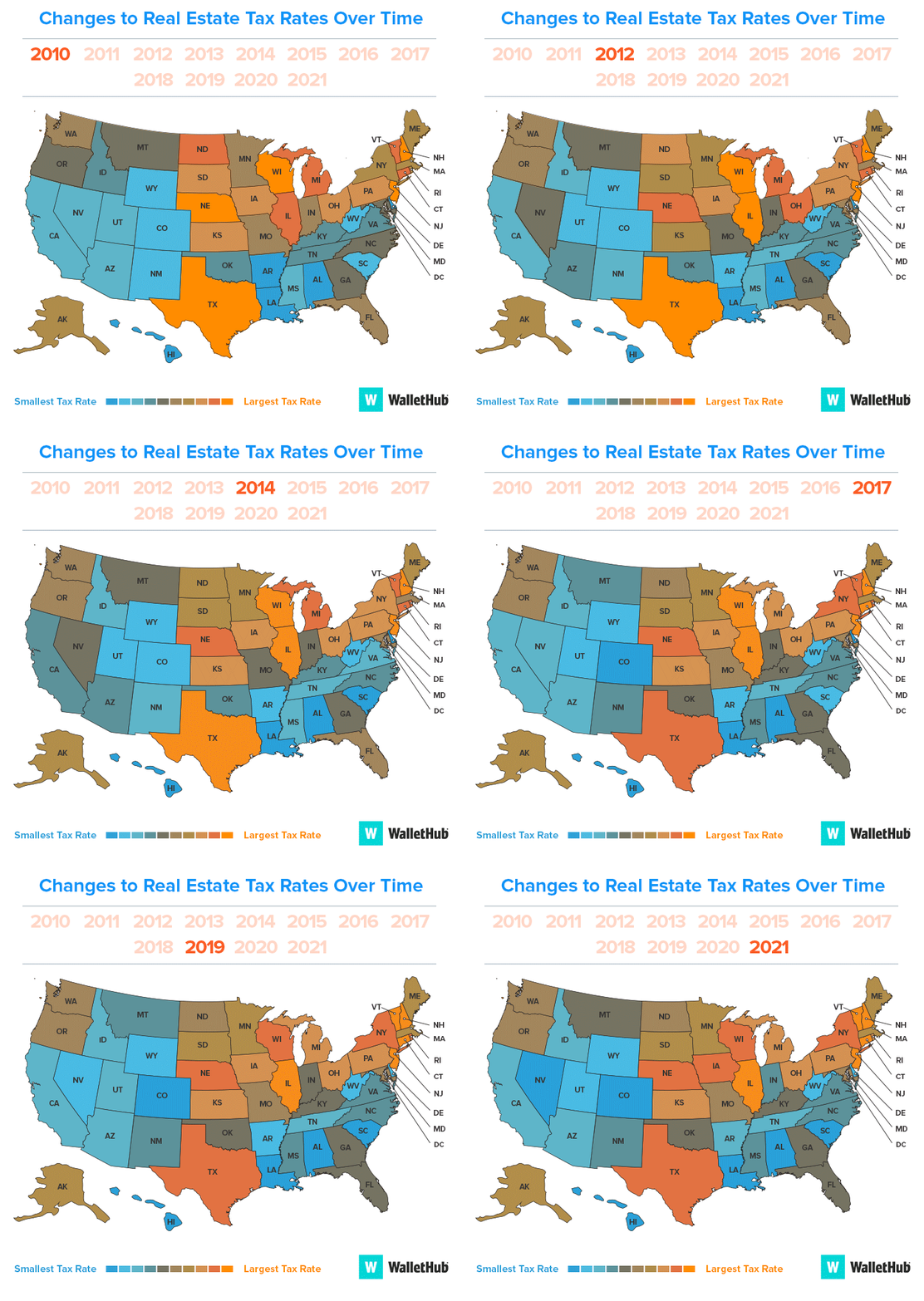
Changes to Real-Estate Tax Rates Over Time

rankings 2010 2021 real estate tax states

EMBED ON YOUR WEBSITE

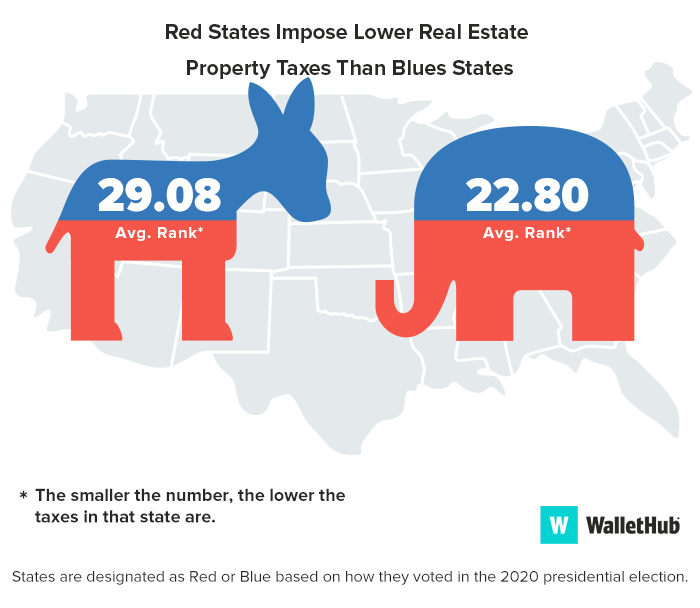
Red States vs Blue States

blue vs red image patriotic 2022

Vehicle Property Tax Ranking

115151
State Rank
Hawaii 1
District of Columbia 1
Delaware 1
Utah 1
Idaho 1
Tennessee 1
New Mexico 1
Florida 1
Oklahoma 1
Georgia 1
Oregon 1
Washington 1
North Dakota 1
Maryland 1
Alaska 1
South Dakota 1
Ohio 1
Pennsylvania 1
Rhode Island 1
New York 1
Wisconsin 1
Texas 1
Vermont 1
Illinois 1
New Jersey 1
Louisiana 26
Michigan 27
California 28
Alabama 29
Iowa 30
Arkansas 31
North Carolina 32
Montana 32
Minnesota 34
Indiana 35
Kentucky 36
Nebraska 37
West Virginia 38
Arizona 38
Colorado 40
Wyoming 41
New Hampshire 41
Nevada 43
Kansas 44
Connecticut 45
Massachusetts 46
Maine 47
South Carolina 48
Missouri 48
Mississippi 50
Virginia 51
EMBED ON YOUR WEBSITE

Vehicle Property Tax Rates by State

Rank
(1=Lowest)
 

State

Effective Vehicle Tax Rate 

Annual Taxes on $26K Car* 

1 Hawaii 0.00% $0
1 District of Columbia 0.00% $0
1 Delaware 0.00% $0
1 Utah 0.00% $0
1 Idaho 0.00% $0
1 Tennessee 0.00% $0
1 New Mexico 0.00% $0
1 Florida 0.00% $0
1 Oklahoma 0.00% $0
1 Georgia 0.00% $0
1 Oregon 0.00% $0
1 Washington 0.00% $0
1 North Dakota 0.00% $0
1 Maryland 0.00% $0
1 Alaska 0.00% $0
1 South Dakota 0.00% $0
1 Ohio 0.00% $0
1 Pennsylvania 0.00% $0
1 Rhode Island 0.00% $0
1 New York 0.00% $0
1 Wisconsin 0.00% $0
1 Texas 0.00% $0
1 Vermont 0.00% $0
1 Illinois 0.00% $0
1 New Jersey 0.00% $0
26 Louisiana 0.10% $26
27 Michigan 0.61% $160
28 California 0.65% $170
29 Alabama 0.69% $181
30 Iowa 1.00% $262
31 Arkansas 1.02% $267
32 North Carolina 1.20% $314
32 Montana 1.20% $316
34 Minnesota 1.29% $337
35 Indiana 1.33% $350
36 Kentucky 1.45% $379
37 Nebraska 1.46% $384
38 West Virginia 1.68% $440
38 Arizona 1.68% $440
40 Colorado 1.79% $468
41 Wyoming 1.80% $472
41 New Hampshire 1.80% $472
43 Nevada 1.86% $487
44 Kansas 1.91% $500
45 Connecticut 2.12% $555
46 Massachusetts 2.25% $590
47 Maine 2.40% $629
48 South Carolina 2.63% $690
48 Missouri 2.63% $690
50 Mississippi 3.50% $917
51 Virginia 3.96% $1,039

*$26,220 is the value of a Toyota Camry LE four door Sedan (as of February 2023), the highest-selling car of 2022.

Ask the Experts

Property taxes are an extremely important issue since they impact all of our lives. But how should we incorporate them into our financial decision making? And how should policy makers across the U.S. approach them as well? For answers to those questions and more, we consulted a panel of tax and public-policy experts. You can check out their bios and responses to key questions below.

  1. Do people consider property taxes when deciding where to move? Should they?
  2. Should nonprofits pay property taxes?
  3. Should local tax policy be adjusted to rely more or less on property taxes versus other forms of taxation?
  4. Should more types of property be subject to property taxes? If yes, what types?
  5. Should certain groups of people be exempt from property taxes or be taxed at a lower rate?

Source: “2023’s Property Taxes by State“

Filed Under: All News

The average American tenant is rent-burdened. Here’s what that means for the economy.

February 21, 2023 by CARNM

The average American renter is now paying more than 30 percent of their income on housing, as wages have failed to keep up with rent hikes and affordable units remain scarce, a new report shows.

The nation is falling short of the demand for affordable housing by at least a million homes in some estimates.

The federal government defines rent-burdened as paying more than that 30 percent threshold.

The typical American renter now falls in that category, according to a recent report from Moody’s Analytics. This marks the first time that’s occurred in the more than 20 years that the ratings agency has been tracking the metric.

“If we’re looking at the low- to moderate-income families, they are taking 40 percent and above all of their income on the rent, even if the metro [area] itself hasn’t crossed that 30 percent line yet,” said Moody’s Analytics senior economist Lu Chen.

“This 30 percent is such a symbolic number … And I have to say we have been close to that 30 percent threshold for some time,” she added.

Many adults working full-time, still struggling with paying rent

While tenants in many U.S. cities have long spent at least 30 percent of their income on housing, the fact that this threshold has been passed at the national level marks a new milestone for housing affordability.

Jennifer Wells, a social worker in Bartholomew County, Indiana, told The Hill her rent has soared since 2016, while maintenance was scarce.

“In 2016, I moved into a two-bedroom, two-bath apartment and was paying $720 a month. And then the six years that I lived there, it was gradually raised to well over $1,000 a month,” Jennifer said.

Wells, a tenant leader with Hoosier Action, a housing advocacy group, said the problems with affordability continued.

“Absolutely no maintenance was done. The last year I lived there, there was no AC for two solid months and that was last year, we had a very hot summer,” she continued. “We were having to borrow AC units from friends, which was just causing my electric bill to skyrocket.”

Wells said she now rents a single-family home with her two adult sons who both have good jobs, but sky-high rents make living on their own impossible.

“None of us can do it by ourselves,” she said. “We kind of band together to try to make it happen.”

Rents are continuing to rise across the country

Rent growth has slowed in recent months, but median asking rents are still rising and jumped by 2.4 percent in January alone.

Some markets are seeing prices spike particularly sharply, with cities like Cleveland, Indianapolis and Raleigh, N.C., experiencing double-digit increases.

Fluctuating mortgage rates, incomes that fail to keep up with rent hikes, and a shortage of houses all contributed to reaching the threshold, though experts say the nation was nearing the mark for some time.

And the steady increase in housing costs has long been a more dire issue for lower-income families, even in areas where rent growth is relatively lower.

What’s behind rising rents?

Housing costs throughout the U.S. have risen steadily in the wake of the 2007-08 financial crisis and recession. Both rents and housing prices have been fueled by a long-term housing shortage, with home construction long lagging behind demand.

Although construction rates began to improve in 2021, the shortage has kept many would-be buyers as renters, putting more pressure on the rental market and driving up prices.

“We haven’t been building enough homes in either market. And that has led to either record low vacancy rates like we’re seeing in the market for homeowners, or very close to all time low vacancy rates in the rental market,” said Danielle Hale, chief economist at Realtor.com.

“In order to compete to find a place to live, Americans are having to fork over more of their monthly budgets.”

Renters interviewed for this article echoed that trend.

Chris Onder, a city employee in Philadelphia, recently moved after a pipe burst in their apartment, causing utilities to go up.

“Now I have to pay a higher rent just to have access to water,” Onder said. “When we had the pipe burst, we didn’t have access to water at all for a while.”

Rising rates set by the Federal Reserve are seeping into the rental market

High mortgage rates compound the problem, as those who want to transition to homeownership are locked out of that market, said Nicole Bachaud, a senior economist at Zillow.

The benchmark mortgage rate is ticking up again after falling below 6 percent in early February for the first time since September. New data released by Freddie Mac last week shows 30-year fixed mortgage rates increased for the second consecutive week, averaging 6.32 percent.

Near their peak, average rates drove up monthly mortgage payments by nearly 50 percent from 2019 levels. This brought the typical payment to more than $1,800 each month, according to a report from the National Association of Realtors.

“We’ve seen mortgage rates going way up, and now that mortgage payment is much higher than rent in most of the country,” Bachaud said.

Effects from the pandemic are lingering with renters

During the height of the COVID-19 pandemic, renters were more likely to be employed by industries impacted by job loss and financial instability, two factors that negatively impacted incomes, Bachaud said.

And the crisis intensified when those with resources left high-density areas for smaller markets with abundant space and less expensive homes.

However, when lockdowns began to ease and offices started requiring employees to return to in-person work, rental prices in more populated areas crept higher.

“Nationwide, we were seeing rents grow faster for the first time in urban areas than we were seeing in suburban areas,” said Hale, the Realtor.com economist.

While the national average rent-to-income ratio reached 30 percent in the final months of 2022, Moody’s data shows the ratio topped 68 percent in the New York City metro area.

How rising incomes, inventory boosts could help

Bringing the rent-to-income ratio back beneath the 30 percent threshold will require changes to one or both sides of that equation: Rent prices or wage levels.

A spate of new building could also help drive down rent prices by supplying an increase in available housing.

As more families are priced out of home buying, builders are turning to construction of multi-family units that are more conducive to renting. A new record amount of multi-family units are under construction for the fourth month in a row, data from Realtor.com shows.

Experts also expect to see the shelter-based piece of inflation, or the government’s measure of housing costs as part of its measure of inflation, slow in the coming months.

“Relief is on the horizon. But it’s not going to be immediate for most families,” Hale said.

If incomes were to rise substantially, that growth could also play a role in pushing the typical American below that 30 percent rent-to-income ratio. A recent Zillow report found rent affordability is better in cities with minimum wages higher than the federal rate of $7.25 an hour.

In cities with minimum wages above $7.25 it takes an average of 2.5 full-time minimum wage workers to make the typical two-bedroom rental affordable, meaning renters would spend no more than 30 percent of their income on rent.

In cities with a $7.25 minimum wage, it takes an average of 3.5 full-time workers to meet this threshold.

“Income disparity does really play a big role and impact the affordability outlook for a lot of renters,” Bachaud said.

And while higher incomes could drive up rents, they could also allow renters to better afford units.

Is any relief for renters in sight?

Several moves from the federal government could also help improve the situation.

In January, President Biden introduced a “Blueprint for a Renters Bill of Rights.” The initiative includes a set of principles aimed at making rents more affordable and strengthening tenant protections.

As part of the blueprint, several agencies agreed to actions to improve housing affordability and access. These could include curbing rent hikes for certain properties or addressing practices that prevent consumers from retaining housing.

The U.S. Department of Housing and Urban Development will also award $20 million to fund nonprofits and agencies providing legal assistance to low-income individuals at risk of eviction.

The release follows the Department of the Treasury’s reallocation of nearly $700 million to assist renters facing financial hardship in January. The allotment was made thanks to the 2020 Federal Emergency Rental Assistance (ERA) program, which has reallocated more than $3.5 billion to families since the program’s inception.

Rents are expected to stabilize over the next year as new construction is expected to increase the number of available units. Some experts, however, are pessimistic that any of these initiatives will cause rents to fall, rather than just rise at a slower rate.

Rents will likely stay high for a while

Large-scale price drops are not likely on the horizon, said Thomas LaSalvia, director of economic research at Moody’s Analytics, in an interview with The Hill.

For the time being, the U.S. labor market is not undergoing such stress. It posted surprisingly strong numbers in January, adding 517,000 new jobs. This brought the nation’s unemployment rate to 3.4 percent.

A real drop in rents will take labor market stress like “spells of unemployment, as a strong economy supports rent growth and overall household formation,” he said.

“And without that, there is really no significant reason that we should see a substantial pullback in rent. The demand will be still strong enough. Even if this is going to be a record year of supply … it takes real labor market stress, significant labor market stress, to push rent down,” he added.

Source: “The average American tenant is rent-burdened. Here’s what that means for the economy.“

Filed Under: All News

  • « Go to Previous Page
  • Page 1
  • Page 2
  • Page 3
  • Page 4
  • Page 5
  • Interim pages omitted …
  • Page 7
  • Go to Next Page »
  • Search Property
  • Join CARNM
  • CARNM Login
  • NMAR Forms
  • All News
  • All Events
  • Education
  • Contact Us
  • About Us
  • FAQ
  • Issues/Concerns
6739 Academy Road NE, Ste 310
Albuquerque, NM 87109
admin@carnm.realtor(505) 503-7807

© 2026, Content: © 2021 Commercial Association of REALTORS® New Mexico. All rights reserved. Website by CARRISTO