The May Lunch & Learn featured Tim Casey, Economic Development Administrator with the City of Brookfield, who provided a balanced look at important steps not to be overlooked in site selection. Tim also offered insights on best practices for working with municipalities to help get your project approved in a timely fashion. He provided an in-depth look at the challenges faced when developing The Corridor, the former Ruby Farms site bordering both Bluemound Rd. to the North and I-94 to the South. Tim’s suggestions included: use of the available site mapping tools such as the GIS Land Information System on www.waukeshacounty.gov; conducting a comprehensive site soil survey (he strongly advocated for doing due diligence by working with an experienced Geotech consultant); development of a comprehensive land use plan; and guidelines for the plan review and approval timelines, including fast track approvals. Tim’s Powerpoint presentation is currently available right here [fusion_builder_container hundred_percent=”yes” overflow=”visible”][fusion_builder_row][fusion_builder_column type=”1_1″ background_position=”left top” background_color=”” border_size=”” border_color=”” border_style=”solid” spacing=”yes” background_image=”” background_repeat=”no-repeat” padding=”” margin_top=”0px” margin_bottom=”0px” class=”” id=”” animation_type=”” animation_speed=”0.3″ animation_direction=”left” hide_on_mobile=”no” center_content=”no” min_height=”none”][pdf-embedder url=”https://carw.com/wp-content/uploads/2015/05/Land-Development-Regulatory-Approvals.pdf”][/fusion_builder_column][/fusion_builder_row][/fusion_builder_container]
Archives for August 2019
Will 2019 Set a Record for Industrial Real Estate Sales?
Both REITs and foreign institutional investors have been very active in the sector.
The current high price tags for industrial real estatedon’t seem to be discouraging investors. While total investment sales volume in the sector decreased year-over-year in the second quarter, individual asset sales were up 2.7 percent over the second quarter of 2018, according to a report from real estate services firm CBRE. Total sales volume for industrial properties year-to-date was up by $10.6 billion, CBRE reported.
With current transactions in the works, this year will likely set a record year for industrial sales volume, says Jack Fraker, vice chairman and managing director of global Industrial and logistics with the firm.
One big deal on the horizon is the purchase of Industrial Property Trust’s 37.6-million-sq.-ft. portfolio by Prologis. That deal is valued at $4.0 billion and includes assets in 21 states.
“Smart investors realize this is a great time to make acquisitions in the sector, given the extremely strong fundamentals. Investors are being rewarded with significant growth in NOI and rent growth,” says Fraker, adding that similar to purchasing high-priced stocks with good fundamentals, investors are looking at performance and returns over the long term.
“Industrial has experienced amazing growth in tenant demand, and the forecast is equally optimistic going forward,” Fraker notes. Even with new product coming to market, tenant demand continues to outpace new supply due to growth in e-commence and other trends, and most industry observers do not see an end in sight.
More than 41 million sq. ft. of new supply was delivered in the second quarter, but vacancy nationally remains historically low at 4.3 percent and asking rents rose to $7.50 per sq. ft, according to CBRE’s second quarter industrial report.
Both REITs and private investors were big spenders in the second quarter, with REIT industrial acquisition activity up 77.7 percent year-over-year and private investment increasing 7.8 percent. Institutional investment activity fell 4.9 percent over the previous year, but Fraker suggests that this is a temporary decline, as sizeable institutional transactions are currently in the works.
Industrial REIT stock prices rose by 35 percent in the first half of 2019, compared to the same period in 2018, according to John Worth, executive vice president for research and investor outreach at Nareit, an industry trade group, who attributes this surge in performance to growing demand for last mile distribution facilities. “This sector of the REIT industry is at the right place at the right time,” he says, noting that the deal pipeline (including both acquisitions and new construction) was up nearly $4 billion in the second quarter of 2019, or 7 percent, over the first quarter of the year.
According to NAREIT’s T-Tracker, which monitors operating performance of the REIT industry, industrial REIT’s invested $2.13 billion in acquisitions, net of dispositions, in the first half of 2019. During the previous year, industrial REITs focused primarily on development.
Despite the slowing global economy, Fraker notes that foreign institutional investment in industrial real estate has also continued as “this is the safest place in the world to invest.” Canadians are by far and away the most active investors in U.S. real estate, reports CBRE, accounting for 41.3 percent of all foreign investment dollars, followed by the United Arab Emirates (8.5 percent), Singapore (4 percent) and Germany (3.2 percent).
The strong foreign interest in the sector is partly due to the existence of large portfolios on the market, which make it efficient for large pension funds and foreign investors to place high volumes of capital investments in this asset class, according to Fraker. “For the first time, there are very large transaction opportunities of scale,” he says.
Previously, foreign institutional investors avoided industrial assets because it was hard to put $1 billion to work all at once, as industrial assets had to be acquired piecemeal and involved smaller transactions, Fraker notes.
Meanwhile, although the impact of last week’s interest rate cut is not yet apparent, “The drop in rates will lower the cost of debt for institutional investors and will help sellers sell assets at higher prices and boost investor returns.”
By: Patricia Kirk (NREI)
Click here to view source article
Changes Sought for Paid Leave Bill
Business groups push revisions before vote
Business groups battling Bernalillo County’s paid leave proposal are pushing for significant changes to the bill ahead of Tuesday’s vote, asking that the law exempt smaller employers and require an administrative review before cases wind up in court.
NAIOP, the commercial real estate development association, sent county commissioners a 10-point letter outlining suggested edits, and several other industry groups are advocating for similar changes.
The letter follows months of debate and discussion on the legislation that Commissioners Maggie Hart Stebbins and Debbie O’Malley introduced in May.
Although the proposed law would affect only businesses in the unincorporated areas of Bernalillo County, such as the East Mountains and the South Valley, it has stirred strong opposition from many business advocacy organizations.
NAIOP President Lynne Andersen said that’s partly because the county may be setting a precedent: She suspects any policy it adopts might be replicated in other jurisdictions, such as Albuquerque.
“I think it’s very likely that this or a very similar bill will be before the city, so we wanted to get it right at this point,” she said.
Bernalillo County’s proposal would require all businesses with at least two employees to offer one hour of paid time off to all employees for every 32 hours worked, up to a maximum of 56 hours a year. It would exempt companies in their first year.
Although originally drafted as a paid sick leave bill, a June amendment changed it to a general paid time off proposal that Hart Stebbins said better aligns with modern workplace benefit tracking and was in response to comments from the business community.
The commission chairwoman said Thursday that she remains open to additional feedback and called some of the NAIOP letter’s points “well-founded.”
“I think we are very sincere in our statements that we continue to accept input into this ordinance from all parties, all interested stakeholders,”
Hart Stebbins said. “This is valuable; it is great to have something in writing that gives specific concerns and suggestions.” \
Andersen’s letter asks the commission to establish a mandatory administrative process so that alleged offenses are addressed at the county level before a lawsuit can be filed.
It requests limiting the law’s application to bigger businesses — calling it more “logical” to restrict such a mandate to companies with at least 50 employees — and urges coverage restrictions so employers would not have to provide paid leave to part-time, temporary or seasonal workers.
The letter outlines several other objections, saying the bill’s current language would not permit an employer to deny a request for time off — something it suggests carried over from the bill’s original language as a sick leave proposal.
“Under this ordinance, an employee could use paid leave to go golfing on a day where they are critical in the creation of a product for a customer,” the coalition writes of the bill’s current language.
But Hart Stebbins disputes that reading. She says employers would be empowered to set the process for requesting leave, although they would be prohibited from requiring advance notice for leave related to illness or emergencies.
Any commissioner can propose amendments before Tuesday’s vote.
Hart Stebbins said that she has not drafted any yet but that she will further explore a possible administrative hearing process and look into some of the letter’s specific concerns.
However, she said she does not intend to increase the size of businesses for which the law would apply, saying that the proposed 50-worker threshold “would exempt most Bernalillo County businesses.”
Although many business associations have fought the bill since it was initially introduced as a paid sick leave proposal, many other organizations have voiced support.
At the June public hearing on the bill, about 50 people made public comments — roughly half speaking in favor and half against.
Groups backing the bill include the AARP, Equality New Mexico and the New Mexico Center on Law and Poverty.
Stephanie Welch, supervising attorney for workers’ rights for the Center on Law and Poverty, disagrees with many of the NAIOP requests, saying that workers who file complaints should be able to file a lawsuit without waiting for a county administrative process that may be “overburdened.”
Putting the mandate only on companies with at least 50 workers would render it almost meaningless, she said, because most area businesses have fewer than 50 employees.
“Everyone can be healthier and recover more quickly and reduce the spread of disease if people, when they get sick, can stay home,” she said.
The Bernalillo County Commission is scheduled to vote on the paid leave proposal Tuesday and will start the meeting at 4 p.m., an hour earlier than usual.
By: Jessica Dyer (ABQ Journal)
The $3.4 Trillion Haven Where Investors ‘Hide Out for a While’
As fears of a global economic slowdown deepen and stock prices swing wildly, many U.S. investors are running for cover in money-market funds.
Extended trade tensions between the U.S. and China are exacerbating concerns of a recession that will force the Federal Reserve and other central banks to cut rates and turn to further stimulus. That has triggered a rally in Treasuries which pushed yields on even 30-year government bonds to near or below those of short-term assets held by money market funds, which are still yielding close to 2.2%.
Money-market mutual funds saw $18 billion of inflows in the week ended Wednesday, pushing total assets to an almost 10-year high of $3.35 trillion, data from the Investment Company Institute show. The flows are partly driven by the desire for investors to “take some chips off the table and hide out for a while,” said Rob Sabatino, global head of liquidity at UBS Asset Management, which has $831 billion under management.
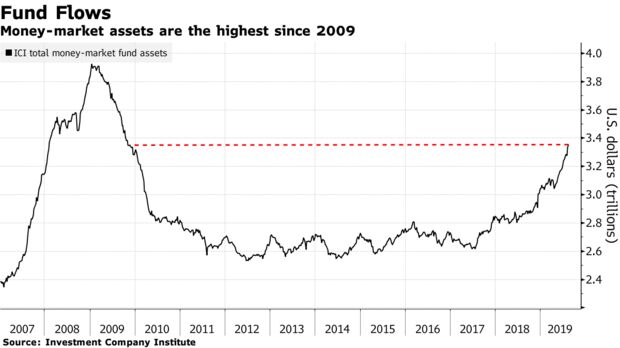
Institutional and individual investors have few better places to park their cash given that bank deposit rates are significantly lower and market volatility has erupted in August. Many investors are simply “parking it in cash,” Sabatino said, using the industry short-hand for money market mutual funds.
The delicate psyche of investors is on display almost everywhere these days: in interest-rate swaps and an inverted term structure; spreads between short- and long-term Treasury yields dipping below zero; and below-average measures of market depth in stocks, bonds and currencies that point to illiquidity.
One metric derived from the implied volatility on one-month and one-year options on 10-year interest-rate swaps, in particular, is flashing panic. The term structure is now more inverted than it was during the Treasury bond-market flash crash of October 2014.
Traders Have Been Gripped by Once-in-a-Generation Dash to Safety
Poor liquidity across stocks, Treasuries and currencies for the month of August is being reflected in reduced market depth, according to JPMorgan Chase & Co. Depth refers to the number of standing bids and offers from potential buyers and sellers. When it decreases, it makes it harder to buy or sell large positions fast without affecting the price of the underlying asset.
Add to that mix $16 trillion in negative-yielding bonds around the world, stocks falling from record highs and memories of the 2007-2008 financial crisis, and investors are showing a preference for funds that stand the best chance of not losing money.
There are signs that “people are afraid and they’re more concerned about preservation, or return of capital, than they are about return on capital,” Guggenheim’s Scott Minerd said in a Bloomberg Television interview on Tuesday.
Not many are ready to call for a repeat of the 2007-2008 global financial crisis just yet, though some investors are concerned about where market instability may manifest during the next recession. The next downturn could see instability spread to places like student debt, auto loans, leveraged loans or high-yield bonds, says JPMorgan strategist Jan Loeys, who sees a growing risk that U.S. yields eventually will fall to zero.
“Investors are looking for a safe-haven place to take cover that’s not subjected to volatility,” said Debbie Cunningham, chief investment officer of global money markets at Pittsburgh-based Federated Investors Inc., which has $502 billion under management. With Federated cash funds yielding around 2.1% to 2.3%, compared with a two-year Treasury yield hovering around 1.5% and a 30-year rate of 1.98%, money market funds are “still pretty attractive and looking better than debt securities.”
By: Vivien Lou Chen and Alex Harris (Bloomberg)
Click here to view source article


