• Skip to primary navigation
  • Skip to main content

CARNM

Commercial Association of REALTORS® - CARNM New Mexico

  • Property Search
    • Search Properties
      • For Sale
      • For Lease
      • For Sale or Lease
      • Start Your Search
    • Location & Type
      • Albuquerque
      • Rio Rancho
      • Las Cruces
      • Santa Fe
      • Industry Types
  • Members
    • New Member
      • About Us
      • Getting Started in Commercial
      • Join CARNM
      • Orientation
    • Resources
      • Find A Broker
      • Code of Ethics
      • Governing Documents
      • NMAR Forms
      • CARNM Forms
      • RPAC
      • Needs & Wants
      • CARNM Directory
      • REALTOR® Benefits
      • Foreign Broker Violation
    • Designations
      • CCIM
      • IREM
      • SIOR
    • Issues/Concerns
      • FAQ
      • Ombuds Process
      • Professional Standards
      • Issues/Concerns
      • Foreign Broker Violation
  • About
    • About
      • About Us
      • Join CARNM
      • Sponsors
      • Contact Us
    • People
      • 2026 Board Members
      • Past Presidents
      • REALTORS® of the Year
      • President’s Award Recipients
      • Founder’s Award Recipients
    • Issues/Concerns
      • FAQ
      • Ombuds Process
      • Professional Standards
      • Issues/Concerns
      • Foreign Broker Violation
  • Education
    • Courses
      • Register
      • All Education
    • Resources
      • NMREC Licensing
      • Code of Ethics
      • NAR Educational Opportunities
      • CCIM Education
      • IREM Education
      • SIOR Educuation
  • News & Events
    • News
      • All News
      • Market Trends
    • Events
      • All Events Calendar
      • Education
      • CCIM Events
      • LIN Marketing Meeting
      • Thank Yous
  • CARNM Login
  • Show Search
Hide Search

Archives for August 2019

Need Space at Work? Just Say ‘Open Sesame’

August 13, 2019 by CARNM

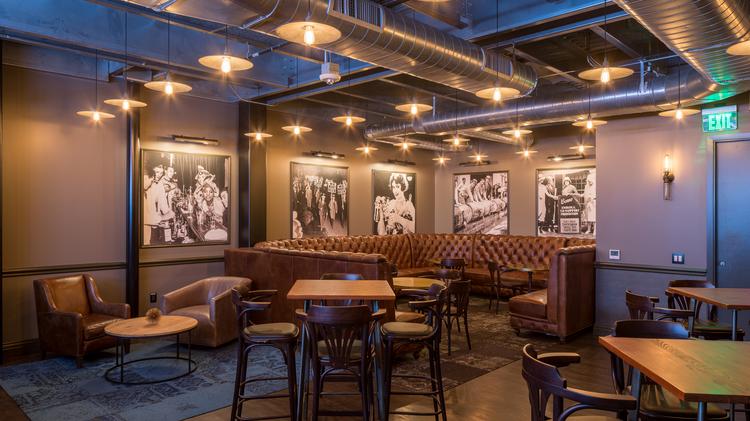
The speakeasy-style secret room at the advertising agency Deutsch in Los Angeles, Aug. 9, 2019. Secret rooms are popping up in workplaces. (Hunter Kerhart/The New York Times)

Transparency is one of the biggest trends in modern office design: open floor plans, fewer offices, glass walls and doors. And at a time when #MeToo has called attention to the sordid things that can happen behind closed doors, there may be some comfort in having everything, and everyone, within view.

But a taste for hidden places still runs deep.

They have appeared throughout history, from secret passageways in medieval castles to Prohibition-era speak-easies. Secret rooms are now popping up in workplaces and other commercial settings, providing the thrill of seeing a room materialize unexpectedly, not to mention the appeal of hanging out in a space reserved for VIPs.

“They add a moment of discovery in a workplace — a surprise for employees and visitors,” said Samantha McCormack, a creative director at TPG Architecture, which has tucked secret rooms into clients’ offices. “There’s a coolness and playfulness factor.”

Bookcases can swing wide in an open-sesame trick. At the Los Angeles office of marketing company Weber Shandwick, TPG designed a wall-to-wall bookcase with a section that can be pushed in, providing access to a steampunk-style room devoted to quiet work. At Maison de la Luz, a boutique hotel in New Orleans, guests enter a private salon through a bookcase. Google has a private reading area hidden behind a bookcase at its East Coast headquarters in New York.

Secret rooms help a company generate “buzz” about their workplaces, which helps with staff recruitment and retention, said David Ballard, director of the American Psychological Association’s office of applied psychology

They might also be part of the pushback against open plans. “Some of it is a legitimate need in a workplace for particular types of environments that allow people to get away, out of the fray,” Ballard said.

Macmillan Publishers: A Green Room for Guest Speakers

When Macmillan Publishers was working with TPG Architecture to lay out its new offices in the Equitable Building in lower Manhattan, the publisher envisioned inviting visiting authors to give talks in its spacious 25th-floor cafe. So a 240-square-foot room next to the cafe, initially intended for storage, was designated instead as a green room, where speakers can “hang out” before an appearance, said Andrew Weber, the company’s chief operating officer for global trade publishing.

It was TPG’s idea to add a little mystery by disguising the entry with a bookcase that resembles the shelving that lines the office’s hallways. “It’s an ‘aha’ moment,” Weber said.

The room is furnished with comfortable upholstered seating. Editors often use the space for meetings or for congratulatory receptions for authors on the publication of their book.

A wall with bookshelves pivots to reveal a secret green room at Macmillan Publishers in New York, Aug. 9, 2019.  (Jeenah Moon/The New York Times)

Shutterstock: A Quiet Library for Alone Time

Shutterstock’s headquarters, in the Empire State Building in midtown Manhattan, were designed by Studios Architecture. As in the open-plan offices of many companies, there are specialized rooms for a wide range of activities, like table tennis, yoga and lactation.

So it’s not surprising that the company would also have a secret library, which is reached through an inconspicuous door on a wall covered with custom-printed vinyl depicting book-filled shelves.

The space inside, lined with real bookshelves modeled on those found in libraries in the 1940s, “was purposefully created to be a secret place that people could go to for alone time but also to relax,” said Lisa Nadler, Shutterstock’s chief human resources officer. “You almost feel like you’re back in time to what the Empire State Building was like in the old times.”

Although everyone on staff knows about the room, it’s not as heavily used as one might think, Nadler said. Still, the company has no plans to tinker with the room.

“It may not be the most efficient use of space,” she said, “but it makes this place unique.”

Inside a secret library room, with bookshelves modeled on those found in libraries in the 1940s, at Shutterstock in New York, Aug. 9, 2019. (Jeenah Moon/The New York Times)

Kang Modern: The Marbled Office of F.W. Woolworth

The office that once belonged to F.W. Woolworth, founder of the five-and-dime empire, was certainly lavish. The 1,600-square-foot space on the 24th floor of the Woolworth Building, built in lower Manhattan in 1913, had an elaborate coffered ceiling and marble walls; its occupant, who is said to have worshipped Napoleon, had gilded chairs modeled on the French emperor’s throne and even hung a large portrait of his hero.

But over the years, its grandeur faded, and the room became subsumed into a 4,600-square-foot office. By the time architect Kang Chang, principal of Kang Modern, checked out the space for an office for his firm, the room’s coffered ceiling was gone, the plaster was crumbling, and doorknobs were missing.

But Chang relished the opportunity to have “something no one else has.” Working with a contractor hired by Witkoff, the building’s owner, he and his colleagues had the room restored. Carpet that had been glued onto the original marble floor was scraped off, and long-shuttered doors were unsealed, revealing Woolworth’s old safe, plus the missing doorknobs with their W motif.

To make the oversize room functional, Chang designed a free-standing partition that divides the space into two without infringing on the historic envelope. One side has a large conference table and chairs for meetings; the other, featuring Woolworth’s marble fireplace, is a waiting area for visiting clients.
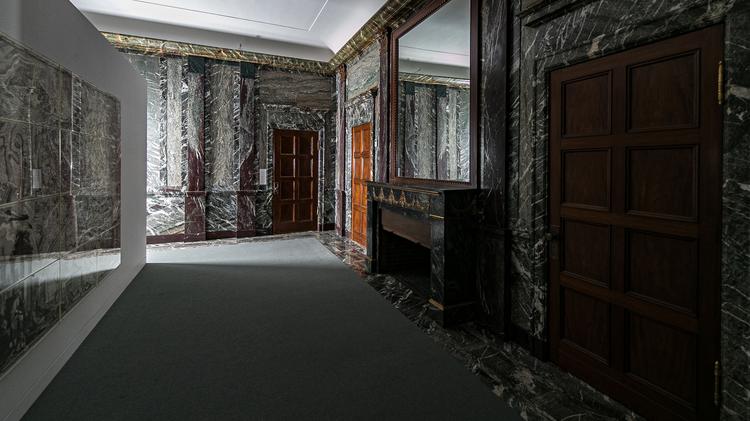
An area of the marbled offices that once belonged to F.W. Woolworth, which architect Kang Chang restored for his firm Kang Modern, in New York, Aug. 9, 2019. (Jeenah Moon/The New York Times)

Deutsch: A Place to Celebrate the Big Win

The large, light-filled conference room in the Los Angeles production facility of advertising agency Deutsch, across the street from its offices, has a back wall covered with gray felt. On it, team members can pin up creative work during presentations for clients.

If the team gets the go-ahead for an ad campaign, the agency has a special way to celebrate. A member of the team that clinched the deal inserts a key into a lock in a section of the felt-covered wall, and a hidden door opens to a dimly lit room with a low ceiling. Designed by HLW International, which equipped the entire production facility, the speak-easy-style room has a stocked bar and a vintage neon sign salvaged from a local bar that went out of business.

“We use it for big wins, big moments with our clients,” said Kim Getty, president of the Los Angeles office, adding that in some cases the team that landed the deal gets to play bartender. “It’s fun to invite them in and raise a toast.”

By: Jane Margolies (ABQ Business Journal)
Click here to view source article

Filed Under: All News

Take Action & Encourage Amendments: Paid Sick Leave 8/20

August 12, 2019 by CARNM

Please Share this with your REALTOR® Colleagues, Clients, and the Bernalillo County Commissioners.

Tell the Bernalillo County Commission to Consider Amendments to Proposed Ordinance Mandating Time Off for Employees An Open Notice to Members of GAAR and CARNM

TAKE ACTION


An Open Notice to Members of GAAR and CARNM

Urgent message from RECPAC, Real Estate Community Political Action Committee. RECPAC’s Board of Trustees is made up of members from GAAR and CARNM.

Please share this with your REALTOR® colleagues, clients, and the Bernalillo County Commissioners.

Dear CARNM Members:

On August 20, 2019 the Bernalillo County Commission will be voting on an ordinance mandating employers to provide paid time off to employees within Bernalillo County. RECPAC Trustees have reviewed this proposal and have determined that, as written, the ordinance will be detrimental to existing small businesses and curtail future business growth, thus inhibiting many consumers from entering the housing market, and even driving businesses to other business locations outside the county, creating a loss of jobs in the area.

Although there are approximately 25 issues with the current version, RECPAC needs your help by highlighting a few of the most concerning issues with the Bernalillo County Commissioners and by encouraging amendments so the ordinance is not so drastic. 

Please respond to the Call for Action and encourage your REALTOR® colleagues and clients to do the same. Your immediate response is requested.

Sean McMullan, CARNM President
John Lopez, GAAR President
Tim House, RECPAC Chair

Read More:
  • Summary of Issues
  • Paid Time Off Ordinance

Filed Under: All News

Meow Wolf Plans Massive Santa Fe Expansion

August 12, 2019 by CARNM

Fast-growing New Mexico arts startup Meow Wolf, which is bringing its immersive experiences to several major U.S. cities, is planning a massive expansion in its hometown of Santa Fe.

Last month, the company filed plans with the city for a four-story, 75,000-square-foot office addition to its local manufacturing facility, 2600 Camino Entrada, confirmed city of Santa Fe Land Use Department Planner Manager Noah Berke. The company is also scouting sites of city-owned property near the facility for additional parking, Berke added. Employees will use the space to create art for its slated installations in other cities, Business First previously reported.

Meow Wolf spokeswoman Laura Hudman said it was too early to disclose project details.

The expansion would more than double the size of the 52,000-square-foot former Caterpillar plant, which Meow Wolf purchased in 2017 with the help of its lenders and investment partners, according to Santa Fe New Mexican reporting.

That same year, the state and Santa Fe announced Meow Wolf would receive $1.1 million in Local Economic Development Act funding, paving a path for 250 full-time jobs over five years at the art-focused plant. The building houses various company operations including welding, sculpture, film and virtual reality, Business First reported, and will support Meow Wolf projects in other locations.

Meow Wolf has announced planned permanent exhibits in Denver; District of Columbia; Las Vegas, Nevada; and Phoenix.

The state also has committed to contribute over $2.3 million in Job Training Incentive Program funds for the creation of 150 Meow Wolf positions, New Mexico Economic Development data shows. It is unclear if this new development will mean new jobs for the company.

Meow Wolf’s proposal will be heard Aug. 19 at an Early Neighborhood Notification meeting, held so residents of potentially impacted residential areas can discuss planned projects over 30,000 square feet in size. Following that meeting, the startup could apply for permits with the city of Santa Fe Planning Commission, Berke said.

The news comes three months after Meow Wolf posted a $158 million funding round with the U.S. Securities and Exchange Commission, the largest round Business First found filed by a New Mexico startup with the SEC over the past decade. CEO Vince Kadlubek previously told Business First the money would be used for its Denver and Las Vegas expansions.

The arts company also recently spurred criticism from its crowdfunding investors when it announced it would be buying back their stock for $83.70 per share, with some saying they contributed with the hopes of reaping the benefits of the company’s aggressive long-term growth plans.

Take a look at our cover story for a more in-depth look at what Meow Wolf’s ambitions could mean for the local business community.

By: Collin Krabbe (ABQ Business Journal)
Click here to view source article

Filed Under: All News

Foreign CRE Investors Benefit from Lower Hedging Costs

August 12, 2019 by CARNM

intl currency-899636606.jpg

The lower costs could lead to an uptick in foreign investment in U.S. real estate.
The drop in interest rates is creating favorable ripple effects across the commercial real estate market in terms of lowering the cost of capital. Some foreign investors could also cash in on hedging costs that have moved significantly lower over the past several months.
The big question is whether lower hedging costs will motivate foreign investors to be more active buyers in U.S. commercial real estate. “We do believe it will spur more foreign investment into the United States,” says Spencer Levy, chairman of Americas Research and senior economic advisor for real estate services firm CBRE.

Hedging costs have shifted markedly in the past year along with declining Treasury rates and weakening of the U.S. dollar. Last November, when the U.S. 10-year Treasury rose to 3.2 percent, hedging costs from foreign capital going into the U.S. from Europe and other countries became very, very expensive, notes Levy. As an example, a German pension fund investor might have had to pay about 3.5 percent of the total investment cost per year simply to equalize the value of the Euro dollar vs. the U.S. dollar.
In certain circumstances, those hedging costs did create a drag on foreign investment decisions. “The segment where it had the greatest impact was in core investing,” adds Levy. Going in cap rates on core assets were already extremely low, which made it challenging for foreign investors to make the case for buying a property at, say, a 4.0 or 4.5 percent cap rate when their hedging costs were 3.5 percent, he says. So, core is the sector that now could be most positively impacted by the improvement in hedging costs.

Lower costs could spur more investment

Hedging costs are an important bellwether to foreign investor appetite for U.S. real estate as it impacts some of the largest commercial real estate investors in the world, notably foreign pension funds and global pension fund advisors. Yet not all foreign investors are required to hedge against fluctuations in value between their home currencies and the U.S. dollar. Those that don’t include private equity investors and sovereign wealth funds.

According to CBRE research on hedging costs, the countries that have seen the biggest declines in hedging costs this year include Japan at 55 basis points, Singapore at 51 basis points and Europe at 48 basis points.
“That is a big deal and a lot of money when you’re dealing with investments in the $100 million-plus range,” says Levy. In addition, with the exception of a rise in hedging costs for Australia, there are a number of countries across the board that are likely to benefit from more favorable hedging costs, he adds.
The shift in hedging costs is due to changing expectations on Fed monetary policy, which have resulted in declining Treasury rates and a weaker U.S. dollar. Even before the Fed announced its 25-basis-point rate cut on July 31, the 10-year Treasury dropped to about 2.0 percent, and following the rate cut, has moved below 1.8 percent. Although commercial real estate investors tend to focus on the 10-year Treasury as a key metric to set permanent debt financing rates, hedging costs are more closely linked with short-term rates, such as the 1-year Treasury. The 1-year rate has dropped from 2.7 percent in November to about 1.8 percent currently.

Volatility remains a concern

Yet some industry observers are more cautious about the potential impact lower hedging costs could have on boosting foreign buying. “Currency hedging costs are certainly something to monitor, but they don’t tell the entirety of the story,” says Heidi Learner, chief economist at real estate services firm Savills. Foreign investors buying U.S. commercial real estate generally have a holding period that is much longer than a year. Foreign investors also take a variety of factors into account when it comes to analyzing cost of capital and cross-border investment opportunities, such as where the capital is coming from to finance the acquisition.
It may be the case that while hedging costs have gone down, prospects for future returns have also weakened, notes Learner. “So, I would not expect a narrowing of interest rate differentials to all of a sudden lead to an increase in activity,” she says. As an example, the value of the Chinese Yuan has deteriorated recently, falling to a rate of about 7 to 1 against the U.S. dollar, meaning that U.S. asset prices have become more expensive, notes Learner.
The volume of cross-border acquisitions has been somewhat subdued this year. The rolling 12-month total of $78.8 billion is the lowest level since mid-year 2018, according to research firm Real Capital Analytics (RCA). “I think there is a bit of a pause in the market from both foreign and domestic buyers,” says Learner. That doesn’t mean that deals aren’t getting done. However, there hasn’t been much of an adjustment in cap rates relative to the decline in interest rates. Investors are taking a closer look at strategies and hold periods in the context that there might not be further cap rate compression and it’s not clear what the prospects are for NOI growth in what appears to be a slowing economy, she adds.
Any decrease in hedging costs is a benefit for U.S. capital markets as it will likely lead to increased foreign capital flows, notes Levy. Yet the caveat is that hedging costs are not only a function of the relative spread between two currencies. The formula for lower hedging costs is reliant on both the lower relative spread between the two country currencies and some decrease in global volatility, he says.
Certainly, there are plenty of examples in recent days, weeks and months, ranging from Brexit to concerns about a trade war with China that indicate a fair amount of market volatility. “If you see a decline in global volatility and you see a decline in relative yield, you will see a decline in hedging costs, which should increase global capital flows,” says Levy.
By: Beth Mattson-Teig (NREI)
Click here to view source article

Filed Under: All News

  • « Go to Previous Page
  • Page 1
  • Page 2
  • Page 3
  • Page 4
  • Page 5
  • Page 6
  • Interim pages omitted …
  • Page 8
  • Go to Next Page »
  • Search Property
  • Join CARNM
  • CARNM Login
  • NMAR Forms
  • All News
  • All Events
  • Education
  • Contact Us
  • About Us
  • FAQ
  • Issues/Concerns
6739 Academy Road NE, Ste 310
Albuquerque, NM 87109
admin@carnm.realtor(505) 503-7807

© 2026, Content: © 2021 Commercial Association of REALTORS® New Mexico. All rights reserved. Website by CARRISTO