• Skip to primary navigation
  • Skip to main content

CARNM

Commercial Association of REALTORS® - CARNM New Mexico

  • Property Search
    • Search Properties
      • For Sale
      • For Lease
      • For Sale or Lease
      • Start Your Search
    • Location & Type
      • Albuquerque
      • Rio Rancho
      • Las Cruces
      • Santa Fe
      • Industry Types
  • Members
    • New Member
      • About Us
      • Getting Started in Commercial
      • Join CARNM
      • Orientation
    • Resources
      • Find A Broker
      • Code of Ethics
      • Governing Documents
      • NMAR Forms
      • CARNM Forms
      • RPAC
      • Needs & Wants
      • CARNM Directory
      • REALTOR® Benefits
      • Foreign Broker Violation
    • Designations
      • CCIM
      • IREM
      • SIOR
    • Issues/Concerns
      • FAQ
      • Ombuds Process
      • Professional Standards
      • Issues/Concerns
      • Foreign Broker Violation
  • About
    • About
      • About Us
      • Join CARNM
      • Sponsors
      • Contact Us
    • People
      • 2026 Board Members
      • Past Presidents
      • REALTORS® of the Year
      • President’s Award Recipients
      • Founder’s Award Recipients
    • Issues/Concerns
      • FAQ
      • Ombuds Process
      • Professional Standards
      • Issues/Concerns
      • Foreign Broker Violation
  • Education
    • Courses
      • Register
      • All Education
    • Resources
      • NMREC Licensing
      • Code of Ethics
      • NAR Educational Opportunities
      • CCIM Education
      • IREM Education
      • SIOR Educuation
  • News & Events
    • News
      • All News
      • Market Trends
    • Events
      • All Events Calendar
      • Education
      • CCIM Events
      • LIN Marketing Meeting
      • Thank Yous
  • CARNM Login
  • Show Search
Hide Search

Archives for January 2020

2020 Economic Outlook

January 9, 2020 by CARNM

Slower growth—but how slow? A recession isn’t in the cards as long as the trade war with China doesn’t escalate.

It’s hard to avoid recession chatter these days. Fueling such talk has been a slowdown in the pace of the economic growth in 2019 and the widespread expectation that the long-running economic expansion, which began in June 2009, is nearing its end. The economy is expected to grow modestly—by 2.2%—in 2020, barely higher than the projected growth of 2.1% in 2019, and much slower than the 2.9% expansion in 2018, when the economy got an initial boost from the federal Tax Cuts and Jobs Act.
Still, National Association of REALTORS® Chief Economist Lawrence Yun says a recession is unlikely in the year ahead. “We expect 2020 will be a year of slower growth but not a recession year. However, an all-out trade war would lead to an economic downturn in nearly every country, including the U.S.,” he says.

1. Unemployment Stays Low

The negative effects of the U.S.-China tariff fight include contracting exports and slumps in investor confidence and business spending. But overall, the economy has managed to grow on the back of strong consumer spending, generating about 2 million new jobs in 2019, with real wages rising. Unemployment reached a low of 3.5% in September, and job openings exceeded the ranks of the 5.8 million unemployed workers. The unemployment outlook remains steady at 3.8%.
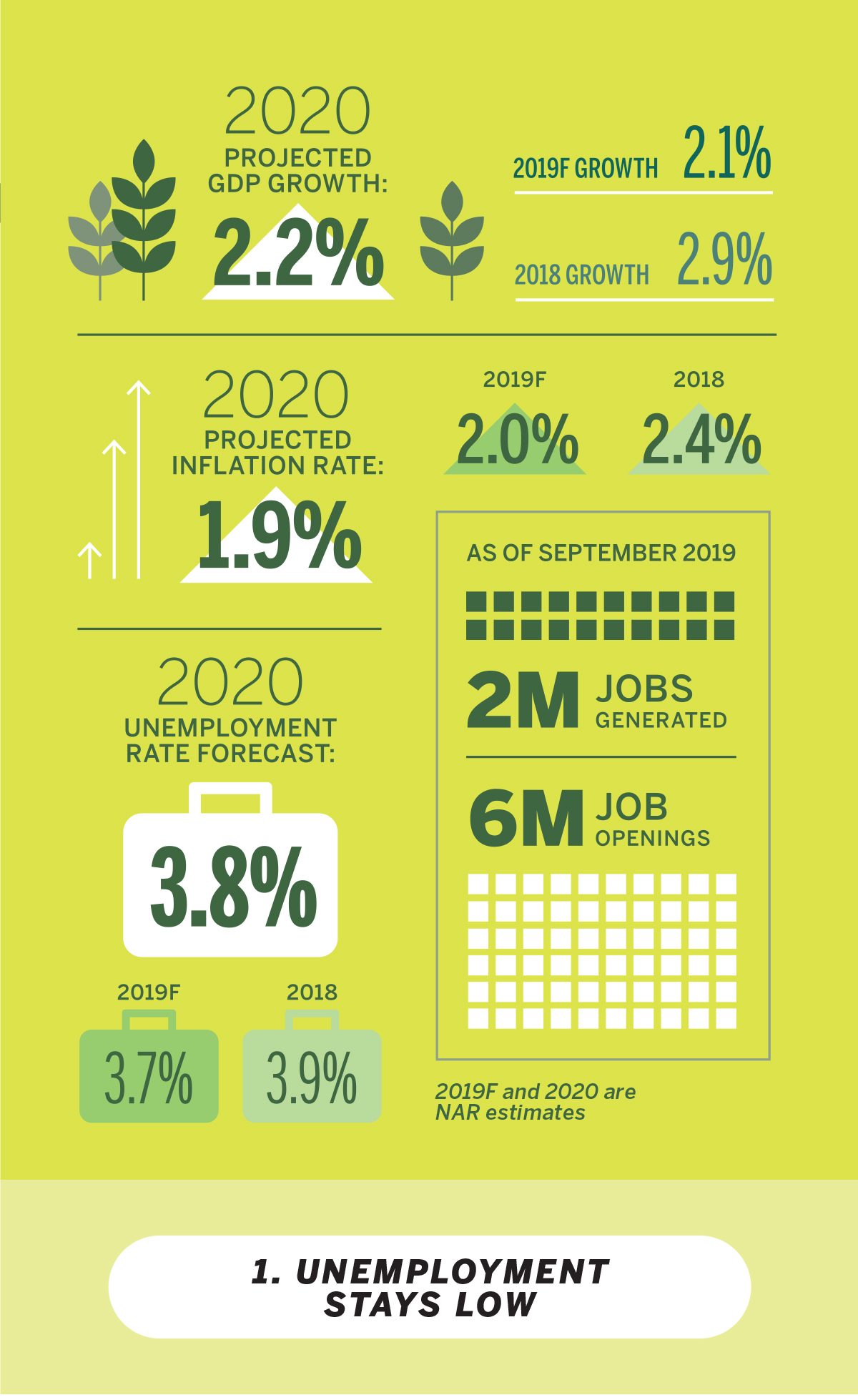
Chart 1

2. Mortgage rates to sustain housing demand

“We don’t foresee the Fed raising the federal funds rates in 2020. A rate cut of at least 25 basis points in early 2020 is the likely scenario,” says Yun. With the Fed maintaining a low-interest-rate policy, the 30-year fixed mortgage rate is expected to average 3.8% this year. Rates for 15-year fixed mortgages are also trending downward, from 3.4% to 3.1%. Low mortgage rates make purchasing a home more affordable, especially among the 46.5 million 25- to 34-year-olds who made up last year’s largest segment of home buyers. Given the existing conditions, home sales—existing and new homes combined—are expected to increase by a little over 4%, from 6 million in 2019 to 6.3 million in 2020.
Chart 2

3. Modest improvement in housing supply

Lack of housing inventory has been the primary constraint on the housing market. The housing supply is expected to improve this year, with housing starts expected to hit 1.42 million, up from 1.27 million last year. Still, the new supply will not meet the demand that will be created in 2020 by new household formation, estimated at 1.2 million, and demolished or obsolete housing, estimated at about 450,000. “Ramping up housing construction will continue to be central to improving home affordability and raising the level of home ownership,” says Yun.
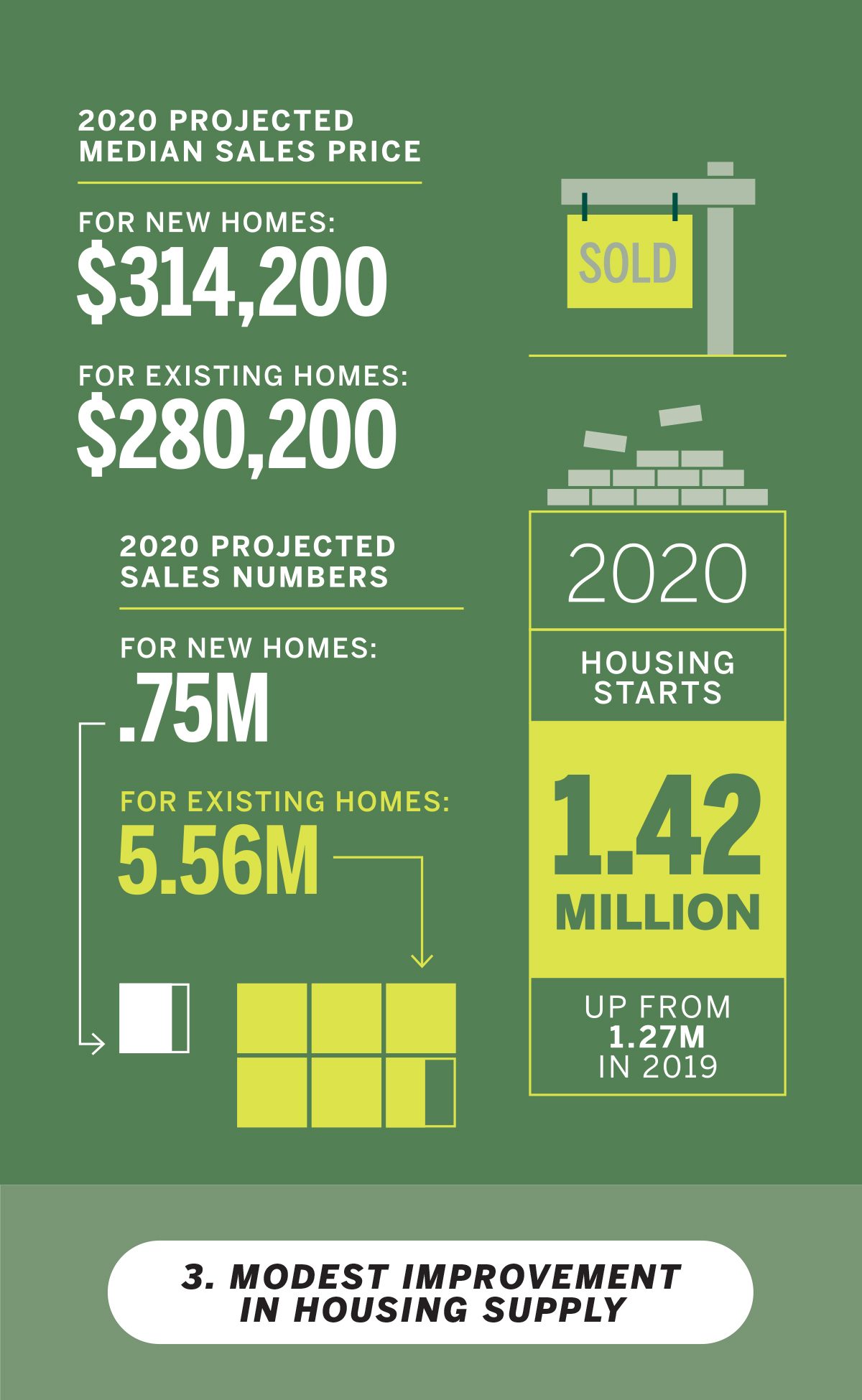
Chart 3

4. Commercial

Bright Outlook for Multifamily and Industrial Properties

In the commercial market space, investors are expected to pay a premium for multifamily, industrial, and warehouse properties because of low rental vacancy rates and the sustained demand for ecommerce sales. Cap rates for these properties will likely remain historically low due to the premium for these properties over other assets like offices and retail malls.
Industrial properties are expected to continue to offer good returns for investors given the sustained demand for industrial space from online and traditional brick-and-mortar stores. Both are fiercely competing for consumer loyalty and spending by offering both offline and online shopping options. Examples include Amazon buying Whole Foods, Walmart offering delivery services, quick consumer gratification through one-day or same-day delivery from Amazon and other retailers, and experiential shopping, such as yoga clothing retailer Lululemon offering yoga classes.
The multifamily rental market, including owner-occupied housing, has suffered from inadequate construction. Low rental vacancy rates mean higher demand for apartments and high net operating income for investors. Investments in the multifamily market are needed to address the serious affordability problems for renters. “More multifamily construction, especially of affordable types such as microapartments in San Francisco and more affordable garden-type apartments elsewhere, will help ease the burden for renters,” says Yun.

Affordable Multifamily Housing Strategies

Nationally, nearly half of renters pay 30% or more of their income on rent and utilities. But in 10 states, the percentage of households spending 30% or more on rent is even higher: Florida (56.5%), Louisiana (55.8%), California (54.6%), Hawaii (52.9%), Delaware (52.6%), Connecticut (52.5%), New York (52%), Colorado (51.3%), Nevada (51.1%), and New Jersey (50.9%). Rising rents have spurred California, Oregon, and New York to pass statewide rent-control measures, but rent control is not a sustainable solution to a problem that is borne of a housing shortage. Rising rents can best be addressed by measures that increase the supply of affordable housing:
• Allowing more density in single-family zoned areas (such as in Minneapolis and Oregon);
• Permitting higher-density housing near transportation hubs (Minneapolis);
• Establishing inclusionary zoning policies, especially in opportunity zones that are financially viable for commercial developers and investors (Washington, D.C.);
• Reducing approval time and the uncertainty for project approvals and the associated cost arising from construction delays (such as easing utility and parking regulations for accessory dwelling units in California).

By: Gay Coroaton (REALTOR Magazine)
Click here to view source article

Filed Under: All News

Do Massive Mall Makeovers Work for Retail Revitalization?

January 8, 2020 by CARNM

Can a mall be reactivated and even stronger with the right makeover—or are malls dead for good?

Is there still room for the mall format in the new retail world? There have been a lot of headlines about the death of the mall, but massive mall makeovers—including the $1 billion Westfield Century City renovation—prove that malls can be revitalized and even more successful with the right plan and upgrades.
“The idea that the mall is going to disappear is fundamentally flawed. Instead, the likeliest result is going to be an evolution of the concept that fits newer consumer behaviors,” Ethan Chernofsky. VP of marketing at Placer.ai, tells GlobeSt.com. “One of the most obvious is a shift away from the cookie-cutter perspective that sees all or most malls following the same pattern with the same types of stores and experiences. Far more interesting is a future defined by many malls creating unique identities and speaking to different audiences. That environment is one that can support a wider variety of offerings that cater to different market segments.”
Following the renovation project at Westfield Century City, the mall had a 92.7% increase in foot traffic. Other mall renovations, like Scottsdale Fashion Square, Westfield Garden State Plaza and Mall at Short Hills, also saw a significant increase in foot traffic following the renovation. While renovation is important, each owner has its own approach. “There is no handbook, but I think the best makeovers have in common a clear sense of direction,” says Chernofsky. “They know what they are looking to achieve and this finds continuity through the tenants, experiences, design and more.”
Successful mall makeovers are well worth the capital investment—which can be significant—but even the less successful ones often result in an improvement. “There will certainly be makeovers that are more or less successful, but that doesn’t necessarily make the decision not worth it,” says Chernofsky. “There is a clear opportunity that many investors are looking to take advantage of, and while not all will succeed, the opportunity is certainly real.”
In many cases, malls will need to take the plunge and invest in revitalization, especially as big box retailers shutter. Many mall owners will need to find ways to utilize that space. “Property owners are getting creative and this is a great thing. From new types of tenants like co-working spaces to expanding food and experiences in place of classic anchors, there is a clear push to innovate,” says Chernofsky. “And this is a big step. Consider co-working spaces, they provide malls with an audience that comes on an ongoing basis, and can provide people to frequent the malls restaurants and stores. This is a win/win for malls giving both ongoing customers and a new sustainable tenant, generally in spaces that are not the most sought after. More important than the type of tenant is the type of thinking that leads to more creative approaches.”
By: Kelsi Maree Borland (GlobeSt)
Click here to view source article

Filed Under: All News

January 2020 CCIM Deal Making Session Properties

January 8, 2020 by CARNM

Thanks to all of the brokers, sponsors, and guests who attended the January 2020 CCIM NM Deal Making Session and to those who shared their properties.

Click here to view source PDF.
Click here to view the Thank Yous.

Name Property, City Type Price
1. John Ransom, CCIM, SIOR
Tim With, CCIM, SIOR
111 Lomas Blvd NW
Albuquerque
Office $6,200,000
2. John Ransom, CCIM, SIOR
Tim With, CCIM, SIOR
320 Osuna Rd NE
Albuquerque
Office $699,000
3. Tim MacEachen, CCIM, SIOR 4630 Eubank Blvd NE
Albuquerque
Office $2,500,000
4. Austin Tidwell
Daniel Kearney
6201 Montgomery Blvd NE
Albuquerque
Land $750,000
5. Riley McKee
Alexandra Pulliam
204 Rossmoor Ave SW
Albuquerque
Industrial $945,000
6. Isaac Romero 2920 Carlisle Blvd NE
Albuquerque
Office $750,000
7. Isaac Romero 1009 Seneca Ln
Carlsbad
Land $1,500,000
8. Anne Apicella
Ed Anlian, CCIM
2127 Menaul Blvd NE
Albuquerque
Retail $352,500

Filed Under: All News

What Does Tech Disruption in the Residential Sector Say About the Future of CRE Brokers?

January 7, 2020 by CARNM

Here’s on outlook on disruption awaiting commercial real estate brokers.
Although the commercial real estate industry has generally been slow to adopt technology, that is starting to change, particularly on the brokerage side of the business. Sell-side brokers are increasingly listing their properties, for sale as well as for lease, with LoopNet and similar online platforms that supplement these listings with property information culled from a variety of public and private sources. These sites have become popular with prospective buyers and tenants alike.
Will these and other innovations lead to the disintermediation of the commercial real estate powerhouses, the integrated CRE services companies (ICRESCs) like Jones Lang Lasalle, CBRE, Cushman and Wakefield, Colliers, Newmark Knight Frank, Marcus & Millichap, and Sperry van Ness that currently handle the lion’s share of office and industrial listings? Can these firms withstand the onslaught of tech-enabled start-ups offering automated processes and compressed fees and that might eventually eliminate the need for brokers altogether?
The residential brokerage industry is a good starting point for understanding the impact of technology on the future of commercial real estate brokerage. For decades, residential brokers have been adapting to the advent of technology in the form of Multiple Listing Services (MLSs) and more recently, they have faced challenges from technology-enabled competitors like Zillow, Redfin, Apartments.com. Their experience can provide clues to how the commercial real estate brokers might fare.

A tentative conclusion: The effects of technology in residential brokerage have been less pronounced in sales than in rentals. In market spaces such as sales, with substantial initial concentration and/or large network economies, transactional tech has actually facilitated the role of the broker and consolidated the position of large incumbent companies. In atomized markets where network economies are absent, disintermediation has taken place. These trends can serve as a guide to the future of commercial real estate brokerage.

The lesson of residential

In residential brokerage, the regional Multiple Listing Services (MLSs) seized on the Internet’s potential to centralize and publicize real estate listings. Before that, computerized MLSs were simply databases with standardized property data fields and photos, which brokers did not necessarily share with their customers. Seeing the potential to increase sales and turnover, the National Association of Realtors (NAR) quick-started the current internet marketing data infrastructure for residential sales.
Websites such as or Zillow, Homefinder.com, Homes.com, or ZipRealty.com took advantage of this trend, aggregating data from regional MLSs and facilitating ubiquitous access to present and past listings. These aggregator services combine the listings with other publicly available information about each home and neighborhood. In the future we will likely see more integration of listing records with other data and audiovisuals, including. Matterport© 3D renderings, thereby facilitating property analysis and statistical research of housing trends.
The effect of ubiquitous residential data has paradoxically been to strengthen the hand of traditional brokers. It has not, for instance, led to an increase in the for-sale-by-owner (FSBO) market, supported by such platforms as ForSaleByOwner.com, FSBO.com, or HomesByOwner.com. According to the NAR’s 2018 Profile of Home Buyers and Sellers, just 7 percent of recent home sales were FSBO, the lowest since the organization started tracking this data in 1981. While thousands of potential buyers log on to Zillow and other sites each day, few have the time, inclination, or knowledge to transact the purchase on their own—and sellers evidently feel the same way.

In other words, online listings have reinforced the position of brokers rather than diminished it. Prospective buyers report what they have learned from online listings to their brokers, and when purchasers approach sell-side realtors directly, these brokers typically realize the additional opportunity to act as dual agents.
While Redfin’s model of discount brokerage—combining online and offline services—has experienced some success, the promise of massive disintermediation in the very large and lucrative residential sales market has clearly not occurred. In effect, the IT revolution has provided brokers with more sophisticated marketing tools while increasing the prominence of realtor franchises.
The picture that emerges from the residential apartment sector is significantly different. Many landlords had historically targeted customers directly, via newspaper ads and dedicated magazine-like publications. The market was atomized and local, without the full consolidating strength of an organization as large as the NAR. In addition, renting an apartment or home is a simpler, less consequential transaction than buying one. As a result of both these factors, the internet furthered disintermediation in this market. Both advertising and searching for rentals—without the assistance of brokers—are now easier than ever, thanks to listing aggregators such as Craigslist, Apartments.com, rent.com, forrent.com, and apartmentguide.com.

The Implications for CRE brokerages

The residential sales market, because its structure is similar to the commercial real estate market, provides a more accurate indicator of the impact of technology on commercial brokerages than the residential rental market. Both commercial real estate sales and leasing exhibit relatively high levels of concentration, and the specialized professional services provided by commercial brokers are out of the reach of their clients. Furthermore, ICRESCs have strengthened their dominance of the industry by bundling brokerage with other critical offerings: marketing, PR, research, financing, investments, asset management, custodial, technology, site selection, planning, consulting, and advisory. The result is that they have forged multidimensional long-term relationships with buyers and tenants that are not easily dislodged, allowing for substantial cross-pollination and bolstering their dominance in brokerage.

ICRESCs are strengthening these relationships even further by adopting and integrating a wide range of prop tech innovations, allowing them to elevate their offerings in such fields as construction management, marketing, tenant representation, property management, smart buildings, asset management, underwriting and valuation, investments, legal, contracts, accounting, and other processes required by the commercial real estate industry. They are both acquiring start-ups and teaming up with software companies in order to develop proprietary IT solutions.
Technical innovation has, however, promoted the creation of services like LoopNet, an online centralized market-making platform that is roughly analogous to online MLS platforms, although it includes leasing as well as sales. LoopNet supplements these listings with data collected by its parent company, CoStar, one of the major repositories of commercial real estate information.
The relatively small numbers of companies that have successfully competed with LoopNet have done so by focusing on niche markets or developed advanced competencies. For instance, Real Capital Analytics displays extraordinary strength in the collection of data about transactions of institutional-grade properties. RE Meter focuses on providing predictive models of lease defaults or early termination of potential tenants. To do so, they apply artificial intelligence algorithms to databases capturing the past performance of similar firms. In the near future, we will see more integration between marketing apps and other data—such as legal information (mortgages, liens, regulatory action), electricity and water consumption, verified income generated by tenants, pedestrian traffic, and financial intelligence about tenants—and perhaps more specialization.
The efforts of these companies have, on balance, empowered traditional brokerage firms and ICRESCs rather than displaced them by raising their clients’ awareness of appropriate listings. At the same time, many of these intermediary companies have been proactive in incorporating their own market-making platforms or formed alliances with market-making providers.
There is a commercial real estate submarket, however, in which technology has led to disintermediation: short- or long-term commercial sublets and unexpired leases. Such transactions are smaller and less specific by nature. This area is reminiscent of the residential rental market, and the landlord base is much more diverse and less institutionalized. It is now facilitated by online platforms such as Flip.com and Real Massive.

Expect minimal disruption in CRE brokerage

New technologies such as data analytics, artificial intelligence, and blockchain were initially seen as forces of disruption and disintermediation, but the results across the general economy have been mixed. True, Uber and Lyft dealt a devasting blow to the taxi industry, but despite Airbnb, the hospitality industry continues to flourish—and technology has also reinforced the position of incumbent companies like Facebook and Google that grow more dominant with each passing year.
Similarly, the application of technology to real estate—both residential, as well as commercial—has led some commentators to see the proverbial writing on the wall for the traditional brokerage system. Right now, given the strength of entrenched intermediaries, their willingness to adapt new technology, and the specialized yet heterogeneous needs of commercial real estate buyers and sellers, landlords and tenants, that seems for the most part unlikely.
By: Lou Rosado (NREI)
Click here to view source article

Filed Under: All News

  • « Go to Previous Page
  • Page 1
  • Interim pages omitted …
  • Page 3
  • Page 4
  • Page 5
  • Page 6
  • Page 7
  • Page 8
  • Go to Next Page »
  • Search Property
  • Join CARNM
  • CARNM Login
  • NMAR Forms
  • All News
  • All Events
  • Education
  • Contact Us
  • About Us
  • FAQ
  • Issues/Concerns
6739 Academy Road NE, Ste 310
Albuquerque, NM 87109
admin@carnm.realtor(505) 503-7807

© 2026, Content: © 2021 Commercial Association of REALTORS® New Mexico. All rights reserved. Website by CARRISTO

